SUBSCRIBE TO OUR FREE NEWSLETTER
Daily news & progressive opinion—funded by the people, not the corporations—delivered straight to your inbox.
5
#000000
#FFFFFF
To donate by check, phone, or other method, see our More Ways to Give page.
Daily news & progressive opinion—funded by the people, not the corporations—delivered straight to your inbox.
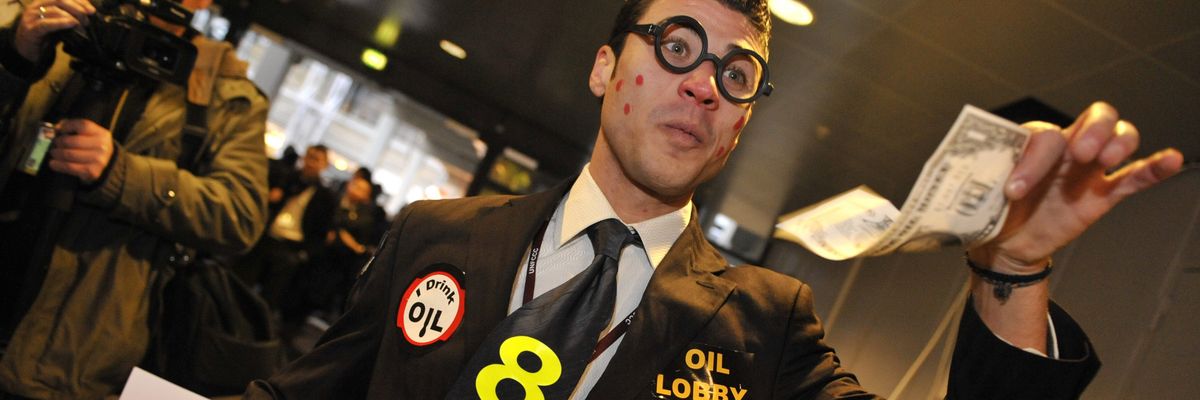
A climate activist dressed as an "oil lobbyist" attends a demonstration on December 16, 2009 at the COP15 Climate Conference.
New research, said one campaigner, "makes clear that the body in charge of implementing global policies to reduce GHG emissions is totally captured by the transnational companies that destroy the planet the most."
As the fossil fuel-driven climate crisis has wreaked increasingly deadly havoc across the planet over the last two decades, lobbyists and other representatives of oil and gas interests have attended United Nations-led climate talks more than 7,000 times in an effort to prevent world leaders from challenging their destructive business model.
That's according to new research released Tuesday by the Kick Big Polluters Out coalition just over a week before the start of COP28 in the United Arab Emirates.
Drawing on official attendance lists since COP9 in 2003, the research shows that the U.N. has granted at least 7,200 attendance passes to delegates for fossil fuel companies and industry trade groups, which often use their presence to peddle false climate solutions such as carbon capture.
The advocacy coalition stressed that its estimate likely understates the presence of oil and gas representatives at past U.N. climate summits given that many delegates didn't specify their affiliation or attended under the banner of nations where they do business.
At COP28, attendees will be required to disclose their affiliation under
new U.N. transparency rules put in place earlier this year after two consecutive climate summits were inundated by fossil fuel lobbyists. At COP26, oil and gas lobbyists had a larger presence than any single country, and more than 636 oil and gas lobbyists attended COP27.
Of the major oil and gas companies, Shell has sent the most staff—at least 115—to U.N. climate talks since 2003. The U.N. has granted a combined 267 attendance passes to disclosed staff from Shell, ExxonMobil, Chevron, BP, and TotalEnergies over the last 20 years, the new analysis says.
The report also shows that the International Emissions Trading Association (IETA), a group whose members include Exxon and Chevron, has been granted at least 2,769 passes to attend U.N.-led climate talks since 2003.
"The research makes clear that the body in charge of implementing global policies to reduce GHG emissions is totally captured by the transnational companies that destroy the planet the most," Pablo Fajardo of the Union of Affected Communities by Texaco/Chevron said in a statement. "The COP must be freed from polluting companies, or the COP becomes partly responsible for global collapse."
George Carew-Jones of the YOUNGO youth constituency at the United Nations Framework Convention on Climate Change noted that the U.N. currently "has no conflict-of-interest rules for COPs."
"This unbelievable fact has allowed fossil fuel lobbyists to undermine talks for years, weakening the process that we are all relying on to secure our futures," Carew-Jones added. "Young people around the world are losing faith in the COP process—we desperately need strong safeguards on the role that oil and gas firms are playing in these talks."
The new research is likely to intensify concerns that fossil fuel industry influence at COP28—which is headed by the CEO of the Abu Dhabi National Oil Company—will derail yet another critical opportunity to rein in oil, gas, and coal production, something that previous U.N. climate summits have failed to do in the face of worsening climate impacts across the globe.
Kathy Mulvey, accountability campaign director at the Union of Concerned Scientists, warned Monday that "without protections against conflicts of interest at COP28, the fossil fuel industry will be out in force."
"As we near the end of a year of devastating climate change-fueled disasters and record-breaking global average temperatures, the options to limit the worst potential impacts of climate change are narrowing," Mulvey wrote. "The fossil fuel industry has a lot to lose in the negotiations at COP28, and a lot to gain from continued diversion, distraction, and delay."
Dear Common Dreams reader, It’s been nearly 30 years since I co-founded Common Dreams with my late wife, Lina Newhouser. We had the radical notion that journalism should serve the public good, not corporate profits. It was clear to us from the outset what it would take to build such a project. No paid advertisements. No corporate sponsors. No millionaire publisher telling us what to think or do. Many people said we wouldn't last a year, but we proved those doubters wrong. Together with a tremendous team of journalists and dedicated staff, we built an independent media outlet free from the constraints of profits and corporate control. Our mission has always been simple: To inform. To inspire. To ignite change for the common good. Building Common Dreams was not easy. Our survival was never guaranteed. When you take on the most powerful forces—Wall Street greed, fossil fuel industry destruction, Big Tech lobbyists, and uber-rich oligarchs who have spent billions upon billions rigging the economy and democracy in their favor—the only bulwark you have is supporters who believe in your work. But here’s the urgent message from me today. It's never been this bad out there. And it's never been this hard to keep us going. At the very moment Common Dreams is most needed, the threats we face are intensifying. We need your support now more than ever. We don't accept corporate advertising and never will. We don't have a paywall because we don't think people should be blocked from critical news based on their ability to pay. Everything we do is funded by the donations of readers like you. When everyone does the little they can afford, we are strong. But if that support retreats or dries up, so do we. Will you donate now to make sure Common Dreams not only survives but thrives? —Craig Brown, Co-founder |
As the fossil fuel-driven climate crisis has wreaked increasingly deadly havoc across the planet over the last two decades, lobbyists and other representatives of oil and gas interests have attended United Nations-led climate talks more than 7,000 times in an effort to prevent world leaders from challenging their destructive business model.
That's according to new research released Tuesday by the Kick Big Polluters Out coalition just over a week before the start of COP28 in the United Arab Emirates.
Drawing on official attendance lists since COP9 in 2003, the research shows that the U.N. has granted at least 7,200 attendance passes to delegates for fossil fuel companies and industry trade groups, which often use their presence to peddle false climate solutions such as carbon capture.
The advocacy coalition stressed that its estimate likely understates the presence of oil and gas representatives at past U.N. climate summits given that many delegates didn't specify their affiliation or attended under the banner of nations where they do business.
At COP28, attendees will be required to disclose their affiliation under
new U.N. transparency rules put in place earlier this year after two consecutive climate summits were inundated by fossil fuel lobbyists. At COP26, oil and gas lobbyists had a larger presence than any single country, and more than 636 oil and gas lobbyists attended COP27.
Of the major oil and gas companies, Shell has sent the most staff—at least 115—to U.N. climate talks since 2003. The U.N. has granted a combined 267 attendance passes to disclosed staff from Shell, ExxonMobil, Chevron, BP, and TotalEnergies over the last 20 years, the new analysis says.
The report also shows that the International Emissions Trading Association (IETA), a group whose members include Exxon and Chevron, has been granted at least 2,769 passes to attend U.N.-led climate talks since 2003.
"The research makes clear that the body in charge of implementing global policies to reduce GHG emissions is totally captured by the transnational companies that destroy the planet the most," Pablo Fajardo of the Union of Affected Communities by Texaco/Chevron said in a statement. "The COP must be freed from polluting companies, or the COP becomes partly responsible for global collapse."
George Carew-Jones of the YOUNGO youth constituency at the United Nations Framework Convention on Climate Change noted that the U.N. currently "has no conflict-of-interest rules for COPs."
"This unbelievable fact has allowed fossil fuel lobbyists to undermine talks for years, weakening the process that we are all relying on to secure our futures," Carew-Jones added. "Young people around the world are losing faith in the COP process—we desperately need strong safeguards on the role that oil and gas firms are playing in these talks."
The new research is likely to intensify concerns that fossil fuel industry influence at COP28—which is headed by the CEO of the Abu Dhabi National Oil Company—will derail yet another critical opportunity to rein in oil, gas, and coal production, something that previous U.N. climate summits have failed to do in the face of worsening climate impacts across the globe.
Kathy Mulvey, accountability campaign director at the Union of Concerned Scientists, warned Monday that "without protections against conflicts of interest at COP28, the fossil fuel industry will be out in force."
"As we near the end of a year of devastating climate change-fueled disasters and record-breaking global average temperatures, the options to limit the worst potential impacts of climate change are narrowing," Mulvey wrote. "The fossil fuel industry has a lot to lose in the negotiations at COP28, and a lot to gain from continued diversion, distraction, and delay."
As the fossil fuel-driven climate crisis has wreaked increasingly deadly havoc across the planet over the last two decades, lobbyists and other representatives of oil and gas interests have attended United Nations-led climate talks more than 7,000 times in an effort to prevent world leaders from challenging their destructive business model.
That's according to new research released Tuesday by the Kick Big Polluters Out coalition just over a week before the start of COP28 in the United Arab Emirates.
Drawing on official attendance lists since COP9 in 2003, the research shows that the U.N. has granted at least 7,200 attendance passes to delegates for fossil fuel companies and industry trade groups, which often use their presence to peddle false climate solutions such as carbon capture.
The advocacy coalition stressed that its estimate likely understates the presence of oil and gas representatives at past U.N. climate summits given that many delegates didn't specify their affiliation or attended under the banner of nations where they do business.
At COP28, attendees will be required to disclose their affiliation under
new U.N. transparency rules put in place earlier this year after two consecutive climate summits were inundated by fossil fuel lobbyists. At COP26, oil and gas lobbyists had a larger presence than any single country, and more than 636 oil and gas lobbyists attended COP27.
Of the major oil and gas companies, Shell has sent the most staff—at least 115—to U.N. climate talks since 2003. The U.N. has granted a combined 267 attendance passes to disclosed staff from Shell, ExxonMobil, Chevron, BP, and TotalEnergies over the last 20 years, the new analysis says.
The report also shows that the International Emissions Trading Association (IETA), a group whose members include Exxon and Chevron, has been granted at least 2,769 passes to attend U.N.-led climate talks since 2003.
"The research makes clear that the body in charge of implementing global policies to reduce GHG emissions is totally captured by the transnational companies that destroy the planet the most," Pablo Fajardo of the Union of Affected Communities by Texaco/Chevron said in a statement. "The COP must be freed from polluting companies, or the COP becomes partly responsible for global collapse."
George Carew-Jones of the YOUNGO youth constituency at the United Nations Framework Convention on Climate Change noted that the U.N. currently "has no conflict-of-interest rules for COPs."
"This unbelievable fact has allowed fossil fuel lobbyists to undermine talks for years, weakening the process that we are all relying on to secure our futures," Carew-Jones added. "Young people around the world are losing faith in the COP process—we desperately need strong safeguards on the role that oil and gas firms are playing in these talks."
The new research is likely to intensify concerns that fossil fuel industry influence at COP28—which is headed by the CEO of the Abu Dhabi National Oil Company—will derail yet another critical opportunity to rein in oil, gas, and coal production, something that previous U.N. climate summits have failed to do in the face of worsening climate impacts across the globe.
Kathy Mulvey, accountability campaign director at the Union of Concerned Scientists, warned Monday that "without protections against conflicts of interest at COP28, the fossil fuel industry will be out in force."
"As we near the end of a year of devastating climate change-fueled disasters and record-breaking global average temperatures, the options to limit the worst potential impacts of climate change are narrowing," Mulvey wrote. "The fossil fuel industry has a lot to lose in the negotiations at COP28, and a lot to gain from continued diversion, distraction, and delay."