SUBSCRIBE TO OUR FREE NEWSLETTER
Daily news & progressive opinion—funded by the people, not the corporations—delivered straight to your inbox.
5
#000000
#FFFFFF
To donate by check, phone, or other method, see our More Ways to Give page.
Daily news & progressive opinion—funded by the people, not the corporations—delivered straight to your inbox.
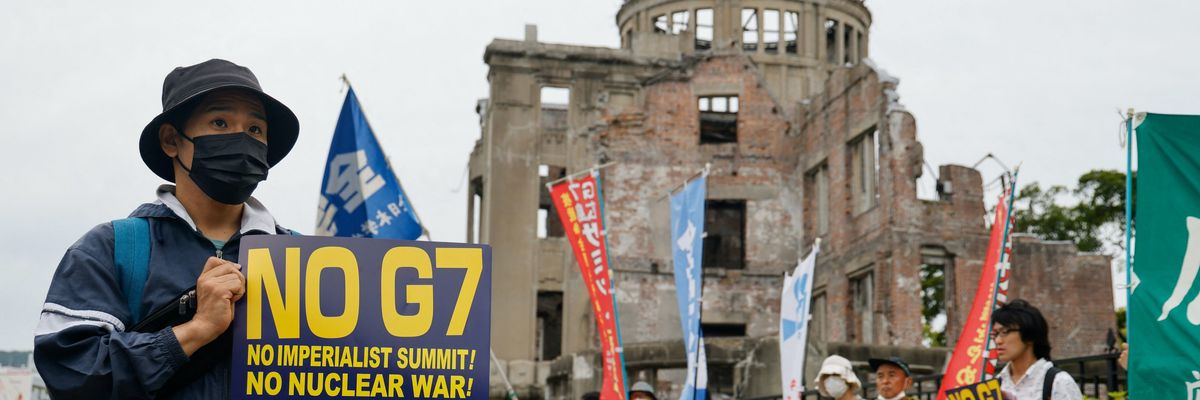
Protesters hold placards and flags during a demonstration at the Hiroshima Peace Memorial against the G7 Leaders' Summit in Hiroshima, Japan on May 18, 2023.
"The G7 are trying to sell decades-old and insufficient initiatives as a new 'vision' when at the same time they themselves are complicit in the rising nuclear risks," said the International Campaign to Abolish Nuclear Weapons.
The International Campaign to Abolish Nuclear Weapons—which won the 2017 Nobel Peace Prize for its work on a landmark treaty banning nukes—and others including survivors of the U.S. atomic bombings of Japan on Friday criticized a Group of Seven joint statement on disarmament as "missing the moment to make the world safer" from the threat of thermonuclear annihilation.
As the G7 summit got underway in Hiroshima, leaders of Japan, Germany, Italy, Canada, France, the United Kingdom, United States—the latter three of which have nuclear arsenals—reiterated their belief that "a nuclear war cannot be won and must never be fought."
While the statement acknowledges "the unprecedented devastation and immense human suffering the people of Hiroshima and Nagasaki experienced as a result of the atomic bombings" and reaffirms G7 members' "commitment to achieving a world without nuclear weapons," the International Campaign to Abolish Nuclear Weapons (ICAN) lamented that "it fails to commit to concrete measures towards that goal and even emphasizes the importance of reserving the right to use nuclear weapons."
"The G7 are trying to sell decades-old and insufficient initiatives as a new 'vision' when at the same time they themselves are complicit in the rising nuclear risks and promoting mass murder of civilians as a legitimate form of national security policy," ICAN added.
ICAN said that "the G7's inaction is an insult to the hibakusha, and the memory of those who died in Hiroshima," referring to the Japanese word for survivors of the atomic bombings, which killed between 110,000 and 210,000 people.
G7 leaders spent less than half an hour visiting the Hiroshima Peace Memorial Museum near ground zero of the August 6, 1945 U.S. nuclear attack. They laid wreaths at the cenotaph memorializing the at least tens of thousands of people who died from the bombing and related illnesses and also met with a handful of hibakusha.
U.S. President Joe Biden drew fire for his refusal to apologize for the Hiroshima and Nagasaki bombings.
"If the U.S. admitted that murdering noncombatants in Hiroshima and Nagasaki was inexcusable, it might face questions about [the] legitimacy of maintaining [a] vastly more destructive stockpile now," writer and activist Jon Reinsch tweeted, referring to the approximately 5,400 nuclear warheads in the American arsenal—the world's second-largest after Russia, which has around 6,000 warheads, according to the Union of Concerned Scientists.
Meanwhile, street protesters condemned nuclear weapons, the "imperialist summit," military aid to Ukraine, and Japan's complicity in U.S. militarism—especially toward China.
"Japan is saying it will send a peaceful message of abolishing nuclear weapons to the world through this summit, but at the same time it is seeking to rely on nuclear weapons to achieve 'national security.' This is contradictory," Ichiro Yuasa, a spokesperson for the advocacy group Peace Depot, told teleSUR.
Some hibakusha renewed criticism of leaders of nuclear-armed nations for failing to pursue meaningful disarmament, including their refusal to join scores of countries in signing the landmark Treaty on the Prohibition of Nuclear Weapons (TPNW).
"This is not the genuine nuclear disarmament that hibakusha are calling for. This is an evasion of their responsibility," Satoshi Tanaka, a survivor of the atomic bombing and secretary general of the Liaison Conference of Hiroshima Hibakusha Organizations, said of the G7 statement.
"Prime Minister [Fumio] Kishida has said that the Treaty on the Prohibition of Nuclear Weapons is the final passage for a nuclear weapons-free world," Tanaka added. "No, it is not a final passage. It is the entry point. Prime Minister Kishida and other G7 leaders should accept the TPNW and start the real process of eliminating nuclear weapons."
Derek Johnson, managing partner of the Global Zero movement for the abolition of nuclear weapons, said that "while the G7 statement embraces the goal of global zero and recites a familiar list of worthwhile ambitions, none acknowledge the fierce urgency of now."
"This is long on vision but short on strategy; Hiroshima deserves to be more than a symbolic setting, and the world deserves more than thoughts and prayers for disarmament," he added.
ICAN executive director Daniel Hogstra responded to the G7 statement by asserting that "this is more than a missed opportunity."
"With the world facing the acute risk that nuclear weapons could be used for the first time since Hiroshima and Nagasaki were bombed, this is a gross failure of global leadership," Hogstra contended, referring to rising fears since Russia invaded Ukraine last year.
"Simply pointing fingers at Russia and China is insufficient," he added. "We need the G7 countries, which all either possess, host, or endorse the use of nuclear weapons, to step up and engage the other nuclear powers in disarmament talks if we are to reach their professed goal of a world without nuclear weapons."
Dear Common Dreams reader, It’s been nearly 30 years since I co-founded Common Dreams with my late wife, Lina Newhouser. We had the radical notion that journalism should serve the public good, not corporate profits. It was clear to us from the outset what it would take to build such a project. No paid advertisements. No corporate sponsors. No millionaire publisher telling us what to think or do. Many people said we wouldn't last a year, but we proved those doubters wrong. Together with a tremendous team of journalists and dedicated staff, we built an independent media outlet free from the constraints of profits and corporate control. Our mission has always been simple: To inform. To inspire. To ignite change for the common good. Building Common Dreams was not easy. Our survival was never guaranteed. When you take on the most powerful forces—Wall Street greed, fossil fuel industry destruction, Big Tech lobbyists, and uber-rich oligarchs who have spent billions upon billions rigging the economy and democracy in their favor—the only bulwark you have is supporters who believe in your work. But here’s the urgent message from me today. It's never been this bad out there. And it's never been this hard to keep us going. At the very moment Common Dreams is most needed, the threats we face are intensifying. We need your support now more than ever. We don't accept corporate advertising and never will. We don't have a paywall because we don't think people should be blocked from critical news based on their ability to pay. Everything we do is funded by the donations of readers like you. When everyone does the little they can afford, we are strong. But if that support retreats or dries up, so do we. Will you donate now to make sure Common Dreams not only survives but thrives? —Craig Brown, Co-founder |
The International Campaign to Abolish Nuclear Weapons—which won the 2017 Nobel Peace Prize for its work on a landmark treaty banning nukes—and others including survivors of the U.S. atomic bombings of Japan on Friday criticized a Group of Seven joint statement on disarmament as "missing the moment to make the world safer" from the threat of thermonuclear annihilation.
As the G7 summit got underway in Hiroshima, leaders of Japan, Germany, Italy, Canada, France, the United Kingdom, United States—the latter three of which have nuclear arsenals—reiterated their belief that "a nuclear war cannot be won and must never be fought."
While the statement acknowledges "the unprecedented devastation and immense human suffering the people of Hiroshima and Nagasaki experienced as a result of the atomic bombings" and reaffirms G7 members' "commitment to achieving a world without nuclear weapons," the International Campaign to Abolish Nuclear Weapons (ICAN) lamented that "it fails to commit to concrete measures towards that goal and even emphasizes the importance of reserving the right to use nuclear weapons."
"The G7 are trying to sell decades-old and insufficient initiatives as a new 'vision' when at the same time they themselves are complicit in the rising nuclear risks and promoting mass murder of civilians as a legitimate form of national security policy," ICAN added.
ICAN said that "the G7's inaction is an insult to the hibakusha, and the memory of those who died in Hiroshima," referring to the Japanese word for survivors of the atomic bombings, which killed between 110,000 and 210,000 people.
G7 leaders spent less than half an hour visiting the Hiroshima Peace Memorial Museum near ground zero of the August 6, 1945 U.S. nuclear attack. They laid wreaths at the cenotaph memorializing the at least tens of thousands of people who died from the bombing and related illnesses and also met with a handful of hibakusha.
U.S. President Joe Biden drew fire for his refusal to apologize for the Hiroshima and Nagasaki bombings.
"If the U.S. admitted that murdering noncombatants in Hiroshima and Nagasaki was inexcusable, it might face questions about [the] legitimacy of maintaining [a] vastly more destructive stockpile now," writer and activist Jon Reinsch tweeted, referring to the approximately 5,400 nuclear warheads in the American arsenal—the world's second-largest after Russia, which has around 6,000 warheads, according to the Union of Concerned Scientists.
Meanwhile, street protesters condemned nuclear weapons, the "imperialist summit," military aid to Ukraine, and Japan's complicity in U.S. militarism—especially toward China.
"Japan is saying it will send a peaceful message of abolishing nuclear weapons to the world through this summit, but at the same time it is seeking to rely on nuclear weapons to achieve 'national security.' This is contradictory," Ichiro Yuasa, a spokesperson for the advocacy group Peace Depot, told teleSUR.
Some hibakusha renewed criticism of leaders of nuclear-armed nations for failing to pursue meaningful disarmament, including their refusal to join scores of countries in signing the landmark Treaty on the Prohibition of Nuclear Weapons (TPNW).
"This is not the genuine nuclear disarmament that hibakusha are calling for. This is an evasion of their responsibility," Satoshi Tanaka, a survivor of the atomic bombing and secretary general of the Liaison Conference of Hiroshima Hibakusha Organizations, said of the G7 statement.
"Prime Minister [Fumio] Kishida has said that the Treaty on the Prohibition of Nuclear Weapons is the final passage for a nuclear weapons-free world," Tanaka added. "No, it is not a final passage. It is the entry point. Prime Minister Kishida and other G7 leaders should accept the TPNW and start the real process of eliminating nuclear weapons."
Derek Johnson, managing partner of the Global Zero movement for the abolition of nuclear weapons, said that "while the G7 statement embraces the goal of global zero and recites a familiar list of worthwhile ambitions, none acknowledge the fierce urgency of now."
"This is long on vision but short on strategy; Hiroshima deserves to be more than a symbolic setting, and the world deserves more than thoughts and prayers for disarmament," he added.
ICAN executive director Daniel Hogstra responded to the G7 statement by asserting that "this is more than a missed opportunity."
"With the world facing the acute risk that nuclear weapons could be used for the first time since Hiroshima and Nagasaki were bombed, this is a gross failure of global leadership," Hogstra contended, referring to rising fears since Russia invaded Ukraine last year.
"Simply pointing fingers at Russia and China is insufficient," he added. "We need the G7 countries, which all either possess, host, or endorse the use of nuclear weapons, to step up and engage the other nuclear powers in disarmament talks if we are to reach their professed goal of a world without nuclear weapons."
The International Campaign to Abolish Nuclear Weapons—which won the 2017 Nobel Peace Prize for its work on a landmark treaty banning nukes—and others including survivors of the U.S. atomic bombings of Japan on Friday criticized a Group of Seven joint statement on disarmament as "missing the moment to make the world safer" from the threat of thermonuclear annihilation.
As the G7 summit got underway in Hiroshima, leaders of Japan, Germany, Italy, Canada, France, the United Kingdom, United States—the latter three of which have nuclear arsenals—reiterated their belief that "a nuclear war cannot be won and must never be fought."
While the statement acknowledges "the unprecedented devastation and immense human suffering the people of Hiroshima and Nagasaki experienced as a result of the atomic bombings" and reaffirms G7 members' "commitment to achieving a world without nuclear weapons," the International Campaign to Abolish Nuclear Weapons (ICAN) lamented that "it fails to commit to concrete measures towards that goal and even emphasizes the importance of reserving the right to use nuclear weapons."
"The G7 are trying to sell decades-old and insufficient initiatives as a new 'vision' when at the same time they themselves are complicit in the rising nuclear risks and promoting mass murder of civilians as a legitimate form of national security policy," ICAN added.
ICAN said that "the G7's inaction is an insult to the hibakusha, and the memory of those who died in Hiroshima," referring to the Japanese word for survivors of the atomic bombings, which killed between 110,000 and 210,000 people.
G7 leaders spent less than half an hour visiting the Hiroshima Peace Memorial Museum near ground zero of the August 6, 1945 U.S. nuclear attack. They laid wreaths at the cenotaph memorializing the at least tens of thousands of people who died from the bombing and related illnesses and also met with a handful of hibakusha.
U.S. President Joe Biden drew fire for his refusal to apologize for the Hiroshima and Nagasaki bombings.
"If the U.S. admitted that murdering noncombatants in Hiroshima and Nagasaki was inexcusable, it might face questions about [the] legitimacy of maintaining [a] vastly more destructive stockpile now," writer and activist Jon Reinsch tweeted, referring to the approximately 5,400 nuclear warheads in the American arsenal—the world's second-largest after Russia, which has around 6,000 warheads, according to the Union of Concerned Scientists.
Meanwhile, street protesters condemned nuclear weapons, the "imperialist summit," military aid to Ukraine, and Japan's complicity in U.S. militarism—especially toward China.
"Japan is saying it will send a peaceful message of abolishing nuclear weapons to the world through this summit, but at the same time it is seeking to rely on nuclear weapons to achieve 'national security.' This is contradictory," Ichiro Yuasa, a spokesperson for the advocacy group Peace Depot, told teleSUR.
Some hibakusha renewed criticism of leaders of nuclear-armed nations for failing to pursue meaningful disarmament, including their refusal to join scores of countries in signing the landmark Treaty on the Prohibition of Nuclear Weapons (TPNW).
"This is not the genuine nuclear disarmament that hibakusha are calling for. This is an evasion of their responsibility," Satoshi Tanaka, a survivor of the atomic bombing and secretary general of the Liaison Conference of Hiroshima Hibakusha Organizations, said of the G7 statement.
"Prime Minister [Fumio] Kishida has said that the Treaty on the Prohibition of Nuclear Weapons is the final passage for a nuclear weapons-free world," Tanaka added. "No, it is not a final passage. It is the entry point. Prime Minister Kishida and other G7 leaders should accept the TPNW and start the real process of eliminating nuclear weapons."
Derek Johnson, managing partner of the Global Zero movement for the abolition of nuclear weapons, said that "while the G7 statement embraces the goal of global zero and recites a familiar list of worthwhile ambitions, none acknowledge the fierce urgency of now."
"This is long on vision but short on strategy; Hiroshima deserves to be more than a symbolic setting, and the world deserves more than thoughts and prayers for disarmament," he added.
ICAN executive director Daniel Hogstra responded to the G7 statement by asserting that "this is more than a missed opportunity."
"With the world facing the acute risk that nuclear weapons could be used for the first time since Hiroshima and Nagasaki were bombed, this is a gross failure of global leadership," Hogstra contended, referring to rising fears since Russia invaded Ukraine last year.
"Simply pointing fingers at Russia and China is insufficient," he added. "We need the G7 countries, which all either possess, host, or endorse the use of nuclear weapons, to step up and engage the other nuclear powers in disarmament talks if we are to reach their professed goal of a world without nuclear weapons."