SUBSCRIBE TO OUR FREE NEWSLETTER
Daily news & progressive opinion—funded by the people, not the corporations—delivered straight to your inbox.
5
#000000
#FFFFFF
To donate by check, phone, or other method, see our More Ways to Give page.
Daily news & progressive opinion—funded by the people, not the corporations—delivered straight to your inbox.
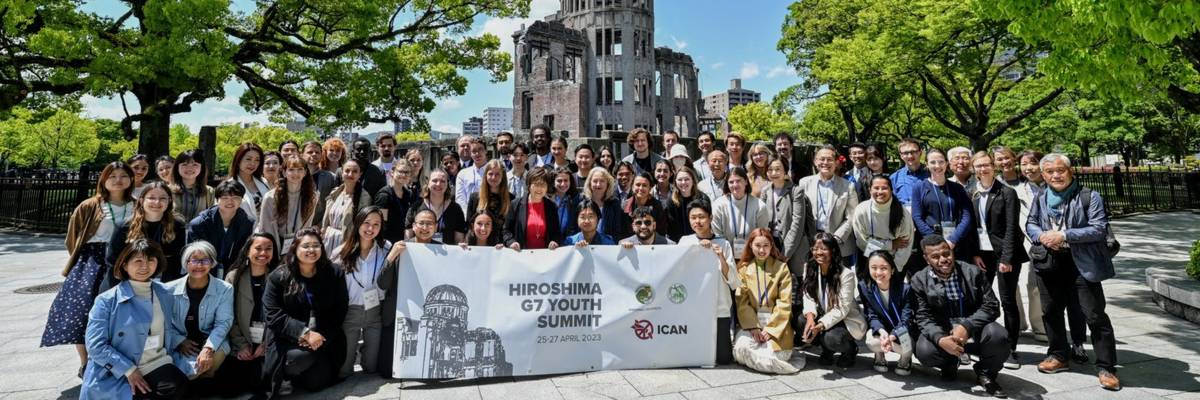
Anti-nuclear activists pose for a photo near Hiroshima Peace Memorial Park in Japan on April 27, 2023.
"Given the conflicts and crises we face today, we believe that the time for action against nuclear weapons is now. As young people, we champion the TPNW as the most effective path to eliminating nuclear weapons."
Youth-led peace activists on Thursday wrapped up a summit in Hiroshima by urging Group of Seven leaders slated to meet next month in the Japanese city—where more than 100,000 people died in a 1945 U.S. atomic bombing—to sign a landmark treaty banning nuclear weapons.
Organized by the International Campaign to Abolish Nuclear Weapons (ICAN) and hosted by the Center for Peace at Hiroshima University, the 50 youth delegates from G7 nations met "in the city that symbolizes the devastating humanitarian consequences of nuclear weapons" to remind the countries' leaders that "possession or use of nuclear weapons is illegitimate as recognized by the Treaty on the Prohibition of Nuclear Weapons (TPNW)."
While
68 nations are parties to the TPNW, none of the G7 countries—Canada, France, Germany, Italy, Japan, the United Kingdom, and the United States—or, more importantly, any of the world's nine nuclear powers, support the treaty. Three nuclear-armed nations—the U.S., U.K., and France—are also G7 members.
"Over the past week, we have had the unique opportunity to visit the Hiroshima Peace Memorial and meet the hibakusha, the courageous survivors of nuclear weapons. Their stories have moved us deeply, further strengthening our resolve to create a world free from the horrors of nuclear warfare," the activists said in a statement.
"We call on the world to listen to the hibakusha... and recognize the moral imperative of nuclear disarmament," the activists' statement continued. "We urgently demand action on nuclear weapons to honor the lived experiences of the hibakusha and other communities affected by nuclear weapons, and to secure a safer world free from weapons of mass destruction for generations to come."
"Given the conflicts and crises we face today, we believe that the time for action against nuclear weapons is now," the youths stressed. "As young people, we champion the TPNW as the most effective path to eliminating nuclear weapons."
The Hiroshima G7 Youth Summit follows a call by United Nations High Representative for Disarmament Affairs Izumi Nakamitsu at last month's ICAN Act On It Forum in Oslo, Norway for urgent global action to eliminate nuclear weapons.
Citing "an increase in dangerous nuclear rhetoric" amid Russia's invasion of Ukraine, Nakamitsu warned that the risk of thermonuclear armageddon is "at the highest level since the depth of the Cold War" and that disarmament efforts "are needed now more than ever."
Dear Common Dreams reader, It’s been nearly 30 years since I co-founded Common Dreams with my late wife, Lina Newhouser. We had the radical notion that journalism should serve the public good, not corporate profits. It was clear to us from the outset what it would take to build such a project. No paid advertisements. No corporate sponsors. No millionaire publisher telling us what to think or do. Many people said we wouldn't last a year, but we proved those doubters wrong. Together with a tremendous team of journalists and dedicated staff, we built an independent media outlet free from the constraints of profits and corporate control. Our mission has always been simple: To inform. To inspire. To ignite change for the common good. Building Common Dreams was not easy. Our survival was never guaranteed. When you take on the most powerful forces—Wall Street greed, fossil fuel industry destruction, Big Tech lobbyists, and uber-rich oligarchs who have spent billions upon billions rigging the economy and democracy in their favor—the only bulwark you have is supporters who believe in your work. But here’s the urgent message from me today. It's never been this bad out there. And it's never been this hard to keep us going. At the very moment Common Dreams is most needed, the threats we face are intensifying. We need your support now more than ever. We don't accept corporate advertising and never will. We don't have a paywall because we don't think people should be blocked from critical news based on their ability to pay. Everything we do is funded by the donations of readers like you. When everyone does the little they can afford, we are strong. But if that support retreats or dries up, so do we. Will you donate now to make sure Common Dreams not only survives but thrives? —Craig Brown, Co-founder |
Youth-led peace activists on Thursday wrapped up a summit in Hiroshima by urging Group of Seven leaders slated to meet next month in the Japanese city—where more than 100,000 people died in a 1945 U.S. atomic bombing—to sign a landmark treaty banning nuclear weapons.
Organized by the International Campaign to Abolish Nuclear Weapons (ICAN) and hosted by the Center for Peace at Hiroshima University, the 50 youth delegates from G7 nations met "in the city that symbolizes the devastating humanitarian consequences of nuclear weapons" to remind the countries' leaders that "possession or use of nuclear weapons is illegitimate as recognized by the Treaty on the Prohibition of Nuclear Weapons (TPNW)."
While
68 nations are parties to the TPNW, none of the G7 countries—Canada, France, Germany, Italy, Japan, the United Kingdom, and the United States—or, more importantly, any of the world's nine nuclear powers, support the treaty. Three nuclear-armed nations—the U.S., U.K., and France—are also G7 members.
"Over the past week, we have had the unique opportunity to visit the Hiroshima Peace Memorial and meet the hibakusha, the courageous survivors of nuclear weapons. Their stories have moved us deeply, further strengthening our resolve to create a world free from the horrors of nuclear warfare," the activists said in a statement.
"We call on the world to listen to the hibakusha... and recognize the moral imperative of nuclear disarmament," the activists' statement continued. "We urgently demand action on nuclear weapons to honor the lived experiences of the hibakusha and other communities affected by nuclear weapons, and to secure a safer world free from weapons of mass destruction for generations to come."
"Given the conflicts and crises we face today, we believe that the time for action against nuclear weapons is now," the youths stressed. "As young people, we champion the TPNW as the most effective path to eliminating nuclear weapons."
The Hiroshima G7 Youth Summit follows a call by United Nations High Representative for Disarmament Affairs Izumi Nakamitsu at last month's ICAN Act On It Forum in Oslo, Norway for urgent global action to eliminate nuclear weapons.
Citing "an increase in dangerous nuclear rhetoric" amid Russia's invasion of Ukraine, Nakamitsu warned that the risk of thermonuclear armageddon is "at the highest level since the depth of the Cold War" and that disarmament efforts "are needed now more than ever."
Youth-led peace activists on Thursday wrapped up a summit in Hiroshima by urging Group of Seven leaders slated to meet next month in the Japanese city—where more than 100,000 people died in a 1945 U.S. atomic bombing—to sign a landmark treaty banning nuclear weapons.
Organized by the International Campaign to Abolish Nuclear Weapons (ICAN) and hosted by the Center for Peace at Hiroshima University, the 50 youth delegates from G7 nations met "in the city that symbolizes the devastating humanitarian consequences of nuclear weapons" to remind the countries' leaders that "possession or use of nuclear weapons is illegitimate as recognized by the Treaty on the Prohibition of Nuclear Weapons (TPNW)."
While
68 nations are parties to the TPNW, none of the G7 countries—Canada, France, Germany, Italy, Japan, the United Kingdom, and the United States—or, more importantly, any of the world's nine nuclear powers, support the treaty. Three nuclear-armed nations—the U.S., U.K., and France—are also G7 members.
"Over the past week, we have had the unique opportunity to visit the Hiroshima Peace Memorial and meet the hibakusha, the courageous survivors of nuclear weapons. Their stories have moved us deeply, further strengthening our resolve to create a world free from the horrors of nuclear warfare," the activists said in a statement.
"We call on the world to listen to the hibakusha... and recognize the moral imperative of nuclear disarmament," the activists' statement continued. "We urgently demand action on nuclear weapons to honor the lived experiences of the hibakusha and other communities affected by nuclear weapons, and to secure a safer world free from weapons of mass destruction for generations to come."
"Given the conflicts and crises we face today, we believe that the time for action against nuclear weapons is now," the youths stressed. "As young people, we champion the TPNW as the most effective path to eliminating nuclear weapons."
The Hiroshima G7 Youth Summit follows a call by United Nations High Representative for Disarmament Affairs Izumi Nakamitsu at last month's ICAN Act On It Forum in Oslo, Norway for urgent global action to eliminate nuclear weapons.
Citing "an increase in dangerous nuclear rhetoric" amid Russia's invasion of Ukraine, Nakamitsu warned that the risk of thermonuclear armageddon is "at the highest level since the depth of the Cold War" and that disarmament efforts "are needed now more than ever."