SUBSCRIBE TO OUR FREE NEWSLETTER
Daily news & progressive opinion—funded by the people, not the corporations—delivered straight to your inbox.
5
#000000
#FFFFFF
To donate by check, phone, or other method, see our More Ways to Give page.
Daily news & progressive opinion—funded by the people, not the corporations—delivered straight to your inbox.
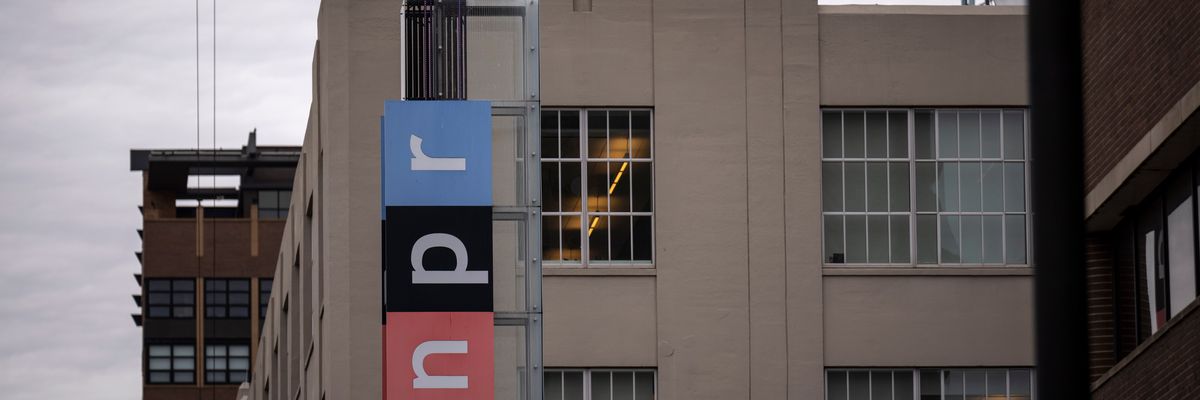
"We are not putting our journalism on platforms that have demonstrated an interest in undermining our credibility and the public's understanding of our editorial independence."
NPR on Wednesday announced plans to leave Twitter—the social media platform now owned by billionaire Elon Musk—after being branded last week with a "state-affiliated media" label that, after backlash, was replaced with "government-funded media."
"NPR's organizational accounts will no longer be active on Twitter because the platform is taking actions that undermine our credibility by falsely implying that we are not editorially independent," the media organization said in a statement.
"We are not putting our journalism on platforms that have demonstrated an interest in undermining our credibility and the public's understanding of our editorial independence," the statement added. "We are turning away from Twitter but not from our audiences and communities. There are plenty of ways to stay connected and keep up with NPR's news, music, and cultural content."
After the platform's initial decision last week, NPR president and CEO John Lansing said that "we were disturbed to see... that Twitter has labeled NPR as 'state-affiliated media,' a description that, per Twitter's own guidelines, does not apply to NPR."
Others also criticized applying that specific label to NPR—including Liz Woolery, PEN America's digital policy leader, who called it "a dangerous move that could further undermine public confidence in reliable news sources."
In an email exchange, an NPR reporter informed Musk that—like other U.S. public media—only about 1% of NPR's budget comes from the government, while about 40% is from corporate sponsors and 31% is from local stations' programming fees.
Musk reportedly wrote to the journalist that "the operating principle at new Twitter is simply fair and equal treatment, so if we label non-U.S. accounts as [government], then we should do the same for U.S., but it sounds like that might not be accurate here."
Twitter then updated the label on NPR's main account—which has 8.8 million followers—to government-affiliated, a label that has also been applied to the BBC, which has disputed the platform's decision.
"The BBC operates through a Royal Charter agreed with the U.K. government, which states the corporation 'must be independent,'" the British outlet explained Wednesday. "Its public service output is funded by U.K. households via a TV license fee, as well as income from commercial operations."
In a wide-ranging Tuesday interview with the BBC, Musk said: "We want [the tag] as truthful and accurate as possible. We're adjusting the label to [the BBC being] publicly funded. We'll try to be accurate."
Since Musk finalized his $44 billion purchase of Twitter in October, when he was the world's richest man, "it has been quite a rollercoaster," Musk admitted to the BBC. "It's been really quite a stressful situation."
The billionaire has come under fire for various platform policy and business decisions, from suspending journalists reporting on the movements of his private jet to laying off Twitter staff. While there was an initial exodus of advertisers, Musk said Tuesday that "I think almost all advertisers have come back or said they are going to come back."
However, the battle over how or even whether to label publicly funded media and NPR's decision to become the first major media outlet to ditch Twitter have some users, such as the U.S.-based advocacy group Free Press, asking, "Should we all join them?"
Dear Common Dreams reader, It’s been nearly 30 years since I co-founded Common Dreams with my late wife, Lina Newhouser. We had the radical notion that journalism should serve the public good, not corporate profits. It was clear to us from the outset what it would take to build such a project. No paid advertisements. No corporate sponsors. No millionaire publisher telling us what to think or do. Many people said we wouldn't last a year, but we proved those doubters wrong. Together with a tremendous team of journalists and dedicated staff, we built an independent media outlet free from the constraints of profits and corporate control. Our mission has always been simple: To inform. To inspire. To ignite change for the common good. Building Common Dreams was not easy. Our survival was never guaranteed. When you take on the most powerful forces—Wall Street greed, fossil fuel industry destruction, Big Tech lobbyists, and uber-rich oligarchs who have spent billions upon billions rigging the economy and democracy in their favor—the only bulwark you have is supporters who believe in your work. But here’s the urgent message from me today. It's never been this bad out there. And it's never been this hard to keep us going. At the very moment Common Dreams is most needed, the threats we face are intensifying. We need your support now more than ever. We don't accept corporate advertising and never will. We don't have a paywall because we don't think people should be blocked from critical news based on their ability to pay. Everything we do is funded by the donations of readers like you. When everyone does the little they can afford, we are strong. But if that support retreats or dries up, so do we. Will you donate now to make sure Common Dreams not only survives but thrives? —Craig Brown, Co-founder |
NPR on Wednesday announced plans to leave Twitter—the social media platform now owned by billionaire Elon Musk—after being branded last week with a "state-affiliated media" label that, after backlash, was replaced with "government-funded media."
"NPR's organizational accounts will no longer be active on Twitter because the platform is taking actions that undermine our credibility by falsely implying that we are not editorially independent," the media organization said in a statement.
"We are not putting our journalism on platforms that have demonstrated an interest in undermining our credibility and the public's understanding of our editorial independence," the statement added. "We are turning away from Twitter but not from our audiences and communities. There are plenty of ways to stay connected and keep up with NPR's news, music, and cultural content."
After the platform's initial decision last week, NPR president and CEO John Lansing said that "we were disturbed to see... that Twitter has labeled NPR as 'state-affiliated media,' a description that, per Twitter's own guidelines, does not apply to NPR."
Others also criticized applying that specific label to NPR—including Liz Woolery, PEN America's digital policy leader, who called it "a dangerous move that could further undermine public confidence in reliable news sources."
In an email exchange, an NPR reporter informed Musk that—like other U.S. public media—only about 1% of NPR's budget comes from the government, while about 40% is from corporate sponsors and 31% is from local stations' programming fees.
Musk reportedly wrote to the journalist that "the operating principle at new Twitter is simply fair and equal treatment, so if we label non-U.S. accounts as [government], then we should do the same for U.S., but it sounds like that might not be accurate here."
Twitter then updated the label on NPR's main account—which has 8.8 million followers—to government-affiliated, a label that has also been applied to the BBC, which has disputed the platform's decision.
"The BBC operates through a Royal Charter agreed with the U.K. government, which states the corporation 'must be independent,'" the British outlet explained Wednesday. "Its public service output is funded by U.K. households via a TV license fee, as well as income from commercial operations."
In a wide-ranging Tuesday interview with the BBC, Musk said: "We want [the tag] as truthful and accurate as possible. We're adjusting the label to [the BBC being] publicly funded. We'll try to be accurate."
Since Musk finalized his $44 billion purchase of Twitter in October, when he was the world's richest man, "it has been quite a rollercoaster," Musk admitted to the BBC. "It's been really quite a stressful situation."
The billionaire has come under fire for various platform policy and business decisions, from suspending journalists reporting on the movements of his private jet to laying off Twitter staff. While there was an initial exodus of advertisers, Musk said Tuesday that "I think almost all advertisers have come back or said they are going to come back."
However, the battle over how or even whether to label publicly funded media and NPR's decision to become the first major media outlet to ditch Twitter have some users, such as the U.S.-based advocacy group Free Press, asking, "Should we all join them?"
NPR on Wednesday announced plans to leave Twitter—the social media platform now owned by billionaire Elon Musk—after being branded last week with a "state-affiliated media" label that, after backlash, was replaced with "government-funded media."
"NPR's organizational accounts will no longer be active on Twitter because the platform is taking actions that undermine our credibility by falsely implying that we are not editorially independent," the media organization said in a statement.
"We are not putting our journalism on platforms that have demonstrated an interest in undermining our credibility and the public's understanding of our editorial independence," the statement added. "We are turning away from Twitter but not from our audiences and communities. There are plenty of ways to stay connected and keep up with NPR's news, music, and cultural content."
After the platform's initial decision last week, NPR president and CEO John Lansing said that "we were disturbed to see... that Twitter has labeled NPR as 'state-affiliated media,' a description that, per Twitter's own guidelines, does not apply to NPR."
Others also criticized applying that specific label to NPR—including Liz Woolery, PEN America's digital policy leader, who called it "a dangerous move that could further undermine public confidence in reliable news sources."
In an email exchange, an NPR reporter informed Musk that—like other U.S. public media—only about 1% of NPR's budget comes from the government, while about 40% is from corporate sponsors and 31% is from local stations' programming fees.
Musk reportedly wrote to the journalist that "the operating principle at new Twitter is simply fair and equal treatment, so if we label non-U.S. accounts as [government], then we should do the same for U.S., but it sounds like that might not be accurate here."
Twitter then updated the label on NPR's main account—which has 8.8 million followers—to government-affiliated, a label that has also been applied to the BBC, which has disputed the platform's decision.
"The BBC operates through a Royal Charter agreed with the U.K. government, which states the corporation 'must be independent,'" the British outlet explained Wednesday. "Its public service output is funded by U.K. households via a TV license fee, as well as income from commercial operations."
In a wide-ranging Tuesday interview with the BBC, Musk said: "We want [the tag] as truthful and accurate as possible. We're adjusting the label to [the BBC being] publicly funded. We'll try to be accurate."
Since Musk finalized his $44 billion purchase of Twitter in October, when he was the world's richest man, "it has been quite a rollercoaster," Musk admitted to the BBC. "It's been really quite a stressful situation."
The billionaire has come under fire for various platform policy and business decisions, from suspending journalists reporting on the movements of his private jet to laying off Twitter staff. While there was an initial exodus of advertisers, Musk said Tuesday that "I think almost all advertisers have come back or said they are going to come back."
However, the battle over how or even whether to label publicly funded media and NPR's decision to become the first major media outlet to ditch Twitter have some users, such as the U.S.-based advocacy group Free Press, asking, "Should we all join them?"