SUBSCRIBE TO OUR FREE NEWSLETTER
Daily news & progressive opinion—funded by the people, not the corporations—delivered straight to your inbox.
5
#000000
#FFFFFF
To donate by check, phone, or other method, see our More Ways to Give page.
Daily news & progressive opinion—funded by the people, not the corporations—delivered straight to your inbox.
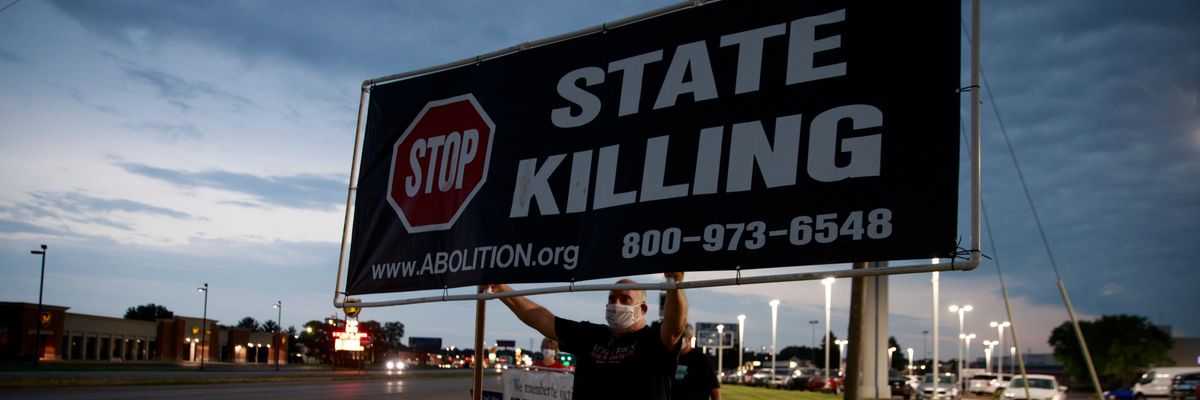
Death penalty abolitionist Abe Bonowitz of Death Penalty Action protests near the Terre Haute Federal Correctional Complex in Indiana on July 15, 2020.
"Drug manufacturers don't want their medicines diverted and misused in torturous executions and the makers of nitrogen gas share the same objection: They do not want their products to be used to kill," said one campaigner.
Three of the leading U.S. manufacturers of medical-grade nitrogen gas said this week that they will not allow their products to be used in executions, a move that came after Louisiana approved the controversial capital punishment method recently used to kill an Alabama prisoner who appeared to be in agony before he died.
Airgas—owned by the French company Air Liquide—along with Air Products, and Matheson Gas told The Guardian that they are banning the use of their nitrogen gas products in the previously untested execution method used to cause death by hypoxia, or deprivation of oxygen to vital tissues.
Veterinarians consider nitrogen gas unethical for euthanizing animals and United Nations human rights experts have asserted that the execution technique may violate international anti-torture law.
"Airgas has not, and will not, supply nitrogen or other inert gases to induce hypoxia for the purpose of human execution," the company said.
Matheson Gas told The Guardian that use of its products in executions is "not consistent with our company values," while Air Products told the U.K.-based newspaper that it has established "prohibited end uses for our products, which includes the use of any of our industrial gas products for the intentional killing of any person (including nitrogen hypoxia)."
Four states—Alabama, Louisiana, Mississippi, and Oklahoma—have approved nitrogen gas for use in executions. Last week, Louisiana Gov. Jeff Landry, a Republican, signed legislation passed by the GOP-controlled state Legislature expanding execution methods to include the electric chair and nitrogen hypoxia. This, despite the agonizing execution in January of 58-year-old Kenneth Smith, who was killed by the state of Alabama by nitrogen hypoxia on January 25 after the U.S. Supreme Court rejected his last-ditch appeal.
Rev. Jeff Hood, a spiritual adviser to U.S. death row inmates, witnessed Smith's killing, which he described as "horrific and cruel." Hood and other witnesses said Smith convulsed violently for several minutes while he was strapped to a gurney and forced to breathe nitrogen gas through a mask. Even prison guards were taken by surprise as the gurney shook and Smith struggled for his life.
Alabama officials had claimed that nitrogen hypoxia is "perhaps the most humane method of execution ever devised."
States have sought alternative means of killing condemned prisoners—including nitrogen gas and firing squads—ever since the European Union banned the sale and export of lethal injection drugs in 2011.
Maya Foa, co-executive director of the anti-death penalty group Reprieve, told The Guardian that "drug manufacturers don't want their medicines diverted and misused in torturous executions and the makers of nitrogen gas share the same objection: They do not want their products to be used to kill."
"States which claim that the lethal injection or gas inhalation are 'humane' methods of execution are merely seeking to mask what it means for a state to forcibly put someone to death," Foa added. "The makers of these products see through the lie and naturally want nothing to do with it."
Dear Common Dreams reader, It’s been nearly 30 years since I co-founded Common Dreams with my late wife, Lina Newhouser. We had the radical notion that journalism should serve the public good, not corporate profits. It was clear to us from the outset what it would take to build such a project. No paid advertisements. No corporate sponsors. No millionaire publisher telling us what to think or do. Many people said we wouldn't last a year, but we proved those doubters wrong. Together with a tremendous team of journalists and dedicated staff, we built an independent media outlet free from the constraints of profits and corporate control. Our mission has always been simple: To inform. To inspire. To ignite change for the common good. Building Common Dreams was not easy. Our survival was never guaranteed. When you take on the most powerful forces—Wall Street greed, fossil fuel industry destruction, Big Tech lobbyists, and uber-rich oligarchs who have spent billions upon billions rigging the economy and democracy in their favor—the only bulwark you have is supporters who believe in your work. But here’s the urgent message from me today. It's never been this bad out there. And it's never been this hard to keep us going. At the very moment Common Dreams is most needed, the threats we face are intensifying. We need your support now more than ever. We don't accept corporate advertising and never will. We don't have a paywall because we don't think people should be blocked from critical news based on their ability to pay. Everything we do is funded by the donations of readers like you. When everyone does the little they can afford, we are strong. But if that support retreats or dries up, so do we. Will you donate now to make sure Common Dreams not only survives but thrives? —Craig Brown, Co-founder |
Three of the leading U.S. manufacturers of medical-grade nitrogen gas said this week that they will not allow their products to be used in executions, a move that came after Louisiana approved the controversial capital punishment method recently used to kill an Alabama prisoner who appeared to be in agony before he died.
Airgas—owned by the French company Air Liquide—along with Air Products, and Matheson Gas told The Guardian that they are banning the use of their nitrogen gas products in the previously untested execution method used to cause death by hypoxia, or deprivation of oxygen to vital tissues.
Veterinarians consider nitrogen gas unethical for euthanizing animals and United Nations human rights experts have asserted that the execution technique may violate international anti-torture law.
"Airgas has not, and will not, supply nitrogen or other inert gases to induce hypoxia for the purpose of human execution," the company said.
Matheson Gas told The Guardian that use of its products in executions is "not consistent with our company values," while Air Products told the U.K.-based newspaper that it has established "prohibited end uses for our products, which includes the use of any of our industrial gas products for the intentional killing of any person (including nitrogen hypoxia)."
Four states—Alabama, Louisiana, Mississippi, and Oklahoma—have approved nitrogen gas for use in executions. Last week, Louisiana Gov. Jeff Landry, a Republican, signed legislation passed by the GOP-controlled state Legislature expanding execution methods to include the electric chair and nitrogen hypoxia. This, despite the agonizing execution in January of 58-year-old Kenneth Smith, who was killed by the state of Alabama by nitrogen hypoxia on January 25 after the U.S. Supreme Court rejected his last-ditch appeal.
Rev. Jeff Hood, a spiritual adviser to U.S. death row inmates, witnessed Smith's killing, which he described as "horrific and cruel." Hood and other witnesses said Smith convulsed violently for several minutes while he was strapped to a gurney and forced to breathe nitrogen gas through a mask. Even prison guards were taken by surprise as the gurney shook and Smith struggled for his life.
Alabama officials had claimed that nitrogen hypoxia is "perhaps the most humane method of execution ever devised."
States have sought alternative means of killing condemned prisoners—including nitrogen gas and firing squads—ever since the European Union banned the sale and export of lethal injection drugs in 2011.
Maya Foa, co-executive director of the anti-death penalty group Reprieve, told The Guardian that "drug manufacturers don't want their medicines diverted and misused in torturous executions and the makers of nitrogen gas share the same objection: They do not want their products to be used to kill."
"States which claim that the lethal injection or gas inhalation are 'humane' methods of execution are merely seeking to mask what it means for a state to forcibly put someone to death," Foa added. "The makers of these products see through the lie and naturally want nothing to do with it."
Three of the leading U.S. manufacturers of medical-grade nitrogen gas said this week that they will not allow their products to be used in executions, a move that came after Louisiana approved the controversial capital punishment method recently used to kill an Alabama prisoner who appeared to be in agony before he died.
Airgas—owned by the French company Air Liquide—along with Air Products, and Matheson Gas told The Guardian that they are banning the use of their nitrogen gas products in the previously untested execution method used to cause death by hypoxia, or deprivation of oxygen to vital tissues.
Veterinarians consider nitrogen gas unethical for euthanizing animals and United Nations human rights experts have asserted that the execution technique may violate international anti-torture law.
"Airgas has not, and will not, supply nitrogen or other inert gases to induce hypoxia for the purpose of human execution," the company said.
Matheson Gas told The Guardian that use of its products in executions is "not consistent with our company values," while Air Products told the U.K.-based newspaper that it has established "prohibited end uses for our products, which includes the use of any of our industrial gas products for the intentional killing of any person (including nitrogen hypoxia)."
Four states—Alabama, Louisiana, Mississippi, and Oklahoma—have approved nitrogen gas for use in executions. Last week, Louisiana Gov. Jeff Landry, a Republican, signed legislation passed by the GOP-controlled state Legislature expanding execution methods to include the electric chair and nitrogen hypoxia. This, despite the agonizing execution in January of 58-year-old Kenneth Smith, who was killed by the state of Alabama by nitrogen hypoxia on January 25 after the U.S. Supreme Court rejected his last-ditch appeal.
Rev. Jeff Hood, a spiritual adviser to U.S. death row inmates, witnessed Smith's killing, which he described as "horrific and cruel." Hood and other witnesses said Smith convulsed violently for several minutes while he was strapped to a gurney and forced to breathe nitrogen gas through a mask. Even prison guards were taken by surprise as the gurney shook and Smith struggled for his life.
Alabama officials had claimed that nitrogen hypoxia is "perhaps the most humane method of execution ever devised."
States have sought alternative means of killing condemned prisoners—including nitrogen gas and firing squads—ever since the European Union banned the sale and export of lethal injection drugs in 2011.
Maya Foa, co-executive director of the anti-death penalty group Reprieve, told The Guardian that "drug manufacturers don't want their medicines diverted and misused in torturous executions and the makers of nitrogen gas share the same objection: They do not want their products to be used to kill."
"States which claim that the lethal injection or gas inhalation are 'humane' methods of execution are merely seeking to mask what it means for a state to forcibly put someone to death," Foa added. "The makers of these products see through the lie and naturally want nothing to do with it."