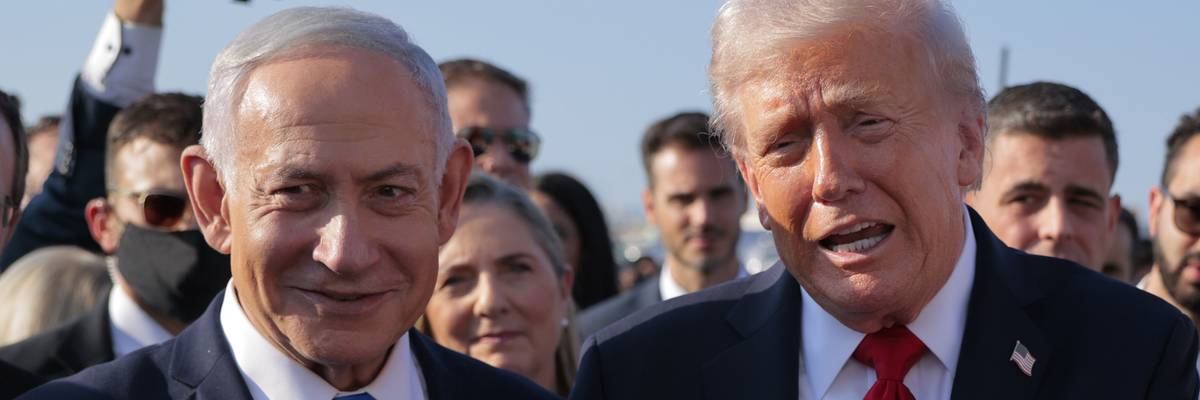
US President Donald Trump speaks to Israeli Prime Minister Benjamin Netanyahu at Ben Gurion International Airport before boarding his plane to Sharm El-Sheikh, Egypt on October 13, 2025 in Tel Aviv, Israel.
With Trump Support, Netanyahu Requests Pardon for Corruption Charges
"There is no such thing as a pardon request without an admission of guilt and without resignation," said one journalist. "This is a demand for the surrender of the rule of law in Israel."
Weeks after President Donald Trump called for a pardon for his ally, Prime Minister Benjamin Netanyahu, the Israeli leader himself issued a formal plea to President Isaac Herzog and addressed the nation—claiming a pardon for allegations of bribery, fraud, and breach of trust, which he's been on trial for since 2020, would be in the country's best interest.
Netanyahu was indicted in 2019 in three separate corruption cases regarding allegations that he took more than $200,000 from wealthy businessmen in exchange for positive media coverage for himself and his family. He has denied wrongdoing in the cases.
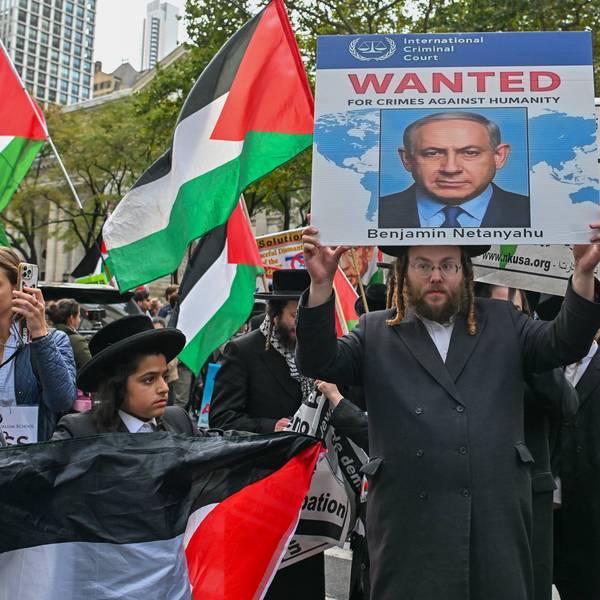
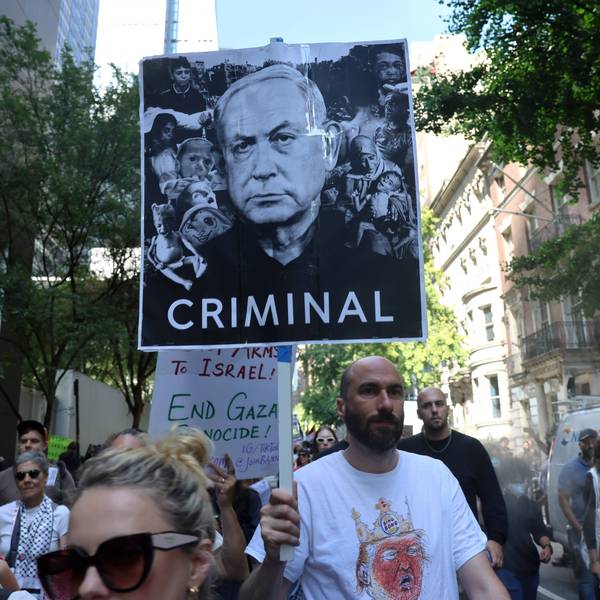
The prime minister has also been accused by the International Criminal Court of war crimes and crimes against humanity in Gaza, where Israel has killed more than 70,000 Palestinians since October 2023, with the slaughter of civilians continuing despite a ceasefire deal that was reached in October. A New York Times report in July described how Netanyahu prolonged the war to maintain his political power. Netanyahu's government also sought to fire the Israeli attorney general, who is prosecuting the prime minister's case.
In his letter to Herzog, whose role is largely ceremonial but who has the authority to pardon convicted criminals, Netanyahu requested the pardon so that he can “devote his full time, abilities, and strengths to advance Israel in these critical times."
“The continuation of the trial tears us apart from within, stirs up this division, and deepens rifts," he added in his video address. "I am sure, like many others in the nation, that an immediate conclusion of the trial would greatly help to lower the flames and promote the broad reconciliation that our country so desperately needs."
The request made clear that he has no intention of admitting wrongdoing or resigning from office—which critics including Israeli opposition leader Yair Lapid said must be a condition for any pardon.
“You cannot grant him a pardon without an admission of guilt, an expression of remorse, and an immediate retirement from political life,” said Lapid.
Israeli journalist Anshel Pfeffer, who authored a biography of Netanyahu, said the prime minister was "demanding immunity from prosecution" rather than asking for a pardon for a crime he's convicted of.
"There is no such thing as a pardon request without an admission of guilt and without resignation," said Pfeffer. "This is not a pardon request. This is a demand for the surrender of the rule of law in Israel."
In the video address Netanyahu released, he suggested a pardon would be for the good of the nation and claimed that his “personal interest remains to continue the trial until the end."
He also referenced Trump's letter to Herzog, in which the president claimed he respected "the independence of the Israeli Justice System" but called the corruption cases a "political, unjustified prosecution.”
Herzog said Sunday that he would seek expert opinions on the request and would “responsibly and sincerely consider" a pardon, noting that it would have “significant implications."
Emi Palmor, former director general of Israel's Justice Ministry, told Al Jazeera that it is "impossible" for Netanyahu to halt his trial with a pardon request.
“You cannot claim that you’re innocent while the trial is going on and come to the president and ask him to intervene," said Palmor.
In the US, Rep. Mark Pocan (D-Wisc.) said that should Herzog grant Netanyahu's request, "it will be hard to consider [Israel] a law-abiding nation."
"It would be a huge mistake," said Pocan. "Real nations follow laws."
We are at a crossroads
This country and this world are at a monumental crossroads. In a few short weeks, US voters will have an opportunity to beat back the forces of fascism and confront the billionaires who are rigging the economy, our media system, and our democracy, making it increasingly impossible for ordinary people to get by. We’re not just talking about the election. We’re talking about what must be done once these fascist elements are vanquished from power. We need a bolder set of solutions than what either major party has so far been willing to offer and a working-class movement ready to fight like hell for it. Trump didn't emerge from nowhere. The conditions that fueled MAGA authoritarianism were created by decades of radical neoliberal economic policies and a corrupt political system dominated by corporate interests. They slashed taxes on the super-rich, promising that the benefits would trickle down. They said giveaways to the corporate titans would make life more affordable for the rest of us. It was all bullshit. And when a bitter, betrayed populace searches for someone to blame, right-wing demagogues have little trouble finding scapegoats. People know when they're being lied to, but you won't hear any of this from the corporate media. Only independent journalism—powered and funded by people who believe in building a better world—can deliver truly trustworthy daily news. Our Fall Campaign is underway, and we need your help. To power our newsroom through the rest of the year, we need to raise $125,000 by midnight on October 31. So if you share our vision, please contribute whatever you can to sustain our work. |
Weeks after President Donald Trump called for a pardon for his ally, Prime Minister Benjamin Netanyahu, the Israeli leader himself issued a formal plea to President Isaac Herzog and addressed the nation—claiming a pardon for allegations of bribery, fraud, and breach of trust, which he's been on trial for since 2020, would be in the country's best interest.
Netanyahu was indicted in 2019 in three separate corruption cases regarding allegations that he took more than $200,000 from wealthy businessmen in exchange for positive media coverage for himself and his family. He has denied wrongdoing in the cases.
The prime minister has also been accused by the International Criminal Court of war crimes and crimes against humanity in Gaza, where Israel has killed more than 70,000 Palestinians since October 2023, with the slaughter of civilians continuing despite a ceasefire deal that was reached in October. A New York Times report in July described how Netanyahu prolonged the war to maintain his political power. Netanyahu's government also sought to fire the Israeli attorney general, who is prosecuting the prime minister's case.
In his letter to Herzog, whose role is largely ceremonial but who has the authority to pardon convicted criminals, Netanyahu requested the pardon so that he can “devote his full time, abilities, and strengths to advance Israel in these critical times."
“The continuation of the trial tears us apart from within, stirs up this division, and deepens rifts," he added in his video address. "I am sure, like many others in the nation, that an immediate conclusion of the trial would greatly help to lower the flames and promote the broad reconciliation that our country so desperately needs."
The request made clear that he has no intention of admitting wrongdoing or resigning from office—which critics including Israeli opposition leader Yair Lapid said must be a condition for any pardon.
“You cannot grant him a pardon without an admission of guilt, an expression of remorse, and an immediate retirement from political life,” said Lapid.
Israeli journalist Anshel Pfeffer, who authored a biography of Netanyahu, said the prime minister was "demanding immunity from prosecution" rather than asking for a pardon for a crime he's convicted of.
"There is no such thing as a pardon request without an admission of guilt and without resignation," said Pfeffer. "This is not a pardon request. This is a demand for the surrender of the rule of law in Israel."
In the video address Netanyahu released, he suggested a pardon would be for the good of the nation and claimed that his “personal interest remains to continue the trial until the end."
He also referenced Trump's letter to Herzog, in which the president claimed he respected "the independence of the Israeli Justice System" but called the corruption cases a "political, unjustified prosecution.”
Herzog said Sunday that he would seek expert opinions on the request and would “responsibly and sincerely consider" a pardon, noting that it would have “significant implications."
Emi Palmor, former director general of Israel's Justice Ministry, told Al Jazeera that it is "impossible" for Netanyahu to halt his trial with a pardon request.
“You cannot claim that you’re innocent while the trial is going on and come to the president and ask him to intervene," said Palmor.
In the US, Rep. Mark Pocan (D-Wisc.) said that should Herzog grant Netanyahu's request, "it will be hard to consider [Israel] a law-abiding nation."
"It would be a huge mistake," said Pocan. "Real nations follow laws."
Weeks after President Donald Trump called for a pardon for his ally, Prime Minister Benjamin Netanyahu, the Israeli leader himself issued a formal plea to President Isaac Herzog and addressed the nation—claiming a pardon for allegations of bribery, fraud, and breach of trust, which he's been on trial for since 2020, would be in the country's best interest.
Netanyahu was indicted in 2019 in three separate corruption cases regarding allegations that he took more than $200,000 from wealthy businessmen in exchange for positive media coverage for himself and his family. He has denied wrongdoing in the cases.
The prime minister has also been accused by the International Criminal Court of war crimes and crimes against humanity in Gaza, where Israel has killed more than 70,000 Palestinians since October 2023, with the slaughter of civilians continuing despite a ceasefire deal that was reached in October. A New York Times report in July described how Netanyahu prolonged the war to maintain his political power. Netanyahu's government also sought to fire the Israeli attorney general, who is prosecuting the prime minister's case.
In his letter to Herzog, whose role is largely ceremonial but who has the authority to pardon convicted criminals, Netanyahu requested the pardon so that he can “devote his full time, abilities, and strengths to advance Israel in these critical times."
“The continuation of the trial tears us apart from within, stirs up this division, and deepens rifts," he added in his video address. "I am sure, like many others in the nation, that an immediate conclusion of the trial would greatly help to lower the flames and promote the broad reconciliation that our country so desperately needs."
The request made clear that he has no intention of admitting wrongdoing or resigning from office—which critics including Israeli opposition leader Yair Lapid said must be a condition for any pardon.
“You cannot grant him a pardon without an admission of guilt, an expression of remorse, and an immediate retirement from political life,” said Lapid.
Israeli journalist Anshel Pfeffer, who authored a biography of Netanyahu, said the prime minister was "demanding immunity from prosecution" rather than asking for a pardon for a crime he's convicted of.
"There is no such thing as a pardon request without an admission of guilt and without resignation," said Pfeffer. "This is not a pardon request. This is a demand for the surrender of the rule of law in Israel."
In the video address Netanyahu released, he suggested a pardon would be for the good of the nation and claimed that his “personal interest remains to continue the trial until the end."
He also referenced Trump's letter to Herzog, in which the president claimed he respected "the independence of the Israeli Justice System" but called the corruption cases a "political, unjustified prosecution.”
Herzog said Sunday that he would seek expert opinions on the request and would “responsibly and sincerely consider" a pardon, noting that it would have “significant implications."
Emi Palmor, former director general of Israel's Justice Ministry, told Al Jazeera that it is "impossible" for Netanyahu to halt his trial with a pardon request.
“You cannot claim that you’re innocent while the trial is going on and come to the president and ask him to intervene," said Palmor.
In the US, Rep. Mark Pocan (D-Wisc.) said that should Herzog grant Netanyahu's request, "it will be hard to consider [Israel] a law-abiding nation."
"It would be a huge mistake," said Pocan. "Real nations follow laws."