SUBSCRIBE TO OUR FREE NEWSLETTER
Daily news & progressive opinion—funded by the people, not the corporations—delivered straight to your inbox.
5
#000000
#FFFFFF
To donate by check, phone, or other method, see our More Ways to Give page.
Daily news & progressive opinion—funded by the people, not the corporations—delivered straight to your inbox.
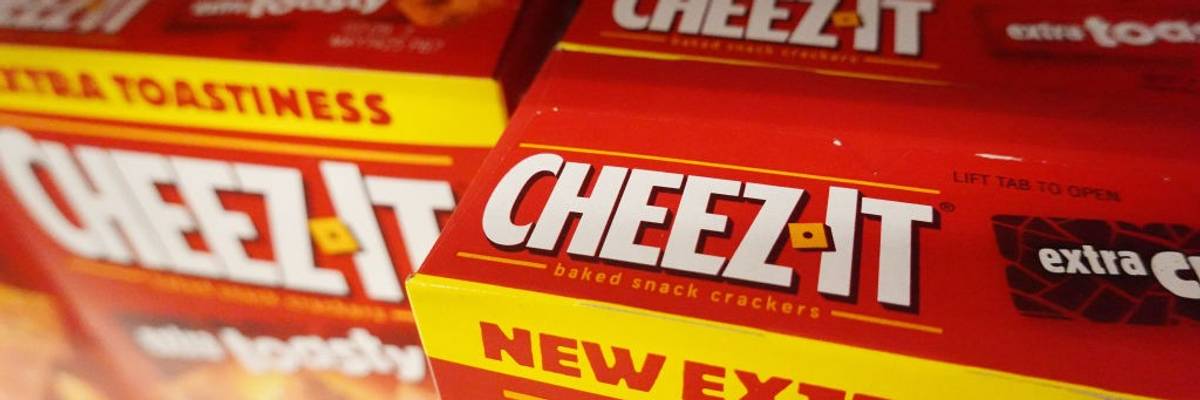
Packages of Cheez-It snacks are displayed for sale in a store on August 14, 2024 in Los Angeles, California. Candy giant Mars is purchasing Kellanova, the maker of Pringles, Eggo, and Cheez-It brands, in a deal valued at about $36 billion.
"The Federal Trade Commission must intervene to block this destructive corporate coupling," an expert said.
Food and Water Watch warned on Wednesday that the announced acquisition of Kellanova by Mars Inc. would hurt consumers by allowing the candy giant to take control of a huge proportion of the market's snack and cereal bar sales and called for federal regulators to block the deal.
"The Biden-Harris administration has committed to reining in the food monopolies," Amanda Starbuck, FWW's research director, said in a statement. "The Federal Trade Commission must intervene to block this destructive corporate coupling."
Mars announced the deal, which valued Kellanova at $35.9 billion, earlier Wednesday. Kellanova formed when Kellogg Company split into two companies in September 2023.
Kellogg Company and Mars accounted for 49% of U.S. snack and cereal bar sales in 2022, according to FWW, which pointed to research showing that "growing market concentration leads to fewer consumer choices and rising food prices."
Starbuck said the current trend of food monopolies must be reversed.
"American grocery shoppers are suffering from high prices and fewer choices on the shelves—Mars' Kellanova acquisition would only make it worse," she said. "While processed food giants stand to ramp up profits from snack market domination, the American consumer will lose out with higher costs and fewer healthy options. A shrinking number of ever-larger corporations control a growing share of the food we buy, putting decisions about our health and finances in the hands of corporate kingpins."
Despite Starbuck's concerns, the deal has a good chance of gaining approval by federal antitrust regulators, Reuters reported last week.
Kellanova CEO Steve Cahillane told CNBC that he doesn't foresee any antitrust issues, though Daniel Hanley, a legal analyst at Open Markets Institute, expressed skepticism about the merger's legality in social media posts.
It's fairly ignorant for a CEO to say they don't foresee any antitrust issues. https://t.co/QP9mOGbNg0 pic.twitter.com/eDU86WO0un
— Daniel Hanley (@danielahanley) August 14, 2024
Another food-related merger under antitrust scrutiny is Kroger's $24.6 billion proposed acquisition of Albertsons, which the Federal Trade Commission, led by Chair Lina Khan, has sued to block.
Dear Common Dreams reader, It’s been nearly 30 years since I co-founded Common Dreams with my late wife, Lina Newhouser. We had the radical notion that journalism should serve the public good, not corporate profits. It was clear to us from the outset what it would take to build such a project. No paid advertisements. No corporate sponsors. No millionaire publisher telling us what to think or do. Many people said we wouldn't last a year, but we proved those doubters wrong. Together with a tremendous team of journalists and dedicated staff, we built an independent media outlet free from the constraints of profits and corporate control. Our mission has always been simple: To inform. To inspire. To ignite change for the common good. Building Common Dreams was not easy. Our survival was never guaranteed. When you take on the most powerful forces—Wall Street greed, fossil fuel industry destruction, Big Tech lobbyists, and uber-rich oligarchs who have spent billions upon billions rigging the economy and democracy in their favor—the only bulwark you have is supporters who believe in your work. But here’s the urgent message from me today. It's never been this bad out there. And it's never been this hard to keep us going. At the very moment Common Dreams is most needed, the threats we face are intensifying. We need your support now more than ever. We don't accept corporate advertising and never will. We don't have a paywall because we don't think people should be blocked from critical news based on their ability to pay. Everything we do is funded by the donations of readers like you. When everyone does the little they can afford, we are strong. But if that support retreats or dries up, so do we. Will you donate now to make sure Common Dreams not only survives but thrives? —Craig Brown, Co-founder |
Food and Water Watch warned on Wednesday that the announced acquisition of Kellanova by Mars Inc. would hurt consumers by allowing the candy giant to take control of a huge proportion of the market's snack and cereal bar sales and called for federal regulators to block the deal.
"The Biden-Harris administration has committed to reining in the food monopolies," Amanda Starbuck, FWW's research director, said in a statement. "The Federal Trade Commission must intervene to block this destructive corporate coupling."
Mars announced the deal, which valued Kellanova at $35.9 billion, earlier Wednesday. Kellanova formed when Kellogg Company split into two companies in September 2023.
Kellogg Company and Mars accounted for 49% of U.S. snack and cereal bar sales in 2022, according to FWW, which pointed to research showing that "growing market concentration leads to fewer consumer choices and rising food prices."
Starbuck said the current trend of food monopolies must be reversed.
"American grocery shoppers are suffering from high prices and fewer choices on the shelves—Mars' Kellanova acquisition would only make it worse," she said. "While processed food giants stand to ramp up profits from snack market domination, the American consumer will lose out with higher costs and fewer healthy options. A shrinking number of ever-larger corporations control a growing share of the food we buy, putting decisions about our health and finances in the hands of corporate kingpins."
Despite Starbuck's concerns, the deal has a good chance of gaining approval by federal antitrust regulators, Reuters reported last week.
Kellanova CEO Steve Cahillane told CNBC that he doesn't foresee any antitrust issues, though Daniel Hanley, a legal analyst at Open Markets Institute, expressed skepticism about the merger's legality in social media posts.
It's fairly ignorant for a CEO to say they don't foresee any antitrust issues. https://t.co/QP9mOGbNg0 pic.twitter.com/eDU86WO0un
— Daniel Hanley (@danielahanley) August 14, 2024
Another food-related merger under antitrust scrutiny is Kroger's $24.6 billion proposed acquisition of Albertsons, which the Federal Trade Commission, led by Chair Lina Khan, has sued to block.
Food and Water Watch warned on Wednesday that the announced acquisition of Kellanova by Mars Inc. would hurt consumers by allowing the candy giant to take control of a huge proportion of the market's snack and cereal bar sales and called for federal regulators to block the deal.
"The Biden-Harris administration has committed to reining in the food monopolies," Amanda Starbuck, FWW's research director, said in a statement. "The Federal Trade Commission must intervene to block this destructive corporate coupling."
Mars announced the deal, which valued Kellanova at $35.9 billion, earlier Wednesday. Kellanova formed when Kellogg Company split into two companies in September 2023.
Kellogg Company and Mars accounted for 49% of U.S. snack and cereal bar sales in 2022, according to FWW, which pointed to research showing that "growing market concentration leads to fewer consumer choices and rising food prices."
Starbuck said the current trend of food monopolies must be reversed.
"American grocery shoppers are suffering from high prices and fewer choices on the shelves—Mars' Kellanova acquisition would only make it worse," she said. "While processed food giants stand to ramp up profits from snack market domination, the American consumer will lose out with higher costs and fewer healthy options. A shrinking number of ever-larger corporations control a growing share of the food we buy, putting decisions about our health and finances in the hands of corporate kingpins."
Despite Starbuck's concerns, the deal has a good chance of gaining approval by federal antitrust regulators, Reuters reported last week.
Kellanova CEO Steve Cahillane told CNBC that he doesn't foresee any antitrust issues, though Daniel Hanley, a legal analyst at Open Markets Institute, expressed skepticism about the merger's legality in social media posts.
It's fairly ignorant for a CEO to say they don't foresee any antitrust issues. https://t.co/QP9mOGbNg0 pic.twitter.com/eDU86WO0un
— Daniel Hanley (@danielahanley) August 14, 2024
Another food-related merger under antitrust scrutiny is Kroger's $24.6 billion proposed acquisition of Albertsons, which the Federal Trade Commission, led by Chair Lina Khan, has sued to block.