SUBSCRIBE TO OUR FREE NEWSLETTER
Daily news & progressive opinion—funded by the people, not the corporations—delivered straight to your inbox.
5
#000000
#FFFFFF
To donate by check, phone, or other method, see our More Ways to Give page.
Daily news & progressive opinion—funded by the people, not the corporations—delivered straight to your inbox.
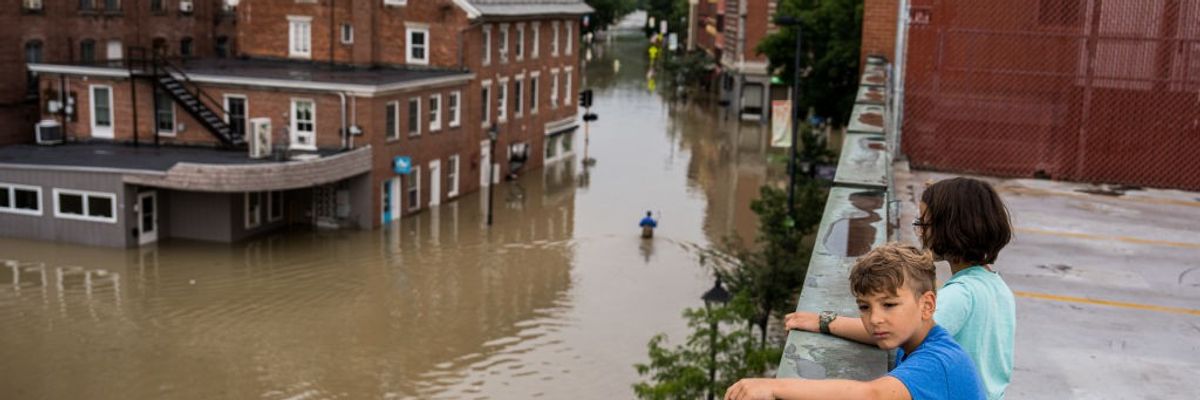
Flooding is seen in downtown Montpelier, Vermont on July 11, 2023.
"Big banks are financing fossil fuels and fanning the flames of climate chaos," said Sen. Ed Markey.
Led by U.S. Sen. Ed Markey and Rep. Ayanna Pressley, lawmakers on Monday warned that the U.S. government ignores climate-related financial risks at its own peril—imploring Federal Reserve Chair Jerome Powell to take the climate into account when overseeing financial institutions.
The two Massachusetts Democrats led colleagues including Sen. Bernie Sanders (I-Vt.) and Rep. Alexandria Ocasio-Cortez (D-N.Y.) in writing to Powell to say the Federal Reserve can and must help "protect the stability of the financial system" by requiring financial firms to end their funding of fossil fuel projects.
With international scientists agreeing that extreme climate events this summer such as prolonged heatwaves in the U.S. and Europe and wildfires in Canada would not have happened without the fossil fuel-driven climate emergency, the lawmakers urged Powell to consider the financial damages of such disasters, which they said cost the U.S. economy more than $617 billion between 2018-22 and $177 billion last year alone.
Record flooding in the Northeast in July is projected to cost up to $5 billion in damages, and heatwaves like those that gripped large portions of the U.S. for weeks on end are projected to continue in the coming years, affecting an untold number of businesses. Wildfire smoke pollution like that which drifted south from Canada this summer also costs workers $125 billion in lost wages annually.
"The Federal Reserve has acknowledged that climate change poses an emerging risk to the safety and soundness of financial institutions and the financial stability of the United States," said the lawmakers. "That is why we urge the Federal Reserve to use its existing authority to oversee bank safety and mitigate risks to financial stability, and require financial institutions to submit and execute plans to align their activities with science-based climate targets, including reducing finance emissions."
Climate risk proposals put out by the Federal Reserve "fall short," the letter reads, with nonprofit research group Positive Money ranking the Federal Reserve "near the bottom of its 'Green Central Banking Scorecard.'"
For example, the scorecard points out that the central bank of the U.S. launched an "unlimited Quantitative Easing program, as well as a range of new facilities aimed at purchasing commercial paper, municipal debt, and bond ETFs" at the beginning of the coronavirus pandemic, warning that "schemes that involve the purchase of corporate assets are often highly carbon-intensive."
Such proposals place the Federal Reserve "well behind its peers in responding to climate change," wrote the lawmakers on Monday.
The letter was sent as climate advocates shut down the entrances of the Federal Reserve Bank of New York, warning that the U.S. is contributing to "millions" of future deaths from "catastrophic climate disasters" and demanding strict regulation of energy financing.
"Big banks are financing fossil fuels and fanning the flames of climate chaos," said Markey on social media. "Climate risk is financial risk."
Dear Common Dreams reader, It’s been nearly 30 years since I co-founded Common Dreams with my late wife, Lina Newhouser. We had the radical notion that journalism should serve the public good, not corporate profits. It was clear to us from the outset what it would take to build such a project. No paid advertisements. No corporate sponsors. No millionaire publisher telling us what to think or do. Many people said we wouldn't last a year, but we proved those doubters wrong. Together with a tremendous team of journalists and dedicated staff, we built an independent media outlet free from the constraints of profits and corporate control. Our mission has always been simple: To inform. To inspire. To ignite change for the common good. Building Common Dreams was not easy. Our survival was never guaranteed. When you take on the most powerful forces—Wall Street greed, fossil fuel industry destruction, Big Tech lobbyists, and uber-rich oligarchs who have spent billions upon billions rigging the economy and democracy in their favor—the only bulwark you have is supporters who believe in your work. But here’s the urgent message from me today. It's never been this bad out there. And it's never been this hard to keep us going. At the very moment Common Dreams is most needed, the threats we face are intensifying. We need your support now more than ever. We don't accept corporate advertising and never will. We don't have a paywall because we don't think people should be blocked from critical news based on their ability to pay. Everything we do is funded by the donations of readers like you. When everyone does the little they can afford, we are strong. But if that support retreats or dries up, so do we. Will you donate now to make sure Common Dreams not only survives but thrives? —Craig Brown, Co-founder |
Led by U.S. Sen. Ed Markey and Rep. Ayanna Pressley, lawmakers on Monday warned that the U.S. government ignores climate-related financial risks at its own peril—imploring Federal Reserve Chair Jerome Powell to take the climate into account when overseeing financial institutions.
The two Massachusetts Democrats led colleagues including Sen. Bernie Sanders (I-Vt.) and Rep. Alexandria Ocasio-Cortez (D-N.Y.) in writing to Powell to say the Federal Reserve can and must help "protect the stability of the financial system" by requiring financial firms to end their funding of fossil fuel projects.
With international scientists agreeing that extreme climate events this summer such as prolonged heatwaves in the U.S. and Europe and wildfires in Canada would not have happened without the fossil fuel-driven climate emergency, the lawmakers urged Powell to consider the financial damages of such disasters, which they said cost the U.S. economy more than $617 billion between 2018-22 and $177 billion last year alone.
Record flooding in the Northeast in July is projected to cost up to $5 billion in damages, and heatwaves like those that gripped large portions of the U.S. for weeks on end are projected to continue in the coming years, affecting an untold number of businesses. Wildfire smoke pollution like that which drifted south from Canada this summer also costs workers $125 billion in lost wages annually.
"The Federal Reserve has acknowledged that climate change poses an emerging risk to the safety and soundness of financial institutions and the financial stability of the United States," said the lawmakers. "That is why we urge the Federal Reserve to use its existing authority to oversee bank safety and mitigate risks to financial stability, and require financial institutions to submit and execute plans to align their activities with science-based climate targets, including reducing finance emissions."
Climate risk proposals put out by the Federal Reserve "fall short," the letter reads, with nonprofit research group Positive Money ranking the Federal Reserve "near the bottom of its 'Green Central Banking Scorecard.'"
For example, the scorecard points out that the central bank of the U.S. launched an "unlimited Quantitative Easing program, as well as a range of new facilities aimed at purchasing commercial paper, municipal debt, and bond ETFs" at the beginning of the coronavirus pandemic, warning that "schemes that involve the purchase of corporate assets are often highly carbon-intensive."
Such proposals place the Federal Reserve "well behind its peers in responding to climate change," wrote the lawmakers on Monday.
The letter was sent as climate advocates shut down the entrances of the Federal Reserve Bank of New York, warning that the U.S. is contributing to "millions" of future deaths from "catastrophic climate disasters" and demanding strict regulation of energy financing.
"Big banks are financing fossil fuels and fanning the flames of climate chaos," said Markey on social media. "Climate risk is financial risk."
Led by U.S. Sen. Ed Markey and Rep. Ayanna Pressley, lawmakers on Monday warned that the U.S. government ignores climate-related financial risks at its own peril—imploring Federal Reserve Chair Jerome Powell to take the climate into account when overseeing financial institutions.
The two Massachusetts Democrats led colleagues including Sen. Bernie Sanders (I-Vt.) and Rep. Alexandria Ocasio-Cortez (D-N.Y.) in writing to Powell to say the Federal Reserve can and must help "protect the stability of the financial system" by requiring financial firms to end their funding of fossil fuel projects.
With international scientists agreeing that extreme climate events this summer such as prolonged heatwaves in the U.S. and Europe and wildfires in Canada would not have happened without the fossil fuel-driven climate emergency, the lawmakers urged Powell to consider the financial damages of such disasters, which they said cost the U.S. economy more than $617 billion between 2018-22 and $177 billion last year alone.
Record flooding in the Northeast in July is projected to cost up to $5 billion in damages, and heatwaves like those that gripped large portions of the U.S. for weeks on end are projected to continue in the coming years, affecting an untold number of businesses. Wildfire smoke pollution like that which drifted south from Canada this summer also costs workers $125 billion in lost wages annually.
"The Federal Reserve has acknowledged that climate change poses an emerging risk to the safety and soundness of financial institutions and the financial stability of the United States," said the lawmakers. "That is why we urge the Federal Reserve to use its existing authority to oversee bank safety and mitigate risks to financial stability, and require financial institutions to submit and execute plans to align their activities with science-based climate targets, including reducing finance emissions."
Climate risk proposals put out by the Federal Reserve "fall short," the letter reads, with nonprofit research group Positive Money ranking the Federal Reserve "near the bottom of its 'Green Central Banking Scorecard.'"
For example, the scorecard points out that the central bank of the U.S. launched an "unlimited Quantitative Easing program, as well as a range of new facilities aimed at purchasing commercial paper, municipal debt, and bond ETFs" at the beginning of the coronavirus pandemic, warning that "schemes that involve the purchase of corporate assets are often highly carbon-intensive."
Such proposals place the Federal Reserve "well behind its peers in responding to climate change," wrote the lawmakers on Monday.
The letter was sent as climate advocates shut down the entrances of the Federal Reserve Bank of New York, warning that the U.S. is contributing to "millions" of future deaths from "catastrophic climate disasters" and demanding strict regulation of energy financing.
"Big banks are financing fossil fuels and fanning the flames of climate chaos," said Markey on social media. "Climate risk is financial risk."