SUBSCRIBE TO OUR FREE NEWSLETTER
Daily news & progressive opinion—funded by the people, not the corporations—delivered straight to your inbox.
5
#000000
#FFFFFF
To donate by check, phone, or other method, see our More Ways to Give page.
Daily news & progressive opinion—funded by the people, not the corporations—delivered straight to your inbox.
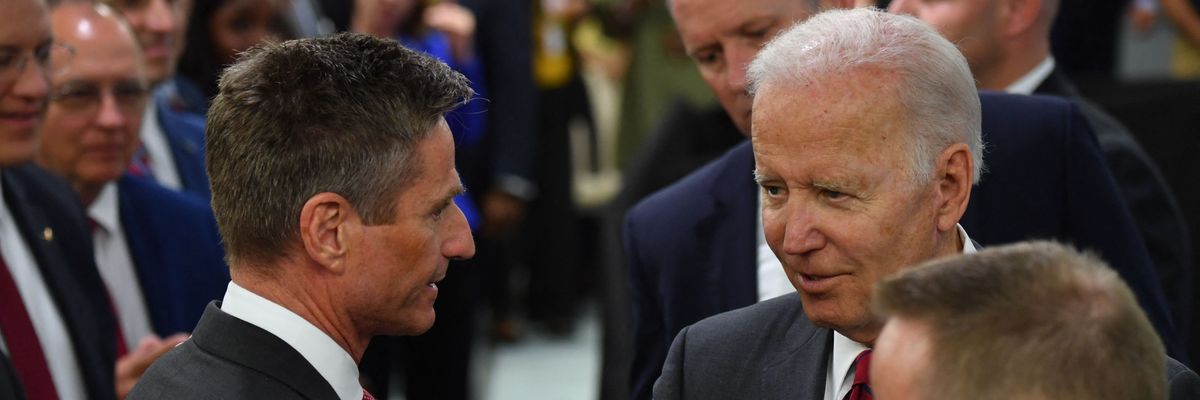
President Joe Biden talks with Lockheed Martin CEO Jim Taiclet on May 3, 2022.
The head of the major U.S. military contractor said the Pentagon top-line in the debt ceiling deal is "as good an outcome as our industry or our company could ask for at this point."
The head of the top weapons contractor in the United States said Thursday that he's happy with the debt ceiling agreement negotiated by the congressional Republicans and the Biden White House, a deal that proposes a military budget increase while imposing two years of caps on other discretionary federal spending—impacting funding for education, housing, and more.
James Taiclet, the CEO of Lockheed Martin, said at a conference that the bill now awaiting President Joe Biden's signature is "as good an outcome as our industry or our company could ask for at this point," noting that it calls for "3% growth for two years in defense where other areas of the budget are being reduced."
"I think we're in a real strong position at this point," said Taiclet, adding that "there's sufficient funding in the president's budget."
Biden's $886 billion military spending request for fiscal year 2024—a $28 billion increase over current levels—is the topline military budget number set by the debt ceiling legislation, though war hawks in both parties are already exploring ways to dump even more money into the Pentagon's overflowing coffers.
If finalized in the appropriations process, military outlays will account for close to 56% of the U.S. federal government's total discretionary spending in fiscal year 2024, Lindsay Koshgarian of the National Priorities Project noted Thursday.
"This represents a massive shift of resources away from domestic programs and toward the military: the already-gargantuan military budget will increase by $28 billion (3.3%), while domestic spending will take a cut of $63 billion (8.2%)," Koshgarian wrote. "Cuts to many domestic programs will need to go deeper, because domestic spending includes veterans' programs, which are protected from cuts in the current deal."
"The only reason there’s a budget deal at all right now is because House Republicans threatened to tank the economy by refusing to allow the U.S. to pay its bills unless they got cuts for programs they don't like," she added. "They succeeded, and as others have shown, the people to pay the price will be the poorest and most down on their luck. Worse, the current deal could set a new precedent for more of the same: unnecessary military increases while domestic programs are slashed."
Lockheed Martin, one of the contractors that has been price-gouging the Department of Defense for years, is poised to be one of the top beneficiaries of the larger Pentagon budget—much of which will likely wind up benefiting private companies.
As Responsible Statecraft's Eli Clifton reported Thursday, Lockheed "received 73 percent of its net sales from the U.S. government in 2022 and invested $13 million in lobbying the federal government."
"Their lobbyists heavily focus their efforts on the defense budget," Clifton added, citing OpenSecrets.
William Hartung, senior research fellow at Quincy Institute for Responsible Statecraft, said Friday that the newly passed debt limit deal "unnecessarily privileges the Pentagon over other essential programs."
"There's no reason to exclude the Pentagon from the budget freeze," he added. "Congress should push the current proposed military spending total of $886 billion back to FY2023 levels in the appropriations process that will play out over the course of this year."
Dear Common Dreams reader, It’s been nearly 30 years since I co-founded Common Dreams with my late wife, Lina Newhouser. We had the radical notion that journalism should serve the public good, not corporate profits. It was clear to us from the outset what it would take to build such a project. No paid advertisements. No corporate sponsors. No millionaire publisher telling us what to think or do. Many people said we wouldn't last a year, but we proved those doubters wrong. Together with a tremendous team of journalists and dedicated staff, we built an independent media outlet free from the constraints of profits and corporate control. Our mission has always been simple: To inform. To inspire. To ignite change for the common good. Building Common Dreams was not easy. Our survival was never guaranteed. When you take on the most powerful forces—Wall Street greed, fossil fuel industry destruction, Big Tech lobbyists, and uber-rich oligarchs who have spent billions upon billions rigging the economy and democracy in their favor—the only bulwark you have is supporters who believe in your work. But here’s the urgent message from me today. It's never been this bad out there. And it's never been this hard to keep us going. At the very moment Common Dreams is most needed, the threats we face are intensifying. We need your support now more than ever. We don't accept corporate advertising and never will. We don't have a paywall because we don't think people should be blocked from critical news based on their ability to pay. Everything we do is funded by the donations of readers like you. When everyone does the little they can afford, we are strong. But if that support retreats or dries up, so do we. Will you donate now to make sure Common Dreams not only survives but thrives? —Craig Brown, Co-founder |
The head of the top weapons contractor in the United States said Thursday that he's happy with the debt ceiling agreement negotiated by the congressional Republicans and the Biden White House, a deal that proposes a military budget increase while imposing two years of caps on other discretionary federal spending—impacting funding for education, housing, and more.
James Taiclet, the CEO of Lockheed Martin, said at a conference that the bill now awaiting President Joe Biden's signature is "as good an outcome as our industry or our company could ask for at this point," noting that it calls for "3% growth for two years in defense where other areas of the budget are being reduced."
"I think we're in a real strong position at this point," said Taiclet, adding that "there's sufficient funding in the president's budget."
Biden's $886 billion military spending request for fiscal year 2024—a $28 billion increase over current levels—is the topline military budget number set by the debt ceiling legislation, though war hawks in both parties are already exploring ways to dump even more money into the Pentagon's overflowing coffers.
If finalized in the appropriations process, military outlays will account for close to 56% of the U.S. federal government's total discretionary spending in fiscal year 2024, Lindsay Koshgarian of the National Priorities Project noted Thursday.
"This represents a massive shift of resources away from domestic programs and toward the military: the already-gargantuan military budget will increase by $28 billion (3.3%), while domestic spending will take a cut of $63 billion (8.2%)," Koshgarian wrote. "Cuts to many domestic programs will need to go deeper, because domestic spending includes veterans' programs, which are protected from cuts in the current deal."
"The only reason there’s a budget deal at all right now is because House Republicans threatened to tank the economy by refusing to allow the U.S. to pay its bills unless they got cuts for programs they don't like," she added. "They succeeded, and as others have shown, the people to pay the price will be the poorest and most down on their luck. Worse, the current deal could set a new precedent for more of the same: unnecessary military increases while domestic programs are slashed."
Lockheed Martin, one of the contractors that has been price-gouging the Department of Defense for years, is poised to be one of the top beneficiaries of the larger Pentagon budget—much of which will likely wind up benefiting private companies.
As Responsible Statecraft's Eli Clifton reported Thursday, Lockheed "received 73 percent of its net sales from the U.S. government in 2022 and invested $13 million in lobbying the federal government."
"Their lobbyists heavily focus their efforts on the defense budget," Clifton added, citing OpenSecrets.
William Hartung, senior research fellow at Quincy Institute for Responsible Statecraft, said Friday that the newly passed debt limit deal "unnecessarily privileges the Pentagon over other essential programs."
"There's no reason to exclude the Pentagon from the budget freeze," he added. "Congress should push the current proposed military spending total of $886 billion back to FY2023 levels in the appropriations process that will play out over the course of this year."
The head of the top weapons contractor in the United States said Thursday that he's happy with the debt ceiling agreement negotiated by the congressional Republicans and the Biden White House, a deal that proposes a military budget increase while imposing two years of caps on other discretionary federal spending—impacting funding for education, housing, and more.
James Taiclet, the CEO of Lockheed Martin, said at a conference that the bill now awaiting President Joe Biden's signature is "as good an outcome as our industry or our company could ask for at this point," noting that it calls for "3% growth for two years in defense where other areas of the budget are being reduced."
"I think we're in a real strong position at this point," said Taiclet, adding that "there's sufficient funding in the president's budget."
Biden's $886 billion military spending request for fiscal year 2024—a $28 billion increase over current levels—is the topline military budget number set by the debt ceiling legislation, though war hawks in both parties are already exploring ways to dump even more money into the Pentagon's overflowing coffers.
If finalized in the appropriations process, military outlays will account for close to 56% of the U.S. federal government's total discretionary spending in fiscal year 2024, Lindsay Koshgarian of the National Priorities Project noted Thursday.
"This represents a massive shift of resources away from domestic programs and toward the military: the already-gargantuan military budget will increase by $28 billion (3.3%), while domestic spending will take a cut of $63 billion (8.2%)," Koshgarian wrote. "Cuts to many domestic programs will need to go deeper, because domestic spending includes veterans' programs, which are protected from cuts in the current deal."
"The only reason there’s a budget deal at all right now is because House Republicans threatened to tank the economy by refusing to allow the U.S. to pay its bills unless they got cuts for programs they don't like," she added. "They succeeded, and as others have shown, the people to pay the price will be the poorest and most down on their luck. Worse, the current deal could set a new precedent for more of the same: unnecessary military increases while domestic programs are slashed."
Lockheed Martin, one of the contractors that has been price-gouging the Department of Defense for years, is poised to be one of the top beneficiaries of the larger Pentagon budget—much of which will likely wind up benefiting private companies.
As Responsible Statecraft's Eli Clifton reported Thursday, Lockheed "received 73 percent of its net sales from the U.S. government in 2022 and invested $13 million in lobbying the federal government."
"Their lobbyists heavily focus their efforts on the defense budget," Clifton added, citing OpenSecrets.
William Hartung, senior research fellow at Quincy Institute for Responsible Statecraft, said Friday that the newly passed debt limit deal "unnecessarily privileges the Pentagon over other essential programs."
"There's no reason to exclude the Pentagon from the budget freeze," he added. "Congress should push the current proposed military spending total of $886 billion back to FY2023 levels in the appropriations process that will play out over the course of this year."