SUBSCRIBE TO OUR FREE NEWSLETTER
Daily news & progressive opinion—funded by the people, not the corporations—delivered straight to your inbox.
5
#000000
#FFFFFF
To donate by check, phone, or other method, see our More Ways to Give page.
Daily news & progressive opinion—funded by the people, not the corporations—delivered straight to your inbox.
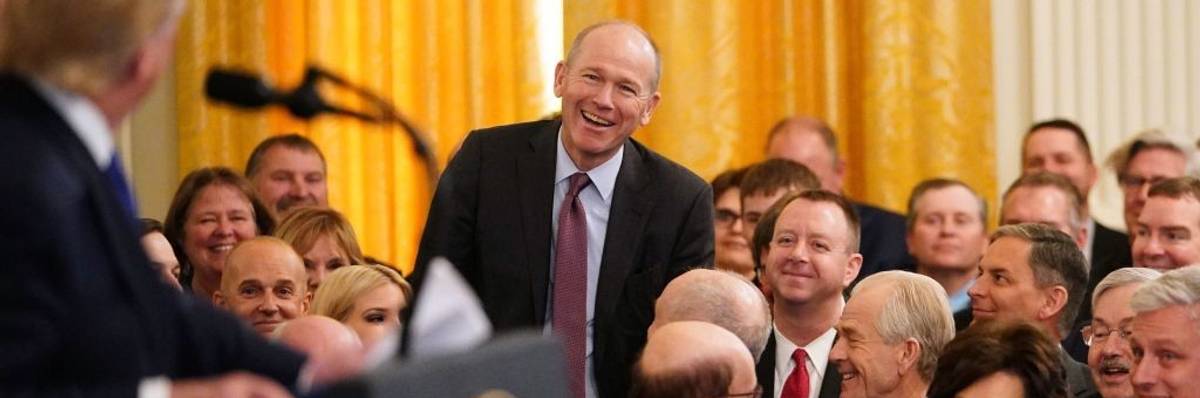
Boeing CEO Dave Calhoun is recognized during a ceremony to sign a trade agreement between the US and China in the East Room of the White House in Washington, DC, on January 15, 2020.
“Huge CEO compensation,” William Hartung observes, “does nothing to advance the defense of the United States and everything to enrich a small number of individuals.”
Does anyone have a sweeter deal than military contractor CEOs?
The United States spent more last year on defense than the next 10 nations combined. A deal just brokered by the White House and House Republicans increases that amount even further—to $886 billion. Defense contractors will pocket about half of that.
Just eight years ago, the national defense community made do with over $300 billion less. But making do with “less” doesn’t come easy to corporate titans like Dave Calhoun, the CEO at Boeing, the nation’s second-largest defense contractor.
In 2021, the most recent year with complete stats, the nation’s top five weapons makers—Lockheed Martin, Boeing, Raytheon, General Dynamics, and Northrop Grumman–grabbed over $116 billion in Pentagon contracts and paid their top executives $287 million.
In March, Boeing’s annual filings revealed that Calhoun had missed his CEO performance targets and would not be receiving a $7 million bonus. As a result, Calhoun had to be content with a mere $22.5 million in 2022—but to sweeten the deal, the Boeing board granted their CEO an extra stack of shares worth some $15 million at today’s value.
The Government Accountability Office may have had incidents just like that in mind when it urged the Pentagon to “comprehensively assess” its contract financing arrangements a few years ago.
This past April, the Department of Defense finally attempted to do it.
“In aggregate,” its report concludes, “the defense industry is financially healthy, and its financial health has improved over time.” But despite “increased profit and cash flow,” the DoD found, corporate contractors have chosen “to reduce the overall share of revenue” they spend on R&D.
Instead, they’re “significantly increasing the share of revenue paid to shareholders in cash dividends and share buybacks.” Those dividends and buybacks have jumped by an astounding 73%!
Contractor CEOs have been lining their pockets accordingly.
In 2021, the most recent year with complete stats, the nation’s top five weapons makers—Lockheed Martin, Boeing, Raytheon, General Dynamics, and Northrop Grumman–grabbed over $116 billion in Pentagon contracts and paid their top executives $287 million, Pentagon-watcher William Hartung noted this past December.
Taxpayers subsidize these more-than-ample paychecks. Corporate giants like Boeing and Raytheon depend on government contracts for about half the dollars they rake in. For Lockheed Martin, General Dynamics, and Northrop Grumman, it’s at least 70%.
“Huge CEO compensation,” Hartung observes, “does nothing to advance the defense of the United States and everything to enrich a small number of individuals.”
Even before Biden and Republicans agreed to increase spending, the National Priorities Project at the Institute for Policy Studies (IPS) calculated the “militarized portion” of the federal budget at 62% of all discretionary spending.
We have precious little to show for this enormous expenditure.
“The post-9/11 ‘war on terror,’ for example, has cost more than $8 trillion and contributed to a horrific death toll of 4.5 million people in affected regions,” the IPS report notes. “Meanwhile, a U.S. military budget that outpaces Russia’s by more than 10 to one has failed to prevent or end the Russian war in Ukraine.”
So what can we do? The IPS analysts advocate reducing the national military budget by at least $100 billion and reinvesting the savings in social programs.
Progressive members of Congress, meanwhile, have also been pushing for a major change in contracting standards. Rep. Jan Schakowsky’s (D-Ill.) “Patriotic Corporations Act” would give companies with smaller pay gaps between their CEOs and workers a leg up in the bidding for federal defense contracts.
Or we could go the FDR route. In the year after Pearl Harbor, President Franklin Delano Roosevelt issued an order limiting top corporate executive pay to $25,000 after taxes—a move Roosevelt said was needed “to correct gross inequities and to provide for greater equality in contributing to the war effort.”
By the war’s end, America’s wealthy were paying federal taxes on income over $200,000 at a 94% rate. That top rate hovered around 90% for the next two decades and helped give birth to the first mass middle class the world had ever seen.
Miracles can happen.
Dear Common Dreams reader, It’s been nearly 30 years since I co-founded Common Dreams with my late wife, Lina Newhouser. We had the radical notion that journalism should serve the public good, not corporate profits. It was clear to us from the outset what it would take to build such a project. No paid advertisements. No corporate sponsors. No millionaire publisher telling us what to think or do. Many people said we wouldn't last a year, but we proved those doubters wrong. Together with a tremendous team of journalists and dedicated staff, we built an independent media outlet free from the constraints of profits and corporate control. Our mission has always been simple: To inform. To inspire. To ignite change for the common good. Building Common Dreams was not easy. Our survival was never guaranteed. When you take on the most powerful forces—Wall Street greed, fossil fuel industry destruction, Big Tech lobbyists, and uber-rich oligarchs who have spent billions upon billions rigging the economy and democracy in their favor—the only bulwark you have is supporters who believe in your work. But here’s the urgent message from me today. It's never been this bad out there. And it's never been this hard to keep us going. At the very moment Common Dreams is most needed, the threats we face are intensifying. We need your support now more than ever. We don't accept corporate advertising and never will. We don't have a paywall because we don't think people should be blocked from critical news based on their ability to pay. Everything we do is funded by the donations of readers like you. When everyone does the little they can afford, we are strong. But if that support retreats or dries up, so do we. Will you donate now to make sure Common Dreams not only survives but thrives? —Craig Brown, Co-founder |
Does anyone have a sweeter deal than military contractor CEOs?
The United States spent more last year on defense than the next 10 nations combined. A deal just brokered by the White House and House Republicans increases that amount even further—to $886 billion. Defense contractors will pocket about half of that.
Just eight years ago, the national defense community made do with over $300 billion less. But making do with “less” doesn’t come easy to corporate titans like Dave Calhoun, the CEO at Boeing, the nation’s second-largest defense contractor.
In 2021, the most recent year with complete stats, the nation’s top five weapons makers—Lockheed Martin, Boeing, Raytheon, General Dynamics, and Northrop Grumman–grabbed over $116 billion in Pentagon contracts and paid their top executives $287 million.
In March, Boeing’s annual filings revealed that Calhoun had missed his CEO performance targets and would not be receiving a $7 million bonus. As a result, Calhoun had to be content with a mere $22.5 million in 2022—but to sweeten the deal, the Boeing board granted their CEO an extra stack of shares worth some $15 million at today’s value.
The Government Accountability Office may have had incidents just like that in mind when it urged the Pentagon to “comprehensively assess” its contract financing arrangements a few years ago.
This past April, the Department of Defense finally attempted to do it.
“In aggregate,” its report concludes, “the defense industry is financially healthy, and its financial health has improved over time.” But despite “increased profit and cash flow,” the DoD found, corporate contractors have chosen “to reduce the overall share of revenue” they spend on R&D.
Instead, they’re “significantly increasing the share of revenue paid to shareholders in cash dividends and share buybacks.” Those dividends and buybacks have jumped by an astounding 73%!
Contractor CEOs have been lining their pockets accordingly.
In 2021, the most recent year with complete stats, the nation’s top five weapons makers—Lockheed Martin, Boeing, Raytheon, General Dynamics, and Northrop Grumman–grabbed over $116 billion in Pentagon contracts and paid their top executives $287 million, Pentagon-watcher William Hartung noted this past December.
Taxpayers subsidize these more-than-ample paychecks. Corporate giants like Boeing and Raytheon depend on government contracts for about half the dollars they rake in. For Lockheed Martin, General Dynamics, and Northrop Grumman, it’s at least 70%.
“Huge CEO compensation,” Hartung observes, “does nothing to advance the defense of the United States and everything to enrich a small number of individuals.”
Even before Biden and Republicans agreed to increase spending, the National Priorities Project at the Institute for Policy Studies (IPS) calculated the “militarized portion” of the federal budget at 62% of all discretionary spending.
We have precious little to show for this enormous expenditure.
“The post-9/11 ‘war on terror,’ for example, has cost more than $8 trillion and contributed to a horrific death toll of 4.5 million people in affected regions,” the IPS report notes. “Meanwhile, a U.S. military budget that outpaces Russia’s by more than 10 to one has failed to prevent or end the Russian war in Ukraine.”
So what can we do? The IPS analysts advocate reducing the national military budget by at least $100 billion and reinvesting the savings in social programs.
Progressive members of Congress, meanwhile, have also been pushing for a major change in contracting standards. Rep. Jan Schakowsky’s (D-Ill.) “Patriotic Corporations Act” would give companies with smaller pay gaps between their CEOs and workers a leg up in the bidding for federal defense contracts.
Or we could go the FDR route. In the year after Pearl Harbor, President Franklin Delano Roosevelt issued an order limiting top corporate executive pay to $25,000 after taxes—a move Roosevelt said was needed “to correct gross inequities and to provide for greater equality in contributing to the war effort.”
By the war’s end, America’s wealthy were paying federal taxes on income over $200,000 at a 94% rate. That top rate hovered around 90% for the next two decades and helped give birth to the first mass middle class the world had ever seen.
Miracles can happen.
Does anyone have a sweeter deal than military contractor CEOs?
The United States spent more last year on defense than the next 10 nations combined. A deal just brokered by the White House and House Republicans increases that amount even further—to $886 billion. Defense contractors will pocket about half of that.
Just eight years ago, the national defense community made do with over $300 billion less. But making do with “less” doesn’t come easy to corporate titans like Dave Calhoun, the CEO at Boeing, the nation’s second-largest defense contractor.
In 2021, the most recent year with complete stats, the nation’s top five weapons makers—Lockheed Martin, Boeing, Raytheon, General Dynamics, and Northrop Grumman–grabbed over $116 billion in Pentagon contracts and paid their top executives $287 million.
In March, Boeing’s annual filings revealed that Calhoun had missed his CEO performance targets and would not be receiving a $7 million bonus. As a result, Calhoun had to be content with a mere $22.5 million in 2022—but to sweeten the deal, the Boeing board granted their CEO an extra stack of shares worth some $15 million at today’s value.
The Government Accountability Office may have had incidents just like that in mind when it urged the Pentagon to “comprehensively assess” its contract financing arrangements a few years ago.
This past April, the Department of Defense finally attempted to do it.
“In aggregate,” its report concludes, “the defense industry is financially healthy, and its financial health has improved over time.” But despite “increased profit and cash flow,” the DoD found, corporate contractors have chosen “to reduce the overall share of revenue” they spend on R&D.
Instead, they’re “significantly increasing the share of revenue paid to shareholders in cash dividends and share buybacks.” Those dividends and buybacks have jumped by an astounding 73%!
Contractor CEOs have been lining their pockets accordingly.
In 2021, the most recent year with complete stats, the nation’s top five weapons makers—Lockheed Martin, Boeing, Raytheon, General Dynamics, and Northrop Grumman–grabbed over $116 billion in Pentagon contracts and paid their top executives $287 million, Pentagon-watcher William Hartung noted this past December.
Taxpayers subsidize these more-than-ample paychecks. Corporate giants like Boeing and Raytheon depend on government contracts for about half the dollars they rake in. For Lockheed Martin, General Dynamics, and Northrop Grumman, it’s at least 70%.
“Huge CEO compensation,” Hartung observes, “does nothing to advance the defense of the United States and everything to enrich a small number of individuals.”
Even before Biden and Republicans agreed to increase spending, the National Priorities Project at the Institute for Policy Studies (IPS) calculated the “militarized portion” of the federal budget at 62% of all discretionary spending.
We have precious little to show for this enormous expenditure.
“The post-9/11 ‘war on terror,’ for example, has cost more than $8 trillion and contributed to a horrific death toll of 4.5 million people in affected regions,” the IPS report notes. “Meanwhile, a U.S. military budget that outpaces Russia’s by more than 10 to one has failed to prevent or end the Russian war in Ukraine.”
So what can we do? The IPS analysts advocate reducing the national military budget by at least $100 billion and reinvesting the savings in social programs.
Progressive members of Congress, meanwhile, have also been pushing for a major change in contracting standards. Rep. Jan Schakowsky’s (D-Ill.) “Patriotic Corporations Act” would give companies with smaller pay gaps between their CEOs and workers a leg up in the bidding for federal defense contracts.
Or we could go the FDR route. In the year after Pearl Harbor, President Franklin Delano Roosevelt issued an order limiting top corporate executive pay to $25,000 after taxes—a move Roosevelt said was needed “to correct gross inequities and to provide for greater equality in contributing to the war effort.”
By the war’s end, America’s wealthy were paying federal taxes on income over $200,000 at a 94% rate. That top rate hovered around 90% for the next two decades and helped give birth to the first mass middle class the world had ever seen.
Miracles can happen.