SUBSCRIBE TO OUR FREE NEWSLETTER
Daily news & progressive opinion—funded by the people, not the corporations—delivered straight to your inbox.
5
#000000
#FFFFFF
To donate by check, phone, or other method, see our More Ways to Give page.
Daily news & progressive opinion—funded by the people, not the corporations—delivered straight to your inbox.
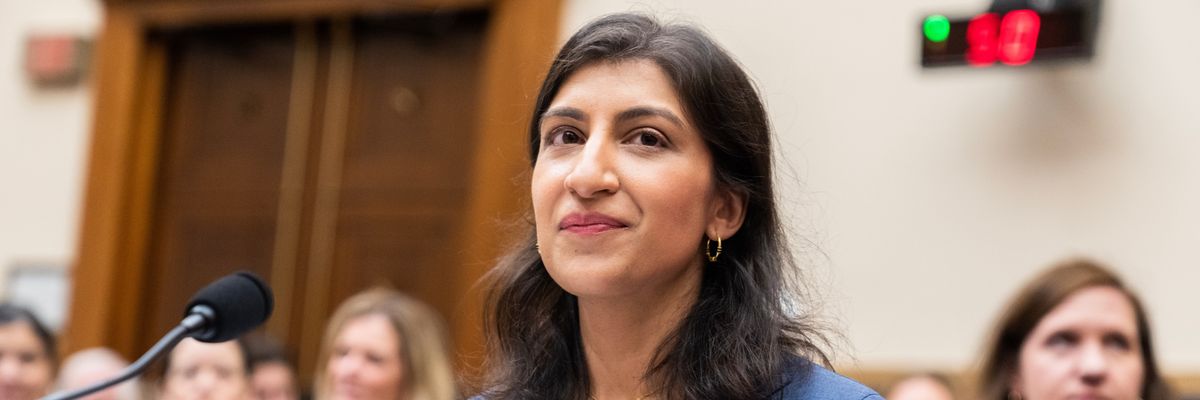
Financiers are reportedly lobbying the incumbent president to remove the Federal Trade Commission chair if he wins reelection in 2024.
Federal Trade Commission Chair Lina Khan's efforts to challenge corporate consolidation across the U.S. economy—from
gaming to pharmaceuticals to semiconductors—have drawn vocal outrage from industry-backed Republican lawmakers and other mouthpieces for big business.
And now, according to the Financial Times, some of the Democratic Party's Wall Street donors are privately calling on President Joe Biden to fire Khan if he wins reelection in 2024.
"Anybody talking to dealmakers over the past year or so will have noticed that barely anyone has been capable of hiding their loathing for Khan," wrote FT's James Fontanella-Khan. "In private, financiers accuse her of being anti-American and against business. Several Wall Street donors to the Democratic Party are using their position of influence to quietly lobby Biden to drop Khan if he gets reelected, according to people briefed on the matter. That's how badly they want her out of the FTC."
Wall Street spent over $74 million in support of Biden in 2020 and industry executives—at the urging of the president's team—have hosted fundraisers this year for his reelection campaign.
Under Khan's leadership, the FTC has taken legal action against several prominent merger proposals—including Microsoft's $69 billion deal to acquire Activision Blizzard, a case the agency paused after recent court defeats. The FTC has also helped rewrite pro-consolidation merger guidelines that were established during the Reagan era, launched a probe into Big Tech's cloud computing businesses, and proposed a ban on exploitative non-compete agreements.
Additionally, as soon as this month, the FTC is
expected to file a major antitrust lawsuit against the online retail behemoth Amazon, which Khan has long argued is a monopoly.
The Khan-led FTC's proactive approach to taking on entrenched power that has worsened inequality and harmed workers has predictably angered corporate America and its GOP allies in Congress, who used a recent hearing to attack Khan as a "bully."
Some of the Republican Party's most outspoken critics of Khan are funded by Big Tech.
The Wall Street Journal's right-wing editorial board has also taken on a major role in fueling the outrage, running dozens of pieces this year attacking Khan's work.
FT's James Fontanella-Khan argued that the widespread "animus" toward Khan in corporate America "might indicate she is having an impact despite the setbacks."
"Khan has an egalitarian vision of competition law that seeks to improve the well-being of citizens beyond their roles as consumers," he added. "The Amazon case will be a big test."
Dear Common Dreams reader, It’s been nearly 30 years since I co-founded Common Dreams with my late wife, Lina Newhouser. We had the radical notion that journalism should serve the public good, not corporate profits. It was clear to us from the outset what it would take to build such a project. No paid advertisements. No corporate sponsors. No millionaire publisher telling us what to think or do. Many people said we wouldn't last a year, but we proved those doubters wrong. Together with a tremendous team of journalists and dedicated staff, we built an independent media outlet free from the constraints of profits and corporate control. Our mission has always been simple: To inform. To inspire. To ignite change for the common good. Building Common Dreams was not easy. Our survival was never guaranteed. When you take on the most powerful forces—Wall Street greed, fossil fuel industry destruction, Big Tech lobbyists, and uber-rich oligarchs who have spent billions upon billions rigging the economy and democracy in their favor—the only bulwark you have is supporters who believe in your work. But here’s the urgent message from me today. It's never been this bad out there. And it's never been this hard to keep us going. At the very moment Common Dreams is most needed, the threats we face are intensifying. We need your support now more than ever. We don't accept corporate advertising and never will. We don't have a paywall because we don't think people should be blocked from critical news based on their ability to pay. Everything we do is funded by the donations of readers like you. When everyone does the little they can afford, we are strong. But if that support retreats or dries up, so do we. Will you donate now to make sure Common Dreams not only survives but thrives? —Craig Brown, Co-founder |
Federal Trade Commission Chair Lina Khan's efforts to challenge corporate consolidation across the U.S. economy—from
gaming to pharmaceuticals to semiconductors—have drawn vocal outrage from industry-backed Republican lawmakers and other mouthpieces for big business.
And now, according to the Financial Times, some of the Democratic Party's Wall Street donors are privately calling on President Joe Biden to fire Khan if he wins reelection in 2024.
"Anybody talking to dealmakers over the past year or so will have noticed that barely anyone has been capable of hiding their loathing for Khan," wrote FT's James Fontanella-Khan. "In private, financiers accuse her of being anti-American and against business. Several Wall Street donors to the Democratic Party are using their position of influence to quietly lobby Biden to drop Khan if he gets reelected, according to people briefed on the matter. That's how badly they want her out of the FTC."
Wall Street spent over $74 million in support of Biden in 2020 and industry executives—at the urging of the president's team—have hosted fundraisers this year for his reelection campaign.
Under Khan's leadership, the FTC has taken legal action against several prominent merger proposals—including Microsoft's $69 billion deal to acquire Activision Blizzard, a case the agency paused after recent court defeats. The FTC has also helped rewrite pro-consolidation merger guidelines that were established during the Reagan era, launched a probe into Big Tech's cloud computing businesses, and proposed a ban on exploitative non-compete agreements.
Additionally, as soon as this month, the FTC is
expected to file a major antitrust lawsuit against the online retail behemoth Amazon, which Khan has long argued is a monopoly.
The Khan-led FTC's proactive approach to taking on entrenched power that has worsened inequality and harmed workers has predictably angered corporate America and its GOP allies in Congress, who used a recent hearing to attack Khan as a "bully."
Some of the Republican Party's most outspoken critics of Khan are funded by Big Tech.
The Wall Street Journal's right-wing editorial board has also taken on a major role in fueling the outrage, running dozens of pieces this year attacking Khan's work.
FT's James Fontanella-Khan argued that the widespread "animus" toward Khan in corporate America "might indicate she is having an impact despite the setbacks."
"Khan has an egalitarian vision of competition law that seeks to improve the well-being of citizens beyond their roles as consumers," he added. "The Amazon case will be a big test."
Federal Trade Commission Chair Lina Khan's efforts to challenge corporate consolidation across the U.S. economy—from
gaming to pharmaceuticals to semiconductors—have drawn vocal outrage from industry-backed Republican lawmakers and other mouthpieces for big business.
And now, according to the Financial Times, some of the Democratic Party's Wall Street donors are privately calling on President Joe Biden to fire Khan if he wins reelection in 2024.
"Anybody talking to dealmakers over the past year or so will have noticed that barely anyone has been capable of hiding their loathing for Khan," wrote FT's James Fontanella-Khan. "In private, financiers accuse her of being anti-American and against business. Several Wall Street donors to the Democratic Party are using their position of influence to quietly lobby Biden to drop Khan if he gets reelected, according to people briefed on the matter. That's how badly they want her out of the FTC."
Wall Street spent over $74 million in support of Biden in 2020 and industry executives—at the urging of the president's team—have hosted fundraisers this year for his reelection campaign.
Under Khan's leadership, the FTC has taken legal action against several prominent merger proposals—including Microsoft's $69 billion deal to acquire Activision Blizzard, a case the agency paused after recent court defeats. The FTC has also helped rewrite pro-consolidation merger guidelines that were established during the Reagan era, launched a probe into Big Tech's cloud computing businesses, and proposed a ban on exploitative non-compete agreements.
Additionally, as soon as this month, the FTC is
expected to file a major antitrust lawsuit against the online retail behemoth Amazon, which Khan has long argued is a monopoly.
The Khan-led FTC's proactive approach to taking on entrenched power that has worsened inequality and harmed workers has predictably angered corporate America and its GOP allies in Congress, who used a recent hearing to attack Khan as a "bully."
Some of the Republican Party's most outspoken critics of Khan are funded by Big Tech.
The Wall Street Journal's right-wing editorial board has also taken on a major role in fueling the outrage, running dozens of pieces this year attacking Khan's work.
FT's James Fontanella-Khan argued that the widespread "animus" toward Khan in corporate America "might indicate she is having an impact despite the setbacks."
"Khan has an egalitarian vision of competition law that seeks to improve the well-being of citizens beyond their roles as consumers," he added. "The Amazon case will be a big test."