SUBSCRIBE TO OUR FREE NEWSLETTER
Daily news & progressive opinion—funded by the people, not the corporations—delivered straight to your inbox.
5
#000000
#FFFFFF
To donate by check, phone, or other method, see our More Ways to Give page.
Daily news & progressive opinion—funded by the people, not the corporations—delivered straight to your inbox.
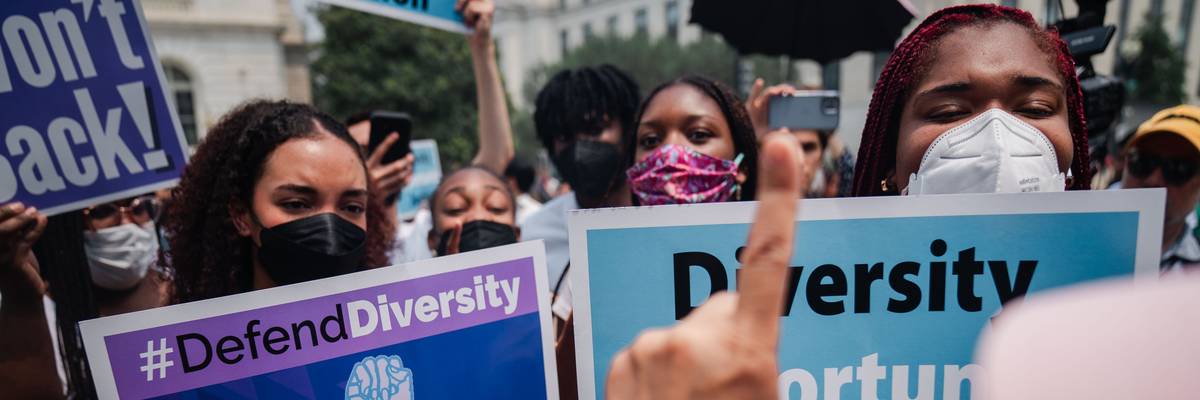
Affirmative action supporters and counterprotestors shout at each outside of the U.S. Supreme Court, which just struck down race-based preferences in college admissions, on June 29, 2023 in Washington, D.C.
Rep. Jamaal Bowman said this means "promoting equitable access to higher education for our Black and Brown students" via policies including ending legacy admissions and expanding the Supreme Court by passing the Judiciary Act.
In the wake of Thursday's annihilation of affirmative action by the Supreme Court's right-wing supermajority in a pair of highly anticipated rulings, progressive U.S. lawmakers and other advocates committed to "fighting back" by reforming higher education—and the judiciary itself.
Responding to the high court's 6-3 ruling in Students for Fair Admissions v. University of North Carolina (UNC) and 6-2 decision in Students for Fair Admissions v. President and Fellows of Harvard College—from which Justice Ketanji Brown Jackson recused herself—Rep. Jamaal Bowman (D-N.Y.) said that "the Supreme Court has yet again taken us back in time by barring institutions of higher education from using race-conscious admissions policies."
"These policies are critical to ensuring that our Black and Brown students, who have already experienced redlining and systemic underinvestment in their schools and communities, have an equitable shot at higher education to pursue their dreams," Bowman, a doctor of education, explained in a Twitter thread.
"Affirmative action is essential to racial and economic justice in education," Bowman continued. "We must commit to fighting back against this devastating decision and to promoting equitable access to higher education for our Black and Brown students."
"This means canceling student debt, ensuring everyone has access to free public college, and passing my Fair College Admissions for Students Act, which would end the legacy and donor-based admissions practices that favor the white and wealthy," he added.
In her scathing dissent in the North Carolina case, Jackson excoriated the majority for ruling "with let-them-eat-cake obliviousness" and imposing "'colorblindness for all' by legal fiat," a sentiment echoed in comments by Rep. Alexandria Ocasio-Cortez (D-N.Y.).
"If SCOTUS was serious about their ludicrous 'colorblindness' claims, they would have abolished legacy admissions, aka affirmative action for the privileged."
"If SCOTUS was serious about their ludicrous 'colorblindness' claims, they would have abolished legacy admissions, aka affirmative action for the privileged," she tweeted, noting that "70% of Harvard's legacy applicants are white."
"SCOTUS didn't touch that—which would have impacted them and their patrons," Ocasio-Cortez added.
Rep. Summer Lee went further, arguing the rulings were "designed to keep a generation of brilliant Black young people out of higher education and positions of power."
"The cruelty is the point," she added.
Helen Torres, CEO of the advocacy group Hispanos Organized for Political Equality (HOPE), issued a "call to action to all higher education institutions and policymakers to employ policies that ensure equal opportunity in higher education."
This, Torres said, includes "the elimination of standardized tests in admissions, ending legacy preferences, improving need-based financial aid, and strengthening transfer pathways."
Torres vowed to "remain steadfast in the pursuit of ensuring equal opportunity to a college education, regardless of a U.S. Supreme Court ruling to end the use of race-conscious admissions, knowing that addressing racial disparities remains both lawful and imperative to our nation."
In addition to educational reforms, many progressives also renewed calls to expand the Supreme Court from nine to 13 justices under the Judiciary Act, which House and Senate Democrats reintroduced last month.
"It's been nearly 50 years since Brown v. Board of Education made clear that education 'is a right which must be made available to all on equal terms.' Yet, today, the Supreme Court made it more difficult for students of color to achieve their educational dreams," Sen. Ed Markey (D-Mass.), the Judiciary Act's lead author, said in a Thursday afternoon press conference following the high court's decisions.
"The Supreme Court majority may think they are blind to race, but what they are truly blind to is inequality, blind to injustice, blind to progress," Markey argued.
"Equal opportunity for all is a bedrock, universal value in our country. We cannot allow this captured Supreme Court majority to turn back the clock on progress," he said.
"Congress must act," Markey added. "We must make sure we continue to hold the doors of opportunity open to all. We must give people the just and equal opportunity to achieve their educational dreams. We must expand the Supreme Court and return legitimacy and balance back to the same institution that rightly ruled that education—and justice—should be made available to all on equal terms."
Rep. Barbara Lee (D-Calif.), a candidate for U.S. Senate, also called for court reform.
The political action group Indivisible said Thursday's Supreme Court decisions "will undoubtedly make it even more difficult for students of color applying to colleges and universities to be accepted."
"Today's decision is yet another example of a rogue court's commitment to undermining and overruling its own civil rights precedents," the group continued. "Without any meaningful intervention, the radical right-wing majority will only continue to manipulate the rule of law to manufacture outcomes that make us a less inclusive and diverse society."
"It is well past time for Congress to acknowledge that this is a captured court and move swiftly to support and pass the Judiciary Act of 2023, and add four seats to the bench," Indivisible added.
"It is well past time for Congress to acknowledge that this is a captured court and move swiftly to support and pass the Judiciary Act of 2023."
The Working Families Party (WFP) asserted that "this ruling upholds white supremacy. It's an attack on racial justice."
"Someone needs to tell the court what equity is. Someone needs to tell the court that the myth of 'color blindness' or being 'race-neutral' means prioritizing whiteness and privilege," the progressive party continued.
"Everyone is not on equal footing in America, period," WFP added. "Pretending that we are means ensuring that communities of color are left behind and not given the same opportunities to thrive."
Congressional Progressive Caucus Chair Pramila Jayapal (D-Wash.) tweeted, "First, abortion rights, now affirmative action—this extreme SCOTUS continues to prove they are WAY out of touch with everyday Americans."
"It's time to restore balance to the bench," Jayapal added. "Expand SCOTUS now."
Dear Common Dreams reader, It’s been nearly 30 years since I co-founded Common Dreams with my late wife, Lina Newhouser. We had the radical notion that journalism should serve the public good, not corporate profits. It was clear to us from the outset what it would take to build such a project. No paid advertisements. No corporate sponsors. No millionaire publisher telling us what to think or do. Many people said we wouldn't last a year, but we proved those doubters wrong. Together with a tremendous team of journalists and dedicated staff, we built an independent media outlet free from the constraints of profits and corporate control. Our mission has always been simple: To inform. To inspire. To ignite change for the common good. Building Common Dreams was not easy. Our survival was never guaranteed. When you take on the most powerful forces—Wall Street greed, fossil fuel industry destruction, Big Tech lobbyists, and uber-rich oligarchs who have spent billions upon billions rigging the economy and democracy in their favor—the only bulwark you have is supporters who believe in your work. But here’s the urgent message from me today. It's never been this bad out there. And it's never been this hard to keep us going. At the very moment Common Dreams is most needed, the threats we face are intensifying. We need your support now more than ever. We don't accept corporate advertising and never will. We don't have a paywall because we don't think people should be blocked from critical news based on their ability to pay. Everything we do is funded by the donations of readers like you. When everyone does the little they can afford, we are strong. But if that support retreats or dries up, so do we. Will you donate now to make sure Common Dreams not only survives but thrives? —Craig Brown, Co-founder |
In the wake of Thursday's annihilation of affirmative action by the Supreme Court's right-wing supermajority in a pair of highly anticipated rulings, progressive U.S. lawmakers and other advocates committed to "fighting back" by reforming higher education—and the judiciary itself.
Responding to the high court's 6-3 ruling in Students for Fair Admissions v. University of North Carolina (UNC) and 6-2 decision in Students for Fair Admissions v. President and Fellows of Harvard College—from which Justice Ketanji Brown Jackson recused herself—Rep. Jamaal Bowman (D-N.Y.) said that "the Supreme Court has yet again taken us back in time by barring institutions of higher education from using race-conscious admissions policies."
"These policies are critical to ensuring that our Black and Brown students, who have already experienced redlining and systemic underinvestment in their schools and communities, have an equitable shot at higher education to pursue their dreams," Bowman, a doctor of education, explained in a Twitter thread.
"Affirmative action is essential to racial and economic justice in education," Bowman continued. "We must commit to fighting back against this devastating decision and to promoting equitable access to higher education for our Black and Brown students."
"This means canceling student debt, ensuring everyone has access to free public college, and passing my Fair College Admissions for Students Act, which would end the legacy and donor-based admissions practices that favor the white and wealthy," he added.
In her scathing dissent in the North Carolina case, Jackson excoriated the majority for ruling "with let-them-eat-cake obliviousness" and imposing "'colorblindness for all' by legal fiat," a sentiment echoed in comments by Rep. Alexandria Ocasio-Cortez (D-N.Y.).
"If SCOTUS was serious about their ludicrous 'colorblindness' claims, they would have abolished legacy admissions, aka affirmative action for the privileged."
"If SCOTUS was serious about their ludicrous 'colorblindness' claims, they would have abolished legacy admissions, aka affirmative action for the privileged," she tweeted, noting that "70% of Harvard's legacy applicants are white."
"SCOTUS didn't touch that—which would have impacted them and their patrons," Ocasio-Cortez added.
Rep. Summer Lee went further, arguing the rulings were "designed to keep a generation of brilliant Black young people out of higher education and positions of power."
"The cruelty is the point," she added.
Helen Torres, CEO of the advocacy group Hispanos Organized for Political Equality (HOPE), issued a "call to action to all higher education institutions and policymakers to employ policies that ensure equal opportunity in higher education."
This, Torres said, includes "the elimination of standardized tests in admissions, ending legacy preferences, improving need-based financial aid, and strengthening transfer pathways."
Torres vowed to "remain steadfast in the pursuit of ensuring equal opportunity to a college education, regardless of a U.S. Supreme Court ruling to end the use of race-conscious admissions, knowing that addressing racial disparities remains both lawful and imperative to our nation."
In addition to educational reforms, many progressives also renewed calls to expand the Supreme Court from nine to 13 justices under the Judiciary Act, which House and Senate Democrats reintroduced last month.
"It's been nearly 50 years since Brown v. Board of Education made clear that education 'is a right which must be made available to all on equal terms.' Yet, today, the Supreme Court made it more difficult for students of color to achieve their educational dreams," Sen. Ed Markey (D-Mass.), the Judiciary Act's lead author, said in a Thursday afternoon press conference following the high court's decisions.
"The Supreme Court majority may think they are blind to race, but what they are truly blind to is inequality, blind to injustice, blind to progress," Markey argued.
"Equal opportunity for all is a bedrock, universal value in our country. We cannot allow this captured Supreme Court majority to turn back the clock on progress," he said.
"Congress must act," Markey added. "We must make sure we continue to hold the doors of opportunity open to all. We must give people the just and equal opportunity to achieve their educational dreams. We must expand the Supreme Court and return legitimacy and balance back to the same institution that rightly ruled that education—and justice—should be made available to all on equal terms."
Rep. Barbara Lee (D-Calif.), a candidate for U.S. Senate, also called for court reform.
The political action group Indivisible said Thursday's Supreme Court decisions "will undoubtedly make it even more difficult for students of color applying to colleges and universities to be accepted."
"Today's decision is yet another example of a rogue court's commitment to undermining and overruling its own civil rights precedents," the group continued. "Without any meaningful intervention, the radical right-wing majority will only continue to manipulate the rule of law to manufacture outcomes that make us a less inclusive and diverse society."
"It is well past time for Congress to acknowledge that this is a captured court and move swiftly to support and pass the Judiciary Act of 2023, and add four seats to the bench," Indivisible added.
"It is well past time for Congress to acknowledge that this is a captured court and move swiftly to support and pass the Judiciary Act of 2023."
The Working Families Party (WFP) asserted that "this ruling upholds white supremacy. It's an attack on racial justice."
"Someone needs to tell the court what equity is. Someone needs to tell the court that the myth of 'color blindness' or being 'race-neutral' means prioritizing whiteness and privilege," the progressive party continued.
"Everyone is not on equal footing in America, period," WFP added. "Pretending that we are means ensuring that communities of color are left behind and not given the same opportunities to thrive."
Congressional Progressive Caucus Chair Pramila Jayapal (D-Wash.) tweeted, "First, abortion rights, now affirmative action—this extreme SCOTUS continues to prove they are WAY out of touch with everyday Americans."
"It's time to restore balance to the bench," Jayapal added. "Expand SCOTUS now."
In the wake of Thursday's annihilation of affirmative action by the Supreme Court's right-wing supermajority in a pair of highly anticipated rulings, progressive U.S. lawmakers and other advocates committed to "fighting back" by reforming higher education—and the judiciary itself.
Responding to the high court's 6-3 ruling in Students for Fair Admissions v. University of North Carolina (UNC) and 6-2 decision in Students for Fair Admissions v. President and Fellows of Harvard College—from which Justice Ketanji Brown Jackson recused herself—Rep. Jamaal Bowman (D-N.Y.) said that "the Supreme Court has yet again taken us back in time by barring institutions of higher education from using race-conscious admissions policies."
"These policies are critical to ensuring that our Black and Brown students, who have already experienced redlining and systemic underinvestment in their schools and communities, have an equitable shot at higher education to pursue their dreams," Bowman, a doctor of education, explained in a Twitter thread.
"Affirmative action is essential to racial and economic justice in education," Bowman continued. "We must commit to fighting back against this devastating decision and to promoting equitable access to higher education for our Black and Brown students."
"This means canceling student debt, ensuring everyone has access to free public college, and passing my Fair College Admissions for Students Act, which would end the legacy and donor-based admissions practices that favor the white and wealthy," he added.
In her scathing dissent in the North Carolina case, Jackson excoriated the majority for ruling "with let-them-eat-cake obliviousness" and imposing "'colorblindness for all' by legal fiat," a sentiment echoed in comments by Rep. Alexandria Ocasio-Cortez (D-N.Y.).
"If SCOTUS was serious about their ludicrous 'colorblindness' claims, they would have abolished legacy admissions, aka affirmative action for the privileged."
"If SCOTUS was serious about their ludicrous 'colorblindness' claims, they would have abolished legacy admissions, aka affirmative action for the privileged," she tweeted, noting that "70% of Harvard's legacy applicants are white."
"SCOTUS didn't touch that—which would have impacted them and their patrons," Ocasio-Cortez added.
Rep. Summer Lee went further, arguing the rulings were "designed to keep a generation of brilliant Black young people out of higher education and positions of power."
"The cruelty is the point," she added.
Helen Torres, CEO of the advocacy group Hispanos Organized for Political Equality (HOPE), issued a "call to action to all higher education institutions and policymakers to employ policies that ensure equal opportunity in higher education."
This, Torres said, includes "the elimination of standardized tests in admissions, ending legacy preferences, improving need-based financial aid, and strengthening transfer pathways."
Torres vowed to "remain steadfast in the pursuit of ensuring equal opportunity to a college education, regardless of a U.S. Supreme Court ruling to end the use of race-conscious admissions, knowing that addressing racial disparities remains both lawful and imperative to our nation."
In addition to educational reforms, many progressives also renewed calls to expand the Supreme Court from nine to 13 justices under the Judiciary Act, which House and Senate Democrats reintroduced last month.
"It's been nearly 50 years since Brown v. Board of Education made clear that education 'is a right which must be made available to all on equal terms.' Yet, today, the Supreme Court made it more difficult for students of color to achieve their educational dreams," Sen. Ed Markey (D-Mass.), the Judiciary Act's lead author, said in a Thursday afternoon press conference following the high court's decisions.
"The Supreme Court majority may think they are blind to race, but what they are truly blind to is inequality, blind to injustice, blind to progress," Markey argued.
"Equal opportunity for all is a bedrock, universal value in our country. We cannot allow this captured Supreme Court majority to turn back the clock on progress," he said.
"Congress must act," Markey added. "We must make sure we continue to hold the doors of opportunity open to all. We must give people the just and equal opportunity to achieve their educational dreams. We must expand the Supreme Court and return legitimacy and balance back to the same institution that rightly ruled that education—and justice—should be made available to all on equal terms."
Rep. Barbara Lee (D-Calif.), a candidate for U.S. Senate, also called for court reform.
The political action group Indivisible said Thursday's Supreme Court decisions "will undoubtedly make it even more difficult for students of color applying to colleges and universities to be accepted."
"Today's decision is yet another example of a rogue court's commitment to undermining and overruling its own civil rights precedents," the group continued. "Without any meaningful intervention, the radical right-wing majority will only continue to manipulate the rule of law to manufacture outcomes that make us a less inclusive and diverse society."
"It is well past time for Congress to acknowledge that this is a captured court and move swiftly to support and pass the Judiciary Act of 2023, and add four seats to the bench," Indivisible added.
"It is well past time for Congress to acknowledge that this is a captured court and move swiftly to support and pass the Judiciary Act of 2023."
The Working Families Party (WFP) asserted that "this ruling upholds white supremacy. It's an attack on racial justice."
"Someone needs to tell the court what equity is. Someone needs to tell the court that the myth of 'color blindness' or being 'race-neutral' means prioritizing whiteness and privilege," the progressive party continued.
"Everyone is not on equal footing in America, period," WFP added. "Pretending that we are means ensuring that communities of color are left behind and not given the same opportunities to thrive."
Congressional Progressive Caucus Chair Pramila Jayapal (D-Wash.) tweeted, "First, abortion rights, now affirmative action—this extreme SCOTUS continues to prove they are WAY out of touch with everyday Americans."
"It's time to restore balance to the bench," Jayapal added. "Expand SCOTUS now."