SUBSCRIBE TO OUR FREE NEWSLETTER
Daily news & progressive opinion—funded by the people, not the corporations—delivered straight to your inbox.
5
#000000
#FFFFFF
To donate by check, phone, or other method, see our More Ways to Give page.
Daily news & progressive opinion—funded by the people, not the corporations—delivered straight to your inbox.
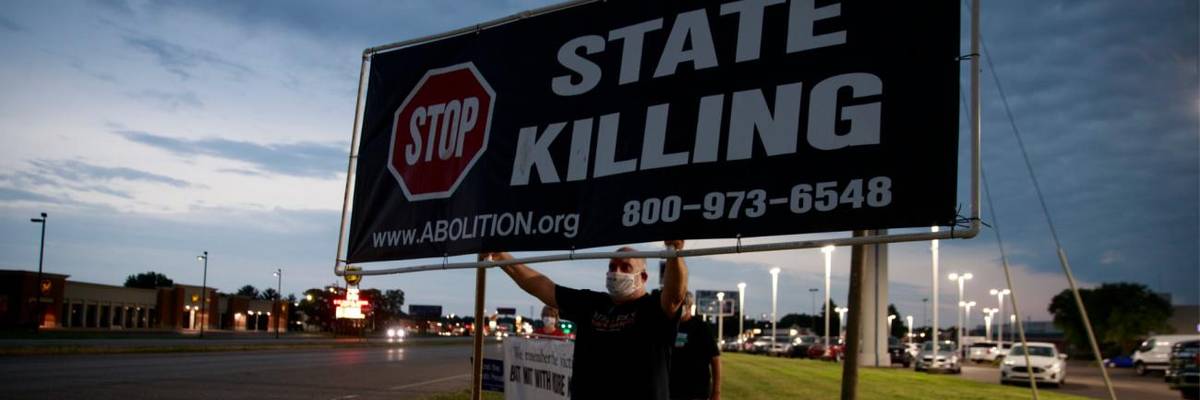
Abe Bonowitz of Death Penalty Action, an execution abolitionist group, protests near the Terre Haute Federal Correctional Complex in July 2015.
"There's no humane method of execution," said one human rights group.
The three liberal justices on the U.S. Supreme Court said the right-wing majority was allowing Alabama to use a death row inmate as a "guinea pig" early Friday when the court denied an emergency request to halt James Barber's execution, making him the first person killed by the state since Gov. Kay Ivey suspended capital punishment last year.
Barber, age 64, was pronounced dead just before 2:00 am local time on Friday at the William C. Holman Correctional Facility in Atmore, Alabama, less than two hours after the Supreme Court denied the stay of execution.
Lawyers for Barber, who was convicted of murdering 75-year-old Dorothy Epps in 2001, argued that the inmate's rights under the Eighth Amendment—which forbids cruel and unusual punishment—would be violated if he was put to death via lethal injection in Alabama, where several executions were botched before Ivey halted the death penalty and ordered a review.
The program was suspended following outcry over the executions of Doyle Lee Hamm, who was punctured with needles for two-and-a-half hours as executioners struggled to access a vein in 2018, and Joe Nathan James Jr., whose execution last year took more than three hours.
Two more executions last year were cancelled in the state after prison officials could not access veins.
The "top-to-bottom" review ordered by Ivey, a Republican, resulted in a change in the personnel who work in the death chamber at Holman and an extension of the time given for killing an inmate—neither of which "constitute[s] serious efforts to fix [Alabama's] pattern of botched execution after botched execution," said lawyers for Barber.
In a dissent authored by Justice Sonia Sotomayor and signed by Justices Elena Kagan and Ketanji Brown Jackson, the court's liberals said the Eighth Amendment "demands more than the state's word that this time will be different."
"The court should not allow Alabama to test the efficacy of its internal review by using Barber as its 'guinea pig'," wrote Sotomayor, adding that the conservative justices were allowing Ivey's government "to experiment again with human life."
The human rights organization Reprieve said the state "shouldn't be resuming executions, it should be ending them once and for all."
Judge Jill Pryor of the 11th Circuit Court of Appeals also accused the Alabama Department of Corrections (ADOC) of using Barber "as its guinea pig" in a dissent on Wednesday as the court handed down a 2-1 ruling allowing the state to execute the man.
Pryor noted that Ivey's review was "conducted entirely internally, entirely outside the scope of any court's or the public's scrutiny, and without saying what went wrong or what it fixed as a result."
"Three botched executions in a row are three too many," Pryor wrote. "Each time, ADOC has insisted that the courts should trust it to get it right, only to fail again."
"Mr. Barber has raised a serious and substantial Eighth Amendment claim that the pattern will continue to repeat itself," Pryor added.
The ACLU of Alabama pointed out that Barber was sentenced to death by a non-unanimous jury, a practice permitted only in Alabama and Florida.
"That alone should be reason to question his death sentence," said the group.
Barber was the 15th person executed in the U.S. this year, according to the Death Penalty Information Center.
Dear Common Dreams reader, It’s been nearly 30 years since I co-founded Common Dreams with my late wife, Lina Newhouser. We had the radical notion that journalism should serve the public good, not corporate profits. It was clear to us from the outset what it would take to build such a project. No paid advertisements. No corporate sponsors. No millionaire publisher telling us what to think or do. Many people said we wouldn't last a year, but we proved those doubters wrong. Together with a tremendous team of journalists and dedicated staff, we built an independent media outlet free from the constraints of profits and corporate control. Our mission has always been simple: To inform. To inspire. To ignite change for the common good. Building Common Dreams was not easy. Our survival was never guaranteed. When you take on the most powerful forces—Wall Street greed, fossil fuel industry destruction, Big Tech lobbyists, and uber-rich oligarchs who have spent billions upon billions rigging the economy and democracy in their favor—the only bulwark you have is supporters who believe in your work. But here’s the urgent message from me today. It's never been this bad out there. And it's never been this hard to keep us going. At the very moment Common Dreams is most needed, the threats we face are intensifying. We need your support now more than ever. We don't accept corporate advertising and never will. We don't have a paywall because we don't think people should be blocked from critical news based on their ability to pay. Everything we do is funded by the donations of readers like you. When everyone does the little they can afford, we are strong. But if that support retreats or dries up, so do we. Will you donate now to make sure Common Dreams not only survives but thrives? —Craig Brown, Co-founder |
The three liberal justices on the U.S. Supreme Court said the right-wing majority was allowing Alabama to use a death row inmate as a "guinea pig" early Friday when the court denied an emergency request to halt James Barber's execution, making him the first person killed by the state since Gov. Kay Ivey suspended capital punishment last year.
Barber, age 64, was pronounced dead just before 2:00 am local time on Friday at the William C. Holman Correctional Facility in Atmore, Alabama, less than two hours after the Supreme Court denied the stay of execution.
Lawyers for Barber, who was convicted of murdering 75-year-old Dorothy Epps in 2001, argued that the inmate's rights under the Eighth Amendment—which forbids cruel and unusual punishment—would be violated if he was put to death via lethal injection in Alabama, where several executions were botched before Ivey halted the death penalty and ordered a review.
The program was suspended following outcry over the executions of Doyle Lee Hamm, who was punctured with needles for two-and-a-half hours as executioners struggled to access a vein in 2018, and Joe Nathan James Jr., whose execution last year took more than three hours.
Two more executions last year were cancelled in the state after prison officials could not access veins.
The "top-to-bottom" review ordered by Ivey, a Republican, resulted in a change in the personnel who work in the death chamber at Holman and an extension of the time given for killing an inmate—neither of which "constitute[s] serious efforts to fix [Alabama's] pattern of botched execution after botched execution," said lawyers for Barber.
In a dissent authored by Justice Sonia Sotomayor and signed by Justices Elena Kagan and Ketanji Brown Jackson, the court's liberals said the Eighth Amendment "demands more than the state's word that this time will be different."
"The court should not allow Alabama to test the efficacy of its internal review by using Barber as its 'guinea pig'," wrote Sotomayor, adding that the conservative justices were allowing Ivey's government "to experiment again with human life."
The human rights organization Reprieve said the state "shouldn't be resuming executions, it should be ending them once and for all."
Judge Jill Pryor of the 11th Circuit Court of Appeals also accused the Alabama Department of Corrections (ADOC) of using Barber "as its guinea pig" in a dissent on Wednesday as the court handed down a 2-1 ruling allowing the state to execute the man.
Pryor noted that Ivey's review was "conducted entirely internally, entirely outside the scope of any court's or the public's scrutiny, and without saying what went wrong or what it fixed as a result."
"Three botched executions in a row are three too many," Pryor wrote. "Each time, ADOC has insisted that the courts should trust it to get it right, only to fail again."
"Mr. Barber has raised a serious and substantial Eighth Amendment claim that the pattern will continue to repeat itself," Pryor added.
The ACLU of Alabama pointed out that Barber was sentenced to death by a non-unanimous jury, a practice permitted only in Alabama and Florida.
"That alone should be reason to question his death sentence," said the group.
Barber was the 15th person executed in the U.S. this year, according to the Death Penalty Information Center.
The three liberal justices on the U.S. Supreme Court said the right-wing majority was allowing Alabama to use a death row inmate as a "guinea pig" early Friday when the court denied an emergency request to halt James Barber's execution, making him the first person killed by the state since Gov. Kay Ivey suspended capital punishment last year.
Barber, age 64, was pronounced dead just before 2:00 am local time on Friday at the William C. Holman Correctional Facility in Atmore, Alabama, less than two hours after the Supreme Court denied the stay of execution.
Lawyers for Barber, who was convicted of murdering 75-year-old Dorothy Epps in 2001, argued that the inmate's rights under the Eighth Amendment—which forbids cruel and unusual punishment—would be violated if he was put to death via lethal injection in Alabama, where several executions were botched before Ivey halted the death penalty and ordered a review.
The program was suspended following outcry over the executions of Doyle Lee Hamm, who was punctured with needles for two-and-a-half hours as executioners struggled to access a vein in 2018, and Joe Nathan James Jr., whose execution last year took more than three hours.
Two more executions last year were cancelled in the state after prison officials could not access veins.
The "top-to-bottom" review ordered by Ivey, a Republican, resulted in a change in the personnel who work in the death chamber at Holman and an extension of the time given for killing an inmate—neither of which "constitute[s] serious efforts to fix [Alabama's] pattern of botched execution after botched execution," said lawyers for Barber.
In a dissent authored by Justice Sonia Sotomayor and signed by Justices Elena Kagan and Ketanji Brown Jackson, the court's liberals said the Eighth Amendment "demands more than the state's word that this time will be different."
"The court should not allow Alabama to test the efficacy of its internal review by using Barber as its 'guinea pig'," wrote Sotomayor, adding that the conservative justices were allowing Ivey's government "to experiment again with human life."
The human rights organization Reprieve said the state "shouldn't be resuming executions, it should be ending them once and for all."
Judge Jill Pryor of the 11th Circuit Court of Appeals also accused the Alabama Department of Corrections (ADOC) of using Barber "as its guinea pig" in a dissent on Wednesday as the court handed down a 2-1 ruling allowing the state to execute the man.
Pryor noted that Ivey's review was "conducted entirely internally, entirely outside the scope of any court's or the public's scrutiny, and without saying what went wrong or what it fixed as a result."
"Three botched executions in a row are three too many," Pryor wrote. "Each time, ADOC has insisted that the courts should trust it to get it right, only to fail again."
"Mr. Barber has raised a serious and substantial Eighth Amendment claim that the pattern will continue to repeat itself," Pryor added.
The ACLU of Alabama pointed out that Barber was sentenced to death by a non-unanimous jury, a practice permitted only in Alabama and Florida.
"That alone should be reason to question his death sentence," said the group.
Barber was the 15th person executed in the U.S. this year, according to the Death Penalty Information Center.