

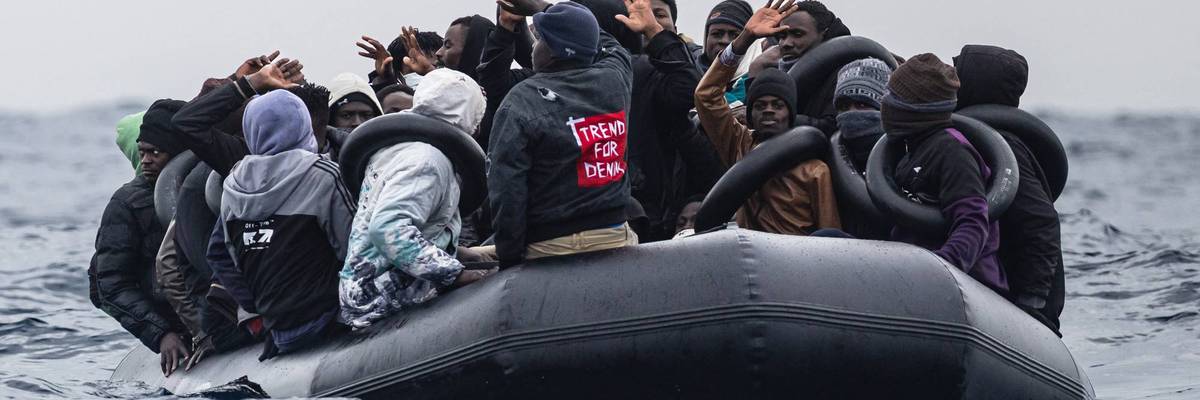
Migrants onboard a rubber boat wave and gesture as they wait to be rescued by crew members of the Ocean Viking in international waters of Libya, on January 16, 2026.
'A Global Failure': UN Says 7,667 People Died or Went Missing on Migration Routes in 2025
"These deaths are not inevitable," said the International Organization for Migration's leader. "When safe pathways are out of reach, people are forced into dangerous journeys and into the hands of smugglers and traffickers."
A United Nations organization announced Thursday that at least 7,667 people died or went missing on migration routes worldwide last year—or around 21 migrants per day—but "the real toll is likely higher."
"Sea crossings remained among the deadliest routes," according to the International Organization for Migration. IOM found that at least 2,185 people died or went missing in the Mediterranean Sea, and another 1,214 on the Western Africa/Atlantic route toward the Canary Islands.
Nearly two months into a new year, the trend in the Mediterranean has persisted. IOM pointed to the "unprecedented number of migrant deaths in the first two months of 2026, with 606 recorded" as of Tuesday.
"The continued loss of life on migration routes is a global failure we cannot accept as normal," said IOM Director General Amy Pope in a statement. "These deaths are not inevitable. When safe pathways are out of reach, people are forced into dangerous journeys and into the hands of smugglers and traffickers."
"We must act now to expand safe and regular routes, and ensure people in need can be reached and protected, regardless of their status," Pope asserted.
Despite such calls, the European Union has worked to curb migration to the continent with its Pact on Migration and Asylum—which has been condemned as a "bow to right-wing extremists and fascists," and is set to take effect next June—and the related "return regulation" that the Council of the EU finalized in December.
"The EU is legitimizing offshore prisons, racial profiling, and child detention in ways we have never seen," Sarah Chander, director at the Equinox Initiative for Racial Justice, said of the council's move last year. "Instead of finding ways to ensure safety and protection for everybody, the EU is pushing a punishment regime for migrants, which will help no one."
Reporting on the new IOM data, Politico noted Thursday:
The EU's priority now is "about bringing illegal arrivals to a minimum and keeping those numbers there," Migration Commissioner Magnus Brunner said when presenting the bloc's migration strategy in January.
That's "not as an end in itself," he said, but reduces pressure on EU countries, prevents abuse, reinforces people's trust in the EU, and helps save lives. "Any smuggling trip prevented is potentially a life which we save."
As a next step, the EU "must address migration along the whole route," including by ensuring protection for people in need "closer to the point of departure," Brunner said.
Meanwhile, in the Americas, US President Trump returned to power in early 2025, having campaigned on a promise of mass deportations. He's aimed to deliver on the pledge by deploying federal agents to various cities, where they have terrorized immigrants and citizens alike with civil rights violations and, in some cases, fatal shootings.
IOM only recorded 409 deaths in the Americas last year, the lowest annual total since its data collection began in 2014. The organization said that "this is likely due to fewer people taking dangerous irregular pathways, such as crossing the Darien Jungle or the US-Mexico border. However, lags in reporting from officials means that the figures for 2025 in the Americas likely will not be finalized until mid-2026."
The overall figure is also down, from nearly 9,200 in 2024. However, IOM explained that "the decline reflects fewer people attempting dangerous irregular migration routes, particularly in the Americas, but is also due to restricted access to information and funding constraints for humanitarian actors documenting migrant deaths on key routes."
IOM called for "urgent funding to strengthen data collection to better guide the humanitarian system in delivering lifesaving responses."
Reuters highlighted that "the Geneva‑based organization is among several aid groups hit by major US funding cuts, forcing it to scale back or close programs in ways it says will severely impact migrants."
We are at a crossroads
This country and this world are at a monumental crossroads. In a few short weeks, US voters will have an opportunity to beat back the forces of fascism and confront the billionaires who are rigging the economy, our media system, and our democracy, making it increasingly impossible for ordinary people to get by. We’re not just talking about the election. We’re talking about what must be done once these fascist elements are vanquished from power. We need a bolder set of solutions than what either major party has so far been willing to offer and a working-class movement ready to fight like hell for it. Trump didn't emerge from nowhere. The conditions that fueled MAGA authoritarianism were created by decades of radical neoliberal economic policies and a corrupt political system dominated by corporate interests. They slashed taxes on the super-rich, promising that the benefits would trickle down. They said giveaways to the corporate titans would make life more affordable for the rest of us. It was all bullshit. And when a bitter, betrayed populace searches for someone to blame, right-wing demagogues have little trouble finding scapegoats. People know when they're being lied to, but you won't hear any of this from the corporate media. Only independent journalism—powered and funded by people who believe in building a better world—can deliver truly trustworthy daily news. Our Fall Campaign is underway, and we need your help. To power our newsroom through the rest of the year, we need to raise $125,000 by midnight on October 31. So if you share our vision, please contribute whatever you can to sustain our work. |
A United Nations organization announced Thursday that at least 7,667 people died or went missing on migration routes worldwide last year—or around 21 migrants per day—but "the real toll is likely higher."
"Sea crossings remained among the deadliest routes," according to the International Organization for Migration. IOM found that at least 2,185 people died or went missing in the Mediterranean Sea, and another 1,214 on the Western Africa/Atlantic route toward the Canary Islands.
Nearly two months into a new year, the trend in the Mediterranean has persisted. IOM pointed to the "unprecedented number of migrant deaths in the first two months of 2026, with 606 recorded" as of Tuesday.
"The continued loss of life on migration routes is a global failure we cannot accept as normal," said IOM Director General Amy Pope in a statement. "These deaths are not inevitable. When safe pathways are out of reach, people are forced into dangerous journeys and into the hands of smugglers and traffickers."
"We must act now to expand safe and regular routes, and ensure people in need can be reached and protected, regardless of their status," Pope asserted.
Despite such calls, the European Union has worked to curb migration to the continent with its Pact on Migration and Asylum—which has been condemned as a "bow to right-wing extremists and fascists," and is set to take effect next June—and the related "return regulation" that the Council of the EU finalized in December.
"The EU is legitimizing offshore prisons, racial profiling, and child detention in ways we have never seen," Sarah Chander, director at the Equinox Initiative for Racial Justice, said of the council's move last year. "Instead of finding ways to ensure safety and protection for everybody, the EU is pushing a punishment regime for migrants, which will help no one."
Reporting on the new IOM data, Politico noted Thursday:
The EU's priority now is "about bringing illegal arrivals to a minimum and keeping those numbers there," Migration Commissioner Magnus Brunner said when presenting the bloc's migration strategy in January.
That's "not as an end in itself," he said, but reduces pressure on EU countries, prevents abuse, reinforces people's trust in the EU, and helps save lives. "Any smuggling trip prevented is potentially a life which we save."
As a next step, the EU "must address migration along the whole route," including by ensuring protection for people in need "closer to the point of departure," Brunner said.
Meanwhile, in the Americas, US President Trump returned to power in early 2025, having campaigned on a promise of mass deportations. He's aimed to deliver on the pledge by deploying federal agents to various cities, where they have terrorized immigrants and citizens alike with civil rights violations and, in some cases, fatal shootings.
IOM only recorded 409 deaths in the Americas last year, the lowest annual total since its data collection began in 2014. The organization said that "this is likely due to fewer people taking dangerous irregular pathways, such as crossing the Darien Jungle or the US-Mexico border. However, lags in reporting from officials means that the figures for 2025 in the Americas likely will not be finalized until mid-2026."
The overall figure is also down, from nearly 9,200 in 2024. However, IOM explained that "the decline reflects fewer people attempting dangerous irregular migration routes, particularly in the Americas, but is also due to restricted access to information and funding constraints for humanitarian actors documenting migrant deaths on key routes."
IOM called for "urgent funding to strengthen data collection to better guide the humanitarian system in delivering lifesaving responses."
Reuters highlighted that "the Geneva‑based organization is among several aid groups hit by major US funding cuts, forcing it to scale back or close programs in ways it says will severely impact migrants."
A United Nations organization announced Thursday that at least 7,667 people died or went missing on migration routes worldwide last year—or around 21 migrants per day—but "the real toll is likely higher."
"Sea crossings remained among the deadliest routes," according to the International Organization for Migration. IOM found that at least 2,185 people died or went missing in the Mediterranean Sea, and another 1,214 on the Western Africa/Atlantic route toward the Canary Islands.
Nearly two months into a new year, the trend in the Mediterranean has persisted. IOM pointed to the "unprecedented number of migrant deaths in the first two months of 2026, with 606 recorded" as of Tuesday.
"The continued loss of life on migration routes is a global failure we cannot accept as normal," said IOM Director General Amy Pope in a statement. "These deaths are not inevitable. When safe pathways are out of reach, people are forced into dangerous journeys and into the hands of smugglers and traffickers."
"We must act now to expand safe and regular routes, and ensure people in need can be reached and protected, regardless of their status," Pope asserted.
Despite such calls, the European Union has worked to curb migration to the continent with its Pact on Migration and Asylum—which has been condemned as a "bow to right-wing extremists and fascists," and is set to take effect next June—and the related "return regulation" that the Council of the EU finalized in December.
"The EU is legitimizing offshore prisons, racial profiling, and child detention in ways we have never seen," Sarah Chander, director at the Equinox Initiative for Racial Justice, said of the council's move last year. "Instead of finding ways to ensure safety and protection for everybody, the EU is pushing a punishment regime for migrants, which will help no one."
Reporting on the new IOM data, Politico noted Thursday:
The EU's priority now is "about bringing illegal arrivals to a minimum and keeping those numbers there," Migration Commissioner Magnus Brunner said when presenting the bloc's migration strategy in January.
That's "not as an end in itself," he said, but reduces pressure on EU countries, prevents abuse, reinforces people's trust in the EU, and helps save lives. "Any smuggling trip prevented is potentially a life which we save."
As a next step, the EU "must address migration along the whole route," including by ensuring protection for people in need "closer to the point of departure," Brunner said.
Meanwhile, in the Americas, US President Trump returned to power in early 2025, having campaigned on a promise of mass deportations. He's aimed to deliver on the pledge by deploying federal agents to various cities, where they have terrorized immigrants and citizens alike with civil rights violations and, in some cases, fatal shootings.
IOM only recorded 409 deaths in the Americas last year, the lowest annual total since its data collection began in 2014. The organization said that "this is likely due to fewer people taking dangerous irregular pathways, such as crossing the Darien Jungle or the US-Mexico border. However, lags in reporting from officials means that the figures for 2025 in the Americas likely will not be finalized until mid-2026."
The overall figure is also down, from nearly 9,200 in 2024. However, IOM explained that "the decline reflects fewer people attempting dangerous irregular migration routes, particularly in the Americas, but is also due to restricted access to information and funding constraints for humanitarian actors documenting migrant deaths on key routes."
IOM called for "urgent funding to strengthen data collection to better guide the humanitarian system in delivering lifesaving responses."
Reuters highlighted that "the Geneva‑based organization is among several aid groups hit by major US funding cuts, forcing it to scale back or close programs in ways it says will severely impact migrants."