SUBSCRIBE TO OUR FREE NEWSLETTER
Daily news & progressive opinion—funded by the people, not the corporations—delivered straight to your inbox.
5
#000000
#FFFFFF
To donate by check, phone, or other method, see our More Ways to Give page.
Daily news & progressive opinion—funded by the people, not the corporations—delivered straight to your inbox.
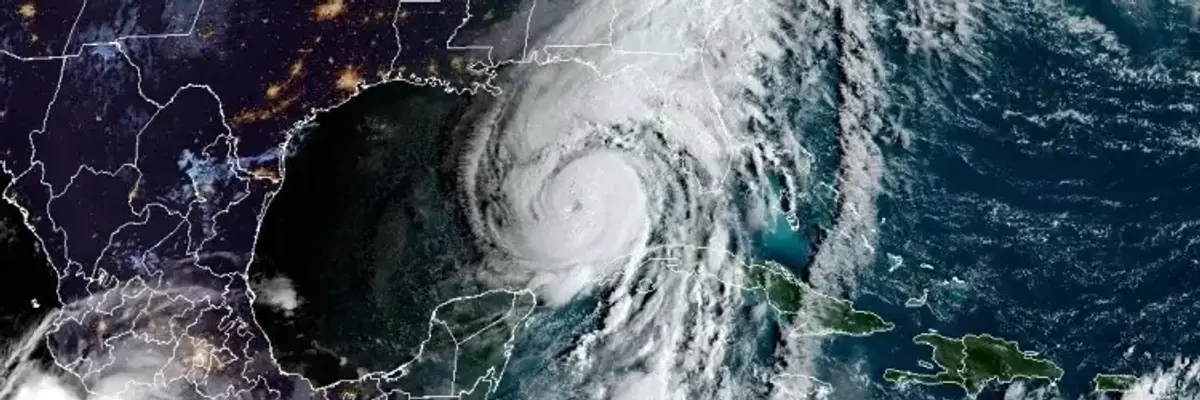
A National Oceanic and Atmospheric Administration satellite image from September 26, 2024 shows Hurricane Helene approaching the Florida coast.
Florida already has one of the nation's largest shares of homeowners "who don't have meaningful insurance."
Hurricane Helene continued barreling toward Florida on Thursday, highlighting the impacts of the fossil fuel-driven climate emergency, including difficulties securing insurance coverage in regions most affected by extreme weather.
"The Air Force Hurricane Hunters found that the maximum sustained winds have increased to near 120 mph," the National Hurricane Center said Thursday afternoon. "This makes Helene a dangerous Category 3 major hurricane. Additional strengthening is expected before Helene makes landfall in the Florida Big Bend this evening."
Federal Emergency Management Agency Administrator Deanne Criswell said during a White House briefing that forecasts suggest Helene will make a "dead-on hit to Tallahassee" and "this is going to be a multistate event with the potential for significant impacts from Florida all the way to Tennessee."
Although this Atlantic hurricane season hasn't yet been as intense as U.S. scientists expected, trends in extreme weather disasters have led some insurance companies to exit the Florida market in recent years. Farmers Insurance announced last year that it would stop covering property in the state, in an effort to "effectively manage risk exposure."
While the Insurance Information Institute, an industry trade group, said in May that "legislative reforms passed in 2022 and 2023 have created a pathway to a stable Florida market," reporting from this week shows that residents—who aren't ultrarich—are still struggling to get and keep coverage.
"Florida ranks sixth among states with the largest shares of homeowners who don't have meaningful insurance. About 18% of homeowners across the state—about 1 in 6—are without it," NBC News noted Wednesday. "Nearly 20% of Florida homeowners pay $4,000 or more a year for homeowners insurance—the largest share in the country, according to the Census Bureau."
According to The Palm Beach Post, the global reinsurance broker Gallagher Re said in a Wednesday analysis that "landfall in the Big Bend or Panhandle region of Florida as a major hurricane (Category 3, 4, or 5) has historically translated to insured losses in the low single-digit billions."
"But Helene is not a typical storm," the firm explained. "Given Helene's very large wind radius, this would still bring hurricane-force wind gusts and high storm surge to coastal areas in the heavily populated Tampa Bay area, tropical storm force winds across most of the Florida peninsula, Georgia, the Carolinas, Tennessee, and southern Appalachia."
Gallagher Re suggested that "Helene's private insurance market losses should be expected to land in the range" of $3 billion to $6 billion, but if the hurricane "unexpectedly" moves toward Tampa, it could be over $10 billion.
Florida isn't the only state facing insurance trouble thanks to climate chaos. Vox reported last year that "insuring property in California has been a dicey proposition," pointing to torrential rainfall that "caused as much as $1.5 billion in insured losses" and "the costliest wildfires in U.S. history, including the 2018 Camp Fire, which led to more than $10 billion in losses."
Amid the intertwined climate and insurance crises, scientists, campaigners, and homeowners have demanded policy action—and elevated criticism of right-wing attacks on crucial programs.
In a June blog post, Rachel Cleetus, policy director with the Union of Concerned Scientists' Climate and Energy program, wrote that "Congress and regulators need to ensure more transparency in the insurance market on how companies are evaluating risks as they make decisions about premiums. There also needs to be better information on what kinds of incentives companies are providing for adaptation measures that would help reduce risks."
"Alongside the necessary but ultimately bounded role of insurance in a warming world, public and private decision-makers must also shift investments away from business-as-usual maladaptive and risky choices to more resilient ones," Cleetus continued. "The nation must scale up resources for climate resilience and ensure they are reaching communities in a just and equitable way. Funding for safe, affordable, and climate-resilient housing must be expanded."
The Climate & Community Institute on Wednesday also shared recommendations in a new report—Shared Fates: A Housing Resilience Policy Vision for the Home Insurance Crisis—using case studies from California, Florida, and Minnesota.
"We propose the creation of Housing Resilience Agencies (HRAs), either by states or the federal government," the institute said. These agencies would:
"In order to confront the growing housing safety and affordability crisis, we need to understand our fates as shared," the institute added. "We must reimagine our home insurance system for it to reduce risk and provide equitable and fair protection."
Dear Common Dreams reader, It’s been nearly 30 years since I co-founded Common Dreams with my late wife, Lina Newhouser. We had the radical notion that journalism should serve the public good, not corporate profits. It was clear to us from the outset what it would take to build such a project. No paid advertisements. No corporate sponsors. No millionaire publisher telling us what to think or do. Many people said we wouldn't last a year, but we proved those doubters wrong. Together with a tremendous team of journalists and dedicated staff, we built an independent media outlet free from the constraints of profits and corporate control. Our mission has always been simple: To inform. To inspire. To ignite change for the common good. Building Common Dreams was not easy. Our survival was never guaranteed. When you take on the most powerful forces—Wall Street greed, fossil fuel industry destruction, Big Tech lobbyists, and uber-rich oligarchs who have spent billions upon billions rigging the economy and democracy in their favor—the only bulwark you have is supporters who believe in your work. But here’s the urgent message from me today. It's never been this bad out there. And it's never been this hard to keep us going. At the very moment Common Dreams is most needed, the threats we face are intensifying. We need your support now more than ever. We don't accept corporate advertising and never will. We don't have a paywall because we don't think people should be blocked from critical news based on their ability to pay. Everything we do is funded by the donations of readers like you. When everyone does the little they can afford, we are strong. But if that support retreats or dries up, so do we. Will you donate now to make sure Common Dreams not only survives but thrives? —Craig Brown, Co-founder |
Hurricane Helene continued barreling toward Florida on Thursday, highlighting the impacts of the fossil fuel-driven climate emergency, including difficulties securing insurance coverage in regions most affected by extreme weather.
"The Air Force Hurricane Hunters found that the maximum sustained winds have increased to near 120 mph," the National Hurricane Center said Thursday afternoon. "This makes Helene a dangerous Category 3 major hurricane. Additional strengthening is expected before Helene makes landfall in the Florida Big Bend this evening."
Federal Emergency Management Agency Administrator Deanne Criswell said during a White House briefing that forecasts suggest Helene will make a "dead-on hit to Tallahassee" and "this is going to be a multistate event with the potential for significant impacts from Florida all the way to Tennessee."
Although this Atlantic hurricane season hasn't yet been as intense as U.S. scientists expected, trends in extreme weather disasters have led some insurance companies to exit the Florida market in recent years. Farmers Insurance announced last year that it would stop covering property in the state, in an effort to "effectively manage risk exposure."
While the Insurance Information Institute, an industry trade group, said in May that "legislative reforms passed in 2022 and 2023 have created a pathway to a stable Florida market," reporting from this week shows that residents—who aren't ultrarich—are still struggling to get and keep coverage.
"Florida ranks sixth among states with the largest shares of homeowners who don't have meaningful insurance. About 18% of homeowners across the state—about 1 in 6—are without it," NBC News noted Wednesday. "Nearly 20% of Florida homeowners pay $4,000 or more a year for homeowners insurance—the largest share in the country, according to the Census Bureau."
According to The Palm Beach Post, the global reinsurance broker Gallagher Re said in a Wednesday analysis that "landfall in the Big Bend or Panhandle region of Florida as a major hurricane (Category 3, 4, or 5) has historically translated to insured losses in the low single-digit billions."
"But Helene is not a typical storm," the firm explained. "Given Helene's very large wind radius, this would still bring hurricane-force wind gusts and high storm surge to coastal areas in the heavily populated Tampa Bay area, tropical storm force winds across most of the Florida peninsula, Georgia, the Carolinas, Tennessee, and southern Appalachia."
Gallagher Re suggested that "Helene's private insurance market losses should be expected to land in the range" of $3 billion to $6 billion, but if the hurricane "unexpectedly" moves toward Tampa, it could be over $10 billion.
Florida isn't the only state facing insurance trouble thanks to climate chaos. Vox reported last year that "insuring property in California has been a dicey proposition," pointing to torrential rainfall that "caused as much as $1.5 billion in insured losses" and "the costliest wildfires in U.S. history, including the 2018 Camp Fire, which led to more than $10 billion in losses."
Amid the intertwined climate and insurance crises, scientists, campaigners, and homeowners have demanded policy action—and elevated criticism of right-wing attacks on crucial programs.
In a June blog post, Rachel Cleetus, policy director with the Union of Concerned Scientists' Climate and Energy program, wrote that "Congress and regulators need to ensure more transparency in the insurance market on how companies are evaluating risks as they make decisions about premiums. There also needs to be better information on what kinds of incentives companies are providing for adaptation measures that would help reduce risks."
"Alongside the necessary but ultimately bounded role of insurance in a warming world, public and private decision-makers must also shift investments away from business-as-usual maladaptive and risky choices to more resilient ones," Cleetus continued. "The nation must scale up resources for climate resilience and ensure they are reaching communities in a just and equitable way. Funding for safe, affordable, and climate-resilient housing must be expanded."
The Climate & Community Institute on Wednesday also shared recommendations in a new report—Shared Fates: A Housing Resilience Policy Vision for the Home Insurance Crisis—using case studies from California, Florida, and Minnesota.
"We propose the creation of Housing Resilience Agencies (HRAs), either by states or the federal government," the institute said. These agencies would:
"In order to confront the growing housing safety and affordability crisis, we need to understand our fates as shared," the institute added. "We must reimagine our home insurance system for it to reduce risk and provide equitable and fair protection."
Hurricane Helene continued barreling toward Florida on Thursday, highlighting the impacts of the fossil fuel-driven climate emergency, including difficulties securing insurance coverage in regions most affected by extreme weather.
"The Air Force Hurricane Hunters found that the maximum sustained winds have increased to near 120 mph," the National Hurricane Center said Thursday afternoon. "This makes Helene a dangerous Category 3 major hurricane. Additional strengthening is expected before Helene makes landfall in the Florida Big Bend this evening."
Federal Emergency Management Agency Administrator Deanne Criswell said during a White House briefing that forecasts suggest Helene will make a "dead-on hit to Tallahassee" and "this is going to be a multistate event with the potential for significant impacts from Florida all the way to Tennessee."
Although this Atlantic hurricane season hasn't yet been as intense as U.S. scientists expected, trends in extreme weather disasters have led some insurance companies to exit the Florida market in recent years. Farmers Insurance announced last year that it would stop covering property in the state, in an effort to "effectively manage risk exposure."
While the Insurance Information Institute, an industry trade group, said in May that "legislative reforms passed in 2022 and 2023 have created a pathway to a stable Florida market," reporting from this week shows that residents—who aren't ultrarich—are still struggling to get and keep coverage.
"Florida ranks sixth among states with the largest shares of homeowners who don't have meaningful insurance. About 18% of homeowners across the state—about 1 in 6—are without it," NBC News noted Wednesday. "Nearly 20% of Florida homeowners pay $4,000 or more a year for homeowners insurance—the largest share in the country, according to the Census Bureau."
According to The Palm Beach Post, the global reinsurance broker Gallagher Re said in a Wednesday analysis that "landfall in the Big Bend or Panhandle region of Florida as a major hurricane (Category 3, 4, or 5) has historically translated to insured losses in the low single-digit billions."
"But Helene is not a typical storm," the firm explained. "Given Helene's very large wind radius, this would still bring hurricane-force wind gusts and high storm surge to coastal areas in the heavily populated Tampa Bay area, tropical storm force winds across most of the Florida peninsula, Georgia, the Carolinas, Tennessee, and southern Appalachia."
Gallagher Re suggested that "Helene's private insurance market losses should be expected to land in the range" of $3 billion to $6 billion, but if the hurricane "unexpectedly" moves toward Tampa, it could be over $10 billion.
Florida isn't the only state facing insurance trouble thanks to climate chaos. Vox reported last year that "insuring property in California has been a dicey proposition," pointing to torrential rainfall that "caused as much as $1.5 billion in insured losses" and "the costliest wildfires in U.S. history, including the 2018 Camp Fire, which led to more than $10 billion in losses."
Amid the intertwined climate and insurance crises, scientists, campaigners, and homeowners have demanded policy action—and elevated criticism of right-wing attacks on crucial programs.
In a June blog post, Rachel Cleetus, policy director with the Union of Concerned Scientists' Climate and Energy program, wrote that "Congress and regulators need to ensure more transparency in the insurance market on how companies are evaluating risks as they make decisions about premiums. There also needs to be better information on what kinds of incentives companies are providing for adaptation measures that would help reduce risks."
"Alongside the necessary but ultimately bounded role of insurance in a warming world, public and private decision-makers must also shift investments away from business-as-usual maladaptive and risky choices to more resilient ones," Cleetus continued. "The nation must scale up resources for climate resilience and ensure they are reaching communities in a just and equitable way. Funding for safe, affordable, and climate-resilient housing must be expanded."
The Climate & Community Institute on Wednesday also shared recommendations in a new report—Shared Fates: A Housing Resilience Policy Vision for the Home Insurance Crisis—using case studies from California, Florida, and Minnesota.
"We propose the creation of Housing Resilience Agencies (HRAs), either by states or the federal government," the institute said. These agencies would:
"In order to confront the growing housing safety and affordability crisis, we need to understand our fates as shared," the institute added. "We must reimagine our home insurance system for it to reduce risk and provide equitable and fair protection."