SUBSCRIBE TO OUR FREE NEWSLETTER
Daily news & progressive opinion—funded by the people, not the corporations—delivered straight to your inbox.
5
#000000
#FFFFFF
To donate by check, phone, or other method, see our More Ways to Give page.
Daily news & progressive opinion—funded by the people, not the corporations—delivered straight to your inbox.
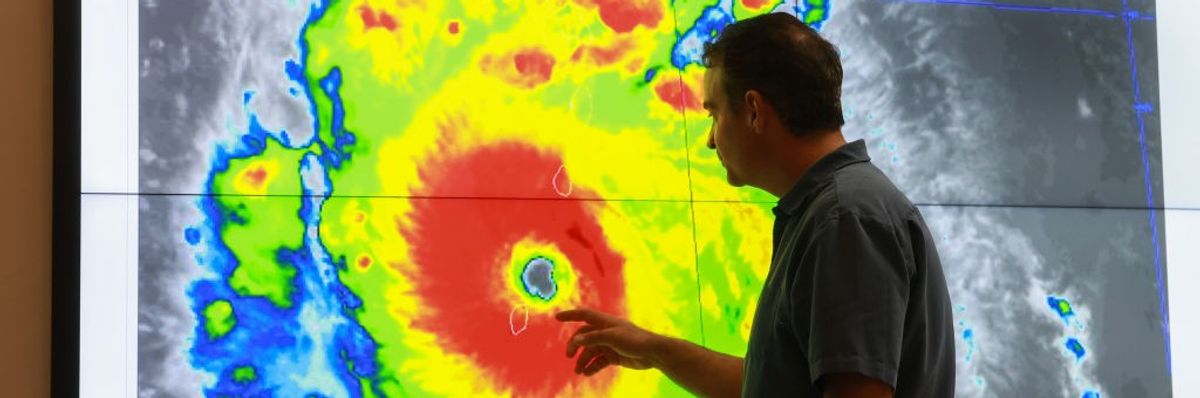
John Cangialosi, senior hurricane specialist at the National Hurricane Center, inspects a satellite image of Hurricane Beryl on July 1, 2024 in Miami, Florida.
"Beryl isn't 'unbelievable,'" one expert said. "it's what happens when you heat up the planet with fossil fuel pollution for decades."
As Hurricane Beryl barreled toward Jamaica on Tuesday after killing at least four people in the Caribbean's Windward Islands, climate scientists warned the record-breaking Category 5 storm is a present-tense example of what's to come on a rapidly heating planet.
Even before the Atlantic hurricane season began on June 1, the U.S. National Oceanic and Atmospheric Administration predicted an 85% chance of above-normal activity and 17-25 total named storms this year. Matthew Cappucci, a meteorologist for The Washington Post's Capital Weather Gang, highlighted some records Beryl has already broken.
"There is a strong, well-documented link between the effects of human-induced climate change and the development of stronger, wetter storms that are more prone to rapidly intensify," he wrote Tuesday. "Beryl sprung from a tropical depression to a Category 4 hurricane in just 48 hours, the fastest any storm on record has strengthened before the month of September."
Beryl is also the earliest Category 4 and 5 hurricane on record in the Atlantic, Cappucci pointed out. Previously, the earliest storm to reach the top level of the Saffir-Simpson Hurricane Wind Scale was Emily, in mid-July of 2005.
The Capital Weather Gang reported that Beryl "strengthened more Monday night, its peak winds climbing to 165 mph. It has surpassed Emily (2005) as strongest July hurricane on record. It's early July but Atlantic is acting like late August."
Certified consulting meteorologist Chris Gloninger emphasized that "the climate crisis has led to well-above-average ocean water temperatures and helped this storm explode."
As Stefan Rahmstorf of the Potsdam Institute for Climate Impact Research and Potsdam University explained: "The heat in the upper ocean is the energy source for tropical cyclones. This heat is at record level, mainly caused by emissions from burning fossil fuel. That's why an extreme hurricane season has been predicted for this year. It's off to a bad start!"
Colorado State University meteorologist Philip Klotzbach on Monday shared graphics showing that "Caribbean ocean heat content today is normally what we get in the middle of September."
While some expressed disbelief over the storm, CNN extreme weather editor Eric Zerkel stressed that "Beryl isn't 'unbelievable' or 'defying all logic,' it's what happens when you heat up the planet with fossil fuel pollution for decades. The oceans store roughly 90% of that excess heat. The ocean is as warm as it typically is... when Category 4 storms form. June is now August."
Acknowledging Beryl's strength, Steve Bowen, a meteorologist who serves as chief science officer at the global reinsurance firm Gallagher Re, concluded that "this is a massive warning sign for the rest of the season."
Looking beyond this hurricane season, which ends in November, University of Hawaii at Mānoa professor and [C]Worthy co-founder David Ho said, "Let's remember that things are just going to get [worse] as we continue to consume nearly 100 million barrels of oil every day."
The "historic" storm is sparking calls for action to phase out fossil fuels across the globe. Noting how Beryl "is breaking records and leaving a trail of destruction throughout the Caribbean," the U.S.-based Sunrise Movement argued that "we must prosecute Big Oil for their role in causing devastation like this."
In response to a climate scientist who shared a photo of some damage Beryl has already caused, Rahmstorf expressed hope that people around the world won't "wait with voting for climate stabilization until extremes hit their homes."
Beryl made landfall Monday as a Category 4 hurricane on Carriacou, a Grenada island, and also affected St. Vincent and Grenadines. According to The Associated Press, at least four people were killed.
The U.S. National Hurricane Center said Tuesday afternoon that on its current path, "the center of Beryl will move quickly across the central Caribbean Sea today and is forecast to pass near Jamaica on Wednesday and the Cayman Islands on Thursday. The center is forecast to approach the Yucatan Peninsula of Mexico on Thursday night."
Dear Common Dreams reader, It’s been nearly 30 years since I co-founded Common Dreams with my late wife, Lina Newhouser. We had the radical notion that journalism should serve the public good, not corporate profits. It was clear to us from the outset what it would take to build such a project. No paid advertisements. No corporate sponsors. No millionaire publisher telling us what to think or do. Many people said we wouldn't last a year, but we proved those doubters wrong. Together with a tremendous team of journalists and dedicated staff, we built an independent media outlet free from the constraints of profits and corporate control. Our mission has always been simple: To inform. To inspire. To ignite change for the common good. Building Common Dreams was not easy. Our survival was never guaranteed. When you take on the most powerful forces—Wall Street greed, fossil fuel industry destruction, Big Tech lobbyists, and uber-rich oligarchs who have spent billions upon billions rigging the economy and democracy in their favor—the only bulwark you have is supporters who believe in your work. But here’s the urgent message from me today. It's never been this bad out there. And it's never been this hard to keep us going. At the very moment Common Dreams is most needed, the threats we face are intensifying. We need your support now more than ever. We don't accept corporate advertising and never will. We don't have a paywall because we don't think people should be blocked from critical news based on their ability to pay. Everything we do is funded by the donations of readers like you. When everyone does the little they can afford, we are strong. But if that support retreats or dries up, so do we. Will you donate now to make sure Common Dreams not only survives but thrives? —Craig Brown, Co-founder |
As Hurricane Beryl barreled toward Jamaica on Tuesday after killing at least four people in the Caribbean's Windward Islands, climate scientists warned the record-breaking Category 5 storm is a present-tense example of what's to come on a rapidly heating planet.
Even before the Atlantic hurricane season began on June 1, the U.S. National Oceanic and Atmospheric Administration predicted an 85% chance of above-normal activity and 17-25 total named storms this year. Matthew Cappucci, a meteorologist for The Washington Post's Capital Weather Gang, highlighted some records Beryl has already broken.
"There is a strong, well-documented link between the effects of human-induced climate change and the development of stronger, wetter storms that are more prone to rapidly intensify," he wrote Tuesday. "Beryl sprung from a tropical depression to a Category 4 hurricane in just 48 hours, the fastest any storm on record has strengthened before the month of September."
Beryl is also the earliest Category 4 and 5 hurricane on record in the Atlantic, Cappucci pointed out. Previously, the earliest storm to reach the top level of the Saffir-Simpson Hurricane Wind Scale was Emily, in mid-July of 2005.
The Capital Weather Gang reported that Beryl "strengthened more Monday night, its peak winds climbing to 165 mph. It has surpassed Emily (2005) as strongest July hurricane on record. It's early July but Atlantic is acting like late August."
Certified consulting meteorologist Chris Gloninger emphasized that "the climate crisis has led to well-above-average ocean water temperatures and helped this storm explode."
As Stefan Rahmstorf of the Potsdam Institute for Climate Impact Research and Potsdam University explained: "The heat in the upper ocean is the energy source for tropical cyclones. This heat is at record level, mainly caused by emissions from burning fossil fuel. That's why an extreme hurricane season has been predicted for this year. It's off to a bad start!"
Colorado State University meteorologist Philip Klotzbach on Monday shared graphics showing that "Caribbean ocean heat content today is normally what we get in the middle of September."
While some expressed disbelief over the storm, CNN extreme weather editor Eric Zerkel stressed that "Beryl isn't 'unbelievable' or 'defying all logic,' it's what happens when you heat up the planet with fossil fuel pollution for decades. The oceans store roughly 90% of that excess heat. The ocean is as warm as it typically is... when Category 4 storms form. June is now August."
Acknowledging Beryl's strength, Steve Bowen, a meteorologist who serves as chief science officer at the global reinsurance firm Gallagher Re, concluded that "this is a massive warning sign for the rest of the season."
Looking beyond this hurricane season, which ends in November, University of Hawaii at Mānoa professor and [C]Worthy co-founder David Ho said, "Let's remember that things are just going to get [worse] as we continue to consume nearly 100 million barrels of oil every day."
The "historic" storm is sparking calls for action to phase out fossil fuels across the globe. Noting how Beryl "is breaking records and leaving a trail of destruction throughout the Caribbean," the U.S.-based Sunrise Movement argued that "we must prosecute Big Oil for their role in causing devastation like this."
In response to a climate scientist who shared a photo of some damage Beryl has already caused, Rahmstorf expressed hope that people around the world won't "wait with voting for climate stabilization until extremes hit their homes."
Beryl made landfall Monday as a Category 4 hurricane on Carriacou, a Grenada island, and also affected St. Vincent and Grenadines. According to The Associated Press, at least four people were killed.
The U.S. National Hurricane Center said Tuesday afternoon that on its current path, "the center of Beryl will move quickly across the central Caribbean Sea today and is forecast to pass near Jamaica on Wednesday and the Cayman Islands on Thursday. The center is forecast to approach the Yucatan Peninsula of Mexico on Thursday night."
As Hurricane Beryl barreled toward Jamaica on Tuesday after killing at least four people in the Caribbean's Windward Islands, climate scientists warned the record-breaking Category 5 storm is a present-tense example of what's to come on a rapidly heating planet.
Even before the Atlantic hurricane season began on June 1, the U.S. National Oceanic and Atmospheric Administration predicted an 85% chance of above-normal activity and 17-25 total named storms this year. Matthew Cappucci, a meteorologist for The Washington Post's Capital Weather Gang, highlighted some records Beryl has already broken.
"There is a strong, well-documented link between the effects of human-induced climate change and the development of stronger, wetter storms that are more prone to rapidly intensify," he wrote Tuesday. "Beryl sprung from a tropical depression to a Category 4 hurricane in just 48 hours, the fastest any storm on record has strengthened before the month of September."
Beryl is also the earliest Category 4 and 5 hurricane on record in the Atlantic, Cappucci pointed out. Previously, the earliest storm to reach the top level of the Saffir-Simpson Hurricane Wind Scale was Emily, in mid-July of 2005.
The Capital Weather Gang reported that Beryl "strengthened more Monday night, its peak winds climbing to 165 mph. It has surpassed Emily (2005) as strongest July hurricane on record. It's early July but Atlantic is acting like late August."
Certified consulting meteorologist Chris Gloninger emphasized that "the climate crisis has led to well-above-average ocean water temperatures and helped this storm explode."
As Stefan Rahmstorf of the Potsdam Institute for Climate Impact Research and Potsdam University explained: "The heat in the upper ocean is the energy source for tropical cyclones. This heat is at record level, mainly caused by emissions from burning fossil fuel. That's why an extreme hurricane season has been predicted for this year. It's off to a bad start!"
Colorado State University meteorologist Philip Klotzbach on Monday shared graphics showing that "Caribbean ocean heat content today is normally what we get in the middle of September."
While some expressed disbelief over the storm, CNN extreme weather editor Eric Zerkel stressed that "Beryl isn't 'unbelievable' or 'defying all logic,' it's what happens when you heat up the planet with fossil fuel pollution for decades. The oceans store roughly 90% of that excess heat. The ocean is as warm as it typically is... when Category 4 storms form. June is now August."
Acknowledging Beryl's strength, Steve Bowen, a meteorologist who serves as chief science officer at the global reinsurance firm Gallagher Re, concluded that "this is a massive warning sign for the rest of the season."
Looking beyond this hurricane season, which ends in November, University of Hawaii at Mānoa professor and [C]Worthy co-founder David Ho said, "Let's remember that things are just going to get [worse] as we continue to consume nearly 100 million barrels of oil every day."
The "historic" storm is sparking calls for action to phase out fossil fuels across the globe. Noting how Beryl "is breaking records and leaving a trail of destruction throughout the Caribbean," the U.S.-based Sunrise Movement argued that "we must prosecute Big Oil for their role in causing devastation like this."
In response to a climate scientist who shared a photo of some damage Beryl has already caused, Rahmstorf expressed hope that people around the world won't "wait with voting for climate stabilization until extremes hit their homes."
Beryl made landfall Monday as a Category 4 hurricane on Carriacou, a Grenada island, and also affected St. Vincent and Grenadines. According to The Associated Press, at least four people were killed.
The U.S. National Hurricane Center said Tuesday afternoon that on its current path, "the center of Beryl will move quickly across the central Caribbean Sea today and is forecast to pass near Jamaica on Wednesday and the Cayman Islands on Thursday. The center is forecast to approach the Yucatan Peninsula of Mexico on Thursday night."