SUBSCRIBE TO OUR FREE NEWSLETTER
Daily news & progressive opinion—funded by the people, not the corporations—delivered straight to your inbox.
5
#000000
#FFFFFF
To donate by check, phone, or other method, see our More Ways to Give page.
Daily news & progressive opinion—funded by the people, not the corporations—delivered straight to your inbox.
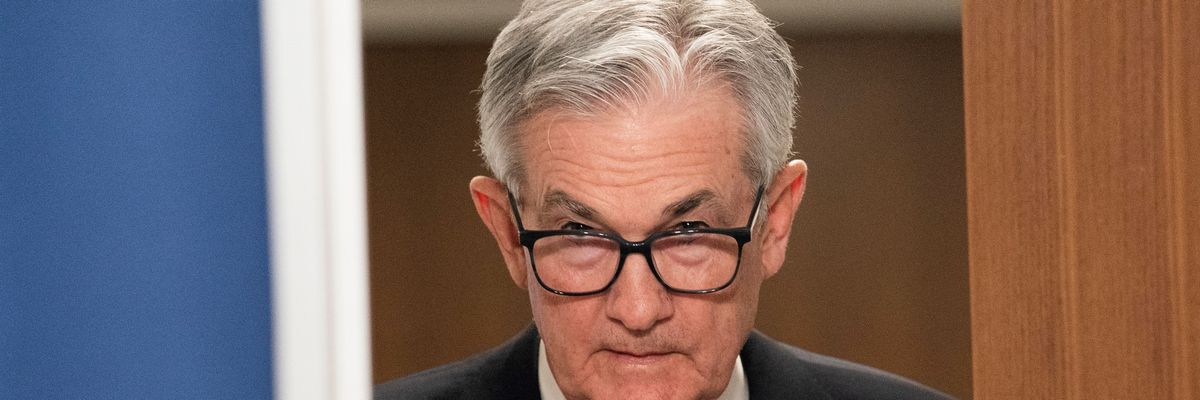
U.S. Federal Reserve Chair Jerome Powell attends a press conference in Washington, D.C. on May 3, 2023.
“The verdict is in: we don't have to choose between low prices and low unemployment. We can have both," said one economist.
Progressive economists on Wednesday welcomed newly released U.S. inflation data as further evidence that price increases can be brought under control without crushing the labor market and throwing millions out of work.
But they also warned that the still-strong job market could falter, with devastating consequences for workers, if the Federal Reserve keeps raising interest rates in the coming months.
"The verdict is in: We don't have to choose between low prices and low unemployment. We can have both," said the Groundwork Collaborative's Lindsay Owens after the Labor Department released new data showing that the Consumer Price Index (CPI) rose 4.9% in April compared with the previous year—a cooler figure than analysts expected.
"Today's inflation numbers show 10 straight months of falling inflation on the heels of a 53-year record low unemployment rate," Owens said, referring to last week's better-than-anticipated jobs report. "The only thing left to do now is to ensure that [Fed Chair Jerome] Powell doesn't screw it up with needless rate hikes that would accelerate instability in financial markets and jeopardize our strong labor market."
Heidi Shierholz, president of the Economic Policy Institute, called the new CPI data "good news for working people," noting that "inflation is nearly back to pre-recession rates, while the unemployment rate is at 50-year lows."
The new CPI figures came a week after the Federal Reserve imposed its 10th consecutive interest rate increase since March 2022, ignoring repeated warnings from outside experts, lawmakers, and even the Fed's own economists that the aggressive attempt to slow the economy and tamp down inflation risks a disastrous recession and mass job loss.
During a press conference last week, Powell left the door open to a pause of interest rate hikes at the Fed's June meeting but did not make a firm commitment, pledging only to "be driven by incoming data meeting by meeting."
Progressives advocates and experts, including Owens, have consistently argued for more than a year that interest rate increases—which target economic demand by raising borrowing costs—are the wrong response to inflation driven by many factors beyond the Fed's direct control, from pandemic-induced supply chain snags to corporate profiteering.
While prominent pundits have dismissed the notion that corporate profit-seeking during the pandemic helps explain persistently high inflation in the U.S. and across the globe, mainstream publications such as The Wall Street Journal have determined that progressive economists were right to emphasize big business pricing power as a significant culprit.
"There are signs that companies are doing more than covering their costs," the Journal reported last week. "According to economists at the [European Central Bank], businesses have been padding their profits. That, they said, was a bigger factor in fueling inflation during the second half of last year than rising wages were."
Major companies have used the windfalls from their price hikes to reward investors. The watchdog group Accountable.US noted in a report released Wednesday that Mondelez, which owns Belvita and Chips Ahoy!, "saw a shocking 142% increase in quarterly earnings after announcing price hikes, which empowered it to spend $928 million in dividends and stock buybacks for their wealthiest shareholders."
"It shouldn't come as a shock that Chair Powell’s actions have eroded public trust in the central bank."
A Gallup poll released Tuesday showed that just 36% of U.S. adults have either a "great deal" or a "fair amount" of confidence in Powell, a former private equity executive first nominated to the Fed chairmanship by former President Donald Trump.
President Joe Biden renominated Powell to the critical post in late 2021 despite outspoken opposition from some Democratic lawmakers, including Sen. Elizabeth Warren (D-Mass.).
"The 36% rating for Powell is the lowest Gallup has measured for him during his six years as Fed chair. It is also the lowest reading Gallup has had for any prior Fed chair," the polling organization noted in a summary of its findings.
Owens said in response to the survey that "it shouldn't come as a shock that Chair Powell's actions have eroded public trust in the central bank."
"Instead of fighting for a strong labor market and securing our banking system, Chair Powell has enacted 10 consecutive rate hikes and put us at risk of a recession," said Owens. "Americans want a Fed that is on their side, not the side of big banks."
Dear Common Dreams reader, It’s been nearly 30 years since I co-founded Common Dreams with my late wife, Lina Newhouser. We had the radical notion that journalism should serve the public good, not corporate profits. It was clear to us from the outset what it would take to build such a project. No paid advertisements. No corporate sponsors. No millionaire publisher telling us what to think or do. Many people said we wouldn't last a year, but we proved those doubters wrong. Together with a tremendous team of journalists and dedicated staff, we built an independent media outlet free from the constraints of profits and corporate control. Our mission has always been simple: To inform. To inspire. To ignite change for the common good. Building Common Dreams was not easy. Our survival was never guaranteed. When you take on the most powerful forces—Wall Street greed, fossil fuel industry destruction, Big Tech lobbyists, and uber-rich oligarchs who have spent billions upon billions rigging the economy and democracy in their favor—the only bulwark you have is supporters who believe in your work. But here’s the urgent message from me today. It's never been this bad out there. And it's never been this hard to keep us going. At the very moment Common Dreams is most needed, the threats we face are intensifying. We need your support now more than ever. We don't accept corporate advertising and never will. We don't have a paywall because we don't think people should be blocked from critical news based on their ability to pay. Everything we do is funded by the donations of readers like you. When everyone does the little they can afford, we are strong. But if that support retreats or dries up, so do we. Will you donate now to make sure Common Dreams not only survives but thrives? —Craig Brown, Co-founder |
Progressive economists on Wednesday welcomed newly released U.S. inflation data as further evidence that price increases can be brought under control without crushing the labor market and throwing millions out of work.
But they also warned that the still-strong job market could falter, with devastating consequences for workers, if the Federal Reserve keeps raising interest rates in the coming months.
"The verdict is in: We don't have to choose between low prices and low unemployment. We can have both," said the Groundwork Collaborative's Lindsay Owens after the Labor Department released new data showing that the Consumer Price Index (CPI) rose 4.9% in April compared with the previous year—a cooler figure than analysts expected.
"Today's inflation numbers show 10 straight months of falling inflation on the heels of a 53-year record low unemployment rate," Owens said, referring to last week's better-than-anticipated jobs report. "The only thing left to do now is to ensure that [Fed Chair Jerome] Powell doesn't screw it up with needless rate hikes that would accelerate instability in financial markets and jeopardize our strong labor market."
Heidi Shierholz, president of the Economic Policy Institute, called the new CPI data "good news for working people," noting that "inflation is nearly back to pre-recession rates, while the unemployment rate is at 50-year lows."
The new CPI figures came a week after the Federal Reserve imposed its 10th consecutive interest rate increase since March 2022, ignoring repeated warnings from outside experts, lawmakers, and even the Fed's own economists that the aggressive attempt to slow the economy and tamp down inflation risks a disastrous recession and mass job loss.
During a press conference last week, Powell left the door open to a pause of interest rate hikes at the Fed's June meeting but did not make a firm commitment, pledging only to "be driven by incoming data meeting by meeting."
Progressives advocates and experts, including Owens, have consistently argued for more than a year that interest rate increases—which target economic demand by raising borrowing costs—are the wrong response to inflation driven by many factors beyond the Fed's direct control, from pandemic-induced supply chain snags to corporate profiteering.
While prominent pundits have dismissed the notion that corporate profit-seeking during the pandemic helps explain persistently high inflation in the U.S. and across the globe, mainstream publications such as The Wall Street Journal have determined that progressive economists were right to emphasize big business pricing power as a significant culprit.
"There are signs that companies are doing more than covering their costs," the Journal reported last week. "According to economists at the [European Central Bank], businesses have been padding their profits. That, they said, was a bigger factor in fueling inflation during the second half of last year than rising wages were."
Major companies have used the windfalls from their price hikes to reward investors. The watchdog group Accountable.US noted in a report released Wednesday that Mondelez, which owns Belvita and Chips Ahoy!, "saw a shocking 142% increase in quarterly earnings after announcing price hikes, which empowered it to spend $928 million in dividends and stock buybacks for their wealthiest shareholders."
"It shouldn't come as a shock that Chair Powell’s actions have eroded public trust in the central bank."
A Gallup poll released Tuesday showed that just 36% of U.S. adults have either a "great deal" or a "fair amount" of confidence in Powell, a former private equity executive first nominated to the Fed chairmanship by former President Donald Trump.
President Joe Biden renominated Powell to the critical post in late 2021 despite outspoken opposition from some Democratic lawmakers, including Sen. Elizabeth Warren (D-Mass.).
"The 36% rating for Powell is the lowest Gallup has measured for him during his six years as Fed chair. It is also the lowest reading Gallup has had for any prior Fed chair," the polling organization noted in a summary of its findings.
Owens said in response to the survey that "it shouldn't come as a shock that Chair Powell's actions have eroded public trust in the central bank."
"Instead of fighting for a strong labor market and securing our banking system, Chair Powell has enacted 10 consecutive rate hikes and put us at risk of a recession," said Owens. "Americans want a Fed that is on their side, not the side of big banks."
Progressive economists on Wednesday welcomed newly released U.S. inflation data as further evidence that price increases can be brought under control without crushing the labor market and throwing millions out of work.
But they also warned that the still-strong job market could falter, with devastating consequences for workers, if the Federal Reserve keeps raising interest rates in the coming months.
"The verdict is in: We don't have to choose between low prices and low unemployment. We can have both," said the Groundwork Collaborative's Lindsay Owens after the Labor Department released new data showing that the Consumer Price Index (CPI) rose 4.9% in April compared with the previous year—a cooler figure than analysts expected.
"Today's inflation numbers show 10 straight months of falling inflation on the heels of a 53-year record low unemployment rate," Owens said, referring to last week's better-than-anticipated jobs report. "The only thing left to do now is to ensure that [Fed Chair Jerome] Powell doesn't screw it up with needless rate hikes that would accelerate instability in financial markets and jeopardize our strong labor market."
Heidi Shierholz, president of the Economic Policy Institute, called the new CPI data "good news for working people," noting that "inflation is nearly back to pre-recession rates, while the unemployment rate is at 50-year lows."
The new CPI figures came a week after the Federal Reserve imposed its 10th consecutive interest rate increase since March 2022, ignoring repeated warnings from outside experts, lawmakers, and even the Fed's own economists that the aggressive attempt to slow the economy and tamp down inflation risks a disastrous recession and mass job loss.
During a press conference last week, Powell left the door open to a pause of interest rate hikes at the Fed's June meeting but did not make a firm commitment, pledging only to "be driven by incoming data meeting by meeting."
Progressives advocates and experts, including Owens, have consistently argued for more than a year that interest rate increases—which target economic demand by raising borrowing costs—are the wrong response to inflation driven by many factors beyond the Fed's direct control, from pandemic-induced supply chain snags to corporate profiteering.
While prominent pundits have dismissed the notion that corporate profit-seeking during the pandemic helps explain persistently high inflation in the U.S. and across the globe, mainstream publications such as The Wall Street Journal have determined that progressive economists were right to emphasize big business pricing power as a significant culprit.
"There are signs that companies are doing more than covering their costs," the Journal reported last week. "According to economists at the [European Central Bank], businesses have been padding their profits. That, they said, was a bigger factor in fueling inflation during the second half of last year than rising wages were."
Major companies have used the windfalls from their price hikes to reward investors. The watchdog group Accountable.US noted in a report released Wednesday that Mondelez, which owns Belvita and Chips Ahoy!, "saw a shocking 142% increase in quarterly earnings after announcing price hikes, which empowered it to spend $928 million in dividends and stock buybacks for their wealthiest shareholders."
"It shouldn't come as a shock that Chair Powell’s actions have eroded public trust in the central bank."
A Gallup poll released Tuesday showed that just 36% of U.S. adults have either a "great deal" or a "fair amount" of confidence in Powell, a former private equity executive first nominated to the Fed chairmanship by former President Donald Trump.
President Joe Biden renominated Powell to the critical post in late 2021 despite outspoken opposition from some Democratic lawmakers, including Sen. Elizabeth Warren (D-Mass.).
"The 36% rating for Powell is the lowest Gallup has measured for him during his six years as Fed chair. It is also the lowest reading Gallup has had for any prior Fed chair," the polling organization noted in a summary of its findings.
Owens said in response to the survey that "it shouldn't come as a shock that Chair Powell's actions have eroded public trust in the central bank."
"Instead of fighting for a strong labor market and securing our banking system, Chair Powell has enacted 10 consecutive rate hikes and put us at risk of a recession," said Owens. "Americans want a Fed that is on their side, not the side of big banks."