SUBSCRIBE TO OUR FREE NEWSLETTER
Daily news & progressive opinion—funded by the people, not the corporations—delivered straight to your inbox.
5
#000000
#FFFFFF
To donate by check, phone, or other method, see our More Ways to Give page.
Daily news & progressive opinion—funded by the people, not the corporations—delivered straight to your inbox.
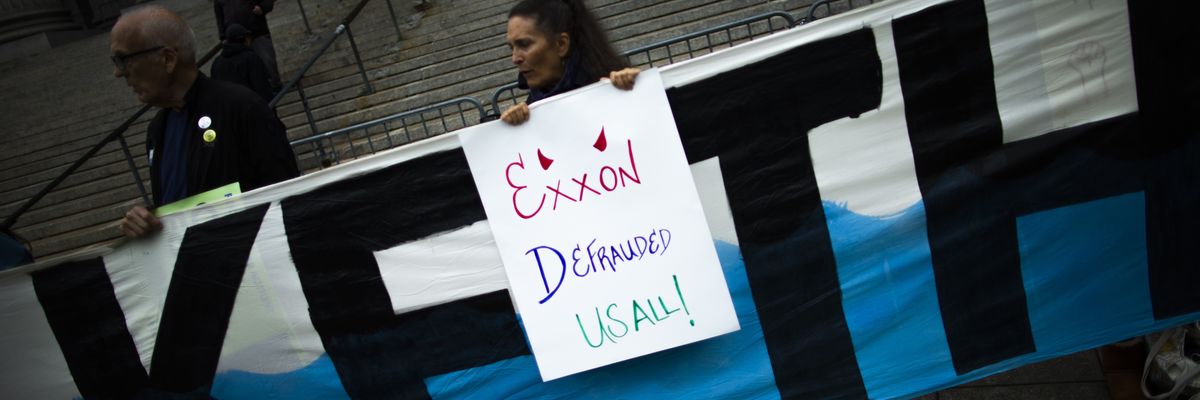
Climate advocates take part in a protest against ExxonMobil on October 22, 2019 in New York.
"Climate change isn't just a tragedy, it's a crime," said one climate campaigner in response to documents reported by The Wall Street Journal.
Previously unreported documents published on the front page of The Wall Street Journal Thursday show that ExxonMobil continued to work behind closed doors to cast doubt on climate science, even after the company publicly acknowledged the link between fossil fuel-driven greenhouse gas emissions and climate change in 2006.
The documents—which detail email exchanges between executives, board meeting conversations, and other company proceedings—reveal that during his tenure as CEO, Rex Tillerson joined other Exxon leaders in questioning "the severity of climate change's impacts," the Journal reported.
The company's scientists, meanwhile, "supported research that questioned the findings of mainstream climate science" despite Exxon's pledge to stop bankrolling think tanks and other groups peddling climate denial.
After scientists with the United Nations' Intergovernmental Panel on Climate Change (IPCC) sounded the alarm in 2011 about the potentially devastating global impacts of runaway warming, Tillerson told a leading Exxon researcher that the IPCC's warning was "not credible" and complained about the media's coverage of the potentially dire scenario, according to documents reviewed by the Journal.
"Tillerson wanted to engage with IPCC 'to influence [the group], in addition to gathering info,'" the newspaper reported.
Tillerson also dismissed the Paris Climate Agreement's 2°C warming target as "something magical" shortly before Exxon endorsed the accord.
"As communities pay an ever-greater price for our worsening climate crisis, it's more clear than ever that Exxon must be held accountable to pay for the harm it has caused."
Richard Wiles, president of the Center for Climate Integrity, said in a statement that "this damning new evidence of Exxon's climate lies shows that for decades it has been official company policy for executives to undermine climate science, minimize the dangers of their oil and gas business, and protect company profits at all costs—with no concern for the catastrophic impact their actions would have on humanity."
Wiles argued that the documents reported by the Journal provide more evidence for the dozens of states, cities, and counties that are currently suing Exxon and other fossil fuel giants over their decades-long effort to deceive the public about climate change.
"As communities pay an ever-greater price for our worsening climate crisis," said Wiles, "it's more clear than ever that Exxon must be held accountable to pay for the harm it has caused."
The new reporting could also heighten pressure on the Biden Justice Department to join the legal fight against Big Oil.
In late July, a group of progressive U.S. senators led by Sen. Bernie Sanders (I-Vt.) urged the DOJ to sue fossil fuel giants for violating "federal racketeering laws, truth in advertising laws, consumer protection laws, and potentially other laws."
It has long been public knowledge that Exxon, the largest oil and gas company in the United States, was aware of the climate impacts of its business model well before it admitted the link between fossil fuels and climate change.
A peer-reviewed study published earlier this year in the journal Science shows that Exxon's own internal data between 1977 and 2003 contradicted the company's public statements downplaying and questioning the veracity of climate science.
The Journal's reporting confirms that Exxon did not stop working to sow doubt about climate change after it conceded for the first time in 2006 that "the accumulation of greenhouse gases in the Earth's atmosphere poses risks that may prove significant for society and ecosystems."
"In 2008, Exxon announced it would stop funding think tanks and other groups that questioned climate science, saying their positions 'could divert attention from the important discussion on how the world will secure the energy required for economic growth in an environmentally responsible manner,'" the Journal noted.
But internal company documents show that "Exxon researchers continued to support scientific research that cast doubt on climate science and its impacts," the newspaper reported.
The same year the company vowed to stop funding climate-denial organizations, Exxon's manager of global regulatory affairs said that "Exxon should direct a scientist to help the American Petroleum Institute, the industry's influential lobbying group, write a paper about climate science uncertainty."
Jamie Henn, the director of Fossil Free Media, called the Journal's reporting "another massive exposé of Exxon's strategy to attack climate science and block action."
"Climate change isn't just a tragedy," Henn added, "it's a crime."
Dear Common Dreams reader, It’s been nearly 30 years since I co-founded Common Dreams with my late wife, Lina Newhouser. We had the radical notion that journalism should serve the public good, not corporate profits. It was clear to us from the outset what it would take to build such a project. No paid advertisements. No corporate sponsors. No millionaire publisher telling us what to think or do. Many people said we wouldn't last a year, but we proved those doubters wrong. Together with a tremendous team of journalists and dedicated staff, we built an independent media outlet free from the constraints of profits and corporate control. Our mission has always been simple: To inform. To inspire. To ignite change for the common good. Building Common Dreams was not easy. Our survival was never guaranteed. When you take on the most powerful forces—Wall Street greed, fossil fuel industry destruction, Big Tech lobbyists, and uber-rich oligarchs who have spent billions upon billions rigging the economy and democracy in their favor—the only bulwark you have is supporters who believe in your work. But here’s the urgent message from me today. It's never been this bad out there. And it's never been this hard to keep us going. At the very moment Common Dreams is most needed, the threats we face are intensifying. We need your support now more than ever. We don't accept corporate advertising and never will. We don't have a paywall because we don't think people should be blocked from critical news based on their ability to pay. Everything we do is funded by the donations of readers like you. When everyone does the little they can afford, we are strong. But if that support retreats or dries up, so do we. Will you donate now to make sure Common Dreams not only survives but thrives? —Craig Brown, Co-founder |
Previously unreported documents published on the front page of The Wall Street Journal Thursday show that ExxonMobil continued to work behind closed doors to cast doubt on climate science, even after the company publicly acknowledged the link between fossil fuel-driven greenhouse gas emissions and climate change in 2006.
The documents—which detail email exchanges between executives, board meeting conversations, and other company proceedings—reveal that during his tenure as CEO, Rex Tillerson joined other Exxon leaders in questioning "the severity of climate change's impacts," the Journal reported.
The company's scientists, meanwhile, "supported research that questioned the findings of mainstream climate science" despite Exxon's pledge to stop bankrolling think tanks and other groups peddling climate denial.
After scientists with the United Nations' Intergovernmental Panel on Climate Change (IPCC) sounded the alarm in 2011 about the potentially devastating global impacts of runaway warming, Tillerson told a leading Exxon researcher that the IPCC's warning was "not credible" and complained about the media's coverage of the potentially dire scenario, according to documents reviewed by the Journal.
"Tillerson wanted to engage with IPCC 'to influence [the group], in addition to gathering info,'" the newspaper reported.
Tillerson also dismissed the Paris Climate Agreement's 2°C warming target as "something magical" shortly before Exxon endorsed the accord.
"As communities pay an ever-greater price for our worsening climate crisis, it's more clear than ever that Exxon must be held accountable to pay for the harm it has caused."
Richard Wiles, president of the Center for Climate Integrity, said in a statement that "this damning new evidence of Exxon's climate lies shows that for decades it has been official company policy for executives to undermine climate science, minimize the dangers of their oil and gas business, and protect company profits at all costs—with no concern for the catastrophic impact their actions would have on humanity."
Wiles argued that the documents reported by the Journal provide more evidence for the dozens of states, cities, and counties that are currently suing Exxon and other fossil fuel giants over their decades-long effort to deceive the public about climate change.
"As communities pay an ever-greater price for our worsening climate crisis," said Wiles, "it's more clear than ever that Exxon must be held accountable to pay for the harm it has caused."
The new reporting could also heighten pressure on the Biden Justice Department to join the legal fight against Big Oil.
In late July, a group of progressive U.S. senators led by Sen. Bernie Sanders (I-Vt.) urged the DOJ to sue fossil fuel giants for violating "federal racketeering laws, truth in advertising laws, consumer protection laws, and potentially other laws."
It has long been public knowledge that Exxon, the largest oil and gas company in the United States, was aware of the climate impacts of its business model well before it admitted the link between fossil fuels and climate change.
A peer-reviewed study published earlier this year in the journal Science shows that Exxon's own internal data between 1977 and 2003 contradicted the company's public statements downplaying and questioning the veracity of climate science.
The Journal's reporting confirms that Exxon did not stop working to sow doubt about climate change after it conceded for the first time in 2006 that "the accumulation of greenhouse gases in the Earth's atmosphere poses risks that may prove significant for society and ecosystems."
"In 2008, Exxon announced it would stop funding think tanks and other groups that questioned climate science, saying their positions 'could divert attention from the important discussion on how the world will secure the energy required for economic growth in an environmentally responsible manner,'" the Journal noted.
But internal company documents show that "Exxon researchers continued to support scientific research that cast doubt on climate science and its impacts," the newspaper reported.
The same year the company vowed to stop funding climate-denial organizations, Exxon's manager of global regulatory affairs said that "Exxon should direct a scientist to help the American Petroleum Institute, the industry's influential lobbying group, write a paper about climate science uncertainty."
Jamie Henn, the director of Fossil Free Media, called the Journal's reporting "another massive exposé of Exxon's strategy to attack climate science and block action."
"Climate change isn't just a tragedy," Henn added, "it's a crime."
Previously unreported documents published on the front page of The Wall Street Journal Thursday show that ExxonMobil continued to work behind closed doors to cast doubt on climate science, even after the company publicly acknowledged the link between fossil fuel-driven greenhouse gas emissions and climate change in 2006.
The documents—which detail email exchanges between executives, board meeting conversations, and other company proceedings—reveal that during his tenure as CEO, Rex Tillerson joined other Exxon leaders in questioning "the severity of climate change's impacts," the Journal reported.
The company's scientists, meanwhile, "supported research that questioned the findings of mainstream climate science" despite Exxon's pledge to stop bankrolling think tanks and other groups peddling climate denial.
After scientists with the United Nations' Intergovernmental Panel on Climate Change (IPCC) sounded the alarm in 2011 about the potentially devastating global impacts of runaway warming, Tillerson told a leading Exxon researcher that the IPCC's warning was "not credible" and complained about the media's coverage of the potentially dire scenario, according to documents reviewed by the Journal.
"Tillerson wanted to engage with IPCC 'to influence [the group], in addition to gathering info,'" the newspaper reported.
Tillerson also dismissed the Paris Climate Agreement's 2°C warming target as "something magical" shortly before Exxon endorsed the accord.
"As communities pay an ever-greater price for our worsening climate crisis, it's more clear than ever that Exxon must be held accountable to pay for the harm it has caused."
Richard Wiles, president of the Center for Climate Integrity, said in a statement that "this damning new evidence of Exxon's climate lies shows that for decades it has been official company policy for executives to undermine climate science, minimize the dangers of their oil and gas business, and protect company profits at all costs—with no concern for the catastrophic impact their actions would have on humanity."
Wiles argued that the documents reported by the Journal provide more evidence for the dozens of states, cities, and counties that are currently suing Exxon and other fossil fuel giants over their decades-long effort to deceive the public about climate change.
"As communities pay an ever-greater price for our worsening climate crisis," said Wiles, "it's more clear than ever that Exxon must be held accountable to pay for the harm it has caused."
The new reporting could also heighten pressure on the Biden Justice Department to join the legal fight against Big Oil.
In late July, a group of progressive U.S. senators led by Sen. Bernie Sanders (I-Vt.) urged the DOJ to sue fossil fuel giants for violating "federal racketeering laws, truth in advertising laws, consumer protection laws, and potentially other laws."
It has long been public knowledge that Exxon, the largest oil and gas company in the United States, was aware of the climate impacts of its business model well before it admitted the link between fossil fuels and climate change.
A peer-reviewed study published earlier this year in the journal Science shows that Exxon's own internal data between 1977 and 2003 contradicted the company's public statements downplaying and questioning the veracity of climate science.
The Journal's reporting confirms that Exxon did not stop working to sow doubt about climate change after it conceded for the first time in 2006 that "the accumulation of greenhouse gases in the Earth's atmosphere poses risks that may prove significant for society and ecosystems."
"In 2008, Exxon announced it would stop funding think tanks and other groups that questioned climate science, saying their positions 'could divert attention from the important discussion on how the world will secure the energy required for economic growth in an environmentally responsible manner,'" the Journal noted.
But internal company documents show that "Exxon researchers continued to support scientific research that cast doubt on climate science and its impacts," the newspaper reported.
The same year the company vowed to stop funding climate-denial organizations, Exxon's manager of global regulatory affairs said that "Exxon should direct a scientist to help the American Petroleum Institute, the industry's influential lobbying group, write a paper about climate science uncertainty."
Jamie Henn, the director of Fossil Free Media, called the Journal's reporting "another massive exposé of Exxon's strategy to attack climate science and block action."
"Climate change isn't just a tragedy," Henn added, "it's a crime."