SUBSCRIBE TO OUR FREE NEWSLETTER
Daily news & progressive opinion—funded by the people, not the corporations—delivered straight to your inbox.
5
#000000
#FFFFFF
To donate by check, phone, or other method, see our More Ways to Give page.
Daily news & progressive opinion—funded by the people, not the corporations—delivered straight to your inbox.
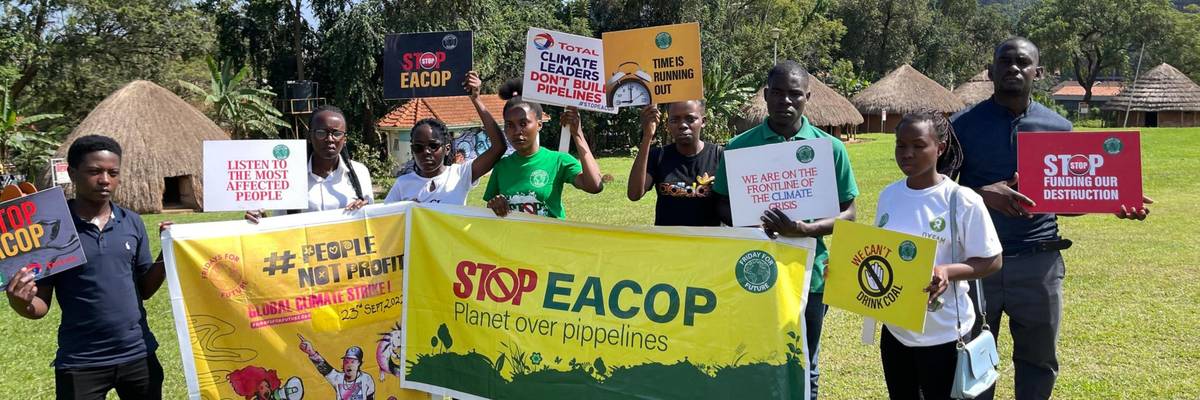
Ugandan climate activists protest the East African Crude Oil Pipeline (EACOP) in Kampala on September 23, 2022.
"They come here promising us everything," said one affected Ugandan. "We believed them. Now we are landless, the compensation money is gone, what fields we have left are flooded, and dust fills the air."
Construction of TotalEnergies' East African Crude Oil Pipeline has "devastated" the lives and livelihoods of tens of thousands of people in its path while exacerbating the climate emergency, according to a report published Monday by Human Rights Watch.
HRW's 47-page report—entitled Our Trust Is Broken: Loss of Land and Livelihoods for Oil Development in Uganda—warns that "in total, over 100,000 people in Uganda and Tanzania will permanently lose land to make way for the pipeline and Tilenga oilfield development, according to calculations based on project documentation."
In addition to massive displacement, the report says EACOP "has caused food insecurity and household debt, caused children to leave school, and is likely to have devastating environmental effects."
"EACOP is also a disaster for the planet and the project should not be completed."
Local farmers told HRW they "felt pressured to sign compensation agreements in English, a language many of them cannot read," while many lamented how "unkept promises about grave relocation and an improvement in the quality of life" have eroded communities' trust in TotalEnergies.
"They come here promising us everything," one Ugandan told HRW. "We believed them. Now we are landless, the compensation money is gone, what fields we have left are flooded, and dust fills the air."
If completed, the $3.5 billion, nearly 900-mile EACOP will transport up to 230,000 barrels of crude oil per day from fields in the Lake Albert region of western Uganda through the world's longest electrically heated pipeline to the Tanzanian port city of Tanga on the Indian Ocean.
In a letter to HRW last month, TotalEnergies said it continues to "pay close attention to respecting the rights of the communities concerned” and insisted the compensation it's offering people displaced by EACOP meets international standards.
TotalEnergies—in partnership with China National Offshore Oil Corporation (CNOOC) and the Uganda National Oil Company (UNOC)—is also leading the Tilenga Development Project, which involves the drilling of 400 wells in dozens of locations, including inside the richly biodiverse Murchison Falls National Park.
"EACOP has been a disaster for the tens of thousands who have lost the land that provided food for their families and an income to send their children to school, and who received too little compensation from TotalEnergies," HRW senior environment researcher Felix Horne said in a statement. "EACOP is also a disaster for the planet and the project should not be completed."
Full funding of the controversial pipeline remains uncertain, as numerous banks including Deutsche Bank, Citi, JPMorgan Chase, Wells Fargo, and Morgan Stanley have eschewed financing the project, in part due to pressure from #StopEACOP and other activists. Only two banks—Standard Bank of South Africa and Industrial and Commercial Bank of China—are actively supporting EACOP.
"The burning of fossil fuels is driving the climate crisis," Horne said. "Financial institutions considering funding EACOP should steer clear of this project and instead help Uganda embrace its significant clean energy potential."
In an opinion piece published Friday in Uganda's Monitor, Shadia Nakazibwe, programs assistant at the NGO Environment Governance Institute, wrote that "EACOP and related oil projects threaten Uganda's efforts to reduce its greenhouse gas emissions by 24.7% by 2030."
"African countries have been disproportionately affected by the climate change crisis... [which] has been largely caused by the burning of fossil fuels," Nakazibwe noted. "African countries, whose citizens will not accrue any meaningful economic or other benefits from the EACOP oil, will bear the brunt of the worsened climate crisis."
"Furthermore, Uganda is one of the most vulnerable and least prepared countries to adapt to climate change impacts," she said.
"Any economic benefits from the project," Nakazibwe added, "will be far outweighed by the project's potential negative impacts on Uganda's most prosperous green economic sectors."
Dear Common Dreams reader, It’s been nearly 30 years since I co-founded Common Dreams with my late wife, Lina Newhouser. We had the radical notion that journalism should serve the public good, not corporate profits. It was clear to us from the outset what it would take to build such a project. No paid advertisements. No corporate sponsors. No millionaire publisher telling us what to think or do. Many people said we wouldn't last a year, but we proved those doubters wrong. Together with a tremendous team of journalists and dedicated staff, we built an independent media outlet free from the constraints of profits and corporate control. Our mission has always been simple: To inform. To inspire. To ignite change for the common good. Building Common Dreams was not easy. Our survival was never guaranteed. When you take on the most powerful forces—Wall Street greed, fossil fuel industry destruction, Big Tech lobbyists, and uber-rich oligarchs who have spent billions upon billions rigging the economy and democracy in their favor—the only bulwark you have is supporters who believe in your work. But here’s the urgent message from me today. It's never been this bad out there. And it's never been this hard to keep us going. At the very moment Common Dreams is most needed, the threats we face are intensifying. We need your support now more than ever. We don't accept corporate advertising and never will. We don't have a paywall because we don't think people should be blocked from critical news based on their ability to pay. Everything we do is funded by the donations of readers like you. When everyone does the little they can afford, we are strong. But if that support retreats or dries up, so do we. Will you donate now to make sure Common Dreams not only survives but thrives? —Craig Brown, Co-founder |
Construction of TotalEnergies' East African Crude Oil Pipeline has "devastated" the lives and livelihoods of tens of thousands of people in its path while exacerbating the climate emergency, according to a report published Monday by Human Rights Watch.
HRW's 47-page report—entitled Our Trust Is Broken: Loss of Land and Livelihoods for Oil Development in Uganda—warns that "in total, over 100,000 people in Uganda and Tanzania will permanently lose land to make way for the pipeline and Tilenga oilfield development, according to calculations based on project documentation."
In addition to massive displacement, the report says EACOP "has caused food insecurity and household debt, caused children to leave school, and is likely to have devastating environmental effects."
"EACOP is also a disaster for the planet and the project should not be completed."
Local farmers told HRW they "felt pressured to sign compensation agreements in English, a language many of them cannot read," while many lamented how "unkept promises about grave relocation and an improvement in the quality of life" have eroded communities' trust in TotalEnergies.
"They come here promising us everything," one Ugandan told HRW. "We believed them. Now we are landless, the compensation money is gone, what fields we have left are flooded, and dust fills the air."
If completed, the $3.5 billion, nearly 900-mile EACOP will transport up to 230,000 barrels of crude oil per day from fields in the Lake Albert region of western Uganda through the world's longest electrically heated pipeline to the Tanzanian port city of Tanga on the Indian Ocean.
In a letter to HRW last month, TotalEnergies said it continues to "pay close attention to respecting the rights of the communities concerned” and insisted the compensation it's offering people displaced by EACOP meets international standards.
TotalEnergies—in partnership with China National Offshore Oil Corporation (CNOOC) and the Uganda National Oil Company (UNOC)—is also leading the Tilenga Development Project, which involves the drilling of 400 wells in dozens of locations, including inside the richly biodiverse Murchison Falls National Park.
"EACOP has been a disaster for the tens of thousands who have lost the land that provided food for their families and an income to send their children to school, and who received too little compensation from TotalEnergies," HRW senior environment researcher Felix Horne said in a statement. "EACOP is also a disaster for the planet and the project should not be completed."
Full funding of the controversial pipeline remains uncertain, as numerous banks including Deutsche Bank, Citi, JPMorgan Chase, Wells Fargo, and Morgan Stanley have eschewed financing the project, in part due to pressure from #StopEACOP and other activists. Only two banks—Standard Bank of South Africa and Industrial and Commercial Bank of China—are actively supporting EACOP.
"The burning of fossil fuels is driving the climate crisis," Horne said. "Financial institutions considering funding EACOP should steer clear of this project and instead help Uganda embrace its significant clean energy potential."
In an opinion piece published Friday in Uganda's Monitor, Shadia Nakazibwe, programs assistant at the NGO Environment Governance Institute, wrote that "EACOP and related oil projects threaten Uganda's efforts to reduce its greenhouse gas emissions by 24.7% by 2030."
"African countries have been disproportionately affected by the climate change crisis... [which] has been largely caused by the burning of fossil fuels," Nakazibwe noted. "African countries, whose citizens will not accrue any meaningful economic or other benefits from the EACOP oil, will bear the brunt of the worsened climate crisis."
"Furthermore, Uganda is one of the most vulnerable and least prepared countries to adapt to climate change impacts," she said.
"Any economic benefits from the project," Nakazibwe added, "will be far outweighed by the project's potential negative impacts on Uganda's most prosperous green economic sectors."
Construction of TotalEnergies' East African Crude Oil Pipeline has "devastated" the lives and livelihoods of tens of thousands of people in its path while exacerbating the climate emergency, according to a report published Monday by Human Rights Watch.
HRW's 47-page report—entitled Our Trust Is Broken: Loss of Land and Livelihoods for Oil Development in Uganda—warns that "in total, over 100,000 people in Uganda and Tanzania will permanently lose land to make way for the pipeline and Tilenga oilfield development, according to calculations based on project documentation."
In addition to massive displacement, the report says EACOP "has caused food insecurity and household debt, caused children to leave school, and is likely to have devastating environmental effects."
"EACOP is also a disaster for the planet and the project should not be completed."
Local farmers told HRW they "felt pressured to sign compensation agreements in English, a language many of them cannot read," while many lamented how "unkept promises about grave relocation and an improvement in the quality of life" have eroded communities' trust in TotalEnergies.
"They come here promising us everything," one Ugandan told HRW. "We believed them. Now we are landless, the compensation money is gone, what fields we have left are flooded, and dust fills the air."
If completed, the $3.5 billion, nearly 900-mile EACOP will transport up to 230,000 barrels of crude oil per day from fields in the Lake Albert region of western Uganda through the world's longest electrically heated pipeline to the Tanzanian port city of Tanga on the Indian Ocean.
In a letter to HRW last month, TotalEnergies said it continues to "pay close attention to respecting the rights of the communities concerned” and insisted the compensation it's offering people displaced by EACOP meets international standards.
TotalEnergies—in partnership with China National Offshore Oil Corporation (CNOOC) and the Uganda National Oil Company (UNOC)—is also leading the Tilenga Development Project, which involves the drilling of 400 wells in dozens of locations, including inside the richly biodiverse Murchison Falls National Park.
"EACOP has been a disaster for the tens of thousands who have lost the land that provided food for their families and an income to send their children to school, and who received too little compensation from TotalEnergies," HRW senior environment researcher Felix Horne said in a statement. "EACOP is also a disaster for the planet and the project should not be completed."
Full funding of the controversial pipeline remains uncertain, as numerous banks including Deutsche Bank, Citi, JPMorgan Chase, Wells Fargo, and Morgan Stanley have eschewed financing the project, in part due to pressure from #StopEACOP and other activists. Only two banks—Standard Bank of South Africa and Industrial and Commercial Bank of China—are actively supporting EACOP.
"The burning of fossil fuels is driving the climate crisis," Horne said. "Financial institutions considering funding EACOP should steer clear of this project and instead help Uganda embrace its significant clean energy potential."
In an opinion piece published Friday in Uganda's Monitor, Shadia Nakazibwe, programs assistant at the NGO Environment Governance Institute, wrote that "EACOP and related oil projects threaten Uganda's efforts to reduce its greenhouse gas emissions by 24.7% by 2030."
"African countries have been disproportionately affected by the climate change crisis... [which] has been largely caused by the burning of fossil fuels," Nakazibwe noted. "African countries, whose citizens will not accrue any meaningful economic or other benefits from the EACOP oil, will bear the brunt of the worsened climate crisis."
"Furthermore, Uganda is one of the most vulnerable and least prepared countries to adapt to climate change impacts," she said.
"Any economic benefits from the project," Nakazibwe added, "will be far outweighed by the project's potential negative impacts on Uganda's most prosperous green economic sectors."