SUBSCRIBE TO OUR FREE NEWSLETTER
Daily news & progressive opinion—funded by the people, not the corporations—delivered straight to your inbox.
5
#000000
#FFFFFF
To donate by check, phone, or other method, see our More Ways to Give page.
Daily news & progressive opinion—funded by the people, not the corporations—delivered straight to your inbox.
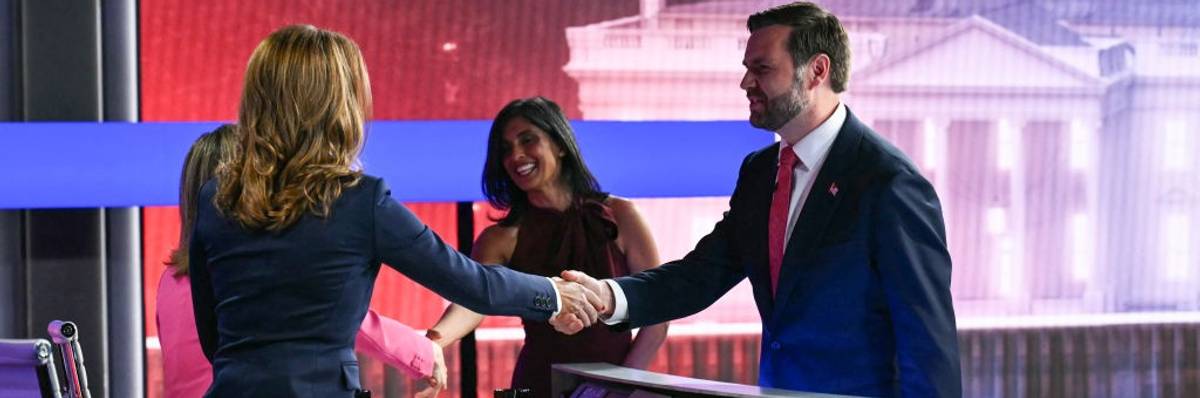
The Republican vice presidential candidate, Sen. JD Vance, and his wife Usha Vance shake hands with moderators Margaret Brennan (left) and Norah O'Donnell (second from left) at the end of the vice presidential debate hosted by CBS News on October 1, 2024.
The Council on American–Islamic Relations said the question was "reckless and biased" and "sounded like it could have written by AIPAC, not CBS."
Foreign policy experts and civil rights groups criticized CBS News' moderators following Monday night's vice presidential debate for asking only one narrowly framed question about conflict in the Middle East.
Co-moderator Margaret Brennan, the network's chief foreign affairs correspondent, opened the debate by stating that Iran could develop a nuclear weapon within a week or two and asking if the two vice presidential candidates would support a preemptive strike by Israel on Iran.
"Wait. What?" Kelley Beaucar Vlahos, a senior adviser for the Quincy Institute for Responsible Statecraft, a think tank, wrote in response to the question.
Vlahos expressed disbelief that "after nearly 12 months of war in Gaza, more than 40,000 dead—mostly civilians—a spiraling humanitarian crisis, hostages dead or still in captivity, Hezbollah and Hamas leaders assassinated, a new war in Lebanon where 1 million people may be displaced, charges of genocide, and a cease-fire endlessly elusive," this was the question CBS had chosen.
Peter Beinart, an editor at Jewish Currents and professor of journalism at the City University of New York, argued that the question should have focused on how to stop a regional war, writing on social media that CBS's framing "pretty much encapsulates what is wrong with U.S. media coverage of this conflict."
The Council on American–Islamic Relations, a Muslim civil rights group, said the question was "reckless and biased" and "sounded like it could have written by [the American Israel Public Affairs Committee], not CBS."
Tonight's vice president debate opened with a reckless and biased question about bombing Iran that sounded like it could have written by AIPAC, not CBS. Our soldiers and taxpayer dollars shouldn’t be wasted on another futile war in the Middle East that ends with more blood on our… pic.twitter.com/jyOmgsBbm1
— CAIR National (@CAIRNational) October 2, 2024
The debate took place on the same day that Iran fired roughly 200 ballistic missiles at Israel. Iran said the strikes were retaliation for recent Israeli assassinations of Hamas and Hezbollah leaders. The strikes followed Israel's launch of a ground incursion into southern Lebanon. Israeli and U.S. forces intercepted the vast majority of the missiles, which were targeted at military facilities.
Vlahos suggested that focusing on the Iran threat was a way of avoiding larger questions—that Brennan's narrow framing was intentional.
"If the CBS moderators wanted to avoid talking frankly about the aforementioned issues which might mean—here it comes—raising criticism of Israel, this was the way to do it," she wrote. "Make it all about Iran."
Sen. JD Vance (R-Ohio), the Republican vice presidential candidate, said that he would defer to Israel.
"We should support our allies wherever they are when they're fighting the bad guys," he said.
Minnesota Gov. Tim Walz, the Democratic vice presidential nominee, didn't directly answer the preemptive strike question but immediately invoked the October 7 massacre of Israelis by Hamas and said Israel had the "absolutely fundamental" right to defend itself.
Dear Common Dreams reader, It’s been nearly 30 years since I co-founded Common Dreams with my late wife, Lina Newhouser. We had the radical notion that journalism should serve the public good, not corporate profits. It was clear to us from the outset what it would take to build such a project. No paid advertisements. No corporate sponsors. No millionaire publisher telling us what to think or do. Many people said we wouldn't last a year, but we proved those doubters wrong. Together with a tremendous team of journalists and dedicated staff, we built an independent media outlet free from the constraints of profits and corporate control. Our mission has always been simple: To inform. To inspire. To ignite change for the common good. Building Common Dreams was not easy. Our survival was never guaranteed. When you take on the most powerful forces—Wall Street greed, fossil fuel industry destruction, Big Tech lobbyists, and uber-rich oligarchs who have spent billions upon billions rigging the economy and democracy in their favor—the only bulwark you have is supporters who believe in your work. But here’s the urgent message from me today. It's never been this bad out there. And it's never been this hard to keep us going. At the very moment Common Dreams is most needed, the threats we face are intensifying. We need your support now more than ever. We don't accept corporate advertising and never will. We don't have a paywall because we don't think people should be blocked from critical news based on their ability to pay. Everything we do is funded by the donations of readers like you. When everyone does the little they can afford, we are strong. But if that support retreats or dries up, so do we. Will you donate now to make sure Common Dreams not only survives but thrives? —Craig Brown, Co-founder |
Foreign policy experts and civil rights groups criticized CBS News' moderators following Monday night's vice presidential debate for asking only one narrowly framed question about conflict in the Middle East.
Co-moderator Margaret Brennan, the network's chief foreign affairs correspondent, opened the debate by stating that Iran could develop a nuclear weapon within a week or two and asking if the two vice presidential candidates would support a preemptive strike by Israel on Iran.
"Wait. What?" Kelley Beaucar Vlahos, a senior adviser for the Quincy Institute for Responsible Statecraft, a think tank, wrote in response to the question.
Vlahos expressed disbelief that "after nearly 12 months of war in Gaza, more than 40,000 dead—mostly civilians—a spiraling humanitarian crisis, hostages dead or still in captivity, Hezbollah and Hamas leaders assassinated, a new war in Lebanon where 1 million people may be displaced, charges of genocide, and a cease-fire endlessly elusive," this was the question CBS had chosen.
Peter Beinart, an editor at Jewish Currents and professor of journalism at the City University of New York, argued that the question should have focused on how to stop a regional war, writing on social media that CBS's framing "pretty much encapsulates what is wrong with U.S. media coverage of this conflict."
The Council on American–Islamic Relations, a Muslim civil rights group, said the question was "reckless and biased" and "sounded like it could have written by [the American Israel Public Affairs Committee], not CBS."
Tonight's vice president debate opened with a reckless and biased question about bombing Iran that sounded like it could have written by AIPAC, not CBS. Our soldiers and taxpayer dollars shouldn’t be wasted on another futile war in the Middle East that ends with more blood on our… pic.twitter.com/jyOmgsBbm1
— CAIR National (@CAIRNational) October 2, 2024
The debate took place on the same day that Iran fired roughly 200 ballistic missiles at Israel. Iran said the strikes were retaliation for recent Israeli assassinations of Hamas and Hezbollah leaders. The strikes followed Israel's launch of a ground incursion into southern Lebanon. Israeli and U.S. forces intercepted the vast majority of the missiles, which were targeted at military facilities.
Vlahos suggested that focusing on the Iran threat was a way of avoiding larger questions—that Brennan's narrow framing was intentional.
"If the CBS moderators wanted to avoid talking frankly about the aforementioned issues which might mean—here it comes—raising criticism of Israel, this was the way to do it," she wrote. "Make it all about Iran."
Sen. JD Vance (R-Ohio), the Republican vice presidential candidate, said that he would defer to Israel.
"We should support our allies wherever they are when they're fighting the bad guys," he said.
Minnesota Gov. Tim Walz, the Democratic vice presidential nominee, didn't directly answer the preemptive strike question but immediately invoked the October 7 massacre of Israelis by Hamas and said Israel had the "absolutely fundamental" right to defend itself.
Foreign policy experts and civil rights groups criticized CBS News' moderators following Monday night's vice presidential debate for asking only one narrowly framed question about conflict in the Middle East.
Co-moderator Margaret Brennan, the network's chief foreign affairs correspondent, opened the debate by stating that Iran could develop a nuclear weapon within a week or two and asking if the two vice presidential candidates would support a preemptive strike by Israel on Iran.
"Wait. What?" Kelley Beaucar Vlahos, a senior adviser for the Quincy Institute for Responsible Statecraft, a think tank, wrote in response to the question.
Vlahos expressed disbelief that "after nearly 12 months of war in Gaza, more than 40,000 dead—mostly civilians—a spiraling humanitarian crisis, hostages dead or still in captivity, Hezbollah and Hamas leaders assassinated, a new war in Lebanon where 1 million people may be displaced, charges of genocide, and a cease-fire endlessly elusive," this was the question CBS had chosen.
Peter Beinart, an editor at Jewish Currents and professor of journalism at the City University of New York, argued that the question should have focused on how to stop a regional war, writing on social media that CBS's framing "pretty much encapsulates what is wrong with U.S. media coverage of this conflict."
The Council on American–Islamic Relations, a Muslim civil rights group, said the question was "reckless and biased" and "sounded like it could have written by [the American Israel Public Affairs Committee], not CBS."
Tonight's vice president debate opened with a reckless and biased question about bombing Iran that sounded like it could have written by AIPAC, not CBS. Our soldiers and taxpayer dollars shouldn’t be wasted on another futile war in the Middle East that ends with more blood on our… pic.twitter.com/jyOmgsBbm1
— CAIR National (@CAIRNational) October 2, 2024
The debate took place on the same day that Iran fired roughly 200 ballistic missiles at Israel. Iran said the strikes were retaliation for recent Israeli assassinations of Hamas and Hezbollah leaders. The strikes followed Israel's launch of a ground incursion into southern Lebanon. Israeli and U.S. forces intercepted the vast majority of the missiles, which were targeted at military facilities.
Vlahos suggested that focusing on the Iran threat was a way of avoiding larger questions—that Brennan's narrow framing was intentional.
"If the CBS moderators wanted to avoid talking frankly about the aforementioned issues which might mean—here it comes—raising criticism of Israel, this was the way to do it," she wrote. "Make it all about Iran."
Sen. JD Vance (R-Ohio), the Republican vice presidential candidate, said that he would defer to Israel.
"We should support our allies wherever they are when they're fighting the bad guys," he said.
Minnesota Gov. Tim Walz, the Democratic vice presidential nominee, didn't directly answer the preemptive strike question but immediately invoked the October 7 massacre of Israelis by Hamas and said Israel had the "absolutely fundamental" right to defend itself.