SUBSCRIBE TO OUR FREE NEWSLETTER
Daily news & progressive opinion—funded by the people, not the corporations—delivered straight to your inbox.
5
#000000
#FFFFFF
To donate by check, phone, or other method, see our More Ways to Give page.
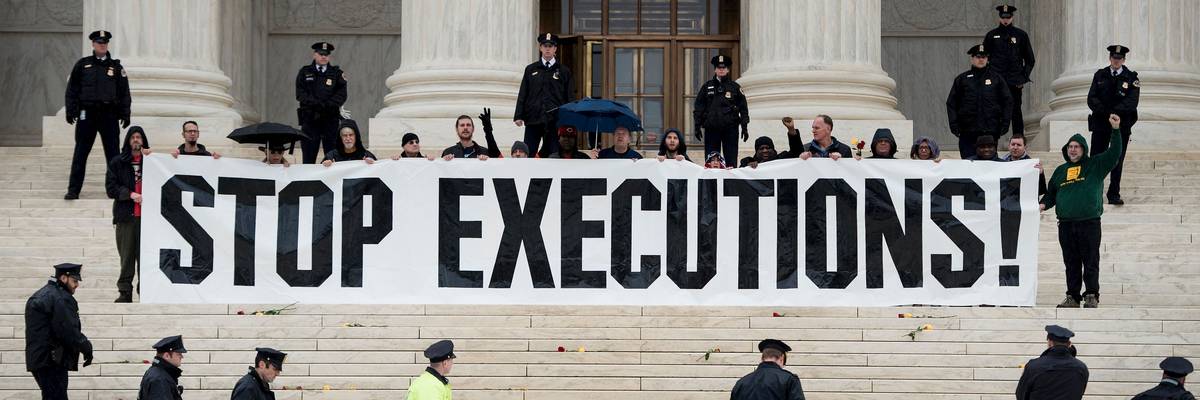
With its number of state-sponsored executions nearly doubling in 2025, the United States joined an ignominious handful of nations around the globe that helped bring death penalty punishments worldwide last year to their highest level in nearly half a century.
Amnesty International released its annual review of the death penalty on Monday, showing that the "staggering" overall increase of executions—up from 1,518 in 2024 to at least 2,707 people—was due "to a handful of governments determined to rule by fear."
While 17 nations carried out at least one death sentence in 2025, it was significant increases in five of those countries—the United States, Iran, Saudi Arabia, Kuwait, Egypt, and Singapore—that account for the historic spike. With rates in those countries doubling or even tripling compared to the 2024 figures, Amnesty found, executions overall rose by 78% worldwide in 2025.
As the human rights group notes:
Iranian authorities, the main drivers behind the spike, executed at least 2,159 people, more than double its 2024 figure. Elsewhere, Saudi Arabia raised its execution tally to at least 356, using the death penalty extensively for drug-related offenses. Executions in Kuwait almost tripled (from 6 to 17), while they near doubled in Egypt (from 13 to 23), Singapore (from 9 to 17), and the United States of America (from 25 to 47).
Notably, the 2025 total put forth by Amnesty does not include thousands of executions the human rights group believes were carried out in China, which it says likely carries out thousands each year.
“This alarming spike in the use of the death penalty is due to a small, isolated group of states willing to carry out executions at all costs, despite the continued global trend towards abolition," said Agnès Callamard, Amnesty International’s secretary general. "From China, Iran, North Korea and Saudi Arabia to Yemen, Kuwait, Singapore and the USA, this shameless minority are weaponizing the death penalty to instill fear, crush dissent and show the strength state institutions have over disadvantaged people and marginalized communities."
Under President Donald Trump, who has championed the return of the federal death penalty during both his first and second terms in office, the 47 executions took place across 11 states, with the highest number being carried out in Florida, where 19 people were killed.
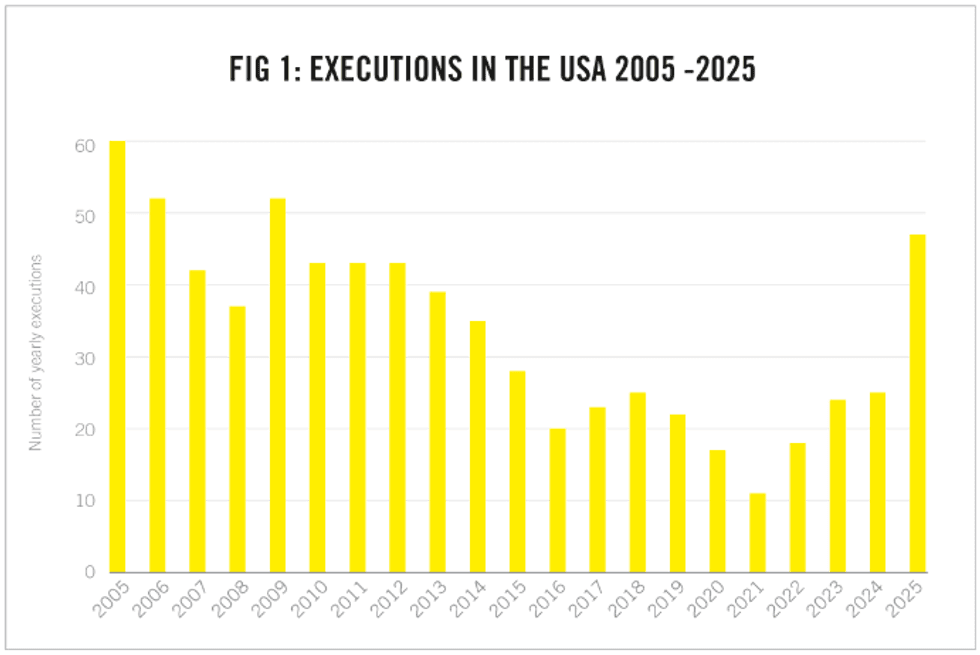 (Source: Amnesty International)
Despite the surge in countries like the US and Iran, Amnesty highlighted that "progress was made elsewhere around the world, proving hope is stronger than fear."
The report notes that no "executions or death sentences were recorded in Europe and Central Asia" and that, for the 17th consecutive year, the US remained the "only country in the Americas to execute people, with close to half of all US executions carried out in Florida."
The group celebrated legislative progress in countries like Nigeria and Lebanon, where bills were introduced in the last year to abolish the death penalty once and for all.
“With human rights under threat around the world, millions of people continue to fight against the death penalty each year in a powerful demonstration of our shared humanity,” said Callamard in her statement. “Total abolition is possible if we all stand strong against the isolated few. We must keep the flame of abolition burning bright until the world is entirely free from the shadows of the gallows."
With its number of state-sponsored executions nearly doubling in 2025, the United States joined an ignominious handful of nations around the globe that helped bring death penalty punishments worldwide last year to their highest level in nearly half a century.
Amnesty International released its annual review of the death penalty on Monday, showing that the "staggering" overall increase of executions—up from 1,518 in 2024 to at least 2,707 people—was due "to a handful of governments determined to rule by fear."
While 17 nations carried out at least one death sentence in 2025, it was significant increases in five of those countries—the United States, Iran, Saudi Arabia, Kuwait, Egypt, and Singapore—that account for the historic spike. With rates in those countries doubling or even tripling compared to the 2024 figures, Amnesty found, executions overall rose by 78% worldwide in 2025.
As the human rights group notes:
Iranian authorities, the main drivers behind the spike, executed at least 2,159 people, more than double its 2024 figure. Elsewhere, Saudi Arabia raised its execution tally to at least 356, using the death penalty extensively for drug-related offenses. Executions in Kuwait almost tripled (from 6 to 17), while they near doubled in Egypt (from 13 to 23), Singapore (from 9 to 17), and the United States of America (from 25 to 47).
Notably, the 2025 total put forth by Amnesty does not include thousands of executions the human rights group believes were carried out in China, which it says likely carries out thousands each year.
“This alarming spike in the use of the death penalty is due to a small, isolated group of states willing to carry out executions at all costs, despite the continued global trend towards abolition," said Agnès Callamard, Amnesty International’s secretary general. "From China, Iran, North Korea and Saudi Arabia to Yemen, Kuwait, Singapore and the USA, this shameless minority are weaponizing the death penalty to instill fear, crush dissent and show the strength state institutions have over disadvantaged people and marginalized communities."
Under President Donald Trump, who has championed the return of the federal death penalty during both his first and second terms in office, the 47 executions took place across 11 states, with the highest number being carried out in Florida, where 19 people were killed.
(Source: Amnesty International)
Despite the surge in countries like the US and Iran, Amnesty highlighted that "progress was made elsewhere around the world, proving hope is stronger than fear."
The report notes that no "executions or death sentences were recorded in Europe and Central Asia" and that, for the 17th consecutive year, the US remained the "only country in the Americas to execute people, with close to half of all US executions carried out in Florida."
The group celebrated legislative progress in countries like Nigeria and Lebanon, where bills were introduced in the last year to abolish the death penalty once and for all.
“With human rights under threat around the world, millions of people continue to fight against the death penalty each year in a powerful demonstration of our shared humanity,” said Callamard in her statement. “Total abolition is possible if we all stand strong against the isolated few. We must keep the flame of abolition burning bright until the world is entirely free from the shadows of the gallows."
With its number of state-sponsored executions nearly doubling in 2025, the United States joined an ignominious handful of nations around the globe that helped bring death penalty punishments worldwide last year to their highest level in nearly half a century.
Amnesty International released its annual review of the death penalty on Monday, showing that the "staggering" overall increase of executions—up from 1,518 in 2024 to at least 2,707 people—was due "to a handful of governments determined to rule by fear."
While 17 nations carried out at least one death sentence in 2025, it was significant increases in five of those countries—the United States, Iran, Saudi Arabia, Kuwait, Egypt, and Singapore—that account for the historic spike. With rates in those countries doubling or even tripling compared to the 2024 figures, Amnesty found, executions overall rose by 78% worldwide in 2025.
As the human rights group notes:
Iranian authorities, the main drivers behind the spike, executed at least 2,159 people, more than double its 2024 figure. Elsewhere, Saudi Arabia raised its execution tally to at least 356, using the death penalty extensively for drug-related offenses. Executions in Kuwait almost tripled (from 6 to 17), while they near doubled in Egypt (from 13 to 23), Singapore (from 9 to 17), and the United States of America (from 25 to 47).
Notably, the 2025 total put forth by Amnesty does not include thousands of executions the human rights group believes were carried out in China, which it says likely carries out thousands each year.
“This alarming spike in the use of the death penalty is due to a small, isolated group of states willing to carry out executions at all costs, despite the continued global trend towards abolition," said Agnès Callamard, Amnesty International’s secretary general. "From China, Iran, North Korea and Saudi Arabia to Yemen, Kuwait, Singapore and the USA, this shameless minority are weaponizing the death penalty to instill fear, crush dissent and show the strength state institutions have over disadvantaged people and marginalized communities."
Under President Donald Trump, who has championed the return of the federal death penalty during both his first and second terms in office, the 47 executions took place across 11 states, with the highest number being carried out in Florida, where 19 people were killed.
(Source: Amnesty International)
Despite the surge in countries like the US and Iran, Amnesty highlighted that "progress was made elsewhere around the world, proving hope is stronger than fear."
The report notes that no "executions or death sentences were recorded in Europe and Central Asia" and that, for the 17th consecutive year, the US remained the "only country in the Americas to execute people, with close to half of all US executions carried out in Florida."
The group celebrated legislative progress in countries like Nigeria and Lebanon, where bills were introduced in the last year to abolish the death penalty once and for all.
“With human rights under threat around the world, millions of people continue to fight against the death penalty each year in a powerful demonstration of our shared humanity,” said Callamard in her statement. “Total abolition is possible if we all stand strong against the isolated few. We must keep the flame of abolition burning bright until the world is entirely free from the shadows of the gallows."