SUBSCRIBE TO OUR FREE NEWSLETTER
Daily news & progressive opinion—funded by the people, not the corporations—delivered straight to your inbox.
5
#000000
#FFFFFF
To donate by check, phone, or other method, see our More Ways to Give page.
Daily news & progressive opinion—funded by the people, not the corporations—delivered straight to your inbox.
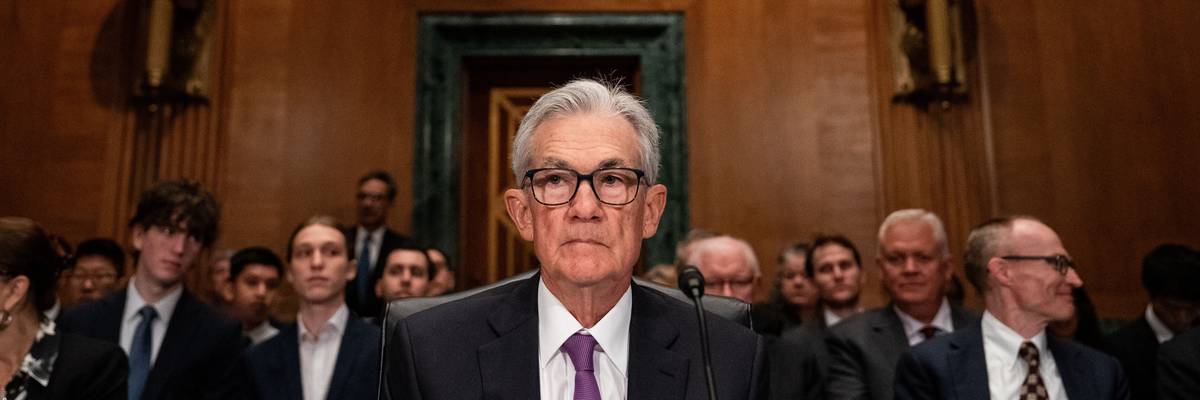
Federal Reserve Chair Jerome Powell arrives for a Senate hearing on March 7, 2024 in Washington, D.C.
Lawmakers warned Federal Reserve Chair Jerome Powell that keeping interest rates high "needlessly worsens housing market imbalances" and "could threaten" workers' jobs and wages.
Progressive lawmakers in the House and Senate urged the Federal Reserve on Monday to begin slashing interest rates in the near future, warning that the increasingly tight monetary conditions the central bank has imposed over the past two years risk imperiling strong post-pandemic job and
wage growth.
In a
letter to Fed Chair Jerome Powell, Sens. Bernie Sanders (I-Vt.) and Elizabeth Warren (D-Mass.) joined 19 House Democrats in calling for a "prompt timeline for future rate reductions," noting that the central bank has hiked rates 11 times since March 2022 and that inflation has nearly fallen "into line with the Federal Reserve's target."
"Today's excessively contractionary monetary policy needlessly worsens housing market imbalances and the unaffordability of home ownership, creates risks for banking stability, and could threaten the achievements of strong employment and wage growth and its attendant reductions in economic and racial inequalities," reads the letter, which was sent a day ahead of the Federal Open Market Committee's (FOMC) March 19-20 meeting.
If the Fed waits too long to begin cutting rates, the lawmakers cautioned, overly restrictive monetary policy could "reduce employment and real wage growth."
"We worry that higher unemployment and a harmful economic slowdown could result from a lagged effect of the prior 11 interest rate hikes since March 2022," the lawmakers added. "We believe it is critical for the FOMC to present the public with a clear and rapid timetable for reducing interest rates, ideally beginning at the May FOMC meeting in order to ensure a strong labor market and full employment for working Americans."
The Federal Reserve has raised interest rates 11 times in the last 2 years, keeping working people from being able to get a raise, a mortgage, or car.
Today, @SenSanders, @SenWarren, and House progressives call on the Fed to finally lower interest rates.https://t.co/VvFNPwZ8lS
— Progressive Caucus (@USProgressives) March 18, 2024
Since the Fed started raising interest rates for the first time since 2018 just over two years ago, progressive lawmakers, advocates, and economists have been arguing that jacking up borrowing was not the solution to inflation fueled in large part by pandemic-related supply chain disruptions and corporate price gouging. According to one recent study by the Groundwork Collaborative, corporate profiteering drove more than half of inflation between April and September 2023.
Last month, following a strong jobs report, Groundwork's Bilal Baydoun called for rate cuts, arguing that "the data is very clear that we never had to sacrifice jobs for lower prices."
"High interest rates will only slow our clean energy transition and put families in more debt," said Baydoun. "Chair Powell must change his tune and cut rates in March."
But the Fed is not expected to announce rate cuts following the two-day FOMC meeting that begins on Tuesday. The Associated Press reported Monday that "Powell and his fellow Fed officials are expected to play it safe when they meet his week, keeping their rate unchanged for a fifth straight time and signaling that they still need further evidence that inflation is returning sustainably to their 2% target."
The Consumer Price Index (CPI) report released last week showed that overall inflation was 3.2% year-over-year—a slight uptick from January's reading but far below the 9.1% peak in 2022.
Hiring, meanwhile, has remained strong even as Powell has explicitly targeted the jobs market and workers' wages. Employers added 275,000 jobs last month, according to the U.S. Labor Department, and unemployment stayed low at 3.9%.
Rep. Pramila Jayapal (D-Wash.), chair of the Congressional Progressive Caucus, said in a statement Monday that "the American economy recovered from Covid because congressional Democrats and President Biden partnered to invest in workers over corporations and created paths to economic security for people who had been locked out before."
"Unnecessarily high rates put all that at risk," Jayapal added. "They will only punish everyday Americans: exacerbating the housing crisis, hindering the deployment of clean energy, and throwing the future of the Biden recovery into uncertainty, while threatening the wages and jobs that our communities depend on. It's past time for the Fed to end this squeeze on working- and middle-class families."
Dear Common Dreams reader, It’s been nearly 30 years since I co-founded Common Dreams with my late wife, Lina Newhouser. We had the radical notion that journalism should serve the public good, not corporate profits. It was clear to us from the outset what it would take to build such a project. No paid advertisements. No corporate sponsors. No millionaire publisher telling us what to think or do. Many people said we wouldn't last a year, but we proved those doubters wrong. Together with a tremendous team of journalists and dedicated staff, we built an independent media outlet free from the constraints of profits and corporate control. Our mission has always been simple: To inform. To inspire. To ignite change for the common good. Building Common Dreams was not easy. Our survival was never guaranteed. When you take on the most powerful forces—Wall Street greed, fossil fuel industry destruction, Big Tech lobbyists, and uber-rich oligarchs who have spent billions upon billions rigging the economy and democracy in their favor—the only bulwark you have is supporters who believe in your work. But here’s the urgent message from me today. It's never been this bad out there. And it's never been this hard to keep us going. At the very moment Common Dreams is most needed, the threats we face are intensifying. We need your support now more than ever. We don't accept corporate advertising and never will. We don't have a paywall because we don't think people should be blocked from critical news based on their ability to pay. Everything we do is funded by the donations of readers like you. When everyone does the little they can afford, we are strong. But if that support retreats or dries up, so do we. Will you donate now to make sure Common Dreams not only survives but thrives? —Craig Brown, Co-founder |
Progressive lawmakers in the House and Senate urged the Federal Reserve on Monday to begin slashing interest rates in the near future, warning that the increasingly tight monetary conditions the central bank has imposed over the past two years risk imperiling strong post-pandemic job and
wage growth.
In a
letter to Fed Chair Jerome Powell, Sens. Bernie Sanders (I-Vt.) and Elizabeth Warren (D-Mass.) joined 19 House Democrats in calling for a "prompt timeline for future rate reductions," noting that the central bank has hiked rates 11 times since March 2022 and that inflation has nearly fallen "into line with the Federal Reserve's target."
"Today's excessively contractionary monetary policy needlessly worsens housing market imbalances and the unaffordability of home ownership, creates risks for banking stability, and could threaten the achievements of strong employment and wage growth and its attendant reductions in economic and racial inequalities," reads the letter, which was sent a day ahead of the Federal Open Market Committee's (FOMC) March 19-20 meeting.
If the Fed waits too long to begin cutting rates, the lawmakers cautioned, overly restrictive monetary policy could "reduce employment and real wage growth."
"We worry that higher unemployment and a harmful economic slowdown could result from a lagged effect of the prior 11 interest rate hikes since March 2022," the lawmakers added. "We believe it is critical for the FOMC to present the public with a clear and rapid timetable for reducing interest rates, ideally beginning at the May FOMC meeting in order to ensure a strong labor market and full employment for working Americans."
The Federal Reserve has raised interest rates 11 times in the last 2 years, keeping working people from being able to get a raise, a mortgage, or car.
Today, @SenSanders, @SenWarren, and House progressives call on the Fed to finally lower interest rates.https://t.co/VvFNPwZ8lS
— Progressive Caucus (@USProgressives) March 18, 2024
Since the Fed started raising interest rates for the first time since 2018 just over two years ago, progressive lawmakers, advocates, and economists have been arguing that jacking up borrowing was not the solution to inflation fueled in large part by pandemic-related supply chain disruptions and corporate price gouging. According to one recent study by the Groundwork Collaborative, corporate profiteering drove more than half of inflation between April and September 2023.
Last month, following a strong jobs report, Groundwork's Bilal Baydoun called for rate cuts, arguing that "the data is very clear that we never had to sacrifice jobs for lower prices."
"High interest rates will only slow our clean energy transition and put families in more debt," said Baydoun. "Chair Powell must change his tune and cut rates in March."
But the Fed is not expected to announce rate cuts following the two-day FOMC meeting that begins on Tuesday. The Associated Press reported Monday that "Powell and his fellow Fed officials are expected to play it safe when they meet his week, keeping their rate unchanged for a fifth straight time and signaling that they still need further evidence that inflation is returning sustainably to their 2% target."
The Consumer Price Index (CPI) report released last week showed that overall inflation was 3.2% year-over-year—a slight uptick from January's reading but far below the 9.1% peak in 2022.
Hiring, meanwhile, has remained strong even as Powell has explicitly targeted the jobs market and workers' wages. Employers added 275,000 jobs last month, according to the U.S. Labor Department, and unemployment stayed low at 3.9%.
Rep. Pramila Jayapal (D-Wash.), chair of the Congressional Progressive Caucus, said in a statement Monday that "the American economy recovered from Covid because congressional Democrats and President Biden partnered to invest in workers over corporations and created paths to economic security for people who had been locked out before."
"Unnecessarily high rates put all that at risk," Jayapal added. "They will only punish everyday Americans: exacerbating the housing crisis, hindering the deployment of clean energy, and throwing the future of the Biden recovery into uncertainty, while threatening the wages and jobs that our communities depend on. It's past time for the Fed to end this squeeze on working- and middle-class families."
Progressive lawmakers in the House and Senate urged the Federal Reserve on Monday to begin slashing interest rates in the near future, warning that the increasingly tight monetary conditions the central bank has imposed over the past two years risk imperiling strong post-pandemic job and
wage growth.
In a
letter to Fed Chair Jerome Powell, Sens. Bernie Sanders (I-Vt.) and Elizabeth Warren (D-Mass.) joined 19 House Democrats in calling for a "prompt timeline for future rate reductions," noting that the central bank has hiked rates 11 times since March 2022 and that inflation has nearly fallen "into line with the Federal Reserve's target."
"Today's excessively contractionary monetary policy needlessly worsens housing market imbalances and the unaffordability of home ownership, creates risks for banking stability, and could threaten the achievements of strong employment and wage growth and its attendant reductions in economic and racial inequalities," reads the letter, which was sent a day ahead of the Federal Open Market Committee's (FOMC) March 19-20 meeting.
If the Fed waits too long to begin cutting rates, the lawmakers cautioned, overly restrictive monetary policy could "reduce employment and real wage growth."
"We worry that higher unemployment and a harmful economic slowdown could result from a lagged effect of the prior 11 interest rate hikes since March 2022," the lawmakers added. "We believe it is critical for the FOMC to present the public with a clear and rapid timetable for reducing interest rates, ideally beginning at the May FOMC meeting in order to ensure a strong labor market and full employment for working Americans."
The Federal Reserve has raised interest rates 11 times in the last 2 years, keeping working people from being able to get a raise, a mortgage, or car.
Today, @SenSanders, @SenWarren, and House progressives call on the Fed to finally lower interest rates.https://t.co/VvFNPwZ8lS
— Progressive Caucus (@USProgressives) March 18, 2024
Since the Fed started raising interest rates for the first time since 2018 just over two years ago, progressive lawmakers, advocates, and economists have been arguing that jacking up borrowing was not the solution to inflation fueled in large part by pandemic-related supply chain disruptions and corporate price gouging. According to one recent study by the Groundwork Collaborative, corporate profiteering drove more than half of inflation between April and September 2023.
Last month, following a strong jobs report, Groundwork's Bilal Baydoun called for rate cuts, arguing that "the data is very clear that we never had to sacrifice jobs for lower prices."
"High interest rates will only slow our clean energy transition and put families in more debt," said Baydoun. "Chair Powell must change his tune and cut rates in March."
But the Fed is not expected to announce rate cuts following the two-day FOMC meeting that begins on Tuesday. The Associated Press reported Monday that "Powell and his fellow Fed officials are expected to play it safe when they meet his week, keeping their rate unchanged for a fifth straight time and signaling that they still need further evidence that inflation is returning sustainably to their 2% target."
The Consumer Price Index (CPI) report released last week showed that overall inflation was 3.2% year-over-year—a slight uptick from January's reading but far below the 9.1% peak in 2022.
Hiring, meanwhile, has remained strong even as Powell has explicitly targeted the jobs market and workers' wages. Employers added 275,000 jobs last month, according to the U.S. Labor Department, and unemployment stayed low at 3.9%.
Rep. Pramila Jayapal (D-Wash.), chair of the Congressional Progressive Caucus, said in a statement Monday that "the American economy recovered from Covid because congressional Democrats and President Biden partnered to invest in workers over corporations and created paths to economic security for people who had been locked out before."
"Unnecessarily high rates put all that at risk," Jayapal added. "They will only punish everyday Americans: exacerbating the housing crisis, hindering the deployment of clean energy, and throwing the future of the Biden recovery into uncertainty, while threatening the wages and jobs that our communities depend on. It's past time for the Fed to end this squeeze on working- and middle-class families."