SUBSCRIBE TO OUR FREE NEWSLETTER
Daily news & progressive opinion—funded by the people, not the corporations—delivered straight to your inbox.
5
#000000
#FFFFFF
To donate by check, phone, or other method, see our More Ways to Give page.
Daily news & progressive opinion—funded by the people, not the corporations—delivered straight to your inbox.
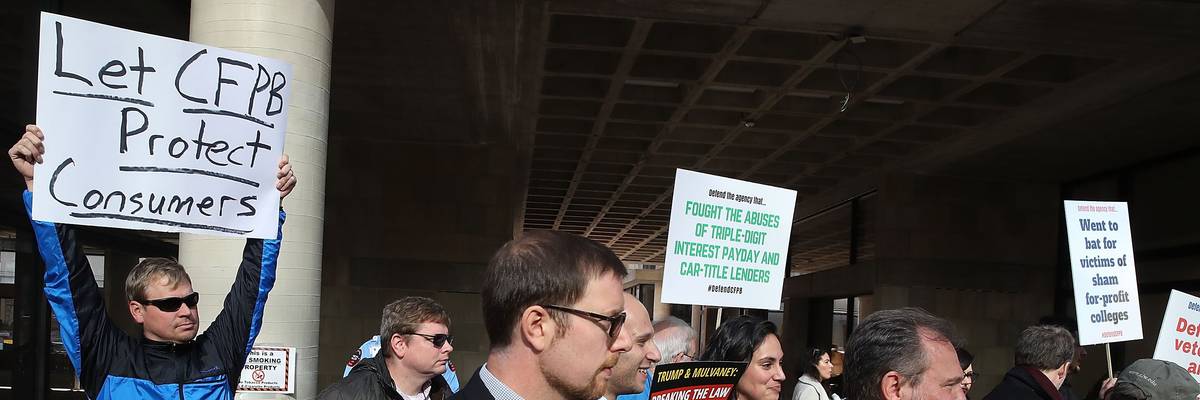
Protesters listen to Sen. Elizabeth Warren (D-Mass.) speak in front of the Consumer Financial Protection Bureau (CFPB) headquarters on November 28, 2017 in Washington, D.C.
"Big bank special interests with a record of discrimination have delivered a one-two punch against the bureau in their own selfish interest to turn away borrowers of color with impunity," said one consumer advocate.
A government watchdog on Tuesday said a federal judge's ruling in Texas blocking the Consumer Financial Protection Bureau from implementing an anti-discrimination rule was the outcome of a "long-running, organized effort by greedy industries" to defang the agency.
Judge Randy Crane, whom former Republican President George W. Bush appointed to be the chief U.S. district judge of the Southern District of Texas, handed down an injunction blocking the CFPB from implementing its rule requiring banks to collect data on loan applications for women-owned, minority-owned, and small businesses to identify and root out potential discrimination.
The ruling applies only to Rio Bank in McAllen, Texas, and members of the Texas Bankers Association (TBA) and American Bankers Association (ABA), which filed a lawsuit earlier this year challenging the rule, claiming it would do "irreparable" harm to banks that would be required to hire and train new employees and install new data collection software in order to comply.
Accountable.US pointed out that members of the banking associations have well-documented histories of discriminating against small business loan applicants in exactly the way the rule set out to eliminate.
"Anyone paying attention knows this latest legal assault against the CFPB has nothing to do with upholding the Constitution and everything to do with keeping the agency from protecting borrowers from industry discrimination and abuse," said Liz Zelnick, director of the economic security and corporate power program at Accountable.US. "Big bank special interests with a record of discrimination have delivered a one-two punch against the bureau in their own selfish interest to turn away borrowers of color with impunity."
"The bankers' case that discrimination is just a normal part of doing business only makes a stronger case for why everyday Americans need the bureau to stay strong, independent, and free from political influence in Congress," she added.
The group noted that ABA board member JPMorgan Chase settled with the U.S. Department of Justice in 2017 for $55 million over allegations of discrimination against mortgage borrowers who were members of minority groups. The CFPB has also fined Washington Federal Bank—whose president and CEO is on the trade group's board of directors—a total of $234,000 for data errors that the agency said could perpetuate discrimination.
The ABA and TBA also joined the U.S. Chamber of Commerce in filing a separate lawsuit last year to challenge the CFPB's crackdown on discrimination; the plaintiffs in that case have spent nearly $1 million to settle discrimination cases in the past decade.
Jesse Van Tol, president and CEO of the National Community Reinvestment Coalition, accused the Wall Street groups of "tedious whining."
"It's a ludicrous and retrograde position to take, in effect asserting a right to discriminate in secret to illegally deprive marginalized communities of economic opportunity," Van Tol told Bloomberg Law on Monday.
In October the U.S. Supreme Court is scheduled to hear arguments in the CFPB's appeal of a ruling last year which found the agency's funding structure through the Federal Reserve violates the Constitution's appropriations clause.
"If the financial industry is allowed to slam the door on Americans seeking financial services on the basis of identity without consequence, it will keep many families from getting ahead," said Zelnick on Tuesday. "If the special interests successfully cripple the CFPB's ability to protect all consumers, it will make it that much harder to grow the middle class."
Dear Common Dreams reader, It’s been nearly 30 years since I co-founded Common Dreams with my late wife, Lina Newhouser. We had the radical notion that journalism should serve the public good, not corporate profits. It was clear to us from the outset what it would take to build such a project. No paid advertisements. No corporate sponsors. No millionaire publisher telling us what to think or do. Many people said we wouldn't last a year, but we proved those doubters wrong. Together with a tremendous team of journalists and dedicated staff, we built an independent media outlet free from the constraints of profits and corporate control. Our mission has always been simple: To inform. To inspire. To ignite change for the common good. Building Common Dreams was not easy. Our survival was never guaranteed. When you take on the most powerful forces—Wall Street greed, fossil fuel industry destruction, Big Tech lobbyists, and uber-rich oligarchs who have spent billions upon billions rigging the economy and democracy in their favor—the only bulwark you have is supporters who believe in your work. But here’s the urgent message from me today. It's never been this bad out there. And it's never been this hard to keep us going. At the very moment Common Dreams is most needed, the threats we face are intensifying. We need your support now more than ever. We don't accept corporate advertising and never will. We don't have a paywall because we don't think people should be blocked from critical news based on their ability to pay. Everything we do is funded by the donations of readers like you. When everyone does the little they can afford, we are strong. But if that support retreats or dries up, so do we. Will you donate now to make sure Common Dreams not only survives but thrives? —Craig Brown, Co-founder |
A government watchdog on Tuesday said a federal judge's ruling in Texas blocking the Consumer Financial Protection Bureau from implementing an anti-discrimination rule was the outcome of a "long-running, organized effort by greedy industries" to defang the agency.
Judge Randy Crane, whom former Republican President George W. Bush appointed to be the chief U.S. district judge of the Southern District of Texas, handed down an injunction blocking the CFPB from implementing its rule requiring banks to collect data on loan applications for women-owned, minority-owned, and small businesses to identify and root out potential discrimination.
The ruling applies only to Rio Bank in McAllen, Texas, and members of the Texas Bankers Association (TBA) and American Bankers Association (ABA), which filed a lawsuit earlier this year challenging the rule, claiming it would do "irreparable" harm to banks that would be required to hire and train new employees and install new data collection software in order to comply.
Accountable.US pointed out that members of the banking associations have well-documented histories of discriminating against small business loan applicants in exactly the way the rule set out to eliminate.
"Anyone paying attention knows this latest legal assault against the CFPB has nothing to do with upholding the Constitution and everything to do with keeping the agency from protecting borrowers from industry discrimination and abuse," said Liz Zelnick, director of the economic security and corporate power program at Accountable.US. "Big bank special interests with a record of discrimination have delivered a one-two punch against the bureau in their own selfish interest to turn away borrowers of color with impunity."
"The bankers' case that discrimination is just a normal part of doing business only makes a stronger case for why everyday Americans need the bureau to stay strong, independent, and free from political influence in Congress," she added.
The group noted that ABA board member JPMorgan Chase settled with the U.S. Department of Justice in 2017 for $55 million over allegations of discrimination against mortgage borrowers who were members of minority groups. The CFPB has also fined Washington Federal Bank—whose president and CEO is on the trade group's board of directors—a total of $234,000 for data errors that the agency said could perpetuate discrimination.
The ABA and TBA also joined the U.S. Chamber of Commerce in filing a separate lawsuit last year to challenge the CFPB's crackdown on discrimination; the plaintiffs in that case have spent nearly $1 million to settle discrimination cases in the past decade.
Jesse Van Tol, president and CEO of the National Community Reinvestment Coalition, accused the Wall Street groups of "tedious whining."
"It's a ludicrous and retrograde position to take, in effect asserting a right to discriminate in secret to illegally deprive marginalized communities of economic opportunity," Van Tol told Bloomberg Law on Monday.
In October the U.S. Supreme Court is scheduled to hear arguments in the CFPB's appeal of a ruling last year which found the agency's funding structure through the Federal Reserve violates the Constitution's appropriations clause.
"If the financial industry is allowed to slam the door on Americans seeking financial services on the basis of identity without consequence, it will keep many families from getting ahead," said Zelnick on Tuesday. "If the special interests successfully cripple the CFPB's ability to protect all consumers, it will make it that much harder to grow the middle class."
A government watchdog on Tuesday said a federal judge's ruling in Texas blocking the Consumer Financial Protection Bureau from implementing an anti-discrimination rule was the outcome of a "long-running, organized effort by greedy industries" to defang the agency.
Judge Randy Crane, whom former Republican President George W. Bush appointed to be the chief U.S. district judge of the Southern District of Texas, handed down an injunction blocking the CFPB from implementing its rule requiring banks to collect data on loan applications for women-owned, minority-owned, and small businesses to identify and root out potential discrimination.
The ruling applies only to Rio Bank in McAllen, Texas, and members of the Texas Bankers Association (TBA) and American Bankers Association (ABA), which filed a lawsuit earlier this year challenging the rule, claiming it would do "irreparable" harm to banks that would be required to hire and train new employees and install new data collection software in order to comply.
Accountable.US pointed out that members of the banking associations have well-documented histories of discriminating against small business loan applicants in exactly the way the rule set out to eliminate.
"Anyone paying attention knows this latest legal assault against the CFPB has nothing to do with upholding the Constitution and everything to do with keeping the agency from protecting borrowers from industry discrimination and abuse," said Liz Zelnick, director of the economic security and corporate power program at Accountable.US. "Big bank special interests with a record of discrimination have delivered a one-two punch against the bureau in their own selfish interest to turn away borrowers of color with impunity."
"The bankers' case that discrimination is just a normal part of doing business only makes a stronger case for why everyday Americans need the bureau to stay strong, independent, and free from political influence in Congress," she added.
The group noted that ABA board member JPMorgan Chase settled with the U.S. Department of Justice in 2017 for $55 million over allegations of discrimination against mortgage borrowers who were members of minority groups. The CFPB has also fined Washington Federal Bank—whose president and CEO is on the trade group's board of directors—a total of $234,000 for data errors that the agency said could perpetuate discrimination.
The ABA and TBA also joined the U.S. Chamber of Commerce in filing a separate lawsuit last year to challenge the CFPB's crackdown on discrimination; the plaintiffs in that case have spent nearly $1 million to settle discrimination cases in the past decade.
Jesse Van Tol, president and CEO of the National Community Reinvestment Coalition, accused the Wall Street groups of "tedious whining."
"It's a ludicrous and retrograde position to take, in effect asserting a right to discriminate in secret to illegally deprive marginalized communities of economic opportunity," Van Tol told Bloomberg Law on Monday.
In October the U.S. Supreme Court is scheduled to hear arguments in the CFPB's appeal of a ruling last year which found the agency's funding structure through the Federal Reserve violates the Constitution's appropriations clause.
"If the financial industry is allowed to slam the door on Americans seeking financial services on the basis of identity without consequence, it will keep many families from getting ahead," said Zelnick on Tuesday. "If the special interests successfully cripple the CFPB's ability to protect all consumers, it will make it that much harder to grow the middle class."