SUBSCRIBE TO OUR FREE NEWSLETTER
Daily news & progressive opinion—funded by the people, not the corporations—delivered straight to your inbox.
5
#000000
#FFFFFF
To donate by check, phone, or other method, see our More Ways to Give page.
Daily news & progressive opinion—funded by the people, not the corporations—delivered straight to your inbox.
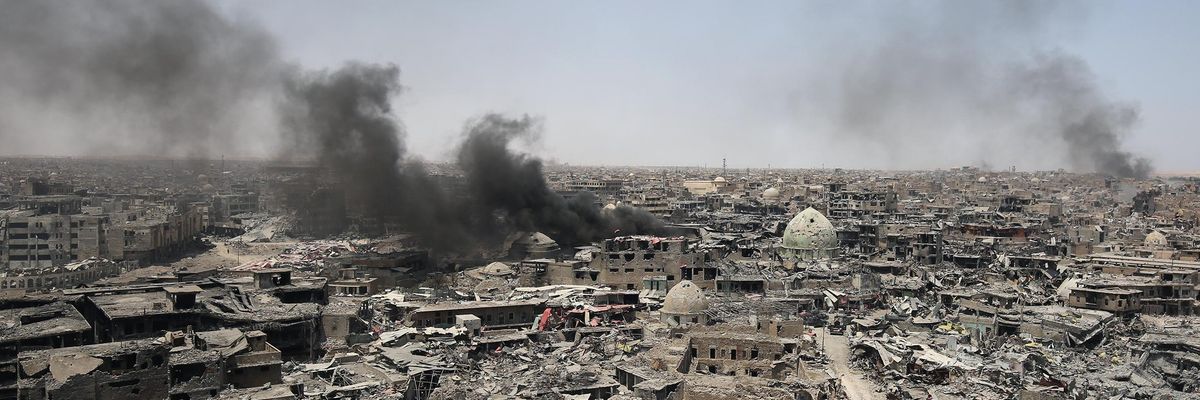
The Iraqi city of Mosul was largely destroyed during fighting between U.S.-led coalition forces and Islamic State militants in 2017. Thousands of civilians were killed or wounded, many of them by ferocious U.S. and allied aerial bombing.
"Britain claims a 'perfect' war against Islamic State in Iraq," said a report co-author. "It isn't credible, and it isn't true."
British airstrikes targeting Islamic State militants in Iraq and Syria likely killed dozens of noncombatants despite claims by U.K. military leaders that no civilians died during such bombings, a major investigation by the monitor group Airwars and The Guardian revealed on Tuesday.
"Britain claims a 'perfect' war against Islamic State in Iraq. Thousands of missiles fired, thousands of fighters killed, and not a single civilian harmed," Guardian senior international affairs reporter and report co-author Emma Graham-Harrison tweeted. "It isn't credible, and it isn't true."
Airwars obtained via Freedom of Information Act requests previously classified documents from which the group identified eight airstrikes that may have been carried out by U.K. warplanes in which at least 32 civilians were killed.
"Working with The Guardian, we visited Iraq to search for the victims mentioned in the original casualty allegations and piece together what happened," said Airwars. "One of those we found was the Younis family in Mosul."
Using declassified reports, coalition statements, survivor and other witness interviews, and 3D modeling, Airwars reconstructed the November 29, 2016 strike that killed a 6-year-old member of the Younis family in the Iraqi city.
"We found that shortly before 4:00 pm a mission commander requested a strike on ISIS militants firing at Iraqi allies. After the strike was approved, coalition analysts reported losing sight of their initial targets," the group said. "They ultimately identified another group of males on the sidewalk carrying a 'possible' weapon."
Around this time, Enam Younis and her children left their home "looking for safety a few streets away. Both Enam and her father said there were no ISIS fighters within 30 meters. As they walked past the door of the neighboring house, the missile detonated."
As The Guardian reports:
Enam Younis, 31 at the time, was thrown to the ground by the blast and has never walked again. Her older daughter, Taiba, 6, inquisitive and desperate to start school, was killed instantly. Zahra, just 3, was hurled over a fence. She survived but was peppered with shrapnel that tore into her stomach and is still lodged deep in her skull. Doctors have said that if it moves, it could cause devastating brain injury.
There was a third child, Ali, a toddler too young to walk, who was shielded from the drone cameras—and the worst of the blast—by his mother's arms, but who still lost part of a foot and hand.
Younis was taken out of Mosul for treatment and even six years later, her memories are too painful for her to return to the city she called home. "It is still impossible for me to think about going to Mosul now," she said weeping. "I didn't even visit my daughter's grave. I can't do it."
A U.K. Ministry of Defense spokesperson declined to confirm or deny whether British forces carried out any of the airstrikes detailed in the investigation while insisting that "there is no evidence or indication that civilian casualties were caused by strikes in Syria and Iraq."
"The U.K. always minimizes the risk of civilian casualties through our rigorous processes and carefully examines a range of evidence to do this, including comprehensive analysis of the mission data for every strike," the spokesperson told The Guardian.
However, according to Airwars:
Politicians, campaigners, and civil society groups have consistently raised concerns about the U.K.'s lack of civilian harm monitoring and accountability in Iraq and Syria. The Netherlands has since paid millions in compensation to victims of its strikes, while the United States has launched major policy reforms to learn the lessons of the campaign. The U.K. remains an outlier, claiming it had robust mechanisms for monitoring the impact of its strikes—including post-strike battle damage assessments—and refusing to review its policies.
Airwars has also accused U.S. officials of habitually undercounting the number of civilians killed by American bombs and bullets.
The report notes that while "civilian victims of U.K. airstrikes can theoretically claim condolence payments from the British government," those attempting to do so "would face severe procedural and legal hurdles."
"The U.K. has not publicly compensated a single victim of a British airstrike and there is no clear process for victims and their families to apply," Airwars said.
The U.S.-led coalition victory over ISIS was achieved at a tremendous cost of civilian life. Cities, towns, and villages including Mosul and Raqqa, Syria were largely reduced to rubble.
Airwars estimates that between 8,197 and 13,254 Iraqi and Syrian civilians have been killed by U.S.-led coalition forces in 1,525 separate strikes since 2014. This figure stands in stark contrast with a coalition estimate of 1,437 civilians killed in 342 separate incidents.
Since the U.S.-led invasion of Iraq 20 years ago, between 550,000 and 580,000 Iraqis and Syrians have died, according to Airwars.
Dear Common Dreams reader, It’s been nearly 30 years since I co-founded Common Dreams with my late wife, Lina Newhouser. We had the radical notion that journalism should serve the public good, not corporate profits. It was clear to us from the outset what it would take to build such a project. No paid advertisements. No corporate sponsors. No millionaire publisher telling us what to think or do. Many people said we wouldn't last a year, but we proved those doubters wrong. Together with a tremendous team of journalists and dedicated staff, we built an independent media outlet free from the constraints of profits and corporate control. Our mission has always been simple: To inform. To inspire. To ignite change for the common good. Building Common Dreams was not easy. Our survival was never guaranteed. When you take on the most powerful forces—Wall Street greed, fossil fuel industry destruction, Big Tech lobbyists, and uber-rich oligarchs who have spent billions upon billions rigging the economy and democracy in their favor—the only bulwark you have is supporters who believe in your work. But here’s the urgent message from me today. It's never been this bad out there. And it's never been this hard to keep us going. At the very moment Common Dreams is most needed, the threats we face are intensifying. We need your support now more than ever. We don't accept corporate advertising and never will. We don't have a paywall because we don't think people should be blocked from critical news based on their ability to pay. Everything we do is funded by the donations of readers like you. When everyone does the little they can afford, we are strong. But if that support retreats or dries up, so do we. Will you donate now to make sure Common Dreams not only survives but thrives? —Craig Brown, Co-founder |
British airstrikes targeting Islamic State militants in Iraq and Syria likely killed dozens of noncombatants despite claims by U.K. military leaders that no civilians died during such bombings, a major investigation by the monitor group Airwars and The Guardian revealed on Tuesday.
"Britain claims a 'perfect' war against Islamic State in Iraq. Thousands of missiles fired, thousands of fighters killed, and not a single civilian harmed," Guardian senior international affairs reporter and report co-author Emma Graham-Harrison tweeted. "It isn't credible, and it isn't true."
Airwars obtained via Freedom of Information Act requests previously classified documents from which the group identified eight airstrikes that may have been carried out by U.K. warplanes in which at least 32 civilians were killed.
"Working with The Guardian, we visited Iraq to search for the victims mentioned in the original casualty allegations and piece together what happened," said Airwars. "One of those we found was the Younis family in Mosul."
Using declassified reports, coalition statements, survivor and other witness interviews, and 3D modeling, Airwars reconstructed the November 29, 2016 strike that killed a 6-year-old member of the Younis family in the Iraqi city.
"We found that shortly before 4:00 pm a mission commander requested a strike on ISIS militants firing at Iraqi allies. After the strike was approved, coalition analysts reported losing sight of their initial targets," the group said. "They ultimately identified another group of males on the sidewalk carrying a 'possible' weapon."
Around this time, Enam Younis and her children left their home "looking for safety a few streets away. Both Enam and her father said there were no ISIS fighters within 30 meters. As they walked past the door of the neighboring house, the missile detonated."
As The Guardian reports:
Enam Younis, 31 at the time, was thrown to the ground by the blast and has never walked again. Her older daughter, Taiba, 6, inquisitive and desperate to start school, was killed instantly. Zahra, just 3, was hurled over a fence. She survived but was peppered with shrapnel that tore into her stomach and is still lodged deep in her skull. Doctors have said that if it moves, it could cause devastating brain injury.
There was a third child, Ali, a toddler too young to walk, who was shielded from the drone cameras—and the worst of the blast—by his mother's arms, but who still lost part of a foot and hand.
Younis was taken out of Mosul for treatment and even six years later, her memories are too painful for her to return to the city she called home. "It is still impossible for me to think about going to Mosul now," she said weeping. "I didn't even visit my daughter's grave. I can't do it."
A U.K. Ministry of Defense spokesperson declined to confirm or deny whether British forces carried out any of the airstrikes detailed in the investigation while insisting that "there is no evidence or indication that civilian casualties were caused by strikes in Syria and Iraq."
"The U.K. always minimizes the risk of civilian casualties through our rigorous processes and carefully examines a range of evidence to do this, including comprehensive analysis of the mission data for every strike," the spokesperson told The Guardian.
However, according to Airwars:
Politicians, campaigners, and civil society groups have consistently raised concerns about the U.K.'s lack of civilian harm monitoring and accountability in Iraq and Syria. The Netherlands has since paid millions in compensation to victims of its strikes, while the United States has launched major policy reforms to learn the lessons of the campaign. The U.K. remains an outlier, claiming it had robust mechanisms for monitoring the impact of its strikes—including post-strike battle damage assessments—and refusing to review its policies.
Airwars has also accused U.S. officials of habitually undercounting the number of civilians killed by American bombs and bullets.
The report notes that while "civilian victims of U.K. airstrikes can theoretically claim condolence payments from the British government," those attempting to do so "would face severe procedural and legal hurdles."
"The U.K. has not publicly compensated a single victim of a British airstrike and there is no clear process for victims and their families to apply," Airwars said.
The U.S.-led coalition victory over ISIS was achieved at a tremendous cost of civilian life. Cities, towns, and villages including Mosul and Raqqa, Syria were largely reduced to rubble.
Airwars estimates that between 8,197 and 13,254 Iraqi and Syrian civilians have been killed by U.S.-led coalition forces in 1,525 separate strikes since 2014. This figure stands in stark contrast with a coalition estimate of 1,437 civilians killed in 342 separate incidents.
Since the U.S.-led invasion of Iraq 20 years ago, between 550,000 and 580,000 Iraqis and Syrians have died, according to Airwars.
British airstrikes targeting Islamic State militants in Iraq and Syria likely killed dozens of noncombatants despite claims by U.K. military leaders that no civilians died during such bombings, a major investigation by the monitor group Airwars and The Guardian revealed on Tuesday.
"Britain claims a 'perfect' war against Islamic State in Iraq. Thousands of missiles fired, thousands of fighters killed, and not a single civilian harmed," Guardian senior international affairs reporter and report co-author Emma Graham-Harrison tweeted. "It isn't credible, and it isn't true."
Airwars obtained via Freedom of Information Act requests previously classified documents from which the group identified eight airstrikes that may have been carried out by U.K. warplanes in which at least 32 civilians were killed.
"Working with The Guardian, we visited Iraq to search for the victims mentioned in the original casualty allegations and piece together what happened," said Airwars. "One of those we found was the Younis family in Mosul."
Using declassified reports, coalition statements, survivor and other witness interviews, and 3D modeling, Airwars reconstructed the November 29, 2016 strike that killed a 6-year-old member of the Younis family in the Iraqi city.
"We found that shortly before 4:00 pm a mission commander requested a strike on ISIS militants firing at Iraqi allies. After the strike was approved, coalition analysts reported losing sight of their initial targets," the group said. "They ultimately identified another group of males on the sidewalk carrying a 'possible' weapon."
Around this time, Enam Younis and her children left their home "looking for safety a few streets away. Both Enam and her father said there were no ISIS fighters within 30 meters. As they walked past the door of the neighboring house, the missile detonated."
As The Guardian reports:
Enam Younis, 31 at the time, was thrown to the ground by the blast and has never walked again. Her older daughter, Taiba, 6, inquisitive and desperate to start school, was killed instantly. Zahra, just 3, was hurled over a fence. She survived but was peppered with shrapnel that tore into her stomach and is still lodged deep in her skull. Doctors have said that if it moves, it could cause devastating brain injury.
There was a third child, Ali, a toddler too young to walk, who was shielded from the drone cameras—and the worst of the blast—by his mother's arms, but who still lost part of a foot and hand.
Younis was taken out of Mosul for treatment and even six years later, her memories are too painful for her to return to the city she called home. "It is still impossible for me to think about going to Mosul now," she said weeping. "I didn't even visit my daughter's grave. I can't do it."
A U.K. Ministry of Defense spokesperson declined to confirm or deny whether British forces carried out any of the airstrikes detailed in the investigation while insisting that "there is no evidence or indication that civilian casualties were caused by strikes in Syria and Iraq."
"The U.K. always minimizes the risk of civilian casualties through our rigorous processes and carefully examines a range of evidence to do this, including comprehensive analysis of the mission data for every strike," the spokesperson told The Guardian.
However, according to Airwars:
Politicians, campaigners, and civil society groups have consistently raised concerns about the U.K.'s lack of civilian harm monitoring and accountability in Iraq and Syria. The Netherlands has since paid millions in compensation to victims of its strikes, while the United States has launched major policy reforms to learn the lessons of the campaign. The U.K. remains an outlier, claiming it had robust mechanisms for monitoring the impact of its strikes—including post-strike battle damage assessments—and refusing to review its policies.
Airwars has also accused U.S. officials of habitually undercounting the number of civilians killed by American bombs and bullets.
The report notes that while "civilian victims of U.K. airstrikes can theoretically claim condolence payments from the British government," those attempting to do so "would face severe procedural and legal hurdles."
"The U.K. has not publicly compensated a single victim of a British airstrike and there is no clear process for victims and their families to apply," Airwars said.
The U.S.-led coalition victory over ISIS was achieved at a tremendous cost of civilian life. Cities, towns, and villages including Mosul and Raqqa, Syria were largely reduced to rubble.
Airwars estimates that between 8,197 and 13,254 Iraqi and Syrian civilians have been killed by U.S.-led coalition forces in 1,525 separate strikes since 2014. This figure stands in stark contrast with a coalition estimate of 1,437 civilians killed in 342 separate incidents.
Since the U.S.-led invasion of Iraq 20 years ago, between 550,000 and 580,000 Iraqis and Syrians have died, according to Airwars.