

SUBSCRIBE TO OUR FREE NEWSLETTER
Daily news & progressive opinion—funded by the people, not the corporations—delivered straight to your inbox.
5
#000000
#FFFFFF
To donate by check, phone, or other method, see our More Ways to Give page.
Daily news & progressive opinion—funded by the people, not the corporations—delivered straight to your inbox.
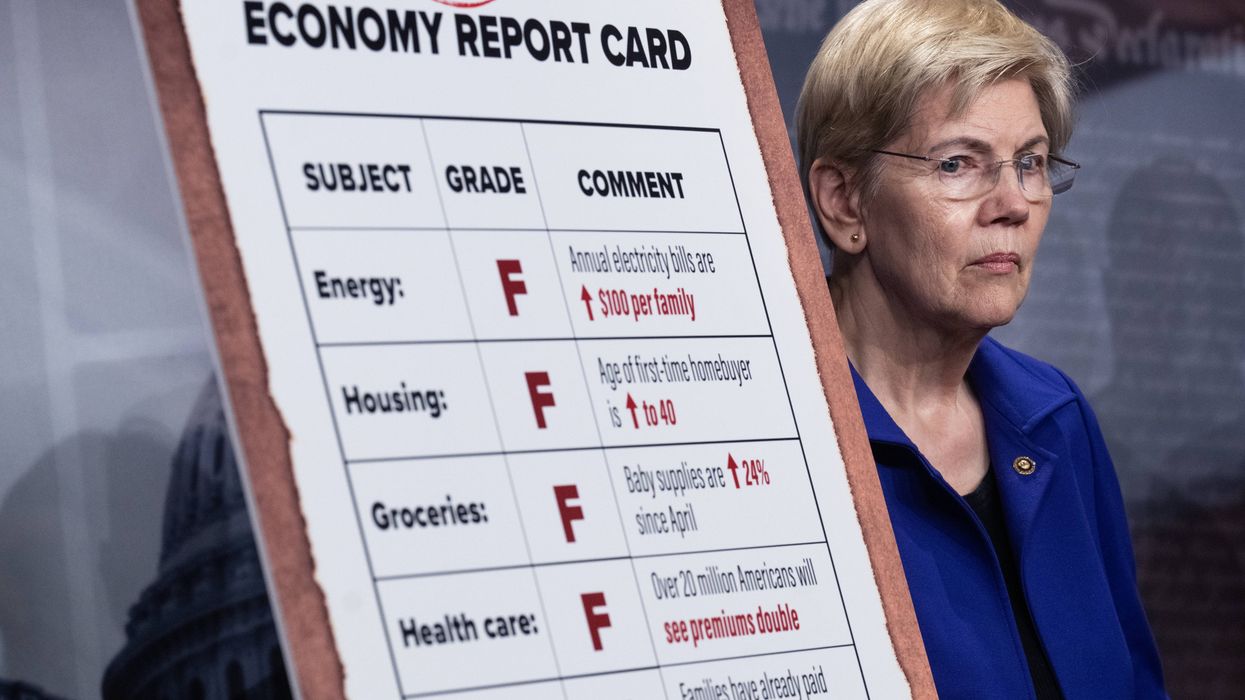
In a recent focus group, one voter who supported the president in 2024 said Trump's recent claims that the economy is strong were "delusional."
New polling from The Guardian on Monday bolstered recent analyses that have shown low consumer confidence and job creation numbers and higher household costs and unemployment: Americans are struggling under President Donald Trump's economic policies, and they increasingly believe the White House—for all Trump's claims that the economy is strong—is to blame.
The poll, conducted by Harris for the news outlet between December 11 and 13, found that respondents were twice as likely to say their financial security is getting worse as they were to report an improvement.
Nearly half of those surveyed said their financial situation is worsening, and 57% said they perceived that the US is in a recession—although that would be defined by two quarters of negative growth in the US economy, which the country has not experienced at this point.
Despite that, the poll—along with recent focus groups including members of Trump's 2024 base, held by Syracuse University and reported on Monday by NBC News—illustrated how Trump's focus on imposing tariffs on countries around the world and his promotion of policies that have raised household bills for millions of people have left Americans feeling pessimistic about their own financial health and that of the country.
Democratic voters were far more likely than Republicans to tell Harris that their financial security is getting worse, with 52% of the latter saying so compared with 27% of the former.
But 54% of independent voters agreed that they are struggling more financially, despite Trump's recent claim that he would give the economy a grade of "A-plus-plus-plus-plus-plus.”
"We have seen a shift among these voters collectively, cracks in their faith, more questioning, oscillating, or outright change of heart about Trump."
Respondents from across the political spectrum were more likely than ever before to blame the White House for their financial struggles, Harris said.
More than three-quarters of Democrats blamed Trump's policies and "government management of the economy," along with 72% of independents and more than half of Republicans—55%.
Analyses this year have shown Trump's tariffs, which he claimed soon after taking office would "liberate" Americans from the national debt, are raising costs for small businesses and making it harder for them to stay afloat, and are passing on higher prices to consumers—resulting in ballooning grocery bills for millions of Americans.
Trump made lowering grocery prices a central promise of his campaign last year, along with repeatedly pledging that he was "going to get your energy prices down by 50%.”
But the president's embrace of artificial intelligence and the expansion of data centers—something he and congressional Republicans have aggressively pushed states to allow despite public disapproval—is unlikely to result in lower utility prices for households. Those costs have risen by 13% since Trump took office, with the president's cancellation of renewable energy projects to blame as well as energy-sucking data centers.
The focus groups held by Syracuse recently found that voters who supported the president last year have rapidly grown discouraged by his economic policies, including his tariffs, which one participant called "a tax on the American people."
"That’s who pays for it, so I don’t support it,” David S. of New Jersey told NBC. “The people who are buying those imports are paying the tax.”
With less than a year until voters are set to decide if Republicans should keep their majorities in the US House and Senate, fewer than half of the people surveyed in four focus groups said they believed Trump has made it a priority to fight inflation and reduce their costs. Robert L. of Virginia told Syracuse researchers that the president's recent comments painting a sunny picture of the economy were "delusional."
Another Virginia voter, Justin K., said the president has been focused on "prosecuting his political enemies" and "pardoning people" and has not "tried at all" to tackle the rising cost of living.
A number of those surveyed said they had decided to back Democratic candidates Abigail Spanberger and Mikie Sherrill in this year's gubernatorial elections in Virginia and New Jersey just a year after supporting Trump.
"Many of these voters gave President Trump a long runway well into the summer because they believed that he understands how business works better than they do and that his own fortune would eventually translate to enriching the country and their own finances," Margaret Talev, director of Syracuse University’s Institute for Democracy, Journalism, and Citizenship, told NBC on Monday.
"But as the year wore on, we have seen a shift among these voters collectively, cracks in their faith, more questioning, oscillating, or outright change of heart about Trump," Talev said. "What we almost never see is a wish for a do-over vote or a rush toward Democrats for the answer."

"Though a step in the right direction," said one legal advocate, "this is not enough to end Microsoft's complicity in the genocide perpetrated by Israel."
After multiple exposés and international protests about Microsoft's "genocidal collaboration" with the Israel Defense Forces, the tech giant told employees on Thursday that it cut the IDF off from certain cloud storage and artificial intelligence technology.
Microsoft launched a review last month, after The Guardian, +972 Magazine, and Local Call reported that the IDF's Unit 8200 was using the cloud platform Azure to store data from "millions of mobile phone calls made each day by Palestinians" in the illegally occupied West Bank and the Gaza Strip, where Israeli forces have killed at least tens of thousands of people over the past two years.
"We have reviewed The Guardian's allegations based on two principles, both grounded in Microsoft's longstanding protection of privacy as a fundamental right," Brad Smith, the company's vice chair and president, wrote to employees. "First, we do not provide technology to facilitate mass surveillance of civilians... Second, we respect and protect the privacy rights of our customers."
"While our review is ongoing, we have found evidence that supports elements of The Guardian's reporting," he continued. Thus, Microsoft has informed Israel's Ministry of Defense (IMOD) of its "decision to cease and disable specified IMOD subscriptions and their services, including their use of specific cloud storage and AI services and technologies."
"I want to note our appreciation for the reporting of The Guardian," he added. "I'll share more information in the coming days and weeks, when it's appropriate to do so, including lessons learned from this review and how we will apply those lessons as we go forward."
Shoutout to the Microsoft worker organizers who have been tirelessly (and often at the cost of their jobs) pushing Microsoft- not nearly enough but just another brick to crumble
[image or embed]
— Molly Shah (@mommunism.bsky.social) September 25, 2025 at 11:31 AM
The newspaper reported Thursday that, according to a document it obtained, a senior Microsoft executive similarly told IMOD late last week that the company "is not in the business of facilitating the mass surveillance of civilians" and "while our review is ongoing, we have at this juncture identified evidence that supports elements of The Guardian's reporting."
As The Guardian noted:
The termination is the first known case of a US technology company withdrawing services provided to the Israeli military since the beginning of its war on Gaza.
The decision has not affected Microsoft's wider commercial relationship with the IDF, which is a longstanding client and will retain access to other services.
The outlets involved in the August 6 reporting—and others, including The Associated Press and Drop Site News—have reported on Microsoft's relationship with the Israeli military throughout the year.
Drop Site's Ryan Grim highlighted that the company's decision is "a major victory for dissident Microsoft workers, who have been protesting intensely internally."
Microsoft employees have protested the company's ties to Israel since even before this year's reporting. For example, the "No Azure for Apartheid" petition was written by workers and shared internally in May 2024, to mark the 76th year of the Nakba—which means catastrophe in Arabic and is used to describe the ethnic cleansing of Palestine to establish the modern state of Israel.
No Azure for Apartheid on Thursday called the announcement "an unprecedented win" that "has only been possible because of the sustained pressure by our campaign," but also emphasized that "this action is insufficient."
"Today, on the 719th day of the genocide, the Israeli military, armed with Microsoft technology, is intensifying its genocidal campaign by invading Gaza City, forcibly starving more than 2 million Palestinians, and expanding ethnic cleansing in the West Bank," the campaign said. "By choosing to maintain this deep partnership with the Israeli military, Microsoft insists on continuing to serve as the technological backbone to the ongoing genocide and apartheid. At a time when countries around the globe are imposing arms embargoes on the Israeli military, our demand for a digital arms embargo has never been more critical."
Last month, seven current and former Microsoft workers were arrested after occupying Smith's office in Redmond, Washington, to protest the company's complicity in "the first AI-powered genocide." According to No Azure for Apartheid, the company has fired five employees following protests at its headquarters.
There have also been actions by critics outside Microsoft, including an August demonstration at a data center in the Netherlands.
Sabrene Odeh, community legal advocate at the Washington state chapter of the Council on American-Islamic Relations (CAIR-WA), said in a Thursday statement that "though a step in the right direction, this is not enough to end Microsoft's complicity in the genocide perpetrated by Israel. Tech workers, across the board, have been sounding the alarm for two years with serious concerns over how technology is being used against civilians."
"If Microsoft is ready to end its complicity," Odeh continued, "it must listen to the brave tech workers in its base—who have been discriminated against, let go, and even quit their jobs because they no longer can be accomplices to the crimes Israel is committing—and end all ties with Israel."
CAIR-WA executive director Imraan Siddiqi stressed that it's not just Microsoft, arguing that "all tech companies must completely divest from their activities supporting the ongoing genocide of Palestinians and ensure that their employees who speak up against human rights abuses are protected."
This article has been updated with comment from No Azure for Apartheid.
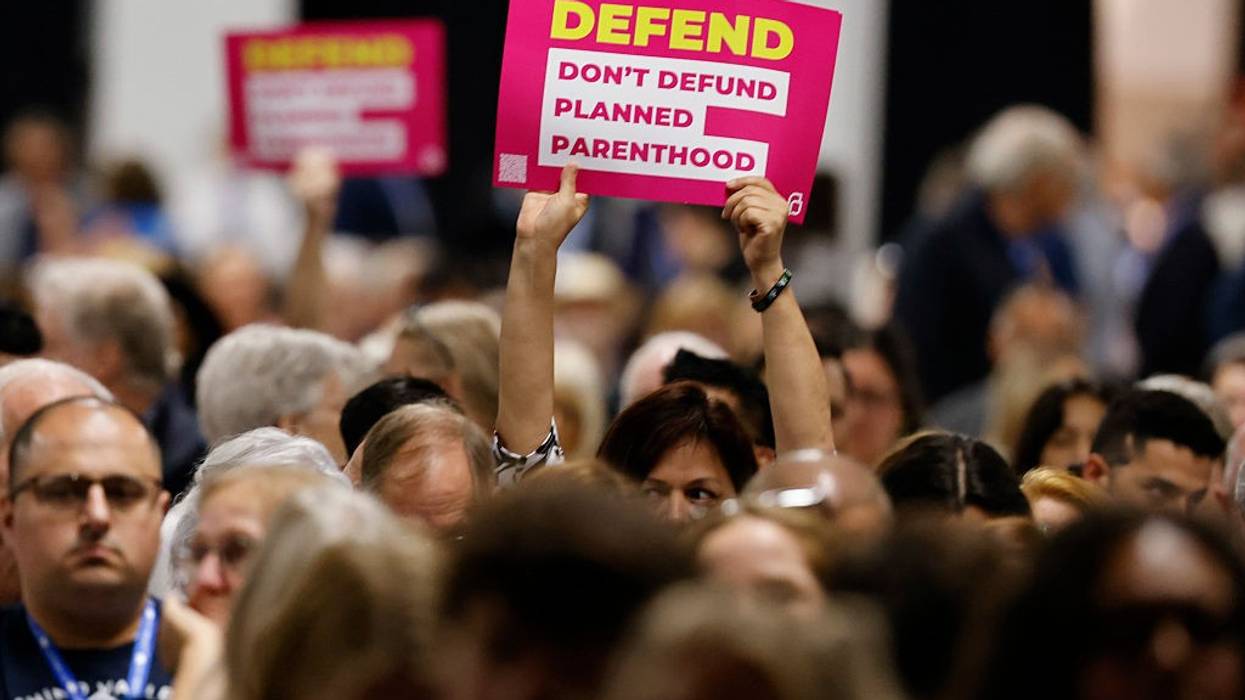
"We have been fighting to hold together an unsustainable infrastructure as the landscape shifts around us and an onslaught of attacks continues," said the head of Planned Parenthood North Central States.
On the heels of Planned Parenthood announcing clinic closures in the Midwest last month, The Guardian published a Monday analysis showing that the reproductive healthcare provider has closed or disclosed plans to shutter at least 20 locations across seven states since the beginning of the year "amid immense financial and political turbulence."
"The Planned Parenthood network, which operates nearly 600 clinics through a web of independent regional affiliates and is overseen by the Planned Parenthood Federation of America, is facing a number of threats from the Trump administration," the newspaper reported, detailing closures in Illinois, Iowa, Michigan, Minnesota, New York, Utah, and Vermont.
In a May statement, Planned Parenthood North Central States (PPNCS) detailed cost-saving closures, consolidation, and layoffs impacting eight health centers in Iowa and Minnesota, and stressed that "dangerous attacks on care continue."
"My heart hurts as we announce the closure of health centers and the departure of trusted and talented colleagues, but our patients come first—always," said Ruth Richardson, president and CEO of PPNCS. "We have been fighting to hold together an unsustainable infrastructure as the landscape shifts around us and an onslaught of attacks continues."
Since the U.S. Supreme Court empowered abortion opponents by reversing Roe v. Wade with the Dobbs v. Jackson Women's Health Organization decision in 2022, those attacks have included the freezing of Title X funds and Republicans in the U.S. House of Representatives voting last month to advance a reconciliation package that would defund Planned Parenthood.
In response to the House's May vote, Jessica Barquist, Kayla Montgomery, and Lisa Margulies, vice presidents of public affairs at Planned Parenthood of Northern New England (PPNNE), said, "To be clear, 'defunding' Planned Parenthood and taking away health insurance from millions will do nothing to lower healthcare costs, address challenges in our healthcare system, or save lives."
"Taking healthcare away from people struggling to deal with rising costs and preventing people from using their health insurance at their trusted provider is cruel," they continued. "We know what happens when people lose access to care: they skip cancer screenings, delay STI testing, miss birth control appointments. These delays lead to worsened health outcomes and more costly emergency care down the line."
In addition to warning of "catastrophic" consequences for patients, the trio highlighted that "analysis from the Congressional Budget Office finds 'defunding' Planned Parenthood would cost $300 million and is the only provision in the healthcare portion of the bill that would increase the deficit."
PPNNE in April announced the closure of a Vermont health center, citing "serious financial hardship." Nicole Clegg, president and CEO of the regional group, said at the time that the decision was "very difficult" and "PPNNE attempted many different investments and organizational changes to tackle the complexities of delivering care in St. Johnsbury, but the challenges persisted."
That same month, Planned Parenthood Association of Utah (PPAU) said that it had to restructure due to the Trump administration's attacks, "including the recent withholding of $2.8 million in Title X funding."
"The painful decisions to close Logan and St. George health centers, reduce PPAU's staff, and increase service fees are forced on us by the Trump administration," declared PPAU interim CEO Sarah Stoesz. "We believe that by consolidating our healthcare delivery and expanding telehealth, we will be in a better position to continue serving those who rely on us for healthcare."
Planned Parenthood of Michigan (PPMI) also revealed in April that it "is reducing its brick-and-mortar footprint and reorganizing operations statewide," which includes closing three health centers in Jackson, Petoskey, and Marquette; consolidating two clinics in Ann Arbor; and expanding its telehealth offerings.
PPMI president and CEO Paula Thornton Greear said at the time that "the Trump administration and its anti-abortion allies have made clear their intention to defund Planned Parenthood and attack access to sexual and reproductive healthcare nationwide," and "these necessary changes strengthen PPMI's ability to adapt quickly in a challenging political landscape."
The Guardian noted that PPMI "was not among the Planned Parenthood affiliates that saw their Title X funding frozen," and "did not immediately respond to a request for comment about the clinic closures and the role of Title X in those closures."
According to the newspaper:
Planned Parenthood’s financial woes have raised eyebrows for some advocates of abortion rights and reproductive health. The organization has weathered several crises, including allegations of mismanagement, in the years since Roe collapsed—but as the face of U.S. abortion access it continued to rake in donations. (Most abortions in the US are in fact performed by small "independent" clinics, which are grappling with their own financial turmoil.) As of June 2023, the Planned Parenthood network had about $3 billion in assets, according to its 2024 report.
In March, Planned Parenthood of Greater New York (PPGNY) announced it would put its property that houses the Manhattan Health Center up for sale as part of an "ongoing strategy to ensure future, long-term patient access for underserved communities throughout New York state."
Just two days after U.S. President Donald Trump returned to office in January—following a campaign in which the Republican tried to downplay how much voters care about reproductive rights while also bragging about his role in reversing Roe—Planned Parenthood of Illinois (PPIL) said it would close four health centers, downsize administrative staff, and boost telehealth.
Illinois, a blue state surrounded by red ones, saw an influx of "abortion refugees" post-Dobbs. PPIL interim president and CEO Tonya Tucker said in January that "we made plans for the patient surge, however, rising care costs and lower reimbursement rates from insurers is jeopardizing PPIL's sustainability."
"Unfortunately, this is the reality many other Planned Parenthood affiliates are facing in the rapidly evolving healthcare environment," Tucker added. "We are making the difficult decisions today so we can continue providing care tomorrow and well into the future."
Other recent reporting has also highlighted how reproductive healthcare providers, particularly those that offer abortion, are struggling to stay open, even in places where politicians haven't passed laws that make it harder to end pregnancies.
"At least 17 clinics closed last year in states where abortion remains legal," NPR reported last month, citing the Guttmacher Institute. "Experts say the closures indicate that financial and operational challenges, rather than future legal bans, may be the biggest threats to abortion access in states whose laws still protect it."
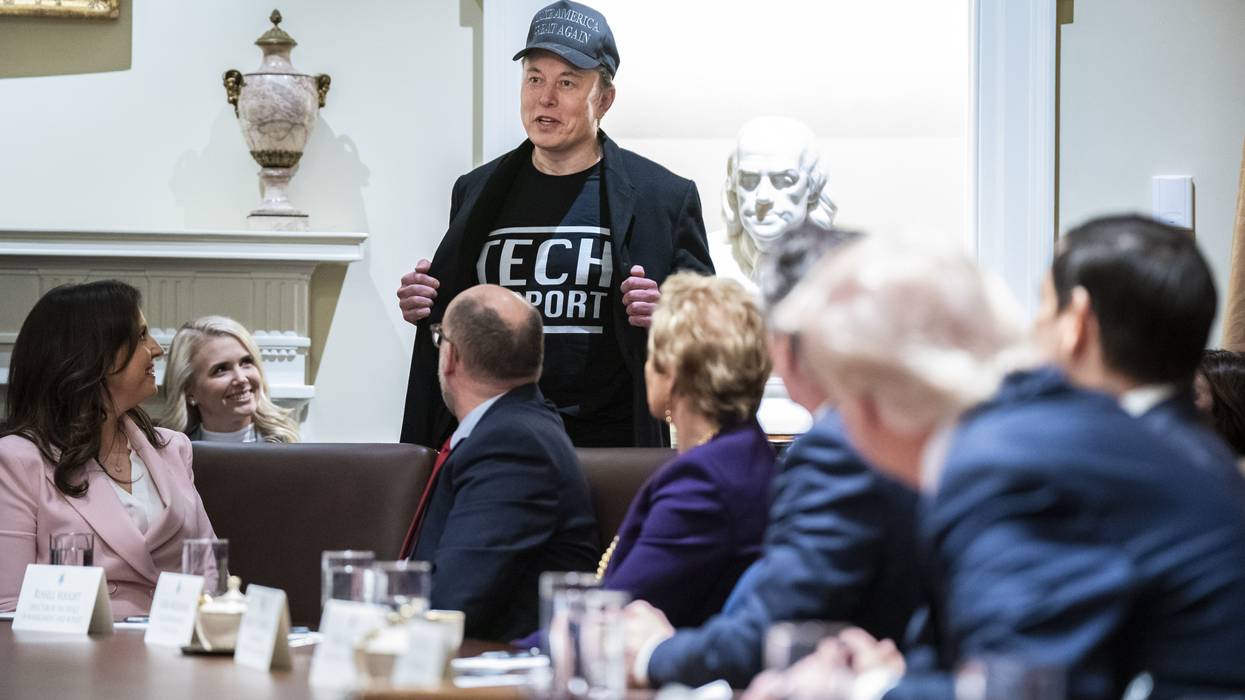
"We have been told they are looking for anti-Trump or anti-Musk language," an anonymous source said of potential surveillance at the U.S. Environmental Protection Agency.
Staff with the U.S. Environmental Protection Agency fear that billionaire and presidential adviser Elon Musk's Department of Government Efficiency is spying on them using artificial intelligence, according to reporting from Reuters, The Guardian, and Crooked Media's newsletter What a Day.
According to Reuters reporting published Tuesday, Trump administration officials told some managers at the EPA that DOGE is rolling out AI to monitor for communications that may be perceived as hostile to U.S. President Donald Trump or Musk, citing two unnamed sources with knowledge of the situation.
According to those two sources, who relayed comments made by Trump-appointed officials in posts at the EPA, DOGE was using AI to monitor communication apps such as Microsoft Teams. "Be careful what you say, what you type, and what you do," an EPA manager said, according to one of the sources.
"We have been told they are looking for anti-Trump or anti-Musk language," a third source told Reuters.
The outlet, however, could not independently confirm whether AI was being implemented.
After the story was published, the EPA told Reuters in a statement that it was "looking at AI to better optimize agency functions and administrative efficiencies." However, the agency said it was not using AI "as it makes personnel decisions in concert with DOGE." The EPA also did not directly address whether it was using AI to snoop on employees.
In response to Reuters' reporting, the government accountability group Citizens for Responsibility and Ethics in Washington wrote on X, "Let's be clear: the career civil servants who work in the government serve the American people, not Donald Trump."
According to Thursday reporting from The Guardian and Reuters, EPA managers told employees during a Wednesday morning meeting that DOGE is "using AI to scan through agency communications to find any anti-Musk, anti-Doge, or anti-Trump statements," according to an employee who was quoted anonymously.
Since returning to power, Trump has launched an all-out assault on environmental protection, including through cuts to programs and personnel at the EPA. According to The New York Times, the EPA has already undergone a 3% staff reduction so far, but the agency also plans to eliminate its scientific research arm, which would mean dismissing as many as 1,155 scientists, according to reporting from last month. EPA Administrator Lee Zeldin has also said he would like to cut 65% of the agency's budget.
The Guardian and What a Day also reviewed an email from a manager at the Association of Clean Water Administrators, a group of state and interstate bodies that works with the EPA on water quality and management, which warned workers that meetings with EPA employees might be monitored by AI.
"We recently learned that all EPA phones (landline/mobile), all Teams/Zoom virtual meetings, and calendar entries are being transcribed/monitored," the email states. The recorded information is then fed into an "AI tool" which analyzes and scrutinizes what has been recorded. "I do not know if DOGE is doing the analysis or … the agency itself," according to the author of the email, per The Guardian and What a Day.
The EPA denied that it's recording meetings, but it did not address the question of an AI tool, according to the outlets.
According to The Guardian and What a Day, employees at other agencies also fear they are being surveilled. For example, a U.S. Department of Veterans Affairs official warned employees that virtual meetings are being recorded in secret, according to an email reviewed by the two outlets. In February, managers at the National Oceanic and Atmospheric Administration warned some workers to be careful about what they say on calls, per an employee there.
"It's like being in a horror film where you know something out there [wants] to kill you but you never know when or how or who it is," one anonymously quoted employee from the U.S. Department of Housing and Urban Development told The Guardian and What a Day, evoking the climate of fear that is rife among government workers.

"All records of dead and injured have been confiscated by authorities," said one doctor. "We are not allowed to talk. Senior government officials are visiting the hospital to hide the records."
The Guardian reported Wednesday that at least 17 civilians in Pakistan were killed and hundreds more were wounded by army and paramilitary gunfire at protesters and one doctor in Islamabad claimed that authorities were attempting to cover up deaths.
"At least seven have died and four are in critical condition in the hospital," according to the unnamed doctor, who said that on Tuesday night he treated over 40 patients, many injured by gunfire. "Eight more have been admitted to the hospital with bullet wounds."
"All records of dead and injured have been confiscated by authorities," added the emergency doctor, who requested anonymity for his safety. "We are not allowed to talk. Senior government officials are visiting the hospital to hide the records."
The newspaper noted that its reporter "witnessed at least five patients with bullet wounds in one hospital, which was surrounded by police."
"Yet again, protestors in Pakistan have faced a brutal and lethal crackdown shrouded in a callous opacity by the authorities."
Supporters of jailed former Prime Minister Imran Khan and his political party Pakistan Tehreek-e-Insaf (PTI) have converged on Islamabad this week. Troops were supposedly given "shoot-on-site" orders as the protesters closed in on D-Chowk, a popular square in the capital near multiple government buildings, calling for fair elections and the release of Khan, who says the charges against him are politically motivated.
"Islamabad's police chief, Ali Rizvi, denied that live ammunition had been used during the operation, which he said police had conducted alongside paramilitary forces," Reuters reported. "Rizvi said 600 protesters had been arrested in Tuesday's operation, bringing the total since the protest sit-in began on Sunday to 954."
The office of Pakistani Interior Minister Mohsin Naqvi said in a statement that "as of now, no death has been reported, and the claims circulating regarding any such incidents are baseless and unverified."
According to Reuters:
Visiting protest sites on Wednesday, Naqvi said law enforcement agencies had successfully cleared protesters from the site of the sit-in and other areas of the capital.
He called on PTI to provide any evidence of the firing of live ammunition by security forces, and said it had not provided any details of deaths of its supporters.
PTI said on social media Tuesday that "a massacre has unfolded in Pakistan at the hands of security forces under the brutal, fascist military regime led by the Shehbaz-Zardari-Asim alliance. The nation is drowning in blood. Today, armed security forces launched a violent assault on peaceful PTI protesters in Islamabad, firing live rounds with the intent to kill as many people as possible."
On Wednesday, PTI highlighted The Guardian's reporting—calling it "alarming"—and shared an image of protesters that the party said are "confirmed dead as a result of direct firing by security forces."
Multiple U.S. lawmakers have condemned the crackdown on PTI protesters in Pakistan. Congressman Ro Khanna (D-Calif.), who has spoken out multiple times this week, took note of The Guardian's reporting on Wednesday.
"Horrified by reports of an attempted cover-up of the alleged killings of peaceful protesters by Asim Munir's regime in Pakistan," Khanna said, referring to Pakistan's chief of the army staff. "The U.S. must impose visa bans and asset freezes on senior officials in the military regime."
Drop Site News journalist Murtaza Hussain explained that "visa bans and asset freezes on Pakistani officials would be [a] nuclear event," because "everyone knows their assets are all in Western countries where they also spend all their free time."
Amnesty International, which on Tuesday demanded that the government rescind the shoot-on-site orders and "exercise maximum restraint" in response to protests, issued a Wednesday statement calling for an urgent and transparent investigation.
"Yet again, protestors in Pakistan have faced a brutal and lethal crackdown shrouded in a callous opacity by the authorities," said Babu Ram Pant, Amnesty's deputy regional director for South Asia. "The escalation of violence, shutdown of mobile internet services, mass detentions, and alarming rhetoric against PTI protesters by the authorities speaks of a pattern of intolerance for the right to freedom of peaceful assembly throughout the country. Similar clampdowns against Baloch and Pashtun protesters were witnessed earlier this year."
"Disturbing reports and testimonies regarding the unlawful use of force including lethal ammunition against protesters, during a government-enforced communication blackout, are emerging from yesterday," the campaigner noted. "Continued restrictions on reporting by media and independent observers have made it difficult to verify the number of casualties and raise urgent questions about accountability for human rights abuses."
"Amnesty International calls for a prompt, thorough, impartial, effective, and transparent investigation into the deaths and injuries of protesters as well as the unlawful use of force including lethal and less-lethal weapons by security personnel," he added. "Authorities must also immediately release all protesters detained solely for exercising their right to freedom of peaceful assembly."

Republican nominee Donald Trump "wants to do away with all regulations and open up the floodgates for the fossil fuel industry and the nuclear industry," she said. "So the choice is very clear."
Actor and activist Jane Fonda took aim at Republican U.S. presidential nominee Donald Trump and his climate-wrecking plans in comments published Monday from her wide-ranging conversation with CBS News, The Guardian, and Rolling Stone.
The interview with Fonda, which took place in California earlier this month, was coordinated by Covering Climate Now and is set to air on "CBS Saturday Morning" on September 28. It comes as she travels the country to support climate champions including Vice President Kamala Harris and Minnesota Gov. Tim Walz, the Democrats taking on Trump and Sen. JD Vance (R-Ohio) in the November election.
Trump "invited all the CEOs of the fossil fuel industry to Mar-a-Lago" and promised to roll back the Biden administration's progress on the climate crisis for just $1 billion in campaign cash, Fonda highlighted, warning that "the future of the planet is at stake."
"This is a collective crisis, and it requires a collective solution," she continued. "[Trump] wants to do away with all regulations and open up the floodgates for the fossil fuel industry and the nuclear industry. So the choice is very clear, do we vote for the future, or do we vote for burning up the planet?"
"We have the solution to the climate crisis, why don't we employ it, instead of allowing a bunch of rich people to destroy everything that's been created by humankind?"
The longtime activist, who is taking time off from acting to focus on this year's elections, acknowledged that some voters who lean toward Democrats, particularly younger people, are angry with Harris, especially over U.S. support for Israel's assault on the Gaza Strip. However, she argued, "to sit this out or to vote for a third-party candidate, is to allow fascism."
"That will elect somebody who will deny you any voice in the future of the United States," Fonda stressed. "Vote for a voice if you really care about Gaza, vote to have a voice so that you can do something about it, and then be ready to turn out into the streets by the millions and fight for it… If the young people stay home, we're going to lose."
"Every candidate has issues. Nobody's perfect, but the Harris-Walz ticket is the ticket that will allow us to fight, to get the solutions that climate scientists are saying we need," she said. "They give us a chance, at least, to fight. They give us a platform on which we can try to pressure."
In addition to backing the Democratic presidential ticket—including by knocking on doors in Michigan, a key swing state—the 86-year-old is working to elect candidates endorsed by the Jane Fonda Climate Political Action Committee (PAC), which she founded in 2022, after she was arrested five times during Fire Drill Fridays, a protest series she started with Greenpeace USA a few years earlier.
The PAC is now supporting over 100 candidates at the local level, "where the really robust work is being done on climate," according to Fonda. The group only endorses candidates who don't take money from the fossil fuel industry, which she said has a "stranglehold over our government."
"We've had so many moderate Democrats that blocked the climate solutions we need because they take money from the fossil fuel industry," she noted. "It's very hard to stand up to the people that are supporting your candidacy."
"We are being killed with cancer, heart diseases, because of the burning of fossil fuel," Fonda said. "We have the solution to the climate crisis, why don't we employ it, instead of allowing a bunch of rich people to destroy everything that's been created by humankind? We've got to rise up."
"You need millions of people in the streets," she said, also emphasizing that "you need people in the halls of power with ears and a heart to hear the protests, to hear the demands."
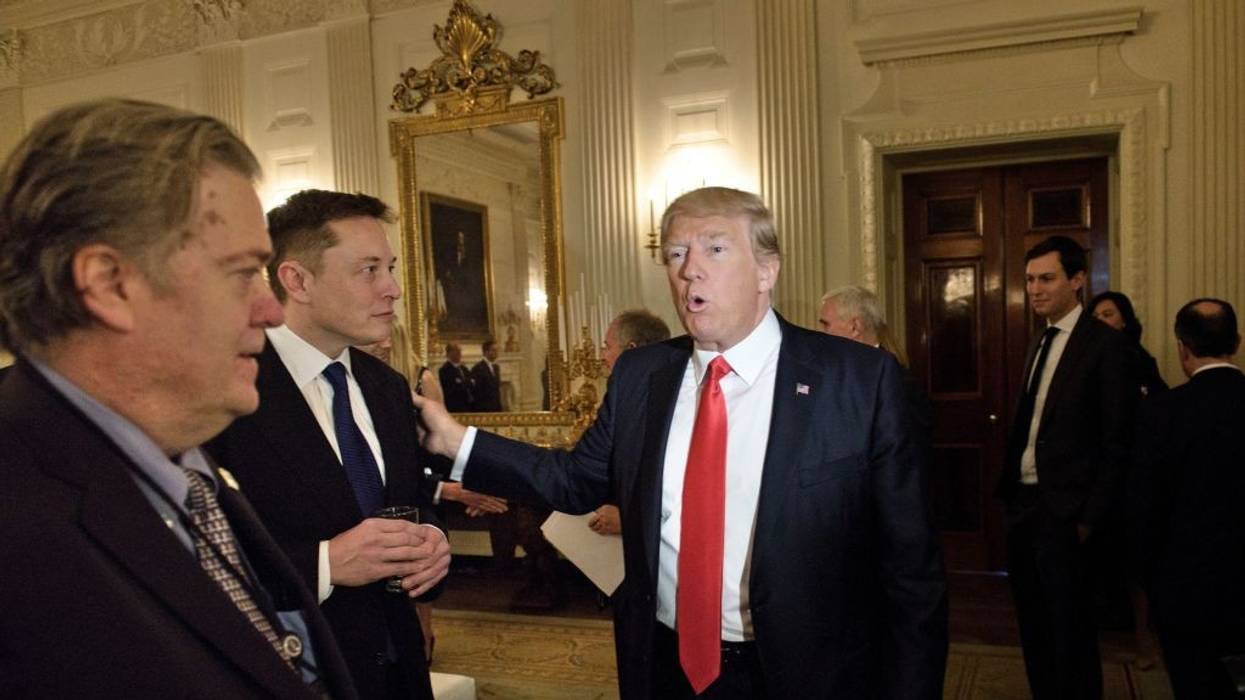
"Why is Musk doing this?" asked 350.org co-founder Bill McKibben. "My only conjecture is that he hopes the world will become barren enough that we simply have to pony up for his big trip to Mars."
Elon Musk thinks he knows more about climate issues than the entire staff of a major international newspaper, but on Wednesday, experts on the planetary emergency offered the billionaire businessman a reality check.
Responding to a Guardian article critical of Monday's glitch- and lie-laden interview of former U.S. President Donald Trump on Musk's X social media platform, Musk proclaimed that "my little fingernail knows more about climate issues than the entire staff of The Guardian."
Bill McKibben, who co-founded the climate action group 350.org, is quoted in that article calling the Musk-Trump interview "the dumbest climate conversation of all time."
Responding to Musk's diss, McKibben said Wednesday on X that he would "be pleased to debate you (or your little fingernail) at any point about why we don't, in fact, have a century to spare in solving this crisis."
Climate scientist Michael Mann, who calls Musk a "climate denier" in the Guardian piece, also weighed in, telling Musk on X that "if you've got a beef, take it up with me."
Some X users noted that once upon a time, Musk—who is the CEO of electric carmaker Tesla—acknowledged the urgency of the climate crisis. In 2018, he said: "Why not go renewable now and avoid [the] increasing risk of climate catastrophe? Betting that science is wrong and oil companies are right, is the dumbest experiment in history, by far."
In an opinion piece published Tuesday by Common Dreams, McKibben noted that after Musk—who endorsed Trump and created a pro-Trump super political action committee—the former president's biggest funder may be fracking billionaire Harold Hamm.
"He took Trump up on his offer that for a billion dollars he'd give the oil industry whatever it wanted, and he's been working the phones ever since," McKibben wrote of Hamm.
Trump returned the favor by calling Hamm "so boring to be with... because all he wants to talk about is oil and gas."
During his first White House run, Trump infamously called climate change "a Chinese hoax." He staffed his administration with climate deniers and rolled back previous administrations' climate policies under the "drill, baby, drill" mantra popularized by former Alaska governor and GOP vice presidential candidate Sarah Palin.
"Why is Musk doing this?" McKibben asked. "Who knows? After all, the success of Tesla has been mostly driven by government subsidy that grows out of the effort to slow the growth of carbon in the atmosphere."
"My only conjecture," McKibben added, "is that he hopes the world will become barren enough that we simply have to pony up for his big trip to Mars."

The planes tracked by a new Guardian report belong to celebrities, billionaires, CEOs, and their families, among them the Murdoch family, Taylor Swift, and the Rolling Stones.
The private jets of just 200 rich and famous individuals or groups released around 415,518 metric tons of climate-heating carbon dioxide between January 2022 and September 22, 2023, The Guardian revealed Tuesday.
That's equal to the emissions burned by nearly 40,000 British residents in all aspects of their lives, the newspaper calculated.
The planes tracked by the outlet belong to celebrities, billionaires, CEOs, and their families, among them the Murdoch family, Taylor Swift, and the Rolling Stones. All told, the high-flyers made a total of 44,739 trips during the study period for a combined 11 years in the air.
"Pollution for wasteful luxury has to be the first to go, we need a ban on private jets."
Notable emitters included the Blavatnik family, the Murdoch family, and Eric Schmidt, whose flights during the 21-month study period released more than 7,500 metric tons of carbon dioxide equivalent. The Sawiris family emitted around 7,500 metric tons, and Lorenzo Fertitta more than 5,000.
The Rolling Stones' Boeing 767 wide-body aircraft released around 5,046 metric tons of carbon dioxide, which is equal to 1,763 economy flights from London to New York. The 39 jets owned by 30 Russian oligarchs released 30,701 metric tons of carbon dioxide.
For comparison, average per capita emissions were 14.44 metric tons in the U.S. for 2022, 13.52 metric tons in Russia in 2021, and 5.2 metric tons in the U.K. the same year.
Taylor Swift was the only celebrity or billionaire in the report whose team responded to a request for comment.
"Before the tour kicked off in March of 2023, Taylor bought more than double the carbon credits needed to offset all tour travel," a spokesperson for the pop star told The Guardian.
Swift appears to have responded to public pressure to reduce private jet use. Her plane averaged 19 flights a month between January and August 2022, when she received criticism after sustainability firm Yard named her the celebrity who used her plane the most. After that point, the plane's average monthly flights dropped to two.
The Guardian's investigation was based on private aircraft registrations compiled by TheAirTraffic Database and flight records from OpenSky. Reporters calculated flight emissions based on model information found in the ADSBExchange Aircraft database and Planespotters.net and emissions per hour per model found in the Conklin & De Decker's CO2 calculator and the Eurocontrol emission calculator.
The report was released the day after an Oxfam study found that the world's richest 1% emitted the same amount as its poorest two-thirds. Given their high carbon footprint and luxury status, private jets have emerged as a rallying point for the climate justice movement.
"It's hugely unfair that rich people can wreck the climate this way, in just one flight polluting more than driving a car 23,000 kilometers," Greenpeace E.U. transport campaigner Thomas Gelin said in March. "Pollution for wasteful luxury has to be the first to go, we need a ban on private jets."
In the U.S., a group of climate campaigners is mobilizing to stop the expansion of Massachusetts' Hanscom Field, the largest private jet field in New England. An October report found that flights from that field between January 1, 2022, and July 15, 2023, released a total of 106,676 tons of carbon emissions.
"While plenty of business is no doubt discussed over golf at Aberdeen, Scotland, or at bird hunting reserves in Argentina (destinations we also documented), this is probably the least defensible form of luxury travel on a warming planet when a Zoom call would often do," Chuck Collins, who co-authored the Hanscom report, wrote for Fortune on November 14.

The U.K. paper confirmed it had removed the letter because of its sudden surge in popularity on TikTok and other social media sites.
The Guardian has removed Osama bin Laden's "Letter to the American People," which had been on its website for more than 20 years, after it went viral on TikTok and other social media sites.
"This page previously displayed a document containing, in translation, the full text of Osama bin Laden's 'Letter to the American People,' as reported in The Observer on Sunday 24 November 2002," the page previously hosting the letter now reads. "The document, which was published here on the same day, was removed on 15 November 2023."
In the letter, which is still available via web archive, bin Laden outlines his grievances against the United States, including its support for Israel, its placement of military bases in Islamic countries, and its participation in or support of other military actions or economic sanctions against people in the Islamic world. He justifies his attacks on U.S. civilians by arguing that they have the power to vote for governments that support different policies. Bin Laden also makes homophobic and antisemitic remarks, including blaming Jews as a group for the excesses of U.S. capitalism.
"The transcript published on our website 20 years ago has been widely shared on social media without the full context."
The letter saw a surprising resurgence on TikTok over the past two days, as posters documented their responses to reading it for the first time.
"The TikToks are from people of all ages, races, ethnicities, and backgrounds," journalist Yashar Ali wrote on social media. "Many of them say that reading the letter has opened their eyes, and they'll never see geopolitical matters the same way again. Many of them—and I have watched a lot—say it has made them reevaluate their perspective on how what is often labeled as terrorism can be a legitimate form of resistance to a hostile power."
The Wrap sourced the trend to a video posted by Lynnette Adkins that TikTok says is currently unavailable.
"I need everyone to stop doing what they're doing right now and go read 'Letter to America,' I feel like I'm going through an existential crisis right now," Adkins reportedly said.
Ali said he saw thousands of similar videos on TikTok and more on other social media platforms. 404 Media reported Wednesday that searching for "Letter to America" on TikTok brought up a few dozen results, some with as many as hundreds of thousands of views. Videos using the hashtag #LettertoAmerica have together generated 1.3 million views. However, the outlet noted that some of the videos were "not particularly viral by TikTok standards." The top-liked video had 75,000 likes, but true TikTok phenomenons can bee seen hundreds of millions of times. It also noted that not all of the videos expressed support for bin Laden's views: Some simply explained the letter, the trend, or the 9/11 attacks.
The Guardian confirmed to both The Wrap and 404 Media that it had removed the letter because of its surge in online popularity.
"The transcript published on our website 20 years ago has been widely shared on social media without the full context," the paper said in the statement. "Therefore we have decided to take it down and direct readers to the news article that originally contextualized it instead."
404 Media noted that removing the letter absent major factual errors or danger to life was a "highly unusual move," one that has only prompted more commentary on TikTok and other social media platforms.
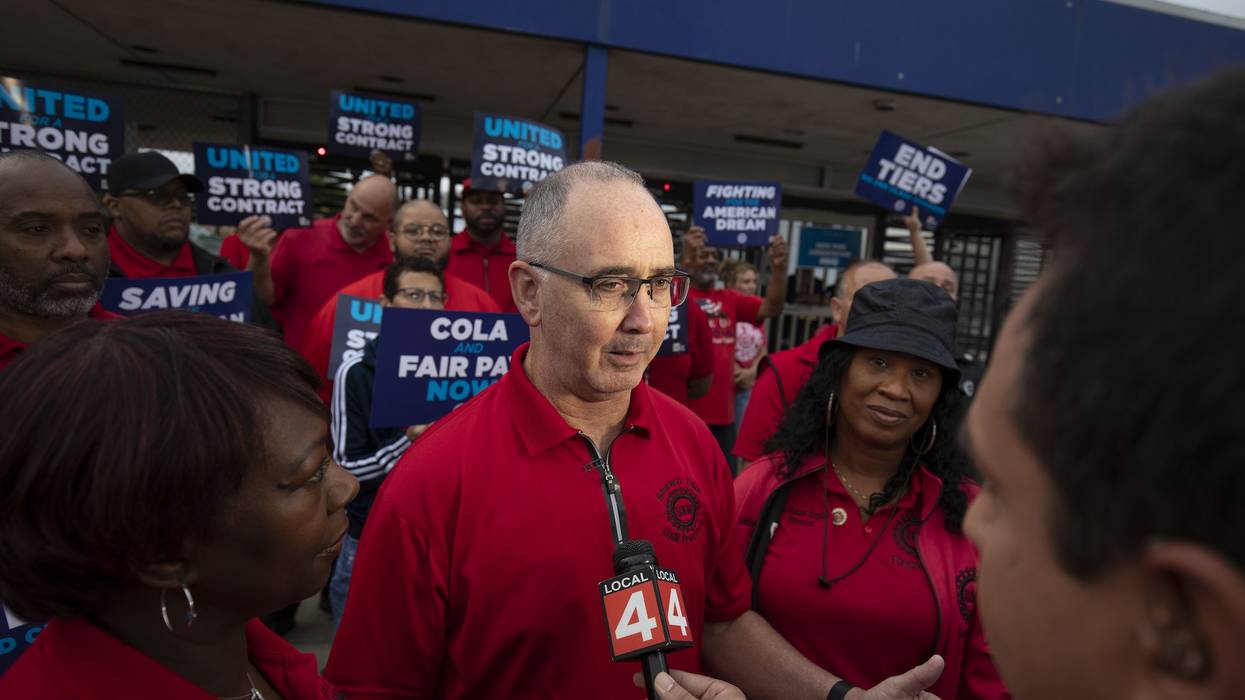
"The government should invest in U.S. manufacturing but money can't go to companies with no strings attached," said United Auto Workers President Shawn Fain. "There should be labor standards built in, this is the future of the car industry at stake."
The president of the United Auto Workers on Tuesday called on U.S. President Joe Biden to use his position of power to help ensure a just transition to electric vehicles—pushing for a major investment in green technology that would also guarantee that workers in the U.S. can earn a decent living in the evolving auto industry.
Biden's actions on the electric vehicle (EV) front, Shawn Fain told The Guardian, have been "disappointing."
It has been a year since the president signed his signature climate and jobs law, the Inflation Reduction Act, which includes incentives for car companies to ramp up manufacturing of EVs and for consumers to purchase them.
The law has paved the way for the "Big Three" automakers—Ford, Stellantis, and General Motors (GM)—to build EV battery plants in joint ventures with companies such as Samsung, SK On, and LG Energy Solution, but the federal incentives and loans have been given to the firms without the guarantee of fair pay and working conditions for the people who will work in the plants.
"We have to make sure endorsements are earned and not freely given. Politicians have to prove they are in the fight with us, which is the only way to win back the working class in the Midwest. We don't have to endorse anyone at all."
A $9.2 billion loan given to Ford and SK On last month for the construction of battery plants in Kentucky and Tennessee, for example, has left the UAW questioning Biden's self-identification as a "union man," considering the states' union protections are not among the nation's strongest.
If Biden hands out incentives and subsidies to automakers who pay "poverty wages," like Fain has accused one joint venture plant built by GM and LG Energy Solutions of doing, the president will miss "our generation's defining moment with electric vehicles," the UAW president said.
"If the IRA continues to bring sweatshops and a continued race to the bottom it will be a tragedy,” Fain told The Guardian. "The government should invest in U.S. manufacturing but money can't go to companies with no strings attached. Labor needs a seat at the table. There should be labor standards built in, this is the future of the car industry at stake."
"You have workers at Ultium on $16.50 an hour, which is less than what you'd get working for Waffle House," he added, referring to the GM joint venture plant in Lordstown, Ohio. "It's criminal."
On Monday, the workers' rights-focused media organization More Perfect Union released a video detailing the conditions Ultium employees have worked in without the protections the UAW has called on the Biden administration to require at EV battery plants.
"It is not a great place to work if you are on the floor producing the product that they so rave about, that's so great and is the future," one worker named Tony told More Perfect Union. "There's a dirty, dirty behind-the-scenes that's going on here at Ultium to get to that future."
The video detailed worker injuries and illnesses suffered by nearly two dozen workers, air quality problems, and retaliation against employees who raise concerns about safety hazards.
"The electric vehicle revolution promised thousands of good union jobs. So far, that hasn't happened," said the outlet. "But now the UAW is calling on Biden to make this promise a reality."
The UAW is in the midst of contract negotiations with the Big Three manufacturers, and Fain has demanded significant wage increases for union auto workers that would reflect the companies' record profits and match the raises CEOs have gotten in recent years.
On Monday, Biden called on the two parties to reach an agreement that will "enable workers to make good wages and benefits to support their families, while leading us into a future where America is leading the way in reducing vehicle emissions."
"I'm asking all sides to work together to forge a fair agreement," said the president. "I support a fair transition to a clean energy future. That means ensuring that Big Three auto jobs are good jobs that can support a family; that auto companies should honor the right to organize; take every possible step to avoid painful plant closings; and ensure that when transitions are needed, the transitions are fair and look to retool, reboot, and rehire in the same factories and communities at comparable wages."
"The UAW deserves a contract that sustains the middle class," he added.
Fain told Politico that the union agrees "with the president that the Big Three's joint venture battery plants should have the same strong pay and safety standards that generations of UAW members have fought for," but the outlet noted that Biden did not speak about labor conditions and pay at the joint venture plants.
The UAW has so far withheld its endorsement of Biden, four months after he officially announced his campaign for reelection, and Fain made clear Tuesday that the union intends to use its strength in numbers to continue pressuring the president to push for fair wages and conditions in the burgeoning EV sector.
"I do believe the president's heart is in the right place but we have to make sure endorsements are earned and not freely given," Fain told The Guardian. "Politicians have to prove they are in the fight with us, which is the only way to win back the working class in the Midwest. We don't have to endorse anyone at all."