5
#000000
#FFFFFF
To donate by check, phone, or other method, see our More Ways to Give page.
Daily news & progressive opinion—funded by the people, not the corporations—delivered straight to your inbox.
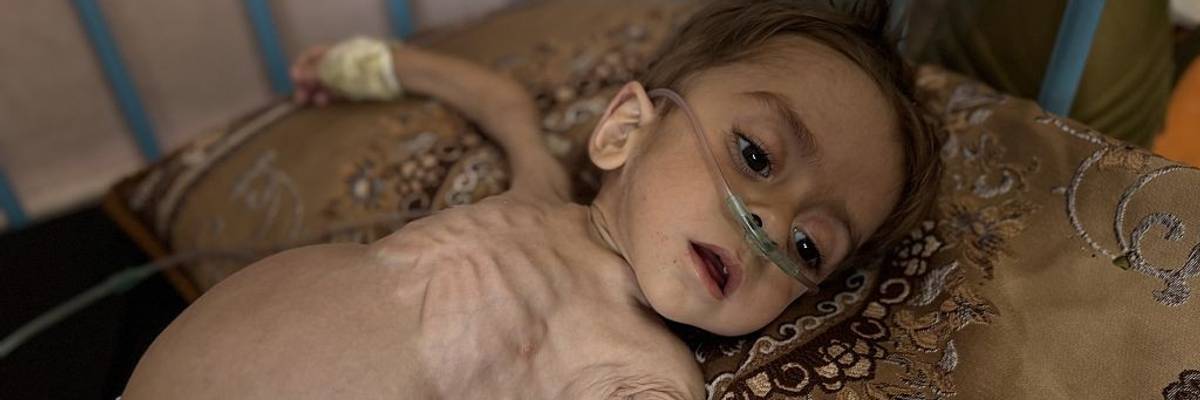
Karim Muammer, who suffers from many serious conditions such as severe malnutrition, liver enlargement, bone softening, kidney leakage, and severe chest infections, continues to receive treatment at Nasser Hospital in Khan Younis under limited circumstances on August 21, 2025 in Gaza.
"Parents know the pain of a hungry baby's cry," said Rep. Ayanna Pressley. "Imagine, instead of fumbling for a bottle, a military blockade is preventing you from feeding your child."
With the number of Palestinian children who have been killed by Israel's blockade on humanitarian rising each day, more than 100 Democratic lawmakers on Tuesday called on the Trump administration to show "moral clarity" and demand that the Israeli government allow "a massive surge in humanitarian aid to enter Gaza," including shipments of baby formula.
U.S. Reps. Ayanna Pressley (D-Mass.) and Brittany Pettersen (D-Colo.) led 101 of their colleagues in writing to Secretary of State Marco Rubio, saying they were appealing to him not only in his "capacity as a government official but as a parent" as they warned that 20,000 children in Gaza have been treated for malnutrition since April, following Israel's decision to once again block all humanitarian aid from entering the enclave.
"Parents know the pain of a hungry baby's cry," said Pressley. "Imagine, instead of fumbling for a bottle, a military blockade is preventing you from feeding your child."
The letter came days after the Integrated Food Security Phase Classification (IPC) announced last week that portions of Gaza are now experiencing a "Phase 5" famine—after months of ignored warnings from human rights groups and United Nations agencies that the enclave's human-caused starvation crisis was rapidly worsening.
Pressley, Pettersen, and their colleagues said that as of their writing, at least 85 children were among those that have starved to death in Gaza; on Tuesday the Gaza Health MInistry reported that at least 303 Palestinians, including 117 children, have been killed by Israel's blockade.
"Infants in particular are especially vulnerable to death by starvation and are dying of malnutrition," said the lawmakers. "The lack of food and aid writ large means mothers do not have the basic nutrition required to sustain breastfeeding, rendering formula the only option for infant survival in many cases."
They emphasized that the only aid operations Israel is currently allowing—the distribution of aid boxes by the US-backed, privatized Gaza Humanitarian Foundation (GHF)—have "delivered only a tiny fraction of the aid that could be delivered by the previous UN-coordinated distribution system," and has not included the allocation of baby formula.
Seeking aid at GHF hubs has also proven deadly for close to 1,000 Palestinians, as Israeli soldiers have reported that they've been ordered to shoot at civilians who approach the sites—even as Israel and its top military funder, the US government, persist in claiming the Israel Defense Forces (IDF) does not target civilians.
The Trump administration has also continued to parrot claims that Hamas is to blame for the famine in Gaza, even after the IDF admitted in July that there is no evidence that the group is stealing or diverting aid.
Since late May, wrote the lawmakers on Tuesday, an average of just 69 trucks per day have brought humanitarian aid from the UN into Gaza—far below the 500-600 trucks needed to meet humanitarian aid.
"As a result, Gaza is currently facing a dire shortage of baby formula, depriving infants of what is their only hope against starvation," said Pressley, Pettersen, and their colleagues.
In July, primary care doctor and public health expert Yipeng Ge described how his colleagues "have had baby formula confiscated by the Israeli military as they enter Gaza."
"These are not isolated incidents, but a systemic policy of genocide," said the doctor.
UN agencies have emphasized for months that trucks filled with aid, including pallets of formula, are languishing just across Gaza's borders.
"This crisis is not one of funding or resources, but of access and political will," wrote the lawmakers. "While we push for a long-lasting resolution and we are devastated that previous ceasefires were not upheld, we believe it is absolutely necessary to prioritize the safe delivery of the pallets of baby formula, specifically ready-to-feed formula, sitting at the border of Gaza to ensure that we do not lose another newborn or infant to starvation."
"All crossing points should immediately be reopened for the entry of humanitarian aid and allowed to operate simultaneously and
consistently," wrote the lawmakers, "and the Israeli government must take additional steps to vastly scale up the amount of aid allowed in through existing crossings and expand movement and access for international aid organizations throughout the Gaza Strip must also be taken, so that they can deliver this aid without diversion."
Dear Common Dreams reader, It’s been nearly 30 years since I co-founded Common Dreams with my late wife, Lina Newhouser. We had the radical notion that journalism should serve the public good, not corporate profits. It was clear to us from the outset what it would take to build such a project. No paid advertisements. No corporate sponsors. No millionaire publisher telling us what to think or do. Many people said we wouldn't last a year, but we proved those doubters wrong. Together with a tremendous team of journalists and dedicated staff, we built an independent media outlet free from the constraints of profits and corporate control. Our mission has always been simple: To inform. To inspire. To ignite change for the common good. Building Common Dreams was not easy. Our survival was never guaranteed. When you take on the most powerful forces—Wall Street greed, fossil fuel industry destruction, Big Tech lobbyists, and uber-rich oligarchs who have spent billions upon billions rigging the economy and democracy in their favor—the only bulwark you have is supporters who believe in your work. But here’s the urgent message from me today. It's never been this bad out there. And it's never been this hard to keep us going. At the very moment Common Dreams is most needed, the threats we face are intensifying. We need your support now more than ever. We don't accept corporate advertising and never will. We don't have a paywall because we don't think people should be blocked from critical news based on their ability to pay. Everything we do is funded by the donations of readers like you. When everyone does the little they can afford, we are strong. But if that support retreats or dries up, so do we. Will you donate now to make sure Common Dreams not only survives but thrives? —Craig Brown, Co-founder |
With the number of Palestinian children who have been killed by Israel's blockade on humanitarian rising each day, more than 100 Democratic lawmakers on Tuesday called on the Trump administration to show "moral clarity" and demand that the Israeli government allow "a massive surge in humanitarian aid to enter Gaza," including shipments of baby formula.
U.S. Reps. Ayanna Pressley (D-Mass.) and Brittany Pettersen (D-Colo.) led 101 of their colleagues in writing to Secretary of State Marco Rubio, saying they were appealing to him not only in his "capacity as a government official but as a parent" as they warned that 20,000 children in Gaza have been treated for malnutrition since April, following Israel's decision to once again block all humanitarian aid from entering the enclave.
"Parents know the pain of a hungry baby's cry," said Pressley. "Imagine, instead of fumbling for a bottle, a military blockade is preventing you from feeding your child."
The letter came days after the Integrated Food Security Phase Classification (IPC) announced last week that portions of Gaza are now experiencing a "Phase 5" famine—after months of ignored warnings from human rights groups and United Nations agencies that the enclave's human-caused starvation crisis was rapidly worsening.
Pressley, Pettersen, and their colleagues said that as of their writing, at least 85 children were among those that have starved to death in Gaza; on Tuesday the Gaza Health MInistry reported that at least 303 Palestinians, including 117 children, have been killed by Israel's blockade.
"Infants in particular are especially vulnerable to death by starvation and are dying of malnutrition," said the lawmakers. "The lack of food and aid writ large means mothers do not have the basic nutrition required to sustain breastfeeding, rendering formula the only option for infant survival in many cases."
They emphasized that the only aid operations Israel is currently allowing—the distribution of aid boxes by the US-backed, privatized Gaza Humanitarian Foundation (GHF)—have "delivered only a tiny fraction of the aid that could be delivered by the previous UN-coordinated distribution system," and has not included the allocation of baby formula.
Seeking aid at GHF hubs has also proven deadly for close to 1,000 Palestinians, as Israeli soldiers have reported that they've been ordered to shoot at civilians who approach the sites—even as Israel and its top military funder, the US government, persist in claiming the Israel Defense Forces (IDF) does not target civilians.
The Trump administration has also continued to parrot claims that Hamas is to blame for the famine in Gaza, even after the IDF admitted in July that there is no evidence that the group is stealing or diverting aid.
Since late May, wrote the lawmakers on Tuesday, an average of just 69 trucks per day have brought humanitarian aid from the UN into Gaza—far below the 500-600 trucks needed to meet humanitarian aid.
"As a result, Gaza is currently facing a dire shortage of baby formula, depriving infants of what is their only hope against starvation," said Pressley, Pettersen, and their colleagues.
In July, primary care doctor and public health expert Yipeng Ge described how his colleagues "have had baby formula confiscated by the Israeli military as they enter Gaza."
"These are not isolated incidents, but a systemic policy of genocide," said the doctor.
UN agencies have emphasized for months that trucks filled with aid, including pallets of formula, are languishing just across Gaza's borders.
"This crisis is not one of funding or resources, but of access and political will," wrote the lawmakers. "While we push for a long-lasting resolution and we are devastated that previous ceasefires were not upheld, we believe it is absolutely necessary to prioritize the safe delivery of the pallets of baby formula, specifically ready-to-feed formula, sitting at the border of Gaza to ensure that we do not lose another newborn or infant to starvation."
"All crossing points should immediately be reopened for the entry of humanitarian aid and allowed to operate simultaneously and
consistently," wrote the lawmakers, "and the Israeli government must take additional steps to vastly scale up the amount of aid allowed in through existing crossings and expand movement and access for international aid organizations throughout the Gaza Strip must also be taken, so that they can deliver this aid without diversion."
With the number of Palestinian children who have been killed by Israel's blockade on humanitarian rising each day, more than 100 Democratic lawmakers on Tuesday called on the Trump administration to show "moral clarity" and demand that the Israeli government allow "a massive surge in humanitarian aid to enter Gaza," including shipments of baby formula.
U.S. Reps. Ayanna Pressley (D-Mass.) and Brittany Pettersen (D-Colo.) led 101 of their colleagues in writing to Secretary of State Marco Rubio, saying they were appealing to him not only in his "capacity as a government official but as a parent" as they warned that 20,000 children in Gaza have been treated for malnutrition since April, following Israel's decision to once again block all humanitarian aid from entering the enclave.
"Parents know the pain of a hungry baby's cry," said Pressley. "Imagine, instead of fumbling for a bottle, a military blockade is preventing you from feeding your child."
The letter came days after the Integrated Food Security Phase Classification (IPC) announced last week that portions of Gaza are now experiencing a "Phase 5" famine—after months of ignored warnings from human rights groups and United Nations agencies that the enclave's human-caused starvation crisis was rapidly worsening.
Pressley, Pettersen, and their colleagues said that as of their writing, at least 85 children were among those that have starved to death in Gaza; on Tuesday the Gaza Health MInistry reported that at least 303 Palestinians, including 117 children, have been killed by Israel's blockade.
"Infants in particular are especially vulnerable to death by starvation and are dying of malnutrition," said the lawmakers. "The lack of food and aid writ large means mothers do not have the basic nutrition required to sustain breastfeeding, rendering formula the only option for infant survival in many cases."
They emphasized that the only aid operations Israel is currently allowing—the distribution of aid boxes by the US-backed, privatized Gaza Humanitarian Foundation (GHF)—have "delivered only a tiny fraction of the aid that could be delivered by the previous UN-coordinated distribution system," and has not included the allocation of baby formula.
Seeking aid at GHF hubs has also proven deadly for close to 1,000 Palestinians, as Israeli soldiers have reported that they've been ordered to shoot at civilians who approach the sites—even as Israel and its top military funder, the US government, persist in claiming the Israel Defense Forces (IDF) does not target civilians.
The Trump administration has also continued to parrot claims that Hamas is to blame for the famine in Gaza, even after the IDF admitted in July that there is no evidence that the group is stealing or diverting aid.
Since late May, wrote the lawmakers on Tuesday, an average of just 69 trucks per day have brought humanitarian aid from the UN into Gaza—far below the 500-600 trucks needed to meet humanitarian aid.
"As a result, Gaza is currently facing a dire shortage of baby formula, depriving infants of what is their only hope against starvation," said Pressley, Pettersen, and their colleagues.
In July, primary care doctor and public health expert Yipeng Ge described how his colleagues "have had baby formula confiscated by the Israeli military as they enter Gaza."
"These are not isolated incidents, but a systemic policy of genocide," said the doctor.
UN agencies have emphasized for months that trucks filled with aid, including pallets of formula, are languishing just across Gaza's borders.
"This crisis is not one of funding or resources, but of access and political will," wrote the lawmakers. "While we push for a long-lasting resolution and we are devastated that previous ceasefires were not upheld, we believe it is absolutely necessary to prioritize the safe delivery of the pallets of baby formula, specifically ready-to-feed formula, sitting at the border of Gaza to ensure that we do not lose another newborn or infant to starvation."
"All crossing points should immediately be reopened for the entry of humanitarian aid and allowed to operate simultaneously and
consistently," wrote the lawmakers, "and the Israeli government must take additional steps to vastly scale up the amount of aid allowed in through existing crossings and expand movement and access for international aid organizations throughout the Gaza Strip must also be taken, so that they can deliver this aid without diversion."