

SUBSCRIBE TO OUR FREE NEWSLETTER
Daily news & progressive opinion—funded by the people, not the corporations—delivered straight to your inbox.
5
#000000
#FFFFFF
To donate by check, phone, or other method, see our More Ways to Give page.
Daily news & progressive opinion—funded by the people, not the corporations—delivered straight to your inbox.
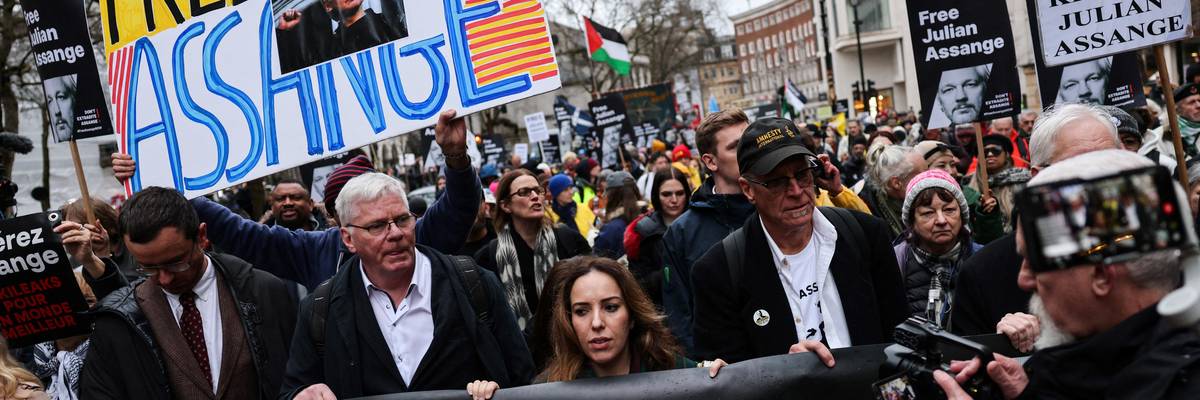
Supporters of WikiLeaks founder Julian Assange, including his wife, Stella, march in central London on February 21, 2024.
"Let me be very clear: This case is about journalism," said a campaigner with Reporters Without Borders. "It is about press freedom. If they make an exception of Julian Assange, the rule will be broken."
Supporters of WikiLeaks founder Julian Assange marched the streets of central London on Wednesday demanding his immediate release after U.S. government lawyers argued to the British High Court that the journalist should be extradited across the Atlantic to face espionage charges.
"How pathetic the U.S. case is," Stella Assange, the WikiLeaks founder's wife, told a crowd gathered outside Wednesday's court hearing, which represents the final legal avenue in the United Kingdom to prevent his extradition to the U.S.
"What they're trying argue is that state secrets trump revealing state crimes," Stella Assange said of U.S. lawyers. "This is the balance they're trying to shift. They want impunity, they don't want to be scrutinized, and journalism stands in the way."
BREAKING: @Stella_Assange explains the arguments laid out by the prosecution#FreeAssangeNOW pic.twitter.com/60M286NkMb
— Free Assange - #FreeAssange (@FreeAssangeNews) February 21, 2024
A decision in the case—which will decide whether Julian Assange can appeal his extradition—could be weeks, or even months, away.
If the British High Court rules that Assange can't appeal, his legal team is expected to ask the European Court of Human Rights to halt his extradition to the U.S., where Assange faces 17 counts of violating the Espionage Act and a possible 175-year prison sentence.
United Nationsexperts, international human rights groups, and even one British judge have argued that extradition to the U.S. would put the 52-year-old publisher's life at grave risk. Assange was unable to attend this week's hearings or even follow them virtually due to his poor health, his lawyers said.
But global calls from
press freedom groups, the government of Assange's home country, and others for the U.S. Justice Department to drop the case and let the publisher go free have not moved the Biden administration, which decided to continue pursuing Assange's extradition after inheriting the case from the Trump administration—whose CIA reportedly considered kidnapping or assassinating the WikiLeaks founder.
During Wednesday's hearing, the U.S. government's lawyers
argued that Assange's decision to seek out and publish classified U.S. documents—some of which exposed American war crimes—went "far beyond" what could be characterized as journalistic conduct, an argument that many journalists have rejected.
"It is impossible to overstate the dangerous precedent Mr. Assange's indictment under the Espionage Act and possible extradition sets: Every national security journalist who reports on classified information now faces possible Espionage Act charges," Laura Poitras, a journalist and documentary filmmaker, wrote in a New York Times op-ed in 2020. "It paves the way for the United States government to indict other international journalists and publishers. And it normalizes other countries' prosecution of journalists from the United States as spies."
Assange's lawyer, Edward Fitzgerald, similarly argued during the first day of the closely watched hearings on Tuesday that Assange is "being prosecuted for engaging in [the] ordinary journalistic practice of obtaining and publishing classified information, information that is both true and of obvious and important public interest."
Thousands marched through the streets to the office of the UK Prime Minister in Downing Street following the conclusion of Julian Assange's court hearing today, calling for his immediate release | via @MintPressNews #FreeAssange #FreeAssangeNOW pic.twitter.com/YIpjdoT65j
— WikiLeaks (@wikileaks) February 21, 2024
Rebecca Vincent, director of campaigns at Reporters Without Borders, said following Wednesday's hearing that "in these past two days, we have heard nothing new from the U.S. government."
"We have heard them double down on the same arguments that they've been making for 13 years," said Vincent. "Let me be very clear: This case is about journalism. It is about press freedom. If they make an exception of Julian Assange, the rule will be broken—and no one, no journalist, no publisher, no journalistic source, no media organization can ever be confident that their rights will be respected again."
Dear Common Dreams reader, It’s been nearly 30 years since I co-founded Common Dreams with my late wife, Lina Newhouser. We had the radical notion that journalism should serve the public good, not corporate profits. It was clear to us from the outset what it would take to build such a project. No paid advertisements. No corporate sponsors. No millionaire publisher telling us what to think or do. Many people said we wouldn't last a year, but we proved those doubters wrong. Together with a tremendous team of journalists and dedicated staff, we built an independent media outlet free from the constraints of profits and corporate control. Our mission has always been simple: To inform. To inspire. To ignite change for the common good. Building Common Dreams was not easy. Our survival was never guaranteed. When you take on the most powerful forces—Wall Street greed, fossil fuel industry destruction, Big Tech lobbyists, and uber-rich oligarchs who have spent billions upon billions rigging the economy and democracy in their favor—the only bulwark you have is supporters who believe in your work. But here’s the urgent message from me today. It's never been this bad out there. And it's never been this hard to keep us going. At the very moment Common Dreams is most needed, the threats we face are intensifying. We need your support now more than ever. We don't accept corporate advertising and never will. We don't have a paywall because we don't think people should be blocked from critical news based on their ability to pay. Everything we do is funded by the donations of readers like you. When everyone does the little they can afford, we are strong. But if that support retreats or dries up, so do we. Will you donate now to make sure Common Dreams not only survives but thrives? —Craig Brown, Co-founder |
Supporters of WikiLeaks founder Julian Assange marched the streets of central London on Wednesday demanding his immediate release after U.S. government lawyers argued to the British High Court that the journalist should be extradited across the Atlantic to face espionage charges.
"How pathetic the U.S. case is," Stella Assange, the WikiLeaks founder's wife, told a crowd gathered outside Wednesday's court hearing, which represents the final legal avenue in the United Kingdom to prevent his extradition to the U.S.
"What they're trying argue is that state secrets trump revealing state crimes," Stella Assange said of U.S. lawyers. "This is the balance they're trying to shift. They want impunity, they don't want to be scrutinized, and journalism stands in the way."
BREAKING: @Stella_Assange explains the arguments laid out by the prosecution#FreeAssangeNOW pic.twitter.com/60M286NkMb
— Free Assange - #FreeAssange (@FreeAssangeNews) February 21, 2024
A decision in the case—which will decide whether Julian Assange can appeal his extradition—could be weeks, or even months, away.
If the British High Court rules that Assange can't appeal, his legal team is expected to ask the European Court of Human Rights to halt his extradition to the U.S., where Assange faces 17 counts of violating the Espionage Act and a possible 175-year prison sentence.
United Nationsexperts, international human rights groups, and even one British judge have argued that extradition to the U.S. would put the 52-year-old publisher's life at grave risk. Assange was unable to attend this week's hearings or even follow them virtually due to his poor health, his lawyers said.
But global calls from
press freedom groups, the government of Assange's home country, and others for the U.S. Justice Department to drop the case and let the publisher go free have not moved the Biden administration, which decided to continue pursuing Assange's extradition after inheriting the case from the Trump administration—whose CIA reportedly considered kidnapping or assassinating the WikiLeaks founder.
During Wednesday's hearing, the U.S. government's lawyers
argued that Assange's decision to seek out and publish classified U.S. documents—some of which exposed American war crimes—went "far beyond" what could be characterized as journalistic conduct, an argument that many journalists have rejected.
"It is impossible to overstate the dangerous precedent Mr. Assange's indictment under the Espionage Act and possible extradition sets: Every national security journalist who reports on classified information now faces possible Espionage Act charges," Laura Poitras, a journalist and documentary filmmaker, wrote in a New York Times op-ed in 2020. "It paves the way for the United States government to indict other international journalists and publishers. And it normalizes other countries' prosecution of journalists from the United States as spies."
Assange's lawyer, Edward Fitzgerald, similarly argued during the first day of the closely watched hearings on Tuesday that Assange is "being prosecuted for engaging in [the] ordinary journalistic practice of obtaining and publishing classified information, information that is both true and of obvious and important public interest."
Thousands marched through the streets to the office of the UK Prime Minister in Downing Street following the conclusion of Julian Assange's court hearing today, calling for his immediate release | via @MintPressNews #FreeAssange #FreeAssangeNOW pic.twitter.com/YIpjdoT65j
— WikiLeaks (@wikileaks) February 21, 2024
Rebecca Vincent, director of campaigns at Reporters Without Borders, said following Wednesday's hearing that "in these past two days, we have heard nothing new from the U.S. government."
"We have heard them double down on the same arguments that they've been making for 13 years," said Vincent. "Let me be very clear: This case is about journalism. It is about press freedom. If they make an exception of Julian Assange, the rule will be broken—and no one, no journalist, no publisher, no journalistic source, no media organization can ever be confident that their rights will be respected again."
Supporters of WikiLeaks founder Julian Assange marched the streets of central London on Wednesday demanding his immediate release after U.S. government lawyers argued to the British High Court that the journalist should be extradited across the Atlantic to face espionage charges.
"How pathetic the U.S. case is," Stella Assange, the WikiLeaks founder's wife, told a crowd gathered outside Wednesday's court hearing, which represents the final legal avenue in the United Kingdom to prevent his extradition to the U.S.
"What they're trying argue is that state secrets trump revealing state crimes," Stella Assange said of U.S. lawyers. "This is the balance they're trying to shift. They want impunity, they don't want to be scrutinized, and journalism stands in the way."
BREAKING: @Stella_Assange explains the arguments laid out by the prosecution#FreeAssangeNOW pic.twitter.com/60M286NkMb
— Free Assange - #FreeAssange (@FreeAssangeNews) February 21, 2024
A decision in the case—which will decide whether Julian Assange can appeal his extradition—could be weeks, or even months, away.
If the British High Court rules that Assange can't appeal, his legal team is expected to ask the European Court of Human Rights to halt his extradition to the U.S., where Assange faces 17 counts of violating the Espionage Act and a possible 175-year prison sentence.
United Nationsexperts, international human rights groups, and even one British judge have argued that extradition to the U.S. would put the 52-year-old publisher's life at grave risk. Assange was unable to attend this week's hearings or even follow them virtually due to his poor health, his lawyers said.
But global calls from
press freedom groups, the government of Assange's home country, and others for the U.S. Justice Department to drop the case and let the publisher go free have not moved the Biden administration, which decided to continue pursuing Assange's extradition after inheriting the case from the Trump administration—whose CIA reportedly considered kidnapping or assassinating the WikiLeaks founder.
During Wednesday's hearing, the U.S. government's lawyers
argued that Assange's decision to seek out and publish classified U.S. documents—some of which exposed American war crimes—went "far beyond" what could be characterized as journalistic conduct, an argument that many journalists have rejected.
"It is impossible to overstate the dangerous precedent Mr. Assange's indictment under the Espionage Act and possible extradition sets: Every national security journalist who reports on classified information now faces possible Espionage Act charges," Laura Poitras, a journalist and documentary filmmaker, wrote in a New York Times op-ed in 2020. "It paves the way for the United States government to indict other international journalists and publishers. And it normalizes other countries' prosecution of journalists from the United States as spies."
Assange's lawyer, Edward Fitzgerald, similarly argued during the first day of the closely watched hearings on Tuesday that Assange is "being prosecuted for engaging in [the] ordinary journalistic practice of obtaining and publishing classified information, information that is both true and of obvious and important public interest."
Thousands marched through the streets to the office of the UK Prime Minister in Downing Street following the conclusion of Julian Assange's court hearing today, calling for his immediate release | via @MintPressNews #FreeAssange #FreeAssangeNOW pic.twitter.com/YIpjdoT65j
— WikiLeaks (@wikileaks) February 21, 2024
Rebecca Vincent, director of campaigns at Reporters Without Borders, said following Wednesday's hearing that "in these past two days, we have heard nothing new from the U.S. government."
"We have heard them double down on the same arguments that they've been making for 13 years," said Vincent. "Let me be very clear: This case is about journalism. It is about press freedom. If they make an exception of Julian Assange, the rule will be broken—and no one, no journalist, no publisher, no journalistic source, no media organization can ever be confident that their rights will be respected again."

