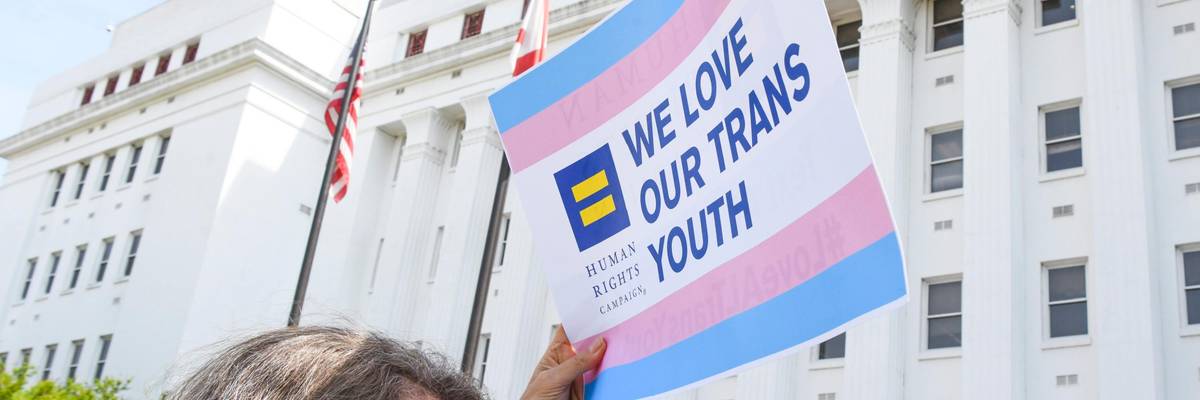
A protester holds a sign that reads "We Love Our Trans Youth" during a rally at the Alabama State House on March 30, 2021 in Montgomery, Alabama.
School Hate Crimes Quadruple in GOP States Attacking LGBTQ+ Rights
"For the activists and politicians writing these laws, this is just a sign that their plan is working," said one rights advocate.
The Republican Party's hateful policies are having a predictable result: more hatefulness.
The GOP's current targeted attacks on transgender and nonbinary youths are relatively new, with right-wing governors and legislatures in the last few years prioritizing legislation barring young people from living according to their gender identity—but federal data shows the impact the push is already having on the safety of LGBTQ+ kids, with school hate crimes surging in states where attacks on their right to exist have passed.
According to FBI data analyzed by The Washington Post, in states where LGBTQ+ rights have been restricted, an average of about 28 anti-LGBTQ+ hate crimes at K-12 schools and colleges were reported annually between 2015-19. The number tripled to an average of 90 in 2021-22.
In just K-12 schools, the average number of hate crimes went up from 13 per year between 2015-19 to 61 per year from 2021-22—more than quadrupling.
Overall, across the country, there was an average of 108 hate crimes at schools reported annually between 2015-19. Between 2021-22, the average more than doubled to 232.
At the same time, counseling services like the Trevor Project and the Rainbow Youth Project have seen a sharp rise in calls from young LGBTQ+ people distressed by the political rhetoric that's seeped into their schools.
"My government hates me," "my school hates me," and "they don't want me to exist" are among the fears that young people in states hostile to LGBTQ+ rights regularly report, Lance Preston, founder and executive director of the Rainbow Youth Project told the Post.
"That... is absolutely unacceptable," he said. "That is shocking."
The surge in anti-LGBTQ+ hate crimes did not come as a surprise to advocates including Mark Pitcavage, senior research fellow for the Anti-Defamation League's Center on Extremism.
"Can anybody be surprised if discriminatory laws produce hateful results?" said Pitcavage.
According to the Trevor Project, at least 580 anti-LGBTQ+ bills were being considered in 2023 and at least 53 had been enacted. The Post traced the beginning of the surge back to around 2021.
Recent proposals include a bill advanced by the Florida Legislature to require residents' driver's licenses and ID cards identify them as their sex assigned at birth and a ban on gender-affirming care and transgender students playing on sports teams that match their gender identity in Ohio. The latter was vetoed by Republican Gov. Mike DeWine but later moved forward when lawmakers overrode the veto.
The Post released its analysis weeks after the death of Nex Benedict, a nonbinary student in Oklahoma who used they/them pronouns and died a day after a getting in a physical fight with a group of girls in a school bathroom.
Oklahoma's anti-LGBTQ laws include a ban on gender transition procedures for minors, a law requiring students to use school bathrooms in accordance with their sex assigned at birth, and the so-called Save Women's Sports Act, pertaining to transgender kids on sports teams. The state is also now considering a requirement that schools teach that "a person's sex is an immutable biological trait."
For right-wing politicians and anti-LGBTQ+ activists, said Gillian Branstetter, communications strategist for the ACLU, the surge in hate crimes "is just a sign that their plan is working."
A transgender 17-year-old named Carden, who lives in Virginia, told the Post that he was harassed twice at school this year over his gender identity, and connected the incidents to the mainstreaming of anti-LGBTQ+ rhetoric by right-wing politicians.
"Kids parrot these ideas in their head, it's like, 'Oh, my parents think...,'" Carden told the Post. "Then it translates to being mean to other people their age."
The Rainbow Youth Project, which offers a hotline for crisis counseling to at-risk LGBTQ+ youth, said the top reason for calling cited by its clients in 2023 was "political rhetoric." The group recorded an average of about 1,000 calls per month in 2022 and over 1,400 per month last year.
"This legislated hate," said Alejandra Caraballo of Harvard Law Cyberlaw Clinic, "has consequences."
We are at a crossroads
This country and this world are at a monumental crossroads. In a few short weeks, US voters will have an opportunity to beat back the forces of fascism and confront the billionaires who are rigging the economy, our media system, and our democracy, making it increasingly impossible for ordinary people to get by. We’re not just talking about the election. We’re talking about what must be done once these fascist elements are vanquished from power. We need a bolder set of solutions than what either major party has so far been willing to offer and a working-class movement ready to fight like hell for it. Trump didn't emerge from nowhere. The conditions that fueled MAGA authoritarianism were created by decades of radical neoliberal economic policies and a corrupt political system dominated by corporate interests. They slashed taxes on the super-rich, promising that the benefits would trickle down. They said giveaways to the corporate titans would make life more affordable for the rest of us. It was all bullshit. And when a bitter, betrayed populace searches for someone to blame, right-wing demagogues have little trouble finding scapegoats. People know when they're being lied to, but you won't hear any of this from the corporate media. Only independent journalism—powered and funded by people who believe in building a better world—can deliver truly trustworthy daily news. Our Fall Campaign is underway, and we need your help. To power our newsroom through the rest of the year, we need to raise $125,000 by midnight on October 31. So if you share our vision, please contribute whatever you can to sustain our work. |
The Republican Party's hateful policies are having a predictable result: more hatefulness.
The GOP's current targeted attacks on transgender and nonbinary youths are relatively new, with right-wing governors and legislatures in the last few years prioritizing legislation barring young people from living according to their gender identity—but federal data shows the impact the push is already having on the safety of LGBTQ+ kids, with school hate crimes surging in states where attacks on their right to exist have passed.
According to FBI data analyzed by The Washington Post, in states where LGBTQ+ rights have been restricted, an average of about 28 anti-LGBTQ+ hate crimes at K-12 schools and colleges were reported annually between 2015-19. The number tripled to an average of 90 in 2021-22.
In just K-12 schools, the average number of hate crimes went up from 13 per year between 2015-19 to 61 per year from 2021-22—more than quadrupling.
Overall, across the country, there was an average of 108 hate crimes at schools reported annually between 2015-19. Between 2021-22, the average more than doubled to 232.
At the same time, counseling services like the Trevor Project and the Rainbow Youth Project have seen a sharp rise in calls from young LGBTQ+ people distressed by the political rhetoric that's seeped into their schools.
"My government hates me," "my school hates me," and "they don't want me to exist" are among the fears that young people in states hostile to LGBTQ+ rights regularly report, Lance Preston, founder and executive director of the Rainbow Youth Project told the Post.
"That... is absolutely unacceptable," he said. "That is shocking."
The surge in anti-LGBTQ+ hate crimes did not come as a surprise to advocates including Mark Pitcavage, senior research fellow for the Anti-Defamation League's Center on Extremism.
"Can anybody be surprised if discriminatory laws produce hateful results?" said Pitcavage.
According to the Trevor Project, at least 580 anti-LGBTQ+ bills were being considered in 2023 and at least 53 had been enacted. The Post traced the beginning of the surge back to around 2021.
Recent proposals include a bill advanced by the Florida Legislature to require residents' driver's licenses and ID cards identify them as their sex assigned at birth and a ban on gender-affirming care and transgender students playing on sports teams that match their gender identity in Ohio. The latter was vetoed by Republican Gov. Mike DeWine but later moved forward when lawmakers overrode the veto.
The Post released its analysis weeks after the death of Nex Benedict, a nonbinary student in Oklahoma who used they/them pronouns and died a day after a getting in a physical fight with a group of girls in a school bathroom.
Oklahoma's anti-LGBTQ laws include a ban on gender transition procedures for minors, a law requiring students to use school bathrooms in accordance with their sex assigned at birth, and the so-called Save Women's Sports Act, pertaining to transgender kids on sports teams. The state is also now considering a requirement that schools teach that "a person's sex is an immutable biological trait."
For right-wing politicians and anti-LGBTQ+ activists, said Gillian Branstetter, communications strategist for the ACLU, the surge in hate crimes "is just a sign that their plan is working."
A transgender 17-year-old named Carden, who lives in Virginia, told the Post that he was harassed twice at school this year over his gender identity, and connected the incidents to the mainstreaming of anti-LGBTQ+ rhetoric by right-wing politicians.
"Kids parrot these ideas in their head, it's like, 'Oh, my parents think...,'" Carden told the Post. "Then it translates to being mean to other people their age."
The Rainbow Youth Project, which offers a hotline for crisis counseling to at-risk LGBTQ+ youth, said the top reason for calling cited by its clients in 2023 was "political rhetoric." The group recorded an average of about 1,000 calls per month in 2022 and over 1,400 per month last year.
"This legislated hate," said Alejandra Caraballo of Harvard Law Cyberlaw Clinic, "has consequences."
- West Virginia, Kentucky Republicans Latest to Ban Gender-Affirming Care for Trans Youth ›
- 'Hate Is Rising in America': During Trump's First Year in Office, Largest Spike in Hate Crimes Since 9/11 ›
- LGBTQ+ Rights Advocates Mourn California Store Owner Killed Over Pride Flag ›
- Utah's Anti-Trans Bathroom Snitch Line Flooded With 'Bogus' Complaints | Common Dreams ›
- Opinion | US Voters Want Real Economic Solutions, Not Attacks on LGBTQ Rights | Common Dreams ›
- Opinion | In Milwaukee, the GOP United Around Hate | Common Dreams ›
- Michiganders Vow to Fight Trump Attacks on LGBTQ+ Youth as DOJ Probes Public Schools | Common Dreams ›
The Republican Party's hateful policies are having a predictable result: more hatefulness.
The GOP's current targeted attacks on transgender and nonbinary youths are relatively new, with right-wing governors and legislatures in the last few years prioritizing legislation barring young people from living according to their gender identity—but federal data shows the impact the push is already having on the safety of LGBTQ+ kids, with school hate crimes surging in states where attacks on their right to exist have passed.
According to FBI data analyzed by The Washington Post, in states where LGBTQ+ rights have been restricted, an average of about 28 anti-LGBTQ+ hate crimes at K-12 schools and colleges were reported annually between 2015-19. The number tripled to an average of 90 in 2021-22.
In just K-12 schools, the average number of hate crimes went up from 13 per year between 2015-19 to 61 per year from 2021-22—more than quadrupling.
Overall, across the country, there was an average of 108 hate crimes at schools reported annually between 2015-19. Between 2021-22, the average more than doubled to 232.
At the same time, counseling services like the Trevor Project and the Rainbow Youth Project have seen a sharp rise in calls from young LGBTQ+ people distressed by the political rhetoric that's seeped into their schools.
"My government hates me," "my school hates me," and "they don't want me to exist" are among the fears that young people in states hostile to LGBTQ+ rights regularly report, Lance Preston, founder and executive director of the Rainbow Youth Project told the Post.
"That... is absolutely unacceptable," he said. "That is shocking."
The surge in anti-LGBTQ+ hate crimes did not come as a surprise to advocates including Mark Pitcavage, senior research fellow for the Anti-Defamation League's Center on Extremism.
"Can anybody be surprised if discriminatory laws produce hateful results?" said Pitcavage.
According to the Trevor Project, at least 580 anti-LGBTQ+ bills were being considered in 2023 and at least 53 had been enacted. The Post traced the beginning of the surge back to around 2021.
Recent proposals include a bill advanced by the Florida Legislature to require residents' driver's licenses and ID cards identify them as their sex assigned at birth and a ban on gender-affirming care and transgender students playing on sports teams that match their gender identity in Ohio. The latter was vetoed by Republican Gov. Mike DeWine but later moved forward when lawmakers overrode the veto.
The Post released its analysis weeks after the death of Nex Benedict, a nonbinary student in Oklahoma who used they/them pronouns and died a day after a getting in a physical fight with a group of girls in a school bathroom.
Oklahoma's anti-LGBTQ laws include a ban on gender transition procedures for minors, a law requiring students to use school bathrooms in accordance with their sex assigned at birth, and the so-called Save Women's Sports Act, pertaining to transgender kids on sports teams. The state is also now considering a requirement that schools teach that "a person's sex is an immutable biological trait."
For right-wing politicians and anti-LGBTQ+ activists, said Gillian Branstetter, communications strategist for the ACLU, the surge in hate crimes "is just a sign that their plan is working."
A transgender 17-year-old named Carden, who lives in Virginia, told the Post that he was harassed twice at school this year over his gender identity, and connected the incidents to the mainstreaming of anti-LGBTQ+ rhetoric by right-wing politicians.
"Kids parrot these ideas in their head, it's like, 'Oh, my parents think...,'" Carden told the Post. "Then it translates to being mean to other people their age."
The Rainbow Youth Project, which offers a hotline for crisis counseling to at-risk LGBTQ+ youth, said the top reason for calling cited by its clients in 2023 was "political rhetoric." The group recorded an average of about 1,000 calls per month in 2022 and over 1,400 per month last year.
"This legislated hate," said Alejandra Caraballo of Harvard Law Cyberlaw Clinic, "has consequences."
- West Virginia, Kentucky Republicans Latest to Ban Gender-Affirming Care for Trans Youth ›
- 'Hate Is Rising in America': During Trump's First Year in Office, Largest Spike in Hate Crimes Since 9/11 ›
- LGBTQ+ Rights Advocates Mourn California Store Owner Killed Over Pride Flag ›
- Utah's Anti-Trans Bathroom Snitch Line Flooded With 'Bogus' Complaints | Common Dreams ›
- Opinion | US Voters Want Real Economic Solutions, Not Attacks on LGBTQ Rights | Common Dreams ›
- Opinion | In Milwaukee, the GOP United Around Hate | Common Dreams ›
- Michiganders Vow to Fight Trump Attacks on LGBTQ+ Youth as DOJ Probes Public Schools | Common Dreams ›