

SUBSCRIBE TO OUR FREE NEWSLETTER
Daily news & progressive opinion—funded by the people, not the corporations—delivered straight to your inbox.
5
#000000
#FFFFFF
To donate by check, phone, or other method, see our More Ways to Give page.
Daily news & progressive opinion—funded by the people, not the corporations—delivered straight to your inbox.
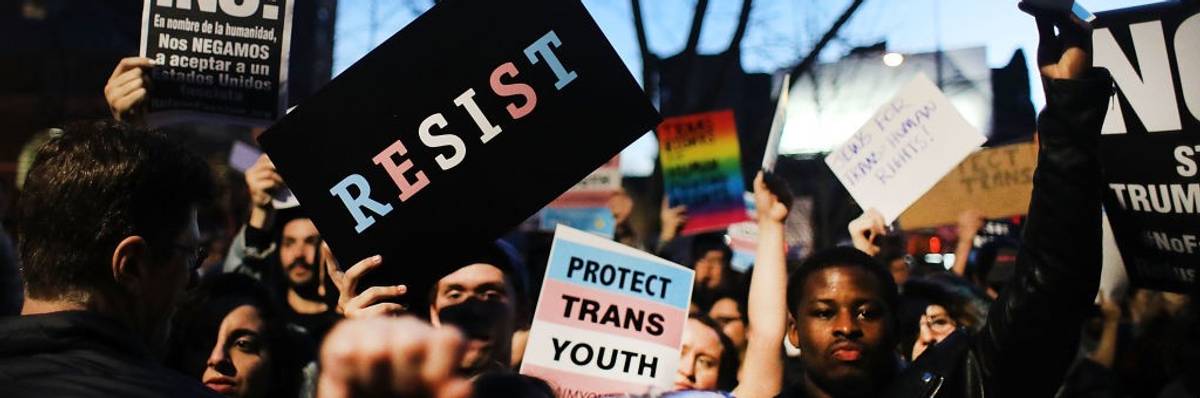
Hundreds protest a Trump administration announcement rescinding an Obama-era order allowing transgender students to use school bathrooms matching their gender identities at the Stonewall Inn on February 23, 2017 in New York City.
State Auditor John Dougall said that "concerned citizens should directly contact the bill sponsor, Rep. Birkeland," who doubled down on her support for the recently enacted law.
In just a week since its launch, Utah's " snitch line" for a new law restricting transgender people's access to some bathrooms and changing facilities was inundated with around 10,000 "bogus" reports, state Auditor John Dougall revealed Tuesday.
Dougall, a Republican running to represent the state's 3rd Congressional District, shared the figure with Utah News Dispatch and released a lengthy statement detailing his office's efforts to comply with House Bill 257, which GOP legislators passed and Gov. Spencer Cox signed earlier this year.
The law prohibits trans students in K-12 public schools from using bathrooms or changing rooms that align with their gender identity, according to an online resource from the ACLU of Utah and Equality Utah. The restrictions also apply to changing rooms in government-owned or -controlled buildings—such as the Utah Capitol and city or county recreation centers—but not to the facilities in private spaces such as restaurants, shopping malls, or theaters.
Since Dougall's office launched the online complaint form last week, Utahans and other opponents of H.B. 257 have posted the link on social media with messages like, " You know what to do." Some people even shared screenshots of their fake submissions.
Among the critics of the form was state Sen. Jennifer Plumb (D-9), who
said on social media last week: "Apparently Utah's solution to people feeling unsafe in restrooms is to encourage folks to take photos of and focus extreme attention on the private parts of others who are taking care of a biological need to eliminate waste? What could possibly go wrong?"
Dougall responded that "our hotline has historically allowed complainant to upload additional supporting information. My office has no interest in those types of photos which, of course you know, would be illegal." The auditor went back and forth with Plumb, who stressed that "these 'hotline' reporting spaces are what make people unsafe."
In his Tuesday statement, Dougall said that he has not received "a single legitimate complaint" and that his office "only investigates alleged violations of the statute by government entities" and "will not investigate the actions of any private individuals."
"The office created the complaint form to comply with a statutory mandate—a role we did not request. Indeed, no auditor sets out to become a bathroom monitor," Dougall continued. He noted that "the bill was rushed to final passage" and neither its sponsor, state Rep. Kera Birkeland (R-4), "nor any other legislator consulted with this office regarding this newly mandated obligation."
"I recognize that many Utahns feel trampled by an invasive and overly aggressive Legislature that too often fails to seek input from those most affected," he added. "The Legislature crafted these public policies, and only the Legislature can revise them. Concerned citizens should directly contact the bill sponsor, Rep. Birkeland, and other legislators at le.utah.gov."
Responding to Dougall's statement on social media Tuesday, Birkeland
said in part that "it's not surprising that activists are taking the time to send false reports" and "backlash from this legislation was completely expected."
"But that isn't a distraction from the importance of the legislation," she added, claiming that the law protects women and girls, and that opposition to it comes from "a loud and vocal minority."
Since North Carolina passed the nation's first bathroom bill in 2016, similar laws and other state-level legislation attacking various trans rights have been advanced by Republican lawmakers throughout the United States, often provoking legal challenges.
As trans journalist Erin Reed, who tracks anti-trans legislation across the country, highlighted Tuesday:
The ordeal over the bathroom reporting tool in Utah mirrors problems seen in many other anti-trans bathroom laws targeting transgender adults. These laws are extremely difficult to enforce. Questions of enforcement were brought up often in the debate, with many pointing out that you can't always tell who is transgender. This sentiment was shared in the Senate Business and Labor Committee by Dustin Parmley, a public defender, who stated: "This bill is impossible to enforce. It relies on citizens to determine if someone is feminine or masculine enough to use it. The exceptions are for hidden conditions, such as someone's surgery or birth certificate. It will lead to unnecessary police investigations."
"Other attempts to create such forms have similarly failed,
such as in Virginia, where Gov. Glenn Youngkin's tip line was flooded with complaints about Beowulf, or in Missouri, where scripts for the Bee Movie were sent in," Reed noted. "In this case, it appears that when faced with problems enforcing anti-trans laws, the state of Utah attempted to sidestep the issue by abdicating the responsibility of enforcement to its citizens."
Dear Common Dreams reader, It’s been nearly 30 years since I co-founded Common Dreams with my late wife, Lina Newhouser. We had the radical notion that journalism should serve the public good, not corporate profits. It was clear to us from the outset what it would take to build such a project. No paid advertisements. No corporate sponsors. No millionaire publisher telling us what to think or do. Many people said we wouldn't last a year, but we proved those doubters wrong. Together with a tremendous team of journalists and dedicated staff, we built an independent media outlet free from the constraints of profits and corporate control. Our mission has always been simple: To inform. To inspire. To ignite change for the common good. Building Common Dreams was not easy. Our survival was never guaranteed. When you take on the most powerful forces—Wall Street greed, fossil fuel industry destruction, Big Tech lobbyists, and uber-rich oligarchs who have spent billions upon billions rigging the economy and democracy in their favor—the only bulwark you have is supporters who believe in your work. But here’s the urgent message from me today. It's never been this bad out there. And it's never been this hard to keep us going. At the very moment Common Dreams is most needed, the threats we face are intensifying. We need your support now more than ever. We don't accept corporate advertising and never will. We don't have a paywall because we don't think people should be blocked from critical news based on their ability to pay. Everything we do is funded by the donations of readers like you. When everyone does the little they can afford, we are strong. But if that support retreats or dries up, so do we. Will you donate now to make sure Common Dreams not only survives but thrives? —Craig Brown, Co-founder |
In just a week since its launch, Utah's " snitch line" for a new law restricting transgender people's access to some bathrooms and changing facilities was inundated with around 10,000 "bogus" reports, state Auditor John Dougall revealed Tuesday.
Dougall, a Republican running to represent the state's 3rd Congressional District, shared the figure with Utah News Dispatch and released a lengthy statement detailing his office's efforts to comply with House Bill 257, which GOP legislators passed and Gov. Spencer Cox signed earlier this year.
The law prohibits trans students in K-12 public schools from using bathrooms or changing rooms that align with their gender identity, according to an online resource from the ACLU of Utah and Equality Utah. The restrictions also apply to changing rooms in government-owned or -controlled buildings—such as the Utah Capitol and city or county recreation centers—but not to the facilities in private spaces such as restaurants, shopping malls, or theaters.
Since Dougall's office launched the online complaint form last week, Utahans and other opponents of H.B. 257 have posted the link on social media with messages like, " You know what to do." Some people even shared screenshots of their fake submissions.
Among the critics of the form was state Sen. Jennifer Plumb (D-9), who
said on social media last week: "Apparently Utah's solution to people feeling unsafe in restrooms is to encourage folks to take photos of and focus extreme attention on the private parts of others who are taking care of a biological need to eliminate waste? What could possibly go wrong?"
Dougall responded that "our hotline has historically allowed complainant to upload additional supporting information. My office has no interest in those types of photos which, of course you know, would be illegal." The auditor went back and forth with Plumb, who stressed that "these 'hotline' reporting spaces are what make people unsafe."
In his Tuesday statement, Dougall said that he has not received "a single legitimate complaint" and that his office "only investigates alleged violations of the statute by government entities" and "will not investigate the actions of any private individuals."
"The office created the complaint form to comply with a statutory mandate—a role we did not request. Indeed, no auditor sets out to become a bathroom monitor," Dougall continued. He noted that "the bill was rushed to final passage" and neither its sponsor, state Rep. Kera Birkeland (R-4), "nor any other legislator consulted with this office regarding this newly mandated obligation."
"I recognize that many Utahns feel trampled by an invasive and overly aggressive Legislature that too often fails to seek input from those most affected," he added. "The Legislature crafted these public policies, and only the Legislature can revise them. Concerned citizens should directly contact the bill sponsor, Rep. Birkeland, and other legislators at le.utah.gov."
Responding to Dougall's statement on social media Tuesday, Birkeland
said in part that "it's not surprising that activists are taking the time to send false reports" and "backlash from this legislation was completely expected."
"But that isn't a distraction from the importance of the legislation," she added, claiming that the law protects women and girls, and that opposition to it comes from "a loud and vocal minority."
Since North Carolina passed the nation's first bathroom bill in 2016, similar laws and other state-level legislation attacking various trans rights have been advanced by Republican lawmakers throughout the United States, often provoking legal challenges.
As trans journalist Erin Reed, who tracks anti-trans legislation across the country, highlighted Tuesday:
The ordeal over the bathroom reporting tool in Utah mirrors problems seen in many other anti-trans bathroom laws targeting transgender adults. These laws are extremely difficult to enforce. Questions of enforcement were brought up often in the debate, with many pointing out that you can't always tell who is transgender. This sentiment was shared in the Senate Business and Labor Committee by Dustin Parmley, a public defender, who stated: "This bill is impossible to enforce. It relies on citizens to determine if someone is feminine or masculine enough to use it. The exceptions are for hidden conditions, such as someone's surgery or birth certificate. It will lead to unnecessary police investigations."
"Other attempts to create such forms have similarly failed,
such as in Virginia, where Gov. Glenn Youngkin's tip line was flooded with complaints about Beowulf, or in Missouri, where scripts for the Bee Movie were sent in," Reed noted. "In this case, it appears that when faced with problems enforcing anti-trans laws, the state of Utah attempted to sidestep the issue by abdicating the responsibility of enforcement to its citizens."
In just a week since its launch, Utah's " snitch line" for a new law restricting transgender people's access to some bathrooms and changing facilities was inundated with around 10,000 "bogus" reports, state Auditor John Dougall revealed Tuesday.
Dougall, a Republican running to represent the state's 3rd Congressional District, shared the figure with Utah News Dispatch and released a lengthy statement detailing his office's efforts to comply with House Bill 257, which GOP legislators passed and Gov. Spencer Cox signed earlier this year.
The law prohibits trans students in K-12 public schools from using bathrooms or changing rooms that align with their gender identity, according to an online resource from the ACLU of Utah and Equality Utah. The restrictions also apply to changing rooms in government-owned or -controlled buildings—such as the Utah Capitol and city or county recreation centers—but not to the facilities in private spaces such as restaurants, shopping malls, or theaters.
Since Dougall's office launched the online complaint form last week, Utahans and other opponents of H.B. 257 have posted the link on social media with messages like, " You know what to do." Some people even shared screenshots of their fake submissions.
Among the critics of the form was state Sen. Jennifer Plumb (D-9), who
said on social media last week: "Apparently Utah's solution to people feeling unsafe in restrooms is to encourage folks to take photos of and focus extreme attention on the private parts of others who are taking care of a biological need to eliminate waste? What could possibly go wrong?"
Dougall responded that "our hotline has historically allowed complainant to upload additional supporting information. My office has no interest in those types of photos which, of course you know, would be illegal." The auditor went back and forth with Plumb, who stressed that "these 'hotline' reporting spaces are what make people unsafe."
In his Tuesday statement, Dougall said that he has not received "a single legitimate complaint" and that his office "only investigates alleged violations of the statute by government entities" and "will not investigate the actions of any private individuals."
"The office created the complaint form to comply with a statutory mandate—a role we did not request. Indeed, no auditor sets out to become a bathroom monitor," Dougall continued. He noted that "the bill was rushed to final passage" and neither its sponsor, state Rep. Kera Birkeland (R-4), "nor any other legislator consulted with this office regarding this newly mandated obligation."
"I recognize that many Utahns feel trampled by an invasive and overly aggressive Legislature that too often fails to seek input from those most affected," he added. "The Legislature crafted these public policies, and only the Legislature can revise them. Concerned citizens should directly contact the bill sponsor, Rep. Birkeland, and other legislators at le.utah.gov."
Responding to Dougall's statement on social media Tuesday, Birkeland
said in part that "it's not surprising that activists are taking the time to send false reports" and "backlash from this legislation was completely expected."
"But that isn't a distraction from the importance of the legislation," she added, claiming that the law protects women and girls, and that opposition to it comes from "a loud and vocal minority."
Since North Carolina passed the nation's first bathroom bill in 2016, similar laws and other state-level legislation attacking various trans rights have been advanced by Republican lawmakers throughout the United States, often provoking legal challenges.
As trans journalist Erin Reed, who tracks anti-trans legislation across the country, highlighted Tuesday:
The ordeal over the bathroom reporting tool in Utah mirrors problems seen in many other anti-trans bathroom laws targeting transgender adults. These laws are extremely difficult to enforce. Questions of enforcement were brought up often in the debate, with many pointing out that you can't always tell who is transgender. This sentiment was shared in the Senate Business and Labor Committee by Dustin Parmley, a public defender, who stated: "This bill is impossible to enforce. It relies on citizens to determine if someone is feminine or masculine enough to use it. The exceptions are for hidden conditions, such as someone's surgery or birth certificate. It will lead to unnecessary police investigations."
"Other attempts to create such forms have similarly failed,
such as in Virginia, where Gov. Glenn Youngkin's tip line was flooded with complaints about Beowulf, or in Missouri, where scripts for the Bee Movie were sent in," Reed noted. "In this case, it appears that when faced with problems enforcing anti-trans laws, the state of Utah attempted to sidestep the issue by abdicating the responsibility of enforcement to its citizens."

