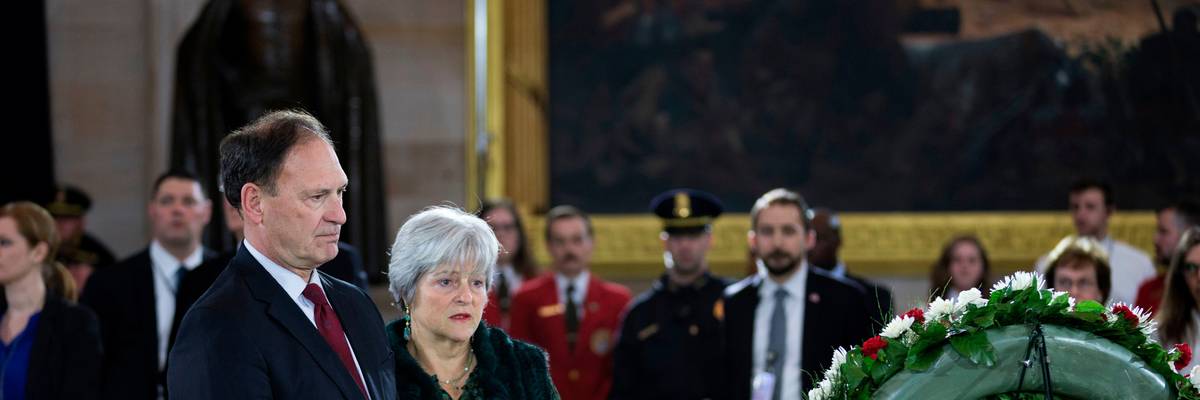
U.S. Supreme Court Associate Justice Samuel Alito and his wife Martha-Ann Bomgardner Alito view the casket of Rev. Billy Graham in the Capitol Rotunda in Washington, D.C. on February 28, 2018.
Wife's Oil and Gas Leasing Deal Raises New Ethics Concerns About Justice Alito
"Alito doesn't have to come across like a drunken Paul Thomas Anderson character gleefully confessing to drinking our collective milkshakes in order to be a real-life, run-of-the-mill political villain," quipped the founder of one ethics watchdog.
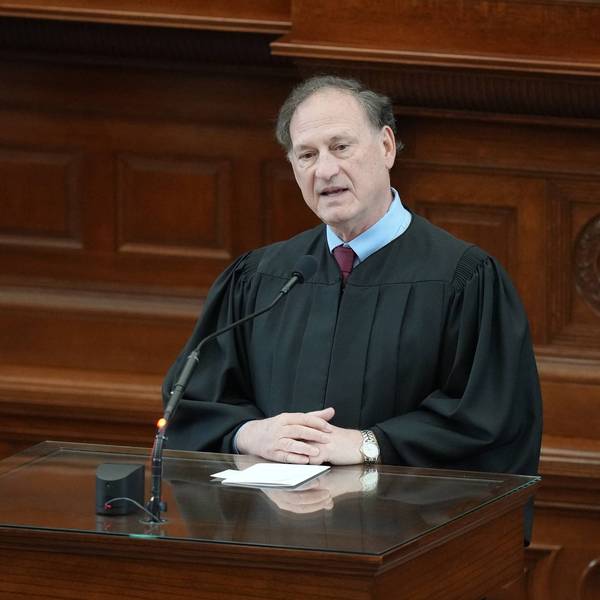
Advocates for ethical government on Monday sounded the alarm on a report revealing that the wife of U.S. Supreme Court Justice Samuel Alito leased property in Oklahoma to a fossil fuel company around the same time that the firm was involved in a case before the high court from which the judge did not recuse himself.
According to The Intercept, Martha Ann Bomgardner Alito last June leased a 160-acre plot of land in Grady County, Oklahoma, just southwest of Oklahoma City, to Citizen Energy III under an agreement that she would be paid 3/16ths of all the money the company made from oil and gas sales.
Last month, Justice Alito wrote the majority opinion in Sackett v. Environmental Protection Agency, which severely curtailed protections under the Waters of the United States rule, as Common Dreams reported at the time. The environmental legal advocacy group Earthjustice called the ruling "a catastrophic loss for water protections across the country and a win for big polluters, putting our communities, public health, and local ecosystems" in peril.
The high court's review was well underway at the time of the lease deal, with the justices agreeing to take the case in January 2022 and hearing arguments that October.
"There need not be a specific case involving the drilling rights associated with a specific plot of land for Alito to understand what outcomes in environmental cases would buttress his family's net wealth," Jeff Hauser, founder and director of the watchdog Revolving Door Project, told The Intercept.
"Alito does not have to come across like a drunken Paul Thomas Anderson character gleefully confessing to drinking our collective milkshakes in order to be a real-life, run-of-the-mill political villain," Hauser added.
As Daniel Boguslaw wrote for The Intercept:
In the past, Alito has often recused himself from cases that pose potential conflicts of interest with his vast investment portfolio. Many of these recusals were born from an inheritance of stocks after the death of Alito's father-in-law, Bobby Gene Bomgardner. Because Citizen Energy III isn't implicated in any cases before the Supreme Court, Alito's holding in Oklahoma doesn't appear to pose any direct conflicts of interest. But it does add context to a political outlook that has alarmed environmentalists since Alito's confirmation hearing in 2006—and cast recent decisions that embolden the oil and gas industry in a damning light.
During his 2006 Senate confirmation hearing, Alito appeared to set a high ethical bar for himself by stating justices should recuse themselves from cases in which "any possible question" might arise regarding "the appearance of impropriety."
The new revelation comes hot on the heels of a ProPublica report that exposed a previously undisclosed luxury fishing trip in Alaska that Alito was gifted by billionaire and GOP megadonor Paul Singer, whose hedge fund repeatedly had cases before the Supreme Court from which Alito declined to recuse himself.
A petition currently in circulation demands that Alito recuse himself from a pair of cases that will decide the fate of President Joe Biden's plan to relieve the college debt burdens of tens of millions of Americans.
Unlike other federal courts, there is no code of ethics governing Supreme Court justices. Although justices must file financial disclosures under the Ethics in Government Act, the choice of whether or not to recuse themselves from cases involving a conflict of interest is up to them.
"What makes political figures who violate ethics laws so exceptional is how much obviously unethical behavior is legal under our current overly permissive rules."
Another ProPublica report, this one published in April, showed how Justice Clarence Thomas and relatives apparently exploited this loophole by accepting lavish gifts including luxury vacations, domestic and international private jet travel, and even private school tuition for one of the judge's relatives.
"What makes political figures who violate ethics laws so exceptional is how much obviously unethical behavior is legal under our current overly permissive rules," Hauser told The Intercept. "Our current ethics regime assumes that a person's financial interests need to be extremely specific in order to influence their behavior, a worldview that ignores the foresight rich people and corporations regularly demonstrate."
We are at a crossroads
This country and this world are at a monumental crossroads. In a few short weeks, US voters will have an opportunity to beat back the forces of fascism and confront the billionaires who are rigging the economy, our media system, and our democracy, making it increasingly impossible for ordinary people to get by. We’re not just talking about the election. We’re talking about what must be done once these fascist elements are vanquished from power. We need a bolder set of solutions than what either major party has so far been willing to offer and a working-class movement ready to fight like hell for it. Trump didn't emerge from nowhere. The conditions that fueled MAGA authoritarianism were created by decades of radical neoliberal economic policies and a corrupt political system dominated by corporate interests. They slashed taxes on the super-rich, promising that the benefits would trickle down. They said giveaways to the corporate titans would make life more affordable for the rest of us. It was all bullshit. And when a bitter, betrayed populace searches for someone to blame, right-wing demagogues have little trouble finding scapegoats. People know when they're being lied to, but you won't hear any of this from the corporate media. Only independent journalism—powered and funded by people who believe in building a better world—can deliver truly trustworthy daily news. Our Fall Campaign is underway, and we need your help. To power our newsroom through the rest of the year, we need to raise $125,000 by midnight on October 31. So if you share our vision, please contribute whatever you can to sustain our work. |
Advocates for ethical government on Monday sounded the alarm on a report revealing that the wife of U.S. Supreme Court Justice Samuel Alito leased property in Oklahoma to a fossil fuel company around the same time that the firm was involved in a case before the high court from which the judge did not recuse himself.
According to The Intercept, Martha Ann Bomgardner Alito last June leased a 160-acre plot of land in Grady County, Oklahoma, just southwest of Oklahoma City, to Citizen Energy III under an agreement that she would be paid 3/16ths of all the money the company made from oil and gas sales.
Last month, Justice Alito wrote the majority opinion in Sackett v. Environmental Protection Agency, which severely curtailed protections under the Waters of the United States rule, as Common Dreams reported at the time. The environmental legal advocacy group Earthjustice called the ruling "a catastrophic loss for water protections across the country and a win for big polluters, putting our communities, public health, and local ecosystems" in peril.
The high court's review was well underway at the time of the lease deal, with the justices agreeing to take the case in January 2022 and hearing arguments that October.
"There need not be a specific case involving the drilling rights associated with a specific plot of land for Alito to understand what outcomes in environmental cases would buttress his family's net wealth," Jeff Hauser, founder and director of the watchdog Revolving Door Project, told The Intercept.
"Alito does not have to come across like a drunken Paul Thomas Anderson character gleefully confessing to drinking our collective milkshakes in order to be a real-life, run-of-the-mill political villain," Hauser added.
As Daniel Boguslaw wrote for The Intercept:
In the past, Alito has often recused himself from cases that pose potential conflicts of interest with his vast investment portfolio. Many of these recusals were born from an inheritance of stocks after the death of Alito's father-in-law, Bobby Gene Bomgardner. Because Citizen Energy III isn't implicated in any cases before the Supreme Court, Alito's holding in Oklahoma doesn't appear to pose any direct conflicts of interest. But it does add context to a political outlook that has alarmed environmentalists since Alito's confirmation hearing in 2006—and cast recent decisions that embolden the oil and gas industry in a damning light.
During his 2006 Senate confirmation hearing, Alito appeared to set a high ethical bar for himself by stating justices should recuse themselves from cases in which "any possible question" might arise regarding "the appearance of impropriety."
The new revelation comes hot on the heels of a ProPublica report that exposed a previously undisclosed luxury fishing trip in Alaska that Alito was gifted by billionaire and GOP megadonor Paul Singer, whose hedge fund repeatedly had cases before the Supreme Court from which Alito declined to recuse himself.
A petition currently in circulation demands that Alito recuse himself from a pair of cases that will decide the fate of President Joe Biden's plan to relieve the college debt burdens of tens of millions of Americans.
Unlike other federal courts, there is no code of ethics governing Supreme Court justices. Although justices must file financial disclosures under the Ethics in Government Act, the choice of whether or not to recuse themselves from cases involving a conflict of interest is up to them.
"What makes political figures who violate ethics laws so exceptional is how much obviously unethical behavior is legal under our current overly permissive rules."
Another ProPublica report, this one published in April, showed how Justice Clarence Thomas and relatives apparently exploited this loophole by accepting lavish gifts including luxury vacations, domestic and international private jet travel, and even private school tuition for one of the judge's relatives.
"What makes political figures who violate ethics laws so exceptional is how much obviously unethical behavior is legal under our current overly permissive rules," Hauser told The Intercept. "Our current ethics regime assumes that a person's financial interests need to be extremely specific in order to influence their behavior, a worldview that ignores the foresight rich people and corporations regularly demonstrate."
- Calls for Ethics Probe Follow Bombshell Report of Right-Wing Attempts to Influence Supreme Court ›
- Petition Demands Alito Recuse From Student Debt Cases Tied to Billionaire Benefactor ›
- 'Wrong and Frightening': Alito Claims Congress Can't Regulate SCOTUS ›
- Alito Family's Upside-Down Flag After Jan. 6 Sparks Call for Justice's Recusal | Common Dreams ›
- 'Ethical Nightmare': House Democrats Demand Alito Recuse From Trump Cases | Common Dreams ›
- Opinion | Blaming His Wife for the Insurrection Flag Is Alito’s Latest Lie | Common Dreams ›
- Caught on Tape, Alito Exposed as 'Crusader for Christian Nationalism' | Common Dreams ›
- 'Shamelessly Corrupt': Recusal From Climate Cases Demanded After Alito's Fossil Fuel Profits Exposed | Common Dreams ›
Advocates for ethical government on Monday sounded the alarm on a report revealing that the wife of U.S. Supreme Court Justice Samuel Alito leased property in Oklahoma to a fossil fuel company around the same time that the firm was involved in a case before the high court from which the judge did not recuse himself.
According to The Intercept, Martha Ann Bomgardner Alito last June leased a 160-acre plot of land in Grady County, Oklahoma, just southwest of Oklahoma City, to Citizen Energy III under an agreement that she would be paid 3/16ths of all the money the company made from oil and gas sales.
Last month, Justice Alito wrote the majority opinion in Sackett v. Environmental Protection Agency, which severely curtailed protections under the Waters of the United States rule, as Common Dreams reported at the time. The environmental legal advocacy group Earthjustice called the ruling "a catastrophic loss for water protections across the country and a win for big polluters, putting our communities, public health, and local ecosystems" in peril.
The high court's review was well underway at the time of the lease deal, with the justices agreeing to take the case in January 2022 and hearing arguments that October.
"There need not be a specific case involving the drilling rights associated with a specific plot of land for Alito to understand what outcomes in environmental cases would buttress his family's net wealth," Jeff Hauser, founder and director of the watchdog Revolving Door Project, told The Intercept.
"Alito does not have to come across like a drunken Paul Thomas Anderson character gleefully confessing to drinking our collective milkshakes in order to be a real-life, run-of-the-mill political villain," Hauser added.
As Daniel Boguslaw wrote for The Intercept:
In the past, Alito has often recused himself from cases that pose potential conflicts of interest with his vast investment portfolio. Many of these recusals were born from an inheritance of stocks after the death of Alito's father-in-law, Bobby Gene Bomgardner. Because Citizen Energy III isn't implicated in any cases before the Supreme Court, Alito's holding in Oklahoma doesn't appear to pose any direct conflicts of interest. But it does add context to a political outlook that has alarmed environmentalists since Alito's confirmation hearing in 2006—and cast recent decisions that embolden the oil and gas industry in a damning light.
During his 2006 Senate confirmation hearing, Alito appeared to set a high ethical bar for himself by stating justices should recuse themselves from cases in which "any possible question" might arise regarding "the appearance of impropriety."
The new revelation comes hot on the heels of a ProPublica report that exposed a previously undisclosed luxury fishing trip in Alaska that Alito was gifted by billionaire and GOP megadonor Paul Singer, whose hedge fund repeatedly had cases before the Supreme Court from which Alito declined to recuse himself.
A petition currently in circulation demands that Alito recuse himself from a pair of cases that will decide the fate of President Joe Biden's plan to relieve the college debt burdens of tens of millions of Americans.
Unlike other federal courts, there is no code of ethics governing Supreme Court justices. Although justices must file financial disclosures under the Ethics in Government Act, the choice of whether or not to recuse themselves from cases involving a conflict of interest is up to them.
"What makes political figures who violate ethics laws so exceptional is how much obviously unethical behavior is legal under our current overly permissive rules."
Another ProPublica report, this one published in April, showed how Justice Clarence Thomas and relatives apparently exploited this loophole by accepting lavish gifts including luxury vacations, domestic and international private jet travel, and even private school tuition for one of the judge's relatives.
"What makes political figures who violate ethics laws so exceptional is how much obviously unethical behavior is legal under our current overly permissive rules," Hauser told The Intercept. "Our current ethics regime assumes that a person's financial interests need to be extremely specific in order to influence their behavior, a worldview that ignores the foresight rich people and corporations regularly demonstrate."
- Calls for Ethics Probe Follow Bombshell Report of Right-Wing Attempts to Influence Supreme Court ›
- Petition Demands Alito Recuse From Student Debt Cases Tied to Billionaire Benefactor ›
- 'Wrong and Frightening': Alito Claims Congress Can't Regulate SCOTUS ›
- Alito Family's Upside-Down Flag After Jan. 6 Sparks Call for Justice's Recusal | Common Dreams ›
- 'Ethical Nightmare': House Democrats Demand Alito Recuse From Trump Cases | Common Dreams ›
- Opinion | Blaming His Wife for the Insurrection Flag Is Alito’s Latest Lie | Common Dreams ›
- Caught on Tape, Alito Exposed as 'Crusader for Christian Nationalism' | Common Dreams ›
- 'Shamelessly Corrupt': Recusal From Climate Cases Demanded After Alito's Fossil Fuel Profits Exposed | Common Dreams ›