SUBSCRIBE TO OUR FREE NEWSLETTER
Daily news & progressive opinion—funded by the people, not the corporations—delivered straight to your inbox.
5
#000000
#FFFFFF
To donate by check, phone, or other method, see our More Ways to Give page.
Daily news & progressive opinion—funded by the people, not the corporations—delivered straight to your inbox.
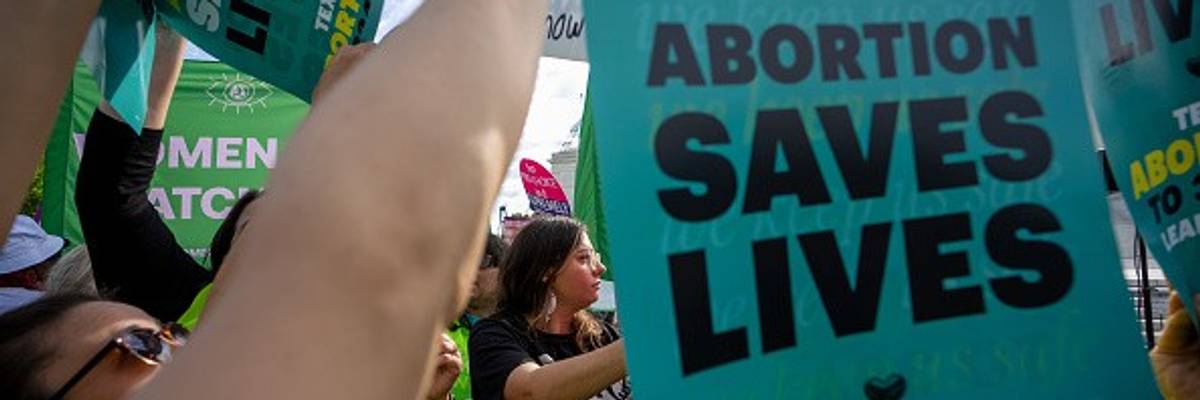
Abortion rights supporters protest outside the Supreme Court on April 24, 2024 in Washington, D.C.
"In thinking about pregnancy itself as a risk factor for homicide, it follows that the ability to prevent or end a pregnancy" could have "immediate implications" for the safety of pregnant people, said one researcher.
A new study links abortion restrictions to an increased risk that pregnant people will be murdered by their intimate partners—and since researchers examined laws that were in place before the U.S. Supreme Court overturned Roe v. Wade and cleared the way for statewide abortion bans, the authors warn that the threat may be even greater than the analysis shows.
In the study released Monday, researchers at Tulane University looked at five separate abortion restrictions and compared them to the intimate partner homicide rates reported by the National Violent Death Reporting System at the U.S. Centers for Disease Control and Prevention.
For each of the abortion restrictions, all of which were in place from 2014-22, the rate of intimate partner homicide among women and girls of reproductive age rose 3.4%.
The researchers found that extrapolated across the United States, an additional 24 women were killed by their intimate partners over the time period.
The study controlled for domestic violence risk factors including income inequality and gun ownership.
Intimate partner homicide is "consistently among the leading causes of death in pregnant and postpartum people," lead author Maeve Wallace, an associate professor at Tulane, told The Guardian.
Because it is still relatively rare, however, the research team used girls and women of reproductive age as a proxy for victims of violence who were likely pregnant or postpartum.
"In thinking about pregnancy itself as a risk factor for homicide, it follows that the ability to prevent or end a pregnancy" could have "immediate implications" for the safety of pregnant people in states with severe abortion restrictions and bans, Wallace told The Guardian.
The newspaper reported that the research "is almost certainly an underestimate of the potential risk to pregnant and postpartum women, because intimate partner violence is generally underreported."
The study is the latest research illustrating "the horrific reality for women in America," said U.S. Sen. Dick Durbin (D-Ill.).
Another study published in the Journal of the American College of Surgeons in February found a 75% higher rate of peripartum homicide—the murder of a pregnant person or within a year of their giving birth—in states that restricted abortion access from 2018-20.
Reproductive justice advocates have pointed out that at least four states with abortion bans in place also ban divorce for married people who are pregnant.
"An abusive partner oftentimes views pregnancy as a loss of control, that their victim will now not be solely dedicated to them but will have somebody else that diverts their attention away from the abusive partner," Crystal Justice, chief external affairs officer at the National Domestic Violence Hotline, told The 19th last month after the Arizona Supreme Court reinstated an 1864 abortion ban, which has since been repealed by state lawmakers but still could be in effect for part of this year.
"Not only is the state now saying with this harmful and antiquated law that you must stay pregnant against your will," Justice said, but "during that pregnancy, the state is not going to let you legally divorce your abusive partner. I can't think of anything more outrageous or cruel."
The U.S. National Domestic Violence Hotline can be reached at 1-800-799-SAFE (7233), by texting "START" to 88788, or through chat at thehotline.org. It offers 24/7, free, and confidential support. DomesticShelters.org has a list of global and national resources.
Dear Common Dreams reader, It’s been nearly 30 years since I co-founded Common Dreams with my late wife, Lina Newhouser. We had the radical notion that journalism should serve the public good, not corporate profits. It was clear to us from the outset what it would take to build such a project. No paid advertisements. No corporate sponsors. No millionaire publisher telling us what to think or do. Many people said we wouldn't last a year, but we proved those doubters wrong. Together with a tremendous team of journalists and dedicated staff, we built an independent media outlet free from the constraints of profits and corporate control. Our mission has always been simple: To inform. To inspire. To ignite change for the common good. Building Common Dreams was not easy. Our survival was never guaranteed. When you take on the most powerful forces—Wall Street greed, fossil fuel industry destruction, Big Tech lobbyists, and uber-rich oligarchs who have spent billions upon billions rigging the economy and democracy in their favor—the only bulwark you have is supporters who believe in your work. But here’s the urgent message from me today. It's never been this bad out there. And it's never been this hard to keep us going. At the very moment Common Dreams is most needed, the threats we face are intensifying. We need your support now more than ever. We don't accept corporate advertising and never will. We don't have a paywall because we don't think people should be blocked from critical news based on their ability to pay. Everything we do is funded by the donations of readers like you. When everyone does the little they can afford, we are strong. But if that support retreats or dries up, so do we. Will you donate now to make sure Common Dreams not only survives but thrives? —Craig Brown, Co-founder |
A new study links abortion restrictions to an increased risk that pregnant people will be murdered by their intimate partners—and since researchers examined laws that were in place before the U.S. Supreme Court overturned Roe v. Wade and cleared the way for statewide abortion bans, the authors warn that the threat may be even greater than the analysis shows.
In the study released Monday, researchers at Tulane University looked at five separate abortion restrictions and compared them to the intimate partner homicide rates reported by the National Violent Death Reporting System at the U.S. Centers for Disease Control and Prevention.
For each of the abortion restrictions, all of which were in place from 2014-22, the rate of intimate partner homicide among women and girls of reproductive age rose 3.4%.
The researchers found that extrapolated across the United States, an additional 24 women were killed by their intimate partners over the time period.
The study controlled for domestic violence risk factors including income inequality and gun ownership.
Intimate partner homicide is "consistently among the leading causes of death in pregnant and postpartum people," lead author Maeve Wallace, an associate professor at Tulane, told The Guardian.
Because it is still relatively rare, however, the research team used girls and women of reproductive age as a proxy for victims of violence who were likely pregnant or postpartum.
"In thinking about pregnancy itself as a risk factor for homicide, it follows that the ability to prevent or end a pregnancy" could have "immediate implications" for the safety of pregnant people in states with severe abortion restrictions and bans, Wallace told The Guardian.
The newspaper reported that the research "is almost certainly an underestimate of the potential risk to pregnant and postpartum women, because intimate partner violence is generally underreported."
The study is the latest research illustrating "the horrific reality for women in America," said U.S. Sen. Dick Durbin (D-Ill.).
Another study published in the Journal of the American College of Surgeons in February found a 75% higher rate of peripartum homicide—the murder of a pregnant person or within a year of their giving birth—in states that restricted abortion access from 2018-20.
Reproductive justice advocates have pointed out that at least four states with abortion bans in place also ban divorce for married people who are pregnant.
"An abusive partner oftentimes views pregnancy as a loss of control, that their victim will now not be solely dedicated to them but will have somebody else that diverts their attention away from the abusive partner," Crystal Justice, chief external affairs officer at the National Domestic Violence Hotline, told The 19th last month after the Arizona Supreme Court reinstated an 1864 abortion ban, which has since been repealed by state lawmakers but still could be in effect for part of this year.
"Not only is the state now saying with this harmful and antiquated law that you must stay pregnant against your will," Justice said, but "during that pregnancy, the state is not going to let you legally divorce your abusive partner. I can't think of anything more outrageous or cruel."
The U.S. National Domestic Violence Hotline can be reached at 1-800-799-SAFE (7233), by texting "START" to 88788, or through chat at thehotline.org. It offers 24/7, free, and confidential support. DomesticShelters.org has a list of global and national resources.
A new study links abortion restrictions to an increased risk that pregnant people will be murdered by their intimate partners—and since researchers examined laws that were in place before the U.S. Supreme Court overturned Roe v. Wade and cleared the way for statewide abortion bans, the authors warn that the threat may be even greater than the analysis shows.
In the study released Monday, researchers at Tulane University looked at five separate abortion restrictions and compared them to the intimate partner homicide rates reported by the National Violent Death Reporting System at the U.S. Centers for Disease Control and Prevention.
For each of the abortion restrictions, all of which were in place from 2014-22, the rate of intimate partner homicide among women and girls of reproductive age rose 3.4%.
The researchers found that extrapolated across the United States, an additional 24 women were killed by their intimate partners over the time period.
The study controlled for domestic violence risk factors including income inequality and gun ownership.
Intimate partner homicide is "consistently among the leading causes of death in pregnant and postpartum people," lead author Maeve Wallace, an associate professor at Tulane, told The Guardian.
Because it is still relatively rare, however, the research team used girls and women of reproductive age as a proxy for victims of violence who were likely pregnant or postpartum.
"In thinking about pregnancy itself as a risk factor for homicide, it follows that the ability to prevent or end a pregnancy" could have "immediate implications" for the safety of pregnant people in states with severe abortion restrictions and bans, Wallace told The Guardian.
The newspaper reported that the research "is almost certainly an underestimate of the potential risk to pregnant and postpartum women, because intimate partner violence is generally underreported."
The study is the latest research illustrating "the horrific reality for women in America," said U.S. Sen. Dick Durbin (D-Ill.).
Another study published in the Journal of the American College of Surgeons in February found a 75% higher rate of peripartum homicide—the murder of a pregnant person or within a year of their giving birth—in states that restricted abortion access from 2018-20.
Reproductive justice advocates have pointed out that at least four states with abortion bans in place also ban divorce for married people who are pregnant.
"An abusive partner oftentimes views pregnancy as a loss of control, that their victim will now not be solely dedicated to them but will have somebody else that diverts their attention away from the abusive partner," Crystal Justice, chief external affairs officer at the National Domestic Violence Hotline, told The 19th last month after the Arizona Supreme Court reinstated an 1864 abortion ban, which has since been repealed by state lawmakers but still could be in effect for part of this year.
"Not only is the state now saying with this harmful and antiquated law that you must stay pregnant against your will," Justice said, but "during that pregnancy, the state is not going to let you legally divorce your abusive partner. I can't think of anything more outrageous or cruel."
The U.S. National Domestic Violence Hotline can be reached at 1-800-799-SAFE (7233), by texting "START" to 88788, or through chat at thehotline.org. It offers 24/7, free, and confidential support. DomesticShelters.org has a list of global and national resources.