SUBSCRIBE TO OUR FREE NEWSLETTER
Daily news & progressive opinion—funded by the people, not the corporations—delivered straight to your inbox.
5
#000000
#FFFFFF
To donate by check, phone, or other method, see our More Ways to Give page.
Daily news & progressive opinion—funded by the people, not the corporations—delivered straight to your inbox.
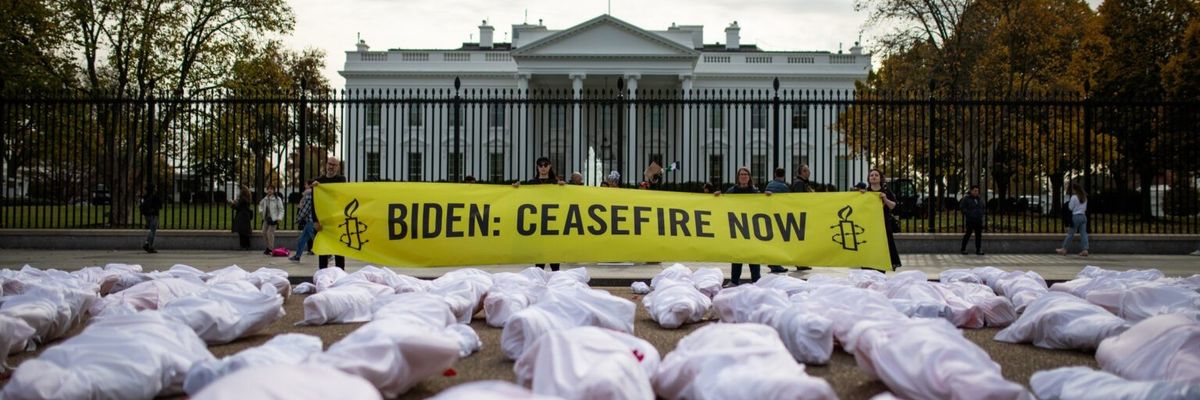
Body bags are laid in front of the White House as part of a protest calling for a Gaza cease-fire.
"What we saw in 2023 confirms that many powerful states are abandoning the founding values of humanity and universality enshrined in the Universal Declaration of Human Rights," Amnesty's secretary-general said.
Government aggression and the rise of Big Tech are threatening the rules-based international order and global human rights, Amnesty International warned in its annual State of the World's Human Rights report, released Wednesday.
The organization expressed particular alarm over Israel's war on Gaza and the inability or unwillingness of its allies to rein in the government of Prime Minister Benjamin Netanyahu from bombing civilian populations, displacing more than 1.9 million people, and restricting the flow of aid into the besieged Gaza Strip. This and other conflicts, such as Russia's invasion of Ukraine, had led to a "near breakdown of international law," Amnesty said.
"For millions the world over, Gaza now symbolizes utter moral failure by many of the architects of the post-World War Two system; their failure to uphold the absolute commitment to universality, our common humanity, and to our 'never again' commitment," Amnesty International's secretary-general Agnès Callamard wrote in the preface to the report.
"One country, one government is allowed to annihilate international law, to put its middle finger in the eye of international law."
Amnesty wrote that Israel had made a "mockery" of some of the key tenants of international humanitarian law such as proportionality and distinction by targeting civilization populations and infrastructure such as refugee camps, hospitals, bakeries, and United Nations schools. As of the end of 2023, Israel had killed 21,600 Palestinians, a third of them children. At present, the death toll has surpassed 34,200, though that is likely an undercount as many remain buried beneath rubble.
Amnesty International researcher Budour Hassan told Deutsche Welle that it was "utterly disappointing" that "one country, one government is allowed to annihilate international law, to put its middle finger in the eye of international law, and go on as if nothing has happened, normalizing the abnormal, normalizing the atrocities that have been happening, so that the crime that was an atrocity two days ago would become normal."
Hassan said there were things that the international community could do to try to stop the violence, such as cutting off weapons sales to Israel and Palestinian armed groups.
"It's just that the international community has proven desperately unwilling and incapable of upholding these norms," Hassan added, saying that, by failing to act, it could be "signing a death sentence to the whole international order."
In particular, Amnesty criticized the U.S. for spending months vetoing U.N. Security Council resolutions calling for a cease-fire, as well as European Union countries like Germany and the U.K. that called out their opponents' human rights abuses but continued to back Israel.
"What we saw in 2023 confirms that many powerful states are abandoning the founding values of humanity and universality enshrined in the Universal Declaration of Human Rights,” Callamard said.
In addition to Israel and its Western allies, Amnesty also pointed to Russia and its ongoing invasion of Ukraine, as well as China's human rights abuses against the Uyghur and financial backing of the Myanmar military, which killed at least 1,000 civilians in 2023.
"We have here three very large countries, superpowers in many ways, sitting on the Security Council that have emptied out the Security Council of its potentials, and that have emptied out international law of its ability to protect people," Callamard told The Associated Press of the U.S., Russia, and China.
In addition to state actors, Amnesty International sounded the alarm about the growing power of large technology companies, and, in particular, the rollout of artificial intelligence. The human rights group said that both new and existing technologies were making it easier for governments to target vulnerable groups like women, minorities, and members of the LGBTQ community. For example, the New York City Police Department informed Amnesty that it used facial recognition technology to keep tabs on Black Lives Matter activists, while Israel used it in the West Bank to help control Palestinian movement. The organization warned of how under-regulated technologies could exacerbate the scapegoating of marginalized groups as many countries hold elections in 2024.
"Big Tech's surveillance business model is pouring fuel on this fire of hate, enabling those with malintent to hound, dehumanize, and amplify dangerous narratives to consolidate power or polling," Callarmard said. "It's a chilling specter of what's to come as technological advances rapaciously outpace accountability."
Callarmard called for reforms to the U.N. Security Council so that no country could use its veto power to obstruct action and for better governmental regulation of developing technologies.
The silver lining is that ordinary people around the world continue to demonstrate for human rights, both their own and others. Amnesty cited the international movement for a cease-fire in Gaza; abortion rights protests in the U.S., El Salvador, and Poland; and the Fridays for Future youth movement to phase out fossil fuels and address the climate emergency.
"People have made it abundantly clear that they want human rights; the onus is on governments to show that they are listening," Callamard said.
Dear Common Dreams reader, It’s been nearly 30 years since I co-founded Common Dreams with my late wife, Lina Newhouser. We had the radical notion that journalism should serve the public good, not corporate profits. It was clear to us from the outset what it would take to build such a project. No paid advertisements. No corporate sponsors. No millionaire publisher telling us what to think or do. Many people said we wouldn't last a year, but we proved those doubters wrong. Together with a tremendous team of journalists and dedicated staff, we built an independent media outlet free from the constraints of profits and corporate control. Our mission has always been simple: To inform. To inspire. To ignite change for the common good. Building Common Dreams was not easy. Our survival was never guaranteed. When you take on the most powerful forces—Wall Street greed, fossil fuel industry destruction, Big Tech lobbyists, and uber-rich oligarchs who have spent billions upon billions rigging the economy and democracy in their favor—the only bulwark you have is supporters who believe in your work. But here’s the urgent message from me today. It's never been this bad out there. And it's never been this hard to keep us going. At the very moment Common Dreams is most needed, the threats we face are intensifying. We need your support now more than ever. We don't accept corporate advertising and never will. We don't have a paywall because we don't think people should be blocked from critical news based on their ability to pay. Everything we do is funded by the donations of readers like you. When everyone does the little they can afford, we are strong. But if that support retreats or dries up, so do we. Will you donate now to make sure Common Dreams not only survives but thrives? —Craig Brown, Co-founder |
Government aggression and the rise of Big Tech are threatening the rules-based international order and global human rights, Amnesty International warned in its annual State of the World's Human Rights report, released Wednesday.
The organization expressed particular alarm over Israel's war on Gaza and the inability or unwillingness of its allies to rein in the government of Prime Minister Benjamin Netanyahu from bombing civilian populations, displacing more than 1.9 million people, and restricting the flow of aid into the besieged Gaza Strip. This and other conflicts, such as Russia's invasion of Ukraine, had led to a "near breakdown of international law," Amnesty said.
"For millions the world over, Gaza now symbolizes utter moral failure by many of the architects of the post-World War Two system; their failure to uphold the absolute commitment to universality, our common humanity, and to our 'never again' commitment," Amnesty International's secretary-general Agnès Callamard wrote in the preface to the report.
"One country, one government is allowed to annihilate international law, to put its middle finger in the eye of international law."
Amnesty wrote that Israel had made a "mockery" of some of the key tenants of international humanitarian law such as proportionality and distinction by targeting civilization populations and infrastructure such as refugee camps, hospitals, bakeries, and United Nations schools. As of the end of 2023, Israel had killed 21,600 Palestinians, a third of them children. At present, the death toll has surpassed 34,200, though that is likely an undercount as many remain buried beneath rubble.
Amnesty International researcher Budour Hassan told Deutsche Welle that it was "utterly disappointing" that "one country, one government is allowed to annihilate international law, to put its middle finger in the eye of international law, and go on as if nothing has happened, normalizing the abnormal, normalizing the atrocities that have been happening, so that the crime that was an atrocity two days ago would become normal."
Hassan said there were things that the international community could do to try to stop the violence, such as cutting off weapons sales to Israel and Palestinian armed groups.
"It's just that the international community has proven desperately unwilling and incapable of upholding these norms," Hassan added, saying that, by failing to act, it could be "signing a death sentence to the whole international order."
In particular, Amnesty criticized the U.S. for spending months vetoing U.N. Security Council resolutions calling for a cease-fire, as well as European Union countries like Germany and the U.K. that called out their opponents' human rights abuses but continued to back Israel.
"What we saw in 2023 confirms that many powerful states are abandoning the founding values of humanity and universality enshrined in the Universal Declaration of Human Rights,” Callamard said.
In addition to Israel and its Western allies, Amnesty also pointed to Russia and its ongoing invasion of Ukraine, as well as China's human rights abuses against the Uyghur and financial backing of the Myanmar military, which killed at least 1,000 civilians in 2023.
"We have here three very large countries, superpowers in many ways, sitting on the Security Council that have emptied out the Security Council of its potentials, and that have emptied out international law of its ability to protect people," Callamard told The Associated Press of the U.S., Russia, and China.
In addition to state actors, Amnesty International sounded the alarm about the growing power of large technology companies, and, in particular, the rollout of artificial intelligence. The human rights group said that both new and existing technologies were making it easier for governments to target vulnerable groups like women, minorities, and members of the LGBTQ community. For example, the New York City Police Department informed Amnesty that it used facial recognition technology to keep tabs on Black Lives Matter activists, while Israel used it in the West Bank to help control Palestinian movement. The organization warned of how under-regulated technologies could exacerbate the scapegoating of marginalized groups as many countries hold elections in 2024.
"Big Tech's surveillance business model is pouring fuel on this fire of hate, enabling those with malintent to hound, dehumanize, and amplify dangerous narratives to consolidate power or polling," Callarmard said. "It's a chilling specter of what's to come as technological advances rapaciously outpace accountability."
Callarmard called for reforms to the U.N. Security Council so that no country could use its veto power to obstruct action and for better governmental regulation of developing technologies.
The silver lining is that ordinary people around the world continue to demonstrate for human rights, both their own and others. Amnesty cited the international movement for a cease-fire in Gaza; abortion rights protests in the U.S., El Salvador, and Poland; and the Fridays for Future youth movement to phase out fossil fuels and address the climate emergency.
"People have made it abundantly clear that they want human rights; the onus is on governments to show that they are listening," Callamard said.
Government aggression and the rise of Big Tech are threatening the rules-based international order and global human rights, Amnesty International warned in its annual State of the World's Human Rights report, released Wednesday.
The organization expressed particular alarm over Israel's war on Gaza and the inability or unwillingness of its allies to rein in the government of Prime Minister Benjamin Netanyahu from bombing civilian populations, displacing more than 1.9 million people, and restricting the flow of aid into the besieged Gaza Strip. This and other conflicts, such as Russia's invasion of Ukraine, had led to a "near breakdown of international law," Amnesty said.
"For millions the world over, Gaza now symbolizes utter moral failure by many of the architects of the post-World War Two system; their failure to uphold the absolute commitment to universality, our common humanity, and to our 'never again' commitment," Amnesty International's secretary-general Agnès Callamard wrote in the preface to the report.
"One country, one government is allowed to annihilate international law, to put its middle finger in the eye of international law."
Amnesty wrote that Israel had made a "mockery" of some of the key tenants of international humanitarian law such as proportionality and distinction by targeting civilization populations and infrastructure such as refugee camps, hospitals, bakeries, and United Nations schools. As of the end of 2023, Israel had killed 21,600 Palestinians, a third of them children. At present, the death toll has surpassed 34,200, though that is likely an undercount as many remain buried beneath rubble.
Amnesty International researcher Budour Hassan told Deutsche Welle that it was "utterly disappointing" that "one country, one government is allowed to annihilate international law, to put its middle finger in the eye of international law, and go on as if nothing has happened, normalizing the abnormal, normalizing the atrocities that have been happening, so that the crime that was an atrocity two days ago would become normal."
Hassan said there were things that the international community could do to try to stop the violence, such as cutting off weapons sales to Israel and Palestinian armed groups.
"It's just that the international community has proven desperately unwilling and incapable of upholding these norms," Hassan added, saying that, by failing to act, it could be "signing a death sentence to the whole international order."
In particular, Amnesty criticized the U.S. for spending months vetoing U.N. Security Council resolutions calling for a cease-fire, as well as European Union countries like Germany and the U.K. that called out their opponents' human rights abuses but continued to back Israel.
"What we saw in 2023 confirms that many powerful states are abandoning the founding values of humanity and universality enshrined in the Universal Declaration of Human Rights,” Callamard said.
In addition to Israel and its Western allies, Amnesty also pointed to Russia and its ongoing invasion of Ukraine, as well as China's human rights abuses against the Uyghur and financial backing of the Myanmar military, which killed at least 1,000 civilians in 2023.
"We have here three very large countries, superpowers in many ways, sitting on the Security Council that have emptied out the Security Council of its potentials, and that have emptied out international law of its ability to protect people," Callamard told The Associated Press of the U.S., Russia, and China.
In addition to state actors, Amnesty International sounded the alarm about the growing power of large technology companies, and, in particular, the rollout of artificial intelligence. The human rights group said that both new and existing technologies were making it easier for governments to target vulnerable groups like women, minorities, and members of the LGBTQ community. For example, the New York City Police Department informed Amnesty that it used facial recognition technology to keep tabs on Black Lives Matter activists, while Israel used it in the West Bank to help control Palestinian movement. The organization warned of how under-regulated technologies could exacerbate the scapegoating of marginalized groups as many countries hold elections in 2024.
"Big Tech's surveillance business model is pouring fuel on this fire of hate, enabling those with malintent to hound, dehumanize, and amplify dangerous narratives to consolidate power or polling," Callarmard said. "It's a chilling specter of what's to come as technological advances rapaciously outpace accountability."
Callarmard called for reforms to the U.N. Security Council so that no country could use its veto power to obstruct action and for better governmental regulation of developing technologies.
The silver lining is that ordinary people around the world continue to demonstrate for human rights, both their own and others. Amnesty cited the international movement for a cease-fire in Gaza; abortion rights protests in the U.S., El Salvador, and Poland; and the Fridays for Future youth movement to phase out fossil fuels and address the climate emergency.
"People have made it abundantly clear that they want human rights; the onus is on governments to show that they are listening," Callamard said.