SUBSCRIBE TO OUR FREE NEWSLETTER
Daily news & progressive opinion—funded by the people, not the corporations—delivered straight to your inbox.
5
#000000
#FFFFFF
To donate by check, phone, or other method, see our More Ways to Give page.
Daily news & progressive opinion—funded by the people, not the corporations—delivered straight to your inbox.
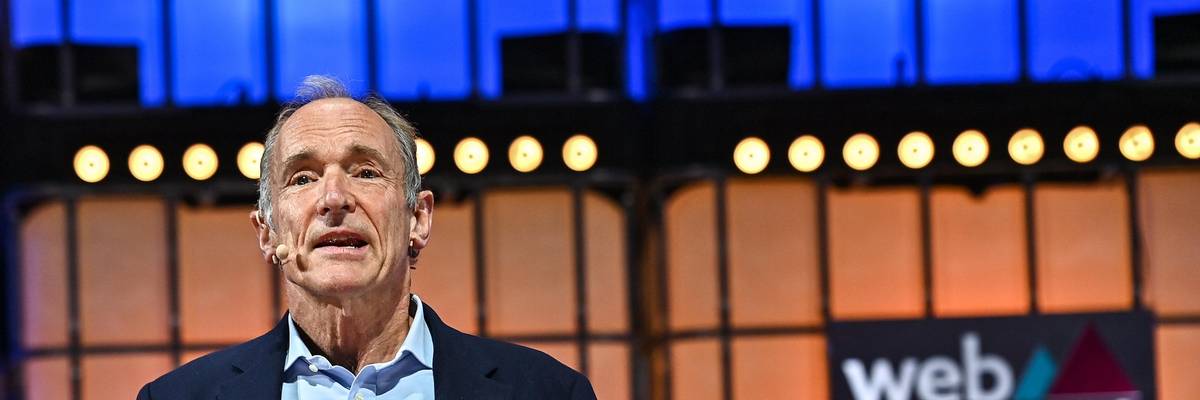
World Wide Web inventor Tim Berners-Lee, now the CTO of Inrupt, speaks at Web Summit 2022 in Lisbon on November 4, 2022.
The creator of the World Wide Web is on a mission to reinvent it and protect personal data from Big Tech.
"I think the public has been concerned about privacy--the fact that these platforms have a huge amount of data, and they abuse it," Tim Berners-Lee, who developed the concept of the web in 1989, told CNN on Friday. "But I think what they're missing sometimes is the lack of empowerment. You need to get back to a situation where you have autonomy, you have control of all your data."
As the news outlet reported:
Through their startup Inrupt, Berners-Lee and CEO John Bruce have created the "Solid Pod"--or Personal Online Data Store. It allows people to keep their data in one central place and control which people and applications can access it, rather than having it stored by apps or sites all over the web.
Users can get a pod from a handful of providers, hosted by web services such as Amazon, or run their own server, if they have they the technical know-how. The main attraction to self-hosting is control and privacy, says Berners-Lee.
Thirty-three years after he invented the web, Berners-Lee--a longtime advocate of giving people power over their personal data online--believes that tech giants currently "control the world and manipulate people by providing information."
In an interview with Euronews Next at the Web Summit conference in Lisbon last month, Berners-Lee said that "some people thought that tech people would save the world then. Now, we're in a situation where there are a lot of things wrong with the web."
He has proposed "a mid-course correction to take it back," which he calls Web3.0.
The earliest iteration of the internet already existed in the 1970s, but few people knew how to access it. Everything changed when Berners-Lee, then a consultant at the European Organization for Nuclear Research (CERN), wrote the code for a web server that allows browsers to view hypertext documents. CERN put the software for the World Wide Web into the public domain in 1993.
As Euronews Next explained:
We then saw the emergence of the first stage of the internet, Web1.0. Despite it being available to everyone, it was a read-only type of web and only the few who knew the ins and outs of coding could publish anything.
This led to the development of Web2.0, which now allows us to interact more with the web and become creators so we can publish what we like under big platforms such as Google, Facebook, and so on.
But it does not come for free. In return, many of these companies can take our data which can be used for targeted advertising.
Berners-Lee's "solution to the dysfunctions of Web2.0 is the third layer of protocols, giving a person the ability to log into something with their own personal ID," the news outlet reported.
While working in his lab at the Massachusetts Institute of Technology, Berners-Lee came up with the "Solid Pod" idea and launched Inrupt in 2017. The company reportedly raised $30 million last December, which Berners-Lee says will help bring the project to fruition.
"Berners-Lee's platform can be accessed from your browser," Euronews Next noted. "But it is not an app; he calls it a 'pod,' where you can store your private data and access it very easily. In simpler terms, it can be thought of as your key or a digital ID that is kept secure."
"He said this is his vision for Web3.0, emphasizing that it is not Web3 which uses the Ethereum blockchain system and promises to be decentralized," the news outlet added. "Many cryptocurrency and metaverse companies wave the word Web3 around as the future of the internet. But Inrupt disagrees."
Bruce, the co-founder and CEO of Inrupt, said that "we're talking Web3.0 which is the real thing... not a marketing hijack if you like."
"Tim explained to me over dinner one night that the web as it's rolling out isn't the web we imagined," Bruce continued. "But we could get it to a place as long as we bumped it in the right way."
According to CNN, Inrupt's platform is being tested by the United Kingdom's National Health Service and by the government of Flanders, the Flemish-speaking northern region of Belgium. The latter intends to use pods to provide social services while allowing people to choose how to share their personal data. Berners-Lee said Flanders' 6.5 million citizens will be able to use the technology by the end of 2022.
Dear Common Dreams reader, It’s been nearly 30 years since I co-founded Common Dreams with my late wife, Lina Newhouser. We had the radical notion that journalism should serve the public good, not corporate profits. It was clear to us from the outset what it would take to build such a project. No paid advertisements. No corporate sponsors. No millionaire publisher telling us what to think or do. Many people said we wouldn't last a year, but we proved those doubters wrong. Together with a tremendous team of journalists and dedicated staff, we built an independent media outlet free from the constraints of profits and corporate control. Our mission has always been simple: To inform. To inspire. To ignite change for the common good. Building Common Dreams was not easy. Our survival was never guaranteed. When you take on the most powerful forces—Wall Street greed, fossil fuel industry destruction, Big Tech lobbyists, and uber-rich oligarchs who have spent billions upon billions rigging the economy and democracy in their favor—the only bulwark you have is supporters who believe in your work. But here’s the urgent message from me today. It's never been this bad out there. And it's never been this hard to keep us going. At the very moment Common Dreams is most needed, the threats we face are intensifying. We need your support now more than ever. We don't accept corporate advertising and never will. We don't have a paywall because we don't think people should be blocked from critical news based on their ability to pay. Everything we do is funded by the donations of readers like you. When everyone does the little they can afford, we are strong. But if that support retreats or dries up, so do we. Will you donate now to make sure Common Dreams not only survives but thrives? —Craig Brown, Co-founder |
The creator of the World Wide Web is on a mission to reinvent it and protect personal data from Big Tech.
"I think the public has been concerned about privacy--the fact that these platforms have a huge amount of data, and they abuse it," Tim Berners-Lee, who developed the concept of the web in 1989, told CNN on Friday. "But I think what they're missing sometimes is the lack of empowerment. You need to get back to a situation where you have autonomy, you have control of all your data."
As the news outlet reported:
Through their startup Inrupt, Berners-Lee and CEO John Bruce have created the "Solid Pod"--or Personal Online Data Store. It allows people to keep their data in one central place and control which people and applications can access it, rather than having it stored by apps or sites all over the web.
Users can get a pod from a handful of providers, hosted by web services such as Amazon, or run their own server, if they have they the technical know-how. The main attraction to self-hosting is control and privacy, says Berners-Lee.
Thirty-three years after he invented the web, Berners-Lee--a longtime advocate of giving people power over their personal data online--believes that tech giants currently "control the world and manipulate people by providing information."
In an interview with Euronews Next at the Web Summit conference in Lisbon last month, Berners-Lee said that "some people thought that tech people would save the world then. Now, we're in a situation where there are a lot of things wrong with the web."
He has proposed "a mid-course correction to take it back," which he calls Web3.0.
The earliest iteration of the internet already existed in the 1970s, but few people knew how to access it. Everything changed when Berners-Lee, then a consultant at the European Organization for Nuclear Research (CERN), wrote the code for a web server that allows browsers to view hypertext documents. CERN put the software for the World Wide Web into the public domain in 1993.
As Euronews Next explained:
We then saw the emergence of the first stage of the internet, Web1.0. Despite it being available to everyone, it was a read-only type of web and only the few who knew the ins and outs of coding could publish anything.
This led to the development of Web2.0, which now allows us to interact more with the web and become creators so we can publish what we like under big platforms such as Google, Facebook, and so on.
But it does not come for free. In return, many of these companies can take our data which can be used for targeted advertising.
Berners-Lee's "solution to the dysfunctions of Web2.0 is the third layer of protocols, giving a person the ability to log into something with their own personal ID," the news outlet reported.
While working in his lab at the Massachusetts Institute of Technology, Berners-Lee came up with the "Solid Pod" idea and launched Inrupt in 2017. The company reportedly raised $30 million last December, which Berners-Lee says will help bring the project to fruition.
"Berners-Lee's platform can be accessed from your browser," Euronews Next noted. "But it is not an app; he calls it a 'pod,' where you can store your private data and access it very easily. In simpler terms, it can be thought of as your key or a digital ID that is kept secure."
"He said this is his vision for Web3.0, emphasizing that it is not Web3 which uses the Ethereum blockchain system and promises to be decentralized," the news outlet added. "Many cryptocurrency and metaverse companies wave the word Web3 around as the future of the internet. But Inrupt disagrees."
Bruce, the co-founder and CEO of Inrupt, said that "we're talking Web3.0 which is the real thing... not a marketing hijack if you like."
"Tim explained to me over dinner one night that the web as it's rolling out isn't the web we imagined," Bruce continued. "But we could get it to a place as long as we bumped it in the right way."
According to CNN, Inrupt's platform is being tested by the United Kingdom's National Health Service and by the government of Flanders, the Flemish-speaking northern region of Belgium. The latter intends to use pods to provide social services while allowing people to choose how to share their personal data. Berners-Lee said Flanders' 6.5 million citizens will be able to use the technology by the end of 2022.
The creator of the World Wide Web is on a mission to reinvent it and protect personal data from Big Tech.
"I think the public has been concerned about privacy--the fact that these platforms have a huge amount of data, and they abuse it," Tim Berners-Lee, who developed the concept of the web in 1989, told CNN on Friday. "But I think what they're missing sometimes is the lack of empowerment. You need to get back to a situation where you have autonomy, you have control of all your data."
As the news outlet reported:
Through their startup Inrupt, Berners-Lee and CEO John Bruce have created the "Solid Pod"--or Personal Online Data Store. It allows people to keep their data in one central place and control which people and applications can access it, rather than having it stored by apps or sites all over the web.
Users can get a pod from a handful of providers, hosted by web services such as Amazon, or run their own server, if they have they the technical know-how. The main attraction to self-hosting is control and privacy, says Berners-Lee.
Thirty-three years after he invented the web, Berners-Lee--a longtime advocate of giving people power over their personal data online--believes that tech giants currently "control the world and manipulate people by providing information."
In an interview with Euronews Next at the Web Summit conference in Lisbon last month, Berners-Lee said that "some people thought that tech people would save the world then. Now, we're in a situation where there are a lot of things wrong with the web."
He has proposed "a mid-course correction to take it back," which he calls Web3.0.
The earliest iteration of the internet already existed in the 1970s, but few people knew how to access it. Everything changed when Berners-Lee, then a consultant at the European Organization for Nuclear Research (CERN), wrote the code for a web server that allows browsers to view hypertext documents. CERN put the software for the World Wide Web into the public domain in 1993.
As Euronews Next explained:
We then saw the emergence of the first stage of the internet, Web1.0. Despite it being available to everyone, it was a read-only type of web and only the few who knew the ins and outs of coding could publish anything.
This led to the development of Web2.0, which now allows us to interact more with the web and become creators so we can publish what we like under big platforms such as Google, Facebook, and so on.
But it does not come for free. In return, many of these companies can take our data which can be used for targeted advertising.
Berners-Lee's "solution to the dysfunctions of Web2.0 is the third layer of protocols, giving a person the ability to log into something with their own personal ID," the news outlet reported.
While working in his lab at the Massachusetts Institute of Technology, Berners-Lee came up with the "Solid Pod" idea and launched Inrupt in 2017. The company reportedly raised $30 million last December, which Berners-Lee says will help bring the project to fruition.
"Berners-Lee's platform can be accessed from your browser," Euronews Next noted. "But it is not an app; he calls it a 'pod,' where you can store your private data and access it very easily. In simpler terms, it can be thought of as your key or a digital ID that is kept secure."
"He said this is his vision for Web3.0, emphasizing that it is not Web3 which uses the Ethereum blockchain system and promises to be decentralized," the news outlet added. "Many cryptocurrency and metaverse companies wave the word Web3 around as the future of the internet. But Inrupt disagrees."
Bruce, the co-founder and CEO of Inrupt, said that "we're talking Web3.0 which is the real thing... not a marketing hijack if you like."
"Tim explained to me over dinner one night that the web as it's rolling out isn't the web we imagined," Bruce continued. "But we could get it to a place as long as we bumped it in the right way."
According to CNN, Inrupt's platform is being tested by the United Kingdom's National Health Service and by the government of Flanders, the Flemish-speaking northern region of Belgium. The latter intends to use pods to provide social services while allowing people to choose how to share their personal data. Berners-Lee said Flanders' 6.5 million citizens will be able to use the technology by the end of 2022.