SUBSCRIBE TO OUR FREE NEWSLETTER
Daily news & progressive opinion—funded by the people, not the corporations—delivered straight to your inbox.
5
#000000
#FFFFFF
To donate by check, phone, or other method, see our More Ways to Give page.
Daily news & progressive opinion—funded by the people, not the corporations—delivered straight to your inbox.
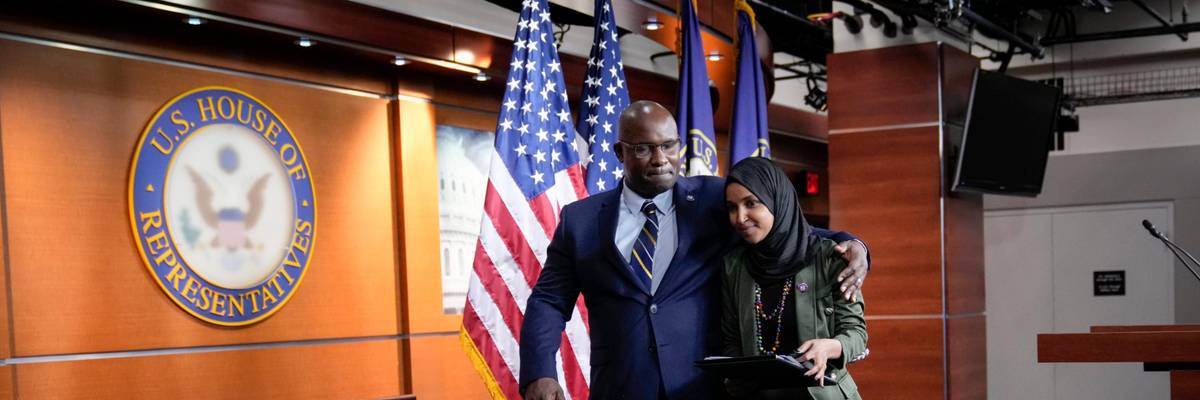
Rep. Jamaal Bowman (D-N.Y.) embraces Rep. Ilhan Omar (D-Minn.) as they leave a news conference on Capitol Hill on November 30, 2021. (Photo: Drew Angerer/Getty Images)
"As you know, the United States is the world's largest historical contributor to climate change."
"Our leadership in supporting loss and damage financing would pave the way for transformative improvements in the global response on climate."
That's how 13 progressive U.S. lawmakers began a Wednesday letter to John Kerry, President Joe Biden's climate envoy, about funding to help the countries that contributed the least to the climate emergency but are disproportionately enduring its impacts.
Loss and damage funding for the Global South is a significant topic at the ongoing United Nations Climate Change Conference (COP27), which is set to wrap up in the Egyptian city of Sharm El-Sheikh this week.
"As we've seen with the historic flooding in Pakistan, the fourth consecutive drought in the Horn of Africa, the painfully slow recovery from hurricane damage in Central America, among many other examples, it is the Global South that disproportionately suffers the harms," wrote the lawmakers, led by Reps. Jamaal Bowman (D-N.Y.) and Ilhan Omar (D-Minn.).
They argued that "we have both a moral and a strategic responsibility to provide comprehensive support for countries facing climate disaster, including debt forgiveness and reparations. While we work toward those crucial goals, there are also smaller but no less important mechanisms we should be supporting."
"One specific step we urge you to take immediately is to throw the United States' support behind the establishment of a loss and damage finance facility under the United Nations Framework Convention on Climate Change (UNFCCC) for the purpose of channeling new, grant-based public finance from developed to developing countries to help them recover from climate catastrophes," the letter continues.
According to the U.S. lawmakers, "Ad hoc humanitarian assistance flows, insurance schemes, debt-based financing, and neglected existing funds under the UNFCCC are wholly insufficient to address the current reality in which countries are facing billions of dollars in loss and damage needs."
The letter stresses the need for "a collaborative international effort... to make more high-quality, accessible, and fit-for-purpose financing available," adding that it "must be supplementary to climate financing for mitigation and adaptation and should be unconditional public funding that does not deepen the debt crises faced by many vulnerable countries."
"We have a momentous opportunity to bring other partner countries to the table and shape an equitable path forward--as you know and have proven repeatedly in your own career, when the United States leads, others follow," they wrote to the former secretary of state, who played a key role in the 2015 Paris agreement. "Our leadership in supporting loss and damage financing would pave the way for transformative improvements in the global response on climate."
The letter was also signed by Democratic Reps. Cori Bush (Mo.), Andre Carson (Ind.), Steve Cohen (Tenn), Jesus G. "Chuy" Garcia (Ill.), Raul M. Grijalva (Ariz.), Andy Levin (Mich.), Betty McCollum (Minn.), Alexandria Ocasio-Cortez (N.Y.), Mark Pocan (Wis.), Jan Schakowsky (Ill.), and Rashida Tlaib (Mich.).
Their message to Kerry comes as leaders of top economies are under fire for ignoring pleas from activists and representatives from the Global South to swiftly establish an international mechanism for loss and damage financing.
Reuters on Tuesday obtained a draft proposal from the Group of 77 (G77) and China to create a loss and damage fund for countries impacted by climate disasters. Under their plan, the fund's principles and policies would be worked out by the 2023 climate talks in Dubai.
However, CNN reported from Sharm El-Sheik Wednesday that "the United States, the European Union, and the United Kingdom are united against establishing a new fund this year to help the world's developing nations."
According to that report:
An E.U. source directly involved in the negotiations at the summit told CNN on Tuesday that the bloc doesn't believe there should be a binding agreement on a new loss and damage fund before the details of how it would work are agreed on.
The source added that the E.U. believes the COP27 agreement could include an agreement that work needs to be done on the issue and a solution should be found by 2024.
Similarly, the U.K. government submitted a document to the conference saying it wants to establish a "process" that would lead to a concrete solution in 2024 at the latest.
U.S. senior administration officials have only committed to having a conversation about loss and damage but have not gone further to explain what kind of fund they would ultimately support. They, too, see 2024 as the deadline for an agreement on loss and damage, but do not support the proposals put forward so far, concerned it could open up developed nations to legal liability in the coming years.
Pressed on what kind of loss and damage fund the U.S. would be open to, officials have repeatedly declined to say. And they want to take the next two years to hammer those questions out, rather than come to an agreement this year.
The outlet noted that a spokesperson for Kerry did not respond to a request for comment.
Meanwhile, Oxfam climate change policy lead Nafkote Dabi was quick to weigh in, saying Wednesday that as COP27 "enters the final crucial days, it is a shame that rich countries--especially the U.S.--continue to reject calls" for creating a loss and damage fund at the current conference.
"Oxfam is in full support of the G77's position and is saddened that the inclusion of loss and damage in the COP27 agenda remains a political game for developed countries, who may likely exit this summit with no agreement on the way forward," Dabi continued. "The principles that underpin the global climate discussion--responsibility, equity, justice, fairness--have left the conference room."
Pointing out that over 40 million people in the Horn of Africa are enduring climate-induced hunger crises while Pakistan faces $30 billion in damage from the floods, Dabi declared that "it is crucial that developing countries can access a formal fund to pay for the damages and losses they are already suffering today."
"Rich countries must meet their $100 billion annual goal for climate finance in addition to establishing a new loss and damage fund that is fit for purpose, accessible, and gender-responsive," she added. "It is long overdue."
Dear Common Dreams reader, It’s been nearly 30 years since I co-founded Common Dreams with my late wife, Lina Newhouser. We had the radical notion that journalism should serve the public good, not corporate profits. It was clear to us from the outset what it would take to build such a project. No paid advertisements. No corporate sponsors. No millionaire publisher telling us what to think or do. Many people said we wouldn't last a year, but we proved those doubters wrong. Together with a tremendous team of journalists and dedicated staff, we built an independent media outlet free from the constraints of profits and corporate control. Our mission has always been simple: To inform. To inspire. To ignite change for the common good. Building Common Dreams was not easy. Our survival was never guaranteed. When you take on the most powerful forces—Wall Street greed, fossil fuel industry destruction, Big Tech lobbyists, and uber-rich oligarchs who have spent billions upon billions rigging the economy and democracy in their favor—the only bulwark you have is supporters who believe in your work. But here’s the urgent message from me today. It's never been this bad out there. And it's never been this hard to keep us going. At the very moment Common Dreams is most needed, the threats we face are intensifying. We need your support now more than ever. We don't accept corporate advertising and never will. We don't have a paywall because we don't think people should be blocked from critical news based on their ability to pay. Everything we do is funded by the donations of readers like you. When everyone does the little they can afford, we are strong. But if that support retreats or dries up, so do we. Will you donate now to make sure Common Dreams not only survives but thrives? —Craig Brown, Co-founder |
"As you know, the United States is the world's largest historical contributor to climate change."
"Our leadership in supporting loss and damage financing would pave the way for transformative improvements in the global response on climate."
That's how 13 progressive U.S. lawmakers began a Wednesday letter to John Kerry, President Joe Biden's climate envoy, about funding to help the countries that contributed the least to the climate emergency but are disproportionately enduring its impacts.
Loss and damage funding for the Global South is a significant topic at the ongoing United Nations Climate Change Conference (COP27), which is set to wrap up in the Egyptian city of Sharm El-Sheikh this week.
"As we've seen with the historic flooding in Pakistan, the fourth consecutive drought in the Horn of Africa, the painfully slow recovery from hurricane damage in Central America, among many other examples, it is the Global South that disproportionately suffers the harms," wrote the lawmakers, led by Reps. Jamaal Bowman (D-N.Y.) and Ilhan Omar (D-Minn.).
They argued that "we have both a moral and a strategic responsibility to provide comprehensive support for countries facing climate disaster, including debt forgiveness and reparations. While we work toward those crucial goals, there are also smaller but no less important mechanisms we should be supporting."
"One specific step we urge you to take immediately is to throw the United States' support behind the establishment of a loss and damage finance facility under the United Nations Framework Convention on Climate Change (UNFCCC) for the purpose of channeling new, grant-based public finance from developed to developing countries to help them recover from climate catastrophes," the letter continues.
According to the U.S. lawmakers, "Ad hoc humanitarian assistance flows, insurance schemes, debt-based financing, and neglected existing funds under the UNFCCC are wholly insufficient to address the current reality in which countries are facing billions of dollars in loss and damage needs."
The letter stresses the need for "a collaborative international effort... to make more high-quality, accessible, and fit-for-purpose financing available," adding that it "must be supplementary to climate financing for mitigation and adaptation and should be unconditional public funding that does not deepen the debt crises faced by many vulnerable countries."
"We have a momentous opportunity to bring other partner countries to the table and shape an equitable path forward--as you know and have proven repeatedly in your own career, when the United States leads, others follow," they wrote to the former secretary of state, who played a key role in the 2015 Paris agreement. "Our leadership in supporting loss and damage financing would pave the way for transformative improvements in the global response on climate."
The letter was also signed by Democratic Reps. Cori Bush (Mo.), Andre Carson (Ind.), Steve Cohen (Tenn), Jesus G. "Chuy" Garcia (Ill.), Raul M. Grijalva (Ariz.), Andy Levin (Mich.), Betty McCollum (Minn.), Alexandria Ocasio-Cortez (N.Y.), Mark Pocan (Wis.), Jan Schakowsky (Ill.), and Rashida Tlaib (Mich.).
Their message to Kerry comes as leaders of top economies are under fire for ignoring pleas from activists and representatives from the Global South to swiftly establish an international mechanism for loss and damage financing.
Reuters on Tuesday obtained a draft proposal from the Group of 77 (G77) and China to create a loss and damage fund for countries impacted by climate disasters. Under their plan, the fund's principles and policies would be worked out by the 2023 climate talks in Dubai.
However, CNN reported from Sharm El-Sheik Wednesday that "the United States, the European Union, and the United Kingdom are united against establishing a new fund this year to help the world's developing nations."
According to that report:
An E.U. source directly involved in the negotiations at the summit told CNN on Tuesday that the bloc doesn't believe there should be a binding agreement on a new loss and damage fund before the details of how it would work are agreed on.
The source added that the E.U. believes the COP27 agreement could include an agreement that work needs to be done on the issue and a solution should be found by 2024.
Similarly, the U.K. government submitted a document to the conference saying it wants to establish a "process" that would lead to a concrete solution in 2024 at the latest.
U.S. senior administration officials have only committed to having a conversation about loss and damage but have not gone further to explain what kind of fund they would ultimately support. They, too, see 2024 as the deadline for an agreement on loss and damage, but do not support the proposals put forward so far, concerned it could open up developed nations to legal liability in the coming years.
Pressed on what kind of loss and damage fund the U.S. would be open to, officials have repeatedly declined to say. And they want to take the next two years to hammer those questions out, rather than come to an agreement this year.
The outlet noted that a spokesperson for Kerry did not respond to a request for comment.
Meanwhile, Oxfam climate change policy lead Nafkote Dabi was quick to weigh in, saying Wednesday that as COP27 "enters the final crucial days, it is a shame that rich countries--especially the U.S.--continue to reject calls" for creating a loss and damage fund at the current conference.
"Oxfam is in full support of the G77's position and is saddened that the inclusion of loss and damage in the COP27 agenda remains a political game for developed countries, who may likely exit this summit with no agreement on the way forward," Dabi continued. "The principles that underpin the global climate discussion--responsibility, equity, justice, fairness--have left the conference room."
Pointing out that over 40 million people in the Horn of Africa are enduring climate-induced hunger crises while Pakistan faces $30 billion in damage from the floods, Dabi declared that "it is crucial that developing countries can access a formal fund to pay for the damages and losses they are already suffering today."
"Rich countries must meet their $100 billion annual goal for climate finance in addition to establishing a new loss and damage fund that is fit for purpose, accessible, and gender-responsive," she added. "It is long overdue."
"As you know, the United States is the world's largest historical contributor to climate change."
"Our leadership in supporting loss and damage financing would pave the way for transformative improvements in the global response on climate."
That's how 13 progressive U.S. lawmakers began a Wednesday letter to John Kerry, President Joe Biden's climate envoy, about funding to help the countries that contributed the least to the climate emergency but are disproportionately enduring its impacts.
Loss and damage funding for the Global South is a significant topic at the ongoing United Nations Climate Change Conference (COP27), which is set to wrap up in the Egyptian city of Sharm El-Sheikh this week.
"As we've seen with the historic flooding in Pakistan, the fourth consecutive drought in the Horn of Africa, the painfully slow recovery from hurricane damage in Central America, among many other examples, it is the Global South that disproportionately suffers the harms," wrote the lawmakers, led by Reps. Jamaal Bowman (D-N.Y.) and Ilhan Omar (D-Minn.).
They argued that "we have both a moral and a strategic responsibility to provide comprehensive support for countries facing climate disaster, including debt forgiveness and reparations. While we work toward those crucial goals, there are also smaller but no less important mechanisms we should be supporting."
"One specific step we urge you to take immediately is to throw the United States' support behind the establishment of a loss and damage finance facility under the United Nations Framework Convention on Climate Change (UNFCCC) for the purpose of channeling new, grant-based public finance from developed to developing countries to help them recover from climate catastrophes," the letter continues.
According to the U.S. lawmakers, "Ad hoc humanitarian assistance flows, insurance schemes, debt-based financing, and neglected existing funds under the UNFCCC are wholly insufficient to address the current reality in which countries are facing billions of dollars in loss and damage needs."
The letter stresses the need for "a collaborative international effort... to make more high-quality, accessible, and fit-for-purpose financing available," adding that it "must be supplementary to climate financing for mitigation and adaptation and should be unconditional public funding that does not deepen the debt crises faced by many vulnerable countries."
"We have a momentous opportunity to bring other partner countries to the table and shape an equitable path forward--as you know and have proven repeatedly in your own career, when the United States leads, others follow," they wrote to the former secretary of state, who played a key role in the 2015 Paris agreement. "Our leadership in supporting loss and damage financing would pave the way for transformative improvements in the global response on climate."
The letter was also signed by Democratic Reps. Cori Bush (Mo.), Andre Carson (Ind.), Steve Cohen (Tenn), Jesus G. "Chuy" Garcia (Ill.), Raul M. Grijalva (Ariz.), Andy Levin (Mich.), Betty McCollum (Minn.), Alexandria Ocasio-Cortez (N.Y.), Mark Pocan (Wis.), Jan Schakowsky (Ill.), and Rashida Tlaib (Mich.).
Their message to Kerry comes as leaders of top economies are under fire for ignoring pleas from activists and representatives from the Global South to swiftly establish an international mechanism for loss and damage financing.
Reuters on Tuesday obtained a draft proposal from the Group of 77 (G77) and China to create a loss and damage fund for countries impacted by climate disasters. Under their plan, the fund's principles and policies would be worked out by the 2023 climate talks in Dubai.
However, CNN reported from Sharm El-Sheik Wednesday that "the United States, the European Union, and the United Kingdom are united against establishing a new fund this year to help the world's developing nations."
According to that report:
An E.U. source directly involved in the negotiations at the summit told CNN on Tuesday that the bloc doesn't believe there should be a binding agreement on a new loss and damage fund before the details of how it would work are agreed on.
The source added that the E.U. believes the COP27 agreement could include an agreement that work needs to be done on the issue and a solution should be found by 2024.
Similarly, the U.K. government submitted a document to the conference saying it wants to establish a "process" that would lead to a concrete solution in 2024 at the latest.
U.S. senior administration officials have only committed to having a conversation about loss and damage but have not gone further to explain what kind of fund they would ultimately support. They, too, see 2024 as the deadline for an agreement on loss and damage, but do not support the proposals put forward so far, concerned it could open up developed nations to legal liability in the coming years.
Pressed on what kind of loss and damage fund the U.S. would be open to, officials have repeatedly declined to say. And they want to take the next two years to hammer those questions out, rather than come to an agreement this year.
The outlet noted that a spokesperson for Kerry did not respond to a request for comment.
Meanwhile, Oxfam climate change policy lead Nafkote Dabi was quick to weigh in, saying Wednesday that as COP27 "enters the final crucial days, it is a shame that rich countries--especially the U.S.--continue to reject calls" for creating a loss and damage fund at the current conference.
"Oxfam is in full support of the G77's position and is saddened that the inclusion of loss and damage in the COP27 agenda remains a political game for developed countries, who may likely exit this summit with no agreement on the way forward," Dabi continued. "The principles that underpin the global climate discussion--responsibility, equity, justice, fairness--have left the conference room."
Pointing out that over 40 million people in the Horn of Africa are enduring climate-induced hunger crises while Pakistan faces $30 billion in damage from the floods, Dabi declared that "it is crucial that developing countries can access a formal fund to pay for the damages and losses they are already suffering today."
"Rich countries must meet their $100 billion annual goal for climate finance in addition to establishing a new loss and damage fund that is fit for purpose, accessible, and gender-responsive," she added. "It is long overdue."