SUBSCRIBE TO OUR FREE NEWSLETTER
Daily news & progressive opinion—funded by the people, not the corporations—delivered straight to your inbox.
5
#000000
#FFFFFF
To donate by check, phone, or other method, see our More Ways to Give page.
Daily news & progressive opinion—funded by the people, not the corporations—delivered straight to your inbox.
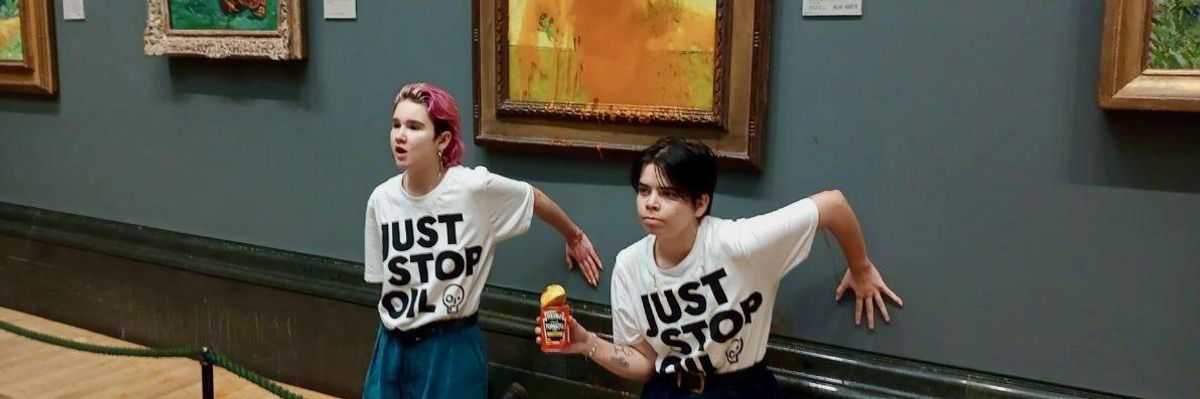
Climate activists tossed cans of tomato soup on Vincent van Gogh's "Sunflowers" at the National Gallery in London on October 14, 2022. (Photo: Just Stop Oil/Twitter)
In the wake of high-profile climate protests that target priceless works of art or block streets and other public infrastructure, researchers at the University of Pennsylvania on Monday published a survey showing such actions broadly decrease support for addressing the climate emergency.
Shawn Patterson Jr. and Michael E. Mann of the University of Pennsylvania Center for Science, Sustainability, and the Media wondered if acts like last month's soup-splashing of Vincent van Gogh's famous glass-protected painting Sunflowers in London by Just Stop Oil activists helped or hindered the cause of boosting support for climate action.
The survey team set out to answer three questions: "First, does the public approve of using tactics like shutting down traffic or gluing oneself to Vermeer's Girl with a Pearl Earring to raise attention to climate change? Second, do these tactics affect public beliefs surrounding human-driven climate change? And third, do the framing of these tactics influence that support?"
The researchers found that "overall, the public expresses general disapproval of nonviolent, disruptive protests to raise attention to the dangers of climate change."
"A plurality (46%) report that such efforts decrease their support for their cause," Patterson and Mann noted. "However, these efforts have minimal effects on people's perceptions of the dangers of climate change."
"Moreover," they added, "the framing of the actions appears to also have a small impact--respondents did not differentiate 'damaging' and 'pretending to damage' pieces of art in their appraisal of such actions."
The survey team did find that Democrats are "significantly more likely" to say that these disruptive tactics increase their support for climate action compared to Republicans or Independents.
The researchers also found that "Black and Hispanic respondents are more likely to report increased support than white respondents."
On social media, Mann said the "key finding" of the survey data in his mind was that independent voters "who might be critical in establishing majority support for aggressive climate policies express strong disapproval of the tactics."
Among independents, 43% of such voters reported decreased support compared to just 11% who reported an increase.
Dear Common Dreams reader, It’s been nearly 30 years since I co-founded Common Dreams with my late wife, Lina Newhouser. We had the radical notion that journalism should serve the public good, not corporate profits. It was clear to us from the outset what it would take to build such a project. No paid advertisements. No corporate sponsors. No millionaire publisher telling us what to think or do. Many people said we wouldn't last a year, but we proved those doubters wrong. Together with a tremendous team of journalists and dedicated staff, we built an independent media outlet free from the constraints of profits and corporate control. Our mission has always been simple: To inform. To inspire. To ignite change for the common good. Building Common Dreams was not easy. Our survival was never guaranteed. When you take on the most powerful forces—Wall Street greed, fossil fuel industry destruction, Big Tech lobbyists, and uber-rich oligarchs who have spent billions upon billions rigging the economy and democracy in their favor—the only bulwark you have is supporters who believe in your work. But here’s the urgent message from me today. It's never been this bad out there. And it's never been this hard to keep us going. At the very moment Common Dreams is most needed, the threats we face are intensifying. We need your support now more than ever. We don't accept corporate advertising and never will. We don't have a paywall because we don't think people should be blocked from critical news based on their ability to pay. Everything we do is funded by the donations of readers like you. When everyone does the little they can afford, we are strong. But if that support retreats or dries up, so do we. Will you donate now to make sure Common Dreams not only survives but thrives? —Craig Brown, Co-founder |
In the wake of high-profile climate protests that target priceless works of art or block streets and other public infrastructure, researchers at the University of Pennsylvania on Monday published a survey showing such actions broadly decrease support for addressing the climate emergency.
Shawn Patterson Jr. and Michael E. Mann of the University of Pennsylvania Center for Science, Sustainability, and the Media wondered if acts like last month's soup-splashing of Vincent van Gogh's famous glass-protected painting Sunflowers in London by Just Stop Oil activists helped or hindered the cause of boosting support for climate action.
The survey team set out to answer three questions: "First, does the public approve of using tactics like shutting down traffic or gluing oneself to Vermeer's Girl with a Pearl Earring to raise attention to climate change? Second, do these tactics affect public beliefs surrounding human-driven climate change? And third, do the framing of these tactics influence that support?"
The researchers found that "overall, the public expresses general disapproval of nonviolent, disruptive protests to raise attention to the dangers of climate change."
"A plurality (46%) report that such efforts decrease their support for their cause," Patterson and Mann noted. "However, these efforts have minimal effects on people's perceptions of the dangers of climate change."
"Moreover," they added, "the framing of the actions appears to also have a small impact--respondents did not differentiate 'damaging' and 'pretending to damage' pieces of art in their appraisal of such actions."
The survey team did find that Democrats are "significantly more likely" to say that these disruptive tactics increase their support for climate action compared to Republicans or Independents.
The researchers also found that "Black and Hispanic respondents are more likely to report increased support than white respondents."
On social media, Mann said the "key finding" of the survey data in his mind was that independent voters "who might be critical in establishing majority support for aggressive climate policies express strong disapproval of the tactics."
Among independents, 43% of such voters reported decreased support compared to just 11% who reported an increase.
In the wake of high-profile climate protests that target priceless works of art or block streets and other public infrastructure, researchers at the University of Pennsylvania on Monday published a survey showing such actions broadly decrease support for addressing the climate emergency.
Shawn Patterson Jr. and Michael E. Mann of the University of Pennsylvania Center for Science, Sustainability, and the Media wondered if acts like last month's soup-splashing of Vincent van Gogh's famous glass-protected painting Sunflowers in London by Just Stop Oil activists helped or hindered the cause of boosting support for climate action.
The survey team set out to answer three questions: "First, does the public approve of using tactics like shutting down traffic or gluing oneself to Vermeer's Girl with a Pearl Earring to raise attention to climate change? Second, do these tactics affect public beliefs surrounding human-driven climate change? And third, do the framing of these tactics influence that support?"
The researchers found that "overall, the public expresses general disapproval of nonviolent, disruptive protests to raise attention to the dangers of climate change."
"A plurality (46%) report that such efforts decrease their support for their cause," Patterson and Mann noted. "However, these efforts have minimal effects on people's perceptions of the dangers of climate change."
"Moreover," they added, "the framing of the actions appears to also have a small impact--respondents did not differentiate 'damaging' and 'pretending to damage' pieces of art in their appraisal of such actions."
The survey team did find that Democrats are "significantly more likely" to say that these disruptive tactics increase their support for climate action compared to Republicans or Independents.
The researchers also found that "Black and Hispanic respondents are more likely to report increased support than white respondents."
On social media, Mann said the "key finding" of the survey data in his mind was that independent voters "who might be critical in establishing majority support for aggressive climate policies express strong disapproval of the tactics."
Among independents, 43% of such voters reported decreased support compared to just 11% who reported an increase.