SUBSCRIBE TO OUR FREE NEWSLETTER
Daily news & progressive opinion—funded by the people, not the corporations—delivered straight to your inbox.
5
#000000
#FFFFFF
To donate by check, phone, or other method, see our More Ways to Give page.
Daily news & progressive opinion—funded by the people, not the corporations—delivered straight to your inbox.
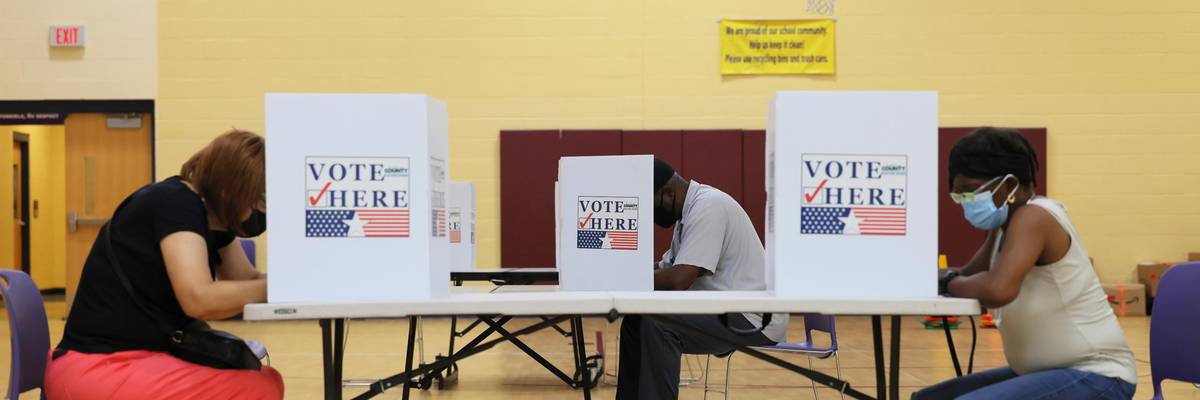
People vote in the primary election at Barack Obama Elementary School in St Louis, Missouri on August 2, 2022. (Photo: Michael M. Santiago/Getty Images)
The League of Women Voters of Missouri and state arm of the NAACP on Friday celebrated after the Cole County Circuit Court granted a preliminary injunction blocking parts of a new law intended to restrict activities of groups encouraging Missourians to vote.
"With today's ruling, we will uplift our voices loud and strong to protect the right to vote heading into next week's critical elections."
"We are gratified that the court has yet again sided with the rights of the NAACP and voters who work to protect the right to vote," said Nimrod Chapel Jr., president of the Missouri arm, just days before the crucial midterm elections.
"The NAACP has long led the fight for African-American voting rights," Chapel continued. "In these Jim Crow provisions, lawmakers stripped us of critical ways to engage our communities by criminalizing our ability to encourage voting and good citizenship. Black voters have been disproportionately harmed by these restrictions."
"With today's ruling, we will uplift our voices loud and strong to protect the right to vote heading into next week's critical elections," he declared.
Republican Gov. Mike Parson signed House Bill 1878 in late June. The two plaintiff groups challenged four provisions: prohibitions on anyone being paid for soliciting voter registration applications and soliciting a voter into obtaining an absentee ballot application, as well as requirements that individuals who solicit more than 10 applications to register with the secretary of state and solicitors be at least 18 years old and a registered Missouri voter.
The court concluded that the plaintiffs have "a fair chance of prevailing" on the merits of their case and that they face a "threat of irreparable harm" absent an injunction that temporarily halts the challenged provisions.
"We applaud the court's ruling, which blocks enforcement of H.B. 1878's restrictions on what civic engagement organizations like the League of Women Voters of Missouri and the Missouri NAACP can do to educate and engage with voters," said Danielle Lang, senior director of voting rights at Campaign Legal Center--which represented the plaintiffs alongside the state ACLU and Missouri Voter Protection Coalition (MOVPC).
"Instead of making our elections any safer, the law criminalizes the very organizations that work around the clock to make our democracy stronger and more accessible," Lang stressed. "Voter engagement is political speech. While the 2022 election is only a few days away, this ruling means that civic engagement organizations will be able to engage with voters over the weekend and in future elections, so every Missourian can make their voice heard."
Marilyn McLeod, president of the League of Women Voters of Missouri, confirmed leading up to the November 8 election--which will determine which party controls Congress and various key state seats--the groups will continue working to get voters to participate.
"We're delighted that the court recognized the league's essential role in encouraging and enabling all eligible Missourians to participate in our democracy," McLeod said. "Although we only have a few days before the 2022 general election, this preliminary injunction lets the league's paid staff and volunteers breathe easier as we continue our work to help voters."
While welcoming the court's decision, some of the involved legal groups also highlighted the danger of laws like H.B. 1878--which Republicans have increasingly worked to force through state legislatures since former President Donald Trump lost reelection in 2020.
"While we remain disappointed that the Missouri Legislature passed these provisions in H.B. 1878 that violate free speech in the first place, we are grateful that the court has recognized the harm they have caused and has issued a decision to prevent future harm," explained Gillian Wilcox, deputy director for litigation at the ACLU of Missouri.
Denise Lieberman, director and general counsel of MOVPC, said that "it is unfortunate that the measures chilled voter engagement activity as long as they did, but after today's ruling, Missouri's civic engagement organizations can rest assured that they can go about their critical work in the days leading into next week's elections without fear of criminal prosecution."
Dear Common Dreams reader, It’s been nearly 30 years since I co-founded Common Dreams with my late wife, Lina Newhouser. We had the radical notion that journalism should serve the public good, not corporate profits. It was clear to us from the outset what it would take to build such a project. No paid advertisements. No corporate sponsors. No millionaire publisher telling us what to think or do. Many people said we wouldn't last a year, but we proved those doubters wrong. Together with a tremendous team of journalists and dedicated staff, we built an independent media outlet free from the constraints of profits and corporate control. Our mission has always been simple: To inform. To inspire. To ignite change for the common good. Building Common Dreams was not easy. Our survival was never guaranteed. When you take on the most powerful forces—Wall Street greed, fossil fuel industry destruction, Big Tech lobbyists, and uber-rich oligarchs who have spent billions upon billions rigging the economy and democracy in their favor—the only bulwark you have is supporters who believe in your work. But here’s the urgent message from me today. It's never been this bad out there. And it's never been this hard to keep us going. At the very moment Common Dreams is most needed, the threats we face are intensifying. We need your support now more than ever. We don't accept corporate advertising and never will. We don't have a paywall because we don't think people should be blocked from critical news based on their ability to pay. Everything we do is funded by the donations of readers like you. When everyone does the little they can afford, we are strong. But if that support retreats or dries up, so do we. Will you donate now to make sure Common Dreams not only survives but thrives? —Craig Brown, Co-founder |
The League of Women Voters of Missouri and state arm of the NAACP on Friday celebrated after the Cole County Circuit Court granted a preliminary injunction blocking parts of a new law intended to restrict activities of groups encouraging Missourians to vote.
"With today's ruling, we will uplift our voices loud and strong to protect the right to vote heading into next week's critical elections."
"We are gratified that the court has yet again sided with the rights of the NAACP and voters who work to protect the right to vote," said Nimrod Chapel Jr., president of the Missouri arm, just days before the crucial midterm elections.
"The NAACP has long led the fight for African-American voting rights," Chapel continued. "In these Jim Crow provisions, lawmakers stripped us of critical ways to engage our communities by criminalizing our ability to encourage voting and good citizenship. Black voters have been disproportionately harmed by these restrictions."
"With today's ruling, we will uplift our voices loud and strong to protect the right to vote heading into next week's critical elections," he declared.
Republican Gov. Mike Parson signed House Bill 1878 in late June. The two plaintiff groups challenged four provisions: prohibitions on anyone being paid for soliciting voter registration applications and soliciting a voter into obtaining an absentee ballot application, as well as requirements that individuals who solicit more than 10 applications to register with the secretary of state and solicitors be at least 18 years old and a registered Missouri voter.
The court concluded that the plaintiffs have "a fair chance of prevailing" on the merits of their case and that they face a "threat of irreparable harm" absent an injunction that temporarily halts the challenged provisions.
"We applaud the court's ruling, which blocks enforcement of H.B. 1878's restrictions on what civic engagement organizations like the League of Women Voters of Missouri and the Missouri NAACP can do to educate and engage with voters," said Danielle Lang, senior director of voting rights at Campaign Legal Center--which represented the plaintiffs alongside the state ACLU and Missouri Voter Protection Coalition (MOVPC).
"Instead of making our elections any safer, the law criminalizes the very organizations that work around the clock to make our democracy stronger and more accessible," Lang stressed. "Voter engagement is political speech. While the 2022 election is only a few days away, this ruling means that civic engagement organizations will be able to engage with voters over the weekend and in future elections, so every Missourian can make their voice heard."
Marilyn McLeod, president of the League of Women Voters of Missouri, confirmed leading up to the November 8 election--which will determine which party controls Congress and various key state seats--the groups will continue working to get voters to participate.
"We're delighted that the court recognized the league's essential role in encouraging and enabling all eligible Missourians to participate in our democracy," McLeod said. "Although we only have a few days before the 2022 general election, this preliminary injunction lets the league's paid staff and volunteers breathe easier as we continue our work to help voters."
While welcoming the court's decision, some of the involved legal groups also highlighted the danger of laws like H.B. 1878--which Republicans have increasingly worked to force through state legislatures since former President Donald Trump lost reelection in 2020.
"While we remain disappointed that the Missouri Legislature passed these provisions in H.B. 1878 that violate free speech in the first place, we are grateful that the court has recognized the harm they have caused and has issued a decision to prevent future harm," explained Gillian Wilcox, deputy director for litigation at the ACLU of Missouri.
Denise Lieberman, director and general counsel of MOVPC, said that "it is unfortunate that the measures chilled voter engagement activity as long as they did, but after today's ruling, Missouri's civic engagement organizations can rest assured that they can go about their critical work in the days leading into next week's elections without fear of criminal prosecution."
The League of Women Voters of Missouri and state arm of the NAACP on Friday celebrated after the Cole County Circuit Court granted a preliminary injunction blocking parts of a new law intended to restrict activities of groups encouraging Missourians to vote.
"With today's ruling, we will uplift our voices loud and strong to protect the right to vote heading into next week's critical elections."
"We are gratified that the court has yet again sided with the rights of the NAACP and voters who work to protect the right to vote," said Nimrod Chapel Jr., president of the Missouri arm, just days before the crucial midterm elections.
"The NAACP has long led the fight for African-American voting rights," Chapel continued. "In these Jim Crow provisions, lawmakers stripped us of critical ways to engage our communities by criminalizing our ability to encourage voting and good citizenship. Black voters have been disproportionately harmed by these restrictions."
"With today's ruling, we will uplift our voices loud and strong to protect the right to vote heading into next week's critical elections," he declared.
Republican Gov. Mike Parson signed House Bill 1878 in late June. The two plaintiff groups challenged four provisions: prohibitions on anyone being paid for soliciting voter registration applications and soliciting a voter into obtaining an absentee ballot application, as well as requirements that individuals who solicit more than 10 applications to register with the secretary of state and solicitors be at least 18 years old and a registered Missouri voter.
The court concluded that the plaintiffs have "a fair chance of prevailing" on the merits of their case and that they face a "threat of irreparable harm" absent an injunction that temporarily halts the challenged provisions.
"We applaud the court's ruling, which blocks enforcement of H.B. 1878's restrictions on what civic engagement organizations like the League of Women Voters of Missouri and the Missouri NAACP can do to educate and engage with voters," said Danielle Lang, senior director of voting rights at Campaign Legal Center--which represented the plaintiffs alongside the state ACLU and Missouri Voter Protection Coalition (MOVPC).
"Instead of making our elections any safer, the law criminalizes the very organizations that work around the clock to make our democracy stronger and more accessible," Lang stressed. "Voter engagement is political speech. While the 2022 election is only a few days away, this ruling means that civic engagement organizations will be able to engage with voters over the weekend and in future elections, so every Missourian can make their voice heard."
Marilyn McLeod, president of the League of Women Voters of Missouri, confirmed leading up to the November 8 election--which will determine which party controls Congress and various key state seats--the groups will continue working to get voters to participate.
"We're delighted that the court recognized the league's essential role in encouraging and enabling all eligible Missourians to participate in our democracy," McLeod said. "Although we only have a few days before the 2022 general election, this preliminary injunction lets the league's paid staff and volunteers breathe easier as we continue our work to help voters."
While welcoming the court's decision, some of the involved legal groups also highlighted the danger of laws like H.B. 1878--which Republicans have increasingly worked to force through state legislatures since former President Donald Trump lost reelection in 2020.
"While we remain disappointed that the Missouri Legislature passed these provisions in H.B. 1878 that violate free speech in the first place, we are grateful that the court has recognized the harm they have caused and has issued a decision to prevent future harm," explained Gillian Wilcox, deputy director for litigation at the ACLU of Missouri.
Denise Lieberman, director and general counsel of MOVPC, said that "it is unfortunate that the measures chilled voter engagement activity as long as they did, but after today's ruling, Missouri's civic engagement organizations can rest assured that they can go about their critical work in the days leading into next week's elections without fear of criminal prosecution."