SUBSCRIBE TO OUR FREE NEWSLETTER
Daily news & progressive opinion—funded by the people, not the corporations—delivered straight to your inbox.
5
#000000
#FFFFFF
To donate by check, phone, or other method, see our More Ways to Give page.
Daily news & progressive opinion—funded by the people, not the corporations—delivered straight to your inbox.
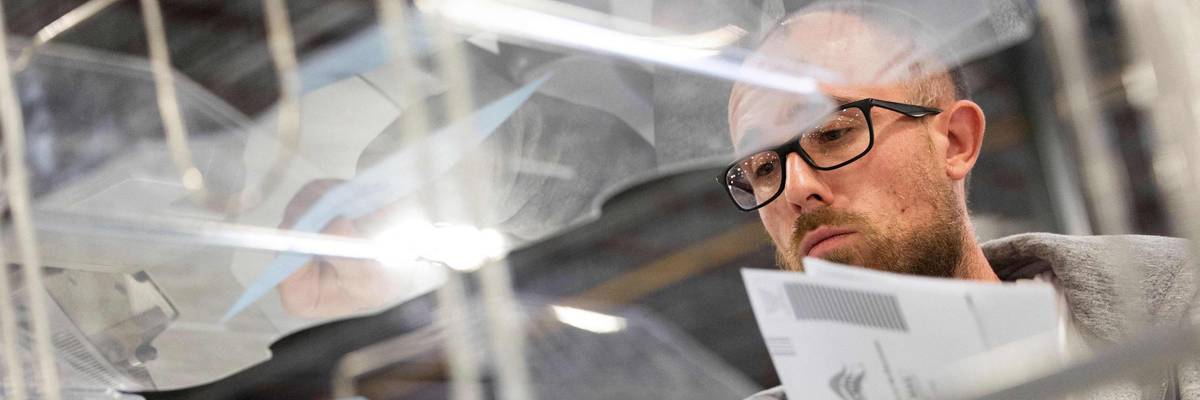
An election official demonstrates part of the ballot sorting process in Philadelphia on October 27, 2022. (Photo: Ryan Collerd/AFP via Getty Images)
Just a week before the midterms, the Pennsylvania Supreme Court ruled Tuesday that state election officials cannot count ballots submitted without a correct date on the outer envelope, siding with a coalition of Republican groups that sued to block undated mail-in ballots.
In a two-page order, the six-judge high court ordered election officials to "refrain from counting any absentee and mail-in ballots received for the November 8, 2022 general election that are contained in undated or incorrectly dated outer envelopes" even if they were received on time, pointing to two specific Pennsylvania statutes.
The judges--four Democrats and two Republicans--were divided on the question of whether excluding ballots inside improperly dated envelopes would violate federal law, as Acting Secretary of the Commonwealth Leigh Chapman has argued. The court was left with an even number of judges following the recent death of Democratic Chief Justice Max Baer.
In a recent filing, Chapman warned the GOP coalition was pursuing "an order that will disenfranchise thousands of qualified Pennsylvania voters, predominantly older citizens, because the voter omitted (or incorrectly wrote) a date that serves no function in the administration of Pennsylvania's elections."
"As a matter of both state and federal law, county boards may not disqualify ballots based on an omission of, or error in, the handwritten date," the brief contended.
The Pennsylvania Supreme Court's ruling to the contrary could have huge implications for midterm races in the battleground state, which could decide which party controls the U.S. Senate next year. The Wall Street Journal noted Tuesday that "the case has been one of the most closely watched voting law battles heading into the 2022 midterm elections."
"More than 1.4 million voters in Pennsylvania have applied to vote by mail or absentee ballot this election," the newspaper observed. "Experts on voting said the decision could affect tight races, including the U.S. Senate contest between Democrat John Fetterman and Republican Mehmet Oz... Some 70% of mail-in ballot requests as of November 1 were from Democrats."
The ACLU of Pennsylvania, which sought to intervene in the case brought by the Republican National Committee (RNC) and other GOP organizations, expressed disappointment in the state court's ruling on social media.
"No one should be disenfranchised for an irrelevant technicality," the group tweeted. "Voters, sign and date your return envelope."
Republicans, meanwhile, hailed the ruling as a major victory as they work to suppress votes nationwide.
Ronna McDaniel, chair of the RNC, called the decision a "massive election integrity win," a sentiment that Doug Mastriano--the GOP's election-denying gubernatorial nominee in Pennsylvania--echoed.
It's not clear whether Pennsylvania officials will be able to appeal the ruling.
Amy Gulli, a spokeswoman for Chapman, told The New York Times that "we are reviewing, but the order underscores the importance of the state's consistent guidance that voters should carefully follow all instructions on their mail ballot and double-check before returning it."
Chapman's office has been working in recent days to combat election lies peddled by state Republicans and amplified by former President Donald Trump, who is backing Mastriano and Dr. Oz.
In a recent post on Truth Social, Trump wrote that "over 240,000 'unverified' ballots have already been sent out in Pennsylvania, a total mess."
Pennsylvania's Department of State responded with a notice pointing out that "this misinformation incorrectly conflates an application for a mail ballot and an approved mail ballot."
Dear Common Dreams reader, It’s been nearly 30 years since I co-founded Common Dreams with my late wife, Lina Newhouser. We had the radical notion that journalism should serve the public good, not corporate profits. It was clear to us from the outset what it would take to build such a project. No paid advertisements. No corporate sponsors. No millionaire publisher telling us what to think or do. Many people said we wouldn't last a year, but we proved those doubters wrong. Together with a tremendous team of journalists and dedicated staff, we built an independent media outlet free from the constraints of profits and corporate control. Our mission has always been simple: To inform. To inspire. To ignite change for the common good. Building Common Dreams was not easy. Our survival was never guaranteed. When you take on the most powerful forces—Wall Street greed, fossil fuel industry destruction, Big Tech lobbyists, and uber-rich oligarchs who have spent billions upon billions rigging the economy and democracy in their favor—the only bulwark you have is supporters who believe in your work. But here’s the urgent message from me today. It's never been this bad out there. And it's never been this hard to keep us going. At the very moment Common Dreams is most needed, the threats we face are intensifying. We need your support now more than ever. We don't accept corporate advertising and never will. We don't have a paywall because we don't think people should be blocked from critical news based on their ability to pay. Everything we do is funded by the donations of readers like you. When everyone does the little they can afford, we are strong. But if that support retreats or dries up, so do we. Will you donate now to make sure Common Dreams not only survives but thrives? —Craig Brown, Co-founder |
Just a week before the midterms, the Pennsylvania Supreme Court ruled Tuesday that state election officials cannot count ballots submitted without a correct date on the outer envelope, siding with a coalition of Republican groups that sued to block undated mail-in ballots.
In a two-page order, the six-judge high court ordered election officials to "refrain from counting any absentee and mail-in ballots received for the November 8, 2022 general election that are contained in undated or incorrectly dated outer envelopes" even if they were received on time, pointing to two specific Pennsylvania statutes.
The judges--four Democrats and two Republicans--were divided on the question of whether excluding ballots inside improperly dated envelopes would violate federal law, as Acting Secretary of the Commonwealth Leigh Chapman has argued. The court was left with an even number of judges following the recent death of Democratic Chief Justice Max Baer.
In a recent filing, Chapman warned the GOP coalition was pursuing "an order that will disenfranchise thousands of qualified Pennsylvania voters, predominantly older citizens, because the voter omitted (or incorrectly wrote) a date that serves no function in the administration of Pennsylvania's elections."
"As a matter of both state and federal law, county boards may not disqualify ballots based on an omission of, or error in, the handwritten date," the brief contended.
The Pennsylvania Supreme Court's ruling to the contrary could have huge implications for midterm races in the battleground state, which could decide which party controls the U.S. Senate next year. The Wall Street Journal noted Tuesday that "the case has been one of the most closely watched voting law battles heading into the 2022 midterm elections."
"More than 1.4 million voters in Pennsylvania have applied to vote by mail or absentee ballot this election," the newspaper observed. "Experts on voting said the decision could affect tight races, including the U.S. Senate contest between Democrat John Fetterman and Republican Mehmet Oz... Some 70% of mail-in ballot requests as of November 1 were from Democrats."
The ACLU of Pennsylvania, which sought to intervene in the case brought by the Republican National Committee (RNC) and other GOP organizations, expressed disappointment in the state court's ruling on social media.
"No one should be disenfranchised for an irrelevant technicality," the group tweeted. "Voters, sign and date your return envelope."
Republicans, meanwhile, hailed the ruling as a major victory as they work to suppress votes nationwide.
Ronna McDaniel, chair of the RNC, called the decision a "massive election integrity win," a sentiment that Doug Mastriano--the GOP's election-denying gubernatorial nominee in Pennsylvania--echoed.
It's not clear whether Pennsylvania officials will be able to appeal the ruling.
Amy Gulli, a spokeswoman for Chapman, told The New York Times that "we are reviewing, but the order underscores the importance of the state's consistent guidance that voters should carefully follow all instructions on their mail ballot and double-check before returning it."
Chapman's office has been working in recent days to combat election lies peddled by state Republicans and amplified by former President Donald Trump, who is backing Mastriano and Dr. Oz.
In a recent post on Truth Social, Trump wrote that "over 240,000 'unverified' ballots have already been sent out in Pennsylvania, a total mess."
Pennsylvania's Department of State responded with a notice pointing out that "this misinformation incorrectly conflates an application for a mail ballot and an approved mail ballot."
Just a week before the midterms, the Pennsylvania Supreme Court ruled Tuesday that state election officials cannot count ballots submitted without a correct date on the outer envelope, siding with a coalition of Republican groups that sued to block undated mail-in ballots.
In a two-page order, the six-judge high court ordered election officials to "refrain from counting any absentee and mail-in ballots received for the November 8, 2022 general election that are contained in undated or incorrectly dated outer envelopes" even if they were received on time, pointing to two specific Pennsylvania statutes.
The judges--four Democrats and two Republicans--were divided on the question of whether excluding ballots inside improperly dated envelopes would violate federal law, as Acting Secretary of the Commonwealth Leigh Chapman has argued. The court was left with an even number of judges following the recent death of Democratic Chief Justice Max Baer.
In a recent filing, Chapman warned the GOP coalition was pursuing "an order that will disenfranchise thousands of qualified Pennsylvania voters, predominantly older citizens, because the voter omitted (or incorrectly wrote) a date that serves no function in the administration of Pennsylvania's elections."
"As a matter of both state and federal law, county boards may not disqualify ballots based on an omission of, or error in, the handwritten date," the brief contended.
The Pennsylvania Supreme Court's ruling to the contrary could have huge implications for midterm races in the battleground state, which could decide which party controls the U.S. Senate next year. The Wall Street Journal noted Tuesday that "the case has been one of the most closely watched voting law battles heading into the 2022 midterm elections."
"More than 1.4 million voters in Pennsylvania have applied to vote by mail or absentee ballot this election," the newspaper observed. "Experts on voting said the decision could affect tight races, including the U.S. Senate contest between Democrat John Fetterman and Republican Mehmet Oz... Some 70% of mail-in ballot requests as of November 1 were from Democrats."
The ACLU of Pennsylvania, which sought to intervene in the case brought by the Republican National Committee (RNC) and other GOP organizations, expressed disappointment in the state court's ruling on social media.
"No one should be disenfranchised for an irrelevant technicality," the group tweeted. "Voters, sign and date your return envelope."
Republicans, meanwhile, hailed the ruling as a major victory as they work to suppress votes nationwide.
Ronna McDaniel, chair of the RNC, called the decision a "massive election integrity win," a sentiment that Doug Mastriano--the GOP's election-denying gubernatorial nominee in Pennsylvania--echoed.
It's not clear whether Pennsylvania officials will be able to appeal the ruling.
Amy Gulli, a spokeswoman for Chapman, told The New York Times that "we are reviewing, but the order underscores the importance of the state's consistent guidance that voters should carefully follow all instructions on their mail ballot and double-check before returning it."
Chapman's office has been working in recent days to combat election lies peddled by state Republicans and amplified by former President Donald Trump, who is backing Mastriano and Dr. Oz.
In a recent post on Truth Social, Trump wrote that "over 240,000 'unverified' ballots have already been sent out in Pennsylvania, a total mess."
Pennsylvania's Department of State responded with a notice pointing out that "this misinformation incorrectly conflates an application for a mail ballot and an approved mail ballot."