

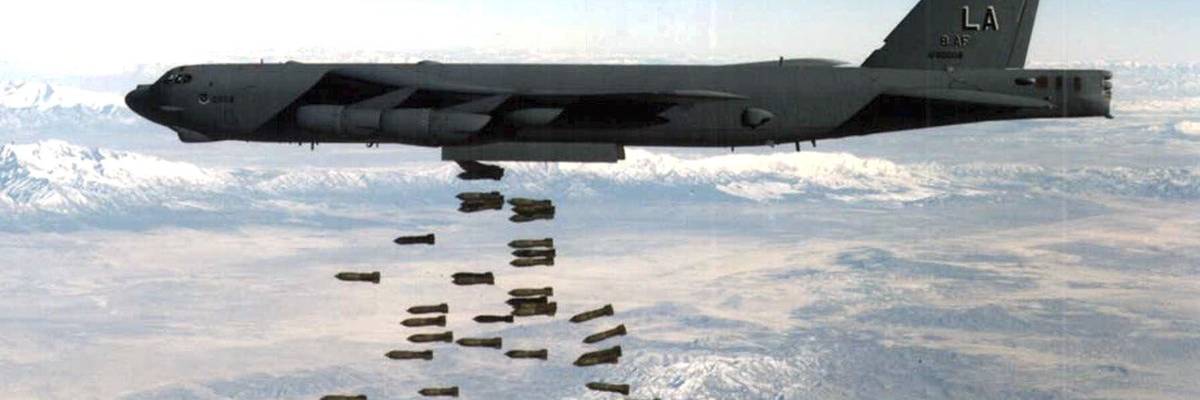
A B-52 drops bombs in this file photo, date unknown. (Photo: API/Gamma-Rapho via Getty Images)
'Military Madness': US to Deploy Nuclear-Capable B-52s to Australia, Provoking China
Deploying "bombers to Australia sends a strong message to adversaries about our ability to project lethal air power," said the U.S. Air Force, alarming anti-war advocates.
In what critics are calling a "dangerous escalation," the United States is reportedly preparing to deploy up to six nuclear-capable B-52 bombers to northern Australia, where they would be close enough to strike China.
"It's a great expansion of Australian commitment to the United States' war plan with China."
"The ability to deploy U.S. Air Force bombers to Australia sends a strong message to adversaries about our ability to project lethal air power," the U.S. Air Force told "Four Corners," a television program of the Australian Broadcasting Corporation (ABC), on Sunday.
Becca Wasser, a senior fellow at the Center for a New American Security, a Washington D.C.-based think tank, told ABC that "having bombers that could range and potentially attack mainland China could be very important in sending a signal to China that any of its actions over Taiwan could also expand further."
Investigative journalist Peter Cronau, however, described the plan, which came with "no debate [or] discussion," as "military madness [that] is fanning tensions with China."
Cronau's message was echoed by David Shoebridge, an Australian Greens senator for New South Wales.
"This is a dangerous escalation," Shoebridge wrote on Twitter. "It makes Australia an even bigger part of the global nuclear weapons threat to humanity's very existence--and by rising military tensions it further destabilizes our region."
According to ABC, "Washington is planning to build dedicated facilities" for the nuclear-capable B-52 bombers at Royal Australian Air Force Base Tindal, less than 200 miles south of Darwin, the capital of the country's Northern Territory.
The Pentagon's plan represents the latest U.S. act of hostility toward China.
Relations between the two countries have only worsened since August, when U.S. House Speaker Nancy Pelosi (D-Calif.) and other members of Congress visited Taiwan (the Republic of China, or ROC) despite opposition from Beijing, which--along with most of the international community, including Washington since the 1970s--considers the breakaway province to be part of the People's Republic of China (PRC).
In a departure from more than four decades of "One China" policy--in which the U.S. recognizes the PRC as the sole legal government of China and maintains informal relations with the ROC while adopting a position of "strategic ambiguity" to obscure how far it would go to protect Taiwan--U.S. President Joe Biden has repeatedly threatened to use military force in response to a Chinese invasion of the island.
Although Biden warned earlier this month that Russia's assault on Ukraine has brought the world closer to "Armagedeon" than at any point since the Cuban Missile Crisis, his move to station B-52 bombers in Australia further increases the global risk of nuclear war.
News of the impending deployment comes just days after the Biden administration released a Nuclear Posture Review (NPR) that nonproliferation advocates said makes catastrophe more, rather than less, likely.
"The formal statement of U.S. nuclear strategy pays lip service to the need to limit the spread and prevent the use of atomic weaponry and cancels an egregious Trump-era missile program," Common Dreams reported last week, but "the document makes clear that the country will move ahead with dangerous and costly modernization plans--and leaves intact the option of a nuclear first strike."
According to Stephen Young, senior Washington representative at the Union of Concerned Scientists, "The world is becoming a more dangerous place, but the only military threat to the survival of the United States is a nuclear war with Russia or China."
"Rather than recognizing that threat and seeking to find ways to end it," said Young, "the Biden NPR doubles down on nuclear deterrence and the status quo approach to security that says we all must be prepared to die in less than an hour."
The move to park B-52 bombers at the Tindal air base also comes just over a year after the establishment of the so-called AUKUS alliance, a trilateral military partnership through which the U.S. and the United Kingdom plan to help Australia build a fleet of nuclear-powered submarines--a long-term initiative widely seen as a challenge to China by Western powers determined to exert control over the Pacific region.
Some Australian critics expressed concerns that the planned deployment of U.S. military aircraft to the Northern Territory locks the country into joining Washington in the event an armed conflict with China erupts.
"It's a great expansion of Australian commitment to the United States' war plan with China," said Richard Tanter, a senior research associate at the Nautilus Institute and longstanding anti-nuclear activist.
"It's a sign to the Chinese that we are willing to be the tip of the spear," said Tanter. "It's very hard to think of a more open commitment that we could make. A more open signal to the Chinese that we are going along with American planning for a war with China."
Beijing, for its part, accused Washington of destabilizing the entire Pacific region with its planned deployment of B-52s to the Tindal air base.
Asked about the U.S. positioning nuclear-capable bombers in Australia, Chinese Foreign Ministry spokesperson Zhao Lijian said that military cooperation pacts between countries should "not target any third parties or harm the interests of third parties."
"The relevant U.S. behaviors have increased regional tensions, seriously undermined regional peace and stability, and may trigger an arms race in the region," Zhao told reporters at a regular briefing in Beijing.
"China urges the parties concerned to abandon the outdated Cold War and zero-sum mentality and narrowminded geopolitical thinking, and to do something conducive to regional peace and stability and enhancing mutual trust between the countries," he added.
We are at a crossroads
This country and this world are at a monumental crossroads. In a few short weeks, US voters will have an opportunity to beat back the forces of fascism and confront the billionaires who are rigging the economy, our media system, and our democracy, making it increasingly impossible for ordinary people to get by. We’re not just talking about the election. We’re talking about what must be done once these fascist elements are vanquished from power. We need a bolder set of solutions than what either major party has so far been willing to offer and a working-class movement ready to fight like hell for it. Trump didn't emerge from nowhere. The conditions that fueled MAGA authoritarianism were created by decades of radical neoliberal economic policies and a corrupt political system dominated by corporate interests. They slashed taxes on the super-rich, promising that the benefits would trickle down. They said giveaways to the corporate titans would make life more affordable for the rest of us. It was all bullshit. And when a bitter, betrayed populace searches for someone to blame, right-wing demagogues have little trouble finding scapegoats. People know when they're being lied to, but you won't hear any of this from the corporate media. Only independent journalism—powered and funded by people who believe in building a better world—can deliver truly trustworthy daily news. Our Fall Campaign is underway, and we need your help. To power our newsroom through the rest of the year, we need to raise $125,000 by midnight on October 31. So if you share our vision, please contribute whatever you can to sustain our work. |
In what critics are calling a "dangerous escalation," the United States is reportedly preparing to deploy up to six nuclear-capable B-52 bombers to northern Australia, where they would be close enough to strike China.
"It's a great expansion of Australian commitment to the United States' war plan with China."
"The ability to deploy U.S. Air Force bombers to Australia sends a strong message to adversaries about our ability to project lethal air power," the U.S. Air Force told "Four Corners," a television program of the Australian Broadcasting Corporation (ABC), on Sunday.
Becca Wasser, a senior fellow at the Center for a New American Security, a Washington D.C.-based think tank, told ABC that "having bombers that could range and potentially attack mainland China could be very important in sending a signal to China that any of its actions over Taiwan could also expand further."
Investigative journalist Peter Cronau, however, described the plan, which came with "no debate [or] discussion," as "military madness [that] is fanning tensions with China."
Cronau's message was echoed by David Shoebridge, an Australian Greens senator for New South Wales.
"This is a dangerous escalation," Shoebridge wrote on Twitter. "It makes Australia an even bigger part of the global nuclear weapons threat to humanity's very existence--and by rising military tensions it further destabilizes our region."
According to ABC, "Washington is planning to build dedicated facilities" for the nuclear-capable B-52 bombers at Royal Australian Air Force Base Tindal, less than 200 miles south of Darwin, the capital of the country's Northern Territory.
The Pentagon's plan represents the latest U.S. act of hostility toward China.
Relations between the two countries have only worsened since August, when U.S. House Speaker Nancy Pelosi (D-Calif.) and other members of Congress visited Taiwan (the Republic of China, or ROC) despite opposition from Beijing, which--along with most of the international community, including Washington since the 1970s--considers the breakaway province to be part of the People's Republic of China (PRC).
In a departure from more than four decades of "One China" policy--in which the U.S. recognizes the PRC as the sole legal government of China and maintains informal relations with the ROC while adopting a position of "strategic ambiguity" to obscure how far it would go to protect Taiwan--U.S. President Joe Biden has repeatedly threatened to use military force in response to a Chinese invasion of the island.
Although Biden warned earlier this month that Russia's assault on Ukraine has brought the world closer to "Armagedeon" than at any point since the Cuban Missile Crisis, his move to station B-52 bombers in Australia further increases the global risk of nuclear war.
News of the impending deployment comes just days after the Biden administration released a Nuclear Posture Review (NPR) that nonproliferation advocates said makes catastrophe more, rather than less, likely.
"The formal statement of U.S. nuclear strategy pays lip service to the need to limit the spread and prevent the use of atomic weaponry and cancels an egregious Trump-era missile program," Common Dreams reported last week, but "the document makes clear that the country will move ahead with dangerous and costly modernization plans--and leaves intact the option of a nuclear first strike."
According to Stephen Young, senior Washington representative at the Union of Concerned Scientists, "The world is becoming a more dangerous place, but the only military threat to the survival of the United States is a nuclear war with Russia or China."
"Rather than recognizing that threat and seeking to find ways to end it," said Young, "the Biden NPR doubles down on nuclear deterrence and the status quo approach to security that says we all must be prepared to die in less than an hour."
The move to park B-52 bombers at the Tindal air base also comes just over a year after the establishment of the so-called AUKUS alliance, a trilateral military partnership through which the U.S. and the United Kingdom plan to help Australia build a fleet of nuclear-powered submarines--a long-term initiative widely seen as a challenge to China by Western powers determined to exert control over the Pacific region.
Some Australian critics expressed concerns that the planned deployment of U.S. military aircraft to the Northern Territory locks the country into joining Washington in the event an armed conflict with China erupts.
"It's a great expansion of Australian commitment to the United States' war plan with China," said Richard Tanter, a senior research associate at the Nautilus Institute and longstanding anti-nuclear activist.
"It's a sign to the Chinese that we are willing to be the tip of the spear," said Tanter. "It's very hard to think of a more open commitment that we could make. A more open signal to the Chinese that we are going along with American planning for a war with China."
Beijing, for its part, accused Washington of destabilizing the entire Pacific region with its planned deployment of B-52s to the Tindal air base.
Asked about the U.S. positioning nuclear-capable bombers in Australia, Chinese Foreign Ministry spokesperson Zhao Lijian said that military cooperation pacts between countries should "not target any third parties or harm the interests of third parties."
"The relevant U.S. behaviors have increased regional tensions, seriously undermined regional peace and stability, and may trigger an arms race in the region," Zhao told reporters at a regular briefing in Beijing.
"China urges the parties concerned to abandon the outdated Cold War and zero-sum mentality and narrowminded geopolitical thinking, and to do something conducive to regional peace and stability and enhancing mutual trust between the countries," he added.
- 'A Terrifying Document': Critics Say Biden Nuclear Policy Makes the World More Dangerous ›
- Opinion | Biden Embraces Autocracies and Deteriorating Democracies to Challenge China | Common Dreams ›
- US Weapons Makers Set to Profit as Japan Readies $320 Billion Military Buildup ›
- Opinion | The US Advances Its Dystopian Plan to Destroy China | Common Dreams ›
- Opinion | Looming War With China Lurks Beneath US-Australia Talks | Common Dreams ›
In what critics are calling a "dangerous escalation," the United States is reportedly preparing to deploy up to six nuclear-capable B-52 bombers to northern Australia, where they would be close enough to strike China.
"It's a great expansion of Australian commitment to the United States' war plan with China."
"The ability to deploy U.S. Air Force bombers to Australia sends a strong message to adversaries about our ability to project lethal air power," the U.S. Air Force told "Four Corners," a television program of the Australian Broadcasting Corporation (ABC), on Sunday.
Becca Wasser, a senior fellow at the Center for a New American Security, a Washington D.C.-based think tank, told ABC that "having bombers that could range and potentially attack mainland China could be very important in sending a signal to China that any of its actions over Taiwan could also expand further."
Investigative journalist Peter Cronau, however, described the plan, which came with "no debate [or] discussion," as "military madness [that] is fanning tensions with China."
Cronau's message was echoed by David Shoebridge, an Australian Greens senator for New South Wales.
"This is a dangerous escalation," Shoebridge wrote on Twitter. "It makes Australia an even bigger part of the global nuclear weapons threat to humanity's very existence--and by rising military tensions it further destabilizes our region."
According to ABC, "Washington is planning to build dedicated facilities" for the nuclear-capable B-52 bombers at Royal Australian Air Force Base Tindal, less than 200 miles south of Darwin, the capital of the country's Northern Territory.
The Pentagon's plan represents the latest U.S. act of hostility toward China.
Relations between the two countries have only worsened since August, when U.S. House Speaker Nancy Pelosi (D-Calif.) and other members of Congress visited Taiwan (the Republic of China, or ROC) despite opposition from Beijing, which--along with most of the international community, including Washington since the 1970s--considers the breakaway province to be part of the People's Republic of China (PRC).
In a departure from more than four decades of "One China" policy--in which the U.S. recognizes the PRC as the sole legal government of China and maintains informal relations with the ROC while adopting a position of "strategic ambiguity" to obscure how far it would go to protect Taiwan--U.S. President Joe Biden has repeatedly threatened to use military force in response to a Chinese invasion of the island.
Although Biden warned earlier this month that Russia's assault on Ukraine has brought the world closer to "Armagedeon" than at any point since the Cuban Missile Crisis, his move to station B-52 bombers in Australia further increases the global risk of nuclear war.
News of the impending deployment comes just days after the Biden administration released a Nuclear Posture Review (NPR) that nonproliferation advocates said makes catastrophe more, rather than less, likely.
"The formal statement of U.S. nuclear strategy pays lip service to the need to limit the spread and prevent the use of atomic weaponry and cancels an egregious Trump-era missile program," Common Dreams reported last week, but "the document makes clear that the country will move ahead with dangerous and costly modernization plans--and leaves intact the option of a nuclear first strike."
According to Stephen Young, senior Washington representative at the Union of Concerned Scientists, "The world is becoming a more dangerous place, but the only military threat to the survival of the United States is a nuclear war with Russia or China."
"Rather than recognizing that threat and seeking to find ways to end it," said Young, "the Biden NPR doubles down on nuclear deterrence and the status quo approach to security that says we all must be prepared to die in less than an hour."
The move to park B-52 bombers at the Tindal air base also comes just over a year after the establishment of the so-called AUKUS alliance, a trilateral military partnership through which the U.S. and the United Kingdom plan to help Australia build a fleet of nuclear-powered submarines--a long-term initiative widely seen as a challenge to China by Western powers determined to exert control over the Pacific region.
Some Australian critics expressed concerns that the planned deployment of U.S. military aircraft to the Northern Territory locks the country into joining Washington in the event an armed conflict with China erupts.
"It's a great expansion of Australian commitment to the United States' war plan with China," said Richard Tanter, a senior research associate at the Nautilus Institute and longstanding anti-nuclear activist.
"It's a sign to the Chinese that we are willing to be the tip of the spear," said Tanter. "It's very hard to think of a more open commitment that we could make. A more open signal to the Chinese that we are going along with American planning for a war with China."
Beijing, for its part, accused Washington of destabilizing the entire Pacific region with its planned deployment of B-52s to the Tindal air base.
Asked about the U.S. positioning nuclear-capable bombers in Australia, Chinese Foreign Ministry spokesperson Zhao Lijian said that military cooperation pacts between countries should "not target any third parties or harm the interests of third parties."
"The relevant U.S. behaviors have increased regional tensions, seriously undermined regional peace and stability, and may trigger an arms race in the region," Zhao told reporters at a regular briefing in Beijing.
"China urges the parties concerned to abandon the outdated Cold War and zero-sum mentality and narrowminded geopolitical thinking, and to do something conducive to regional peace and stability and enhancing mutual trust between the countries," he added.
- 'A Terrifying Document': Critics Say Biden Nuclear Policy Makes the World More Dangerous ›
- Opinion | Biden Embraces Autocracies and Deteriorating Democracies to Challenge China | Common Dreams ›
- US Weapons Makers Set to Profit as Japan Readies $320 Billion Military Buildup ›
- Opinion | The US Advances Its Dystopian Plan to Destroy China | Common Dreams ›
- Opinion | Looming War With China Lurks Beneath US-Australia Talks | Common Dreams ›