SUBSCRIBE TO OUR FREE NEWSLETTER
Daily news & progressive opinion—funded by the people, not the corporations—delivered straight to your inbox.
5
#000000
#FFFFFF
To donate by check, phone, or other method, see our More Ways to Give page.
Daily news & progressive opinion—funded by the people, not the corporations—delivered straight to your inbox.

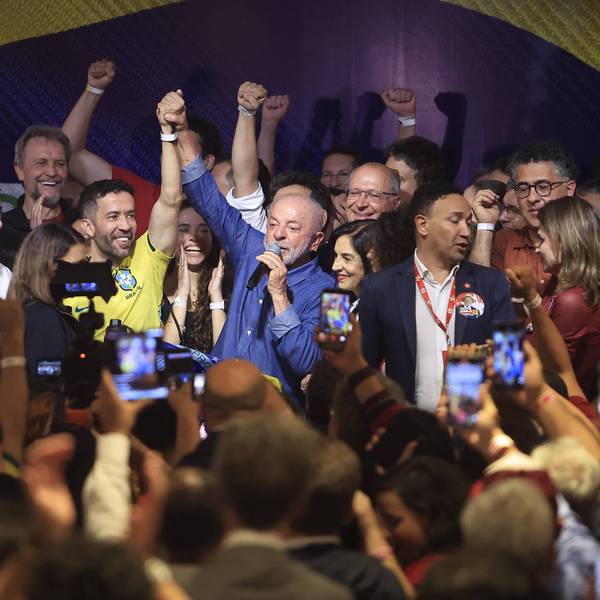
Supporters of former Brazilian President Luiz Inacio Lula da Silva react as they watch the vote count in Sao Paulo, Brazil on October 2, 2022. (Photo: Cris Faga/NurPhoto via Getty Images)
Leftist former President Luiz Inacio Lula da Silva said late Sunday that "the campaign begins tomorrow" after he fell just shy of clearing the 50% threshold to win the closely watched and globally important Brazilian election outright, setting up an October 30 runoff against far-right incumbent Jair Bolsonaro.
"Tomorrow we will be on the streets to win the elections. We don't have a break. We are going to work hard," Lula said as the results showed a second round would be necessary.
"I love campaigning. And we have 28 more days," Lula added. "I love doing rallies, getting on a truck. And it will be the first opportunity to have a face-to-face debate with the current president. So that we can make comparisons between the Brazil he built and the Brazil we built."
Tensions and fears of more political violence in Brazil are likely to remain elevated in the four weeks leading up to another round of voting, with Bolsonaro expected to keep up--and possibly intensify--his attacks on the integrity of the country's electoral process, rhetoric that has sparked concerns of a possible military coup attempt.
On Sunday, Bolsonaro outperformed pre-election polls signaling that Lula had a chance to ride to an outright victory in the first round. The incumbent leader, who has presided over a disastrous Covid-19 response and massive deforestation in the Amazon, received just over 43% of the vote compared to Lula's 48%.
"Yesterday I said that every election I want to win in the first round, but it's not always possible," said Lula, who received roughly 6 million more votes than Bolsonaro. "But the belief that nothing happens by chance motivates me. Every poll put us in first place, and I always thought we were going to win... This is just an extension."
If he's ultimately elected to return to the presidency, Lula and his left-wing Workers' Party will have to contend with a Brazilian Congress packed with Bolsonaro loyalists and other right-wing figures as the popular leftist attempts to implement his anti-poverty and climate agenda.
As Reuters reported, Bolsonaro allies "won 19 of the 27 seats that were up from grabs in the Senate, and initial returns suggested a strong showing for his base in the lower house."
"I plan to make the right political alliances to win this election," Bolsonaro told journalists Sunday, noting his party's wins in congressional races.
Several notorious ex-members of Bolsonaro's government were elected to Brazil's Congress on Sunday, including former environment minister Ricardo Salles--who resigned last year as he faced a criminal investigation involving illegal logging in the Amazon rainforest--and former health minister Eduardo Pazuello, an army general with no medical experience who oversaw the early stages of Brazil's catastrophic pandemic response.
Also elected Sunday was Sergio Moro, Bolsonaro's scandal-plagued former justice member and an architect of the since-annulled corruption case that landed Lula in prison for more than a year, preventing him from running for the presidency in 2018.
Thiago Amparo, an academic and columnist for Brazil's Folha de Sao Paulo newspaper, told The Guardian that Sunday's results show "it was wishful thinking to imagine the election would serve as a way to punish Bolsonaro for his disastrous policies during the pandemic."
"I feel exhausted," Amparo said. "But the results show we do not have the time to rest now. It is time to go out on to the streets... otherwise we are going to have a very dark future again."
This country and this world are at a monumental crossroads. US voters have an opportunity to beat back the forces of fascism and confront the billionaires who are rigging the economy, our media system, and our democracy, making it increasingly impossible for ordinary people to get by. We’re not just talking about the election. We’re talking about what must be done once these fascist elements are vanquished from power. We need a bolder set of solutions than what either major party has so far been willing to offer and a working-class movement ready to fight like hell for it. Trump didn't emerge from nowhere. The conditions that fueled MAGA authoritarianism were created by decades of radical neoliberal economic policies and a corrupt political system dominated by corporate interests. They slashed taxes on the super-rich, promising that the benefits would trickle down. They said giveaways to the corporate titans would make life more affordable for the rest of us. It was all bullshit. And when a bitter, betrayed populace searches for someone to blame, right-wing demagogues have little trouble finding scapegoats. People know when they're being lied to, but you won't hear any of this from the corporate media. Only independent journalism—powered and funded by people who believe in building a better world—can deliver truly trustworthy daily news. If you share our vision, please contribute whatever you can to sustain our work. |
Leftist former President Luiz Inacio Lula da Silva said late Sunday that "the campaign begins tomorrow" after he fell just shy of clearing the 50% threshold to win the closely watched and globally important Brazilian election outright, setting up an October 30 runoff against far-right incumbent Jair Bolsonaro.
"Tomorrow we will be on the streets to win the elections. We don't have a break. We are going to work hard," Lula said as the results showed a second round would be necessary.
"I love campaigning. And we have 28 more days," Lula added. "I love doing rallies, getting on a truck. And it will be the first opportunity to have a face-to-face debate with the current president. So that we can make comparisons between the Brazil he built and the Brazil we built."
Tensions and fears of more political violence in Brazil are likely to remain elevated in the four weeks leading up to another round of voting, with Bolsonaro expected to keep up--and possibly intensify--his attacks on the integrity of the country's electoral process, rhetoric that has sparked concerns of a possible military coup attempt.
On Sunday, Bolsonaro outperformed pre-election polls signaling that Lula had a chance to ride to an outright victory in the first round. The incumbent leader, who has presided over a disastrous Covid-19 response and massive deforestation in the Amazon, received just over 43% of the vote compared to Lula's 48%.
"Yesterday I said that every election I want to win in the first round, but it's not always possible," said Lula, who received roughly 6 million more votes than Bolsonaro. "But the belief that nothing happens by chance motivates me. Every poll put us in first place, and I always thought we were going to win... This is just an extension."
If he's ultimately elected to return to the presidency, Lula and his left-wing Workers' Party will have to contend with a Brazilian Congress packed with Bolsonaro loyalists and other right-wing figures as the popular leftist attempts to implement his anti-poverty and climate agenda.
As Reuters reported, Bolsonaro allies "won 19 of the 27 seats that were up from grabs in the Senate, and initial returns suggested a strong showing for his base in the lower house."
"I plan to make the right political alliances to win this election," Bolsonaro told journalists Sunday, noting his party's wins in congressional races.
Several notorious ex-members of Bolsonaro's government were elected to Brazil's Congress on Sunday, including former environment minister Ricardo Salles--who resigned last year as he faced a criminal investigation involving illegal logging in the Amazon rainforest--and former health minister Eduardo Pazuello, an army general with no medical experience who oversaw the early stages of Brazil's catastrophic pandemic response.
Also elected Sunday was Sergio Moro, Bolsonaro's scandal-plagued former justice member and an architect of the since-annulled corruption case that landed Lula in prison for more than a year, preventing him from running for the presidency in 2018.
Thiago Amparo, an academic and columnist for Brazil's Folha de Sao Paulo newspaper, told The Guardian that Sunday's results show "it was wishful thinking to imagine the election would serve as a way to punish Bolsonaro for his disastrous policies during the pandemic."
"I feel exhausted," Amparo said. "But the results show we do not have the time to rest now. It is time to go out on to the streets... otherwise we are going to have a very dark future again."