SUBSCRIBE TO OUR FREE NEWSLETTER
Daily news & progressive opinion—funded by the people, not the corporations—delivered straight to your inbox.
5
#000000
#FFFFFF
To donate by check, phone, or other method, see our More Ways to Give page.
Daily news & progressive opinion—funded by the people, not the corporations—delivered straight to your inbox.
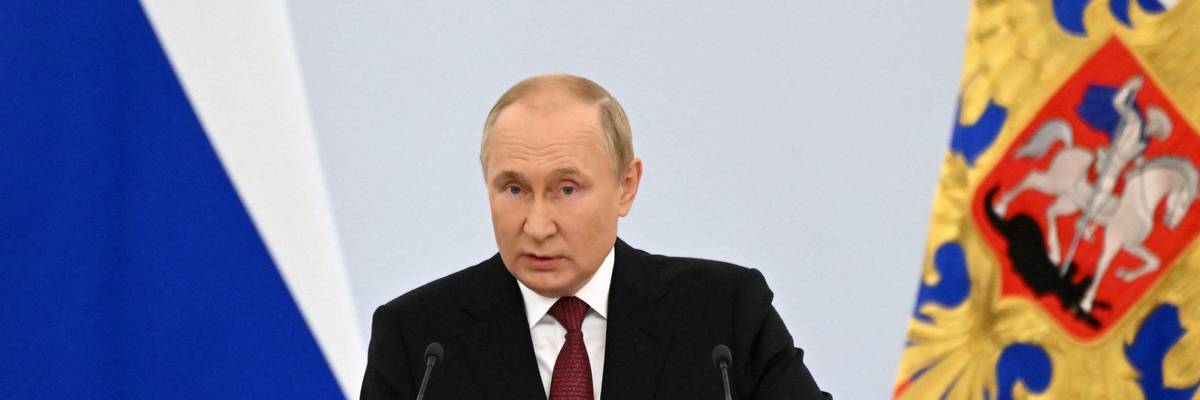
Russian President Vladimir Putin gives a speech at the Kremlin in Moscow on September 30, 2022.(Photo: Grigory Sysoyev/SPUTNIK/AFP via Getty Images)
Moscow's illegal annexation of four occupied regions of Ukraine--formally announced Friday by Russian President Vladimir Putin--is facing international condemnation, with peace advocates warning that it heightens the risk of nuclear war, thus making the need for swift and effective diplomacy even clearer.
In a ceremony at the Kremlin, Putin signed decrees to annex Donetsk, Luhansk, Kherson, and Zaporizhzhia--four Ukrainian territories wholly or partially controlled by Russian troops. Residents of those areas will "be our citizens forever," he said, claiming that this represents "the will of millions of people."
"The Russian action makes it even more essential that Washington and Moscow enter into direct talks to prevent the war from spreading and escalating into... a nuclear exchange that would destroy civilization."
However, the land grab, which is a violation of international law, comes after Moscow staged what critics called "sham" referendums in the occupied regions. Putin's Friday proclamation was made just hours after suspected Russian missile strikes killed at least 25 Ukrainians in a civilian convoy in Zaporizhzhia, which remains heavily contested.
"In this moment of peril, I must underscore my duty as secretary-general to uphold the Charter of the United Nations," U.N. chief Antonio Guterres told journalists in New York City on Thursday after the Kremlin announced its plans to hold an annexation ceremony.
"The Charter is clear," said Guterres. "Any annexation of a state's territory by another state resulting from the threat or use of force is a violation of the principles of the U.N. Charter and international law."
"Any decision to proceed with the annexation of Donetsk, Luhansk, Kherson, and Zaporizhzhia," he continued, "would have no legal value and deserves to be condemned."
The move "cannot be reconciled with the international legal framework" and "stands against everything the international community is meant to stand for," he added. "It flouts the purposes and principles of the United Nations. It is a dangerous escalation. It has no place in the modern world. It must not be accepted."
Analysts have warned, as the Washington Post reported last week, that "annexing the territories could enable Moscow to label Ukrainian attacks on those regions as attacks on Russia itself, raising the threat of a retaliatory nuclear strike."
That's precisely what Moscow did on Friday.
According to Russian news agency TASS, "Russia will view strikes on its new territories as an act of aggression, Kremlin spokesman Dmitry Peskov told reporters Friday."
"It will be nothing else," Peskov said in response to a question about whether Moscow will consider Ukrainian strikes on the annexed regions as attacks on Russia.
As the Post noted last week, "U.S. officials have indicated that the United States would continue to back the Ukrainian military if it tried to retake annexed land, and that an agreement that Ukraine would not strike Russian territory with U.S.-made weapons would not apply to illegally annexed areas."
On Friday, U.S. President Joe Biden unveiled a new round of sanctions targeting Russian government and military officials and their family members.
Nicholas Miller, an associate professor of government at Dartmouth who studies nuclear proliferation and nonproliferation policy, suggested on social media that Russia's annexation has created a no-win situation for Ukraine.
Accepting the annexation, he said, could help strengthen the precedent--which Putin argued Friday was first established by the U.S. at the end of World War II--that the threat of nuclear force can be used to dominate other countries, while resisting it could make it more likely that the invasion escalates into a direct conflict between nuclear-armed powers.
Russia's control of Zaporizhzhia is far from complete, with roughly a quarter of the region still in Ukraine's hands.
"The position of the United Nations is unequivocal," said Guterres. "We are fully committed to the sovereignty, unity, independence, and territorial integrity of Ukraine, within its internationally recognized borders, in accordance with the relevant U.N. resolutions."
"The so-called 'referenda' in the occupied regions were conducted during active armed conflict, in areas under Russian occupation, and outside Ukraine's legal and constitutional framework," Guterres stressed. "They cannot be called a genuine expression of the popular will."
He warned that "any decision by Russia to go forward will further jeopardize the prospects for peace," adding that "it will prolong the dramatic impacts on the global economy, especially [for] developing countries, and hinder our ability to deliver lifesaving aid across Ukraine and beyond."
It is against this backdrop that anti-war advocates are insisting on the need for stronger diplomatic efforts, with the U.N. chief calling it "high time to step back from the brink."
"Now more than ever," said Guterres, "we must work together to end this devastating and senseless war and uphold the U.N. Charter and international law."
That message was echoed by foreign policy expert Anatol Lieven, director of the Eurasia Program at the Quincy Institute for Responsible Statecraft.
In an essay published Friday, Lieven wrote that Russia's illegal acquisition of occupied Ukrainian territories "makes the present situation all the more dangerous, and direct talks between Washington and Moscow all the more urgent."
Putin's move "greatly complicates the search for an eventual peace settlement," Lieven noted, "as Ukraine and Western nations won't formally accept nor recognize the annexation."
"At the same time, once these territories have been officially accepted into Russia under the Russian constitution, it will be much more difficult for a future Russian government to give them up," he pointed out. "Nonetheless, barring the very unlikely prospect of a complete victory for either side, at some stage a ceasefire to end full-scale war will still be necessary."
Lieven continued:
Above all, the drastic nature of the Russian action makes it even more essential that Washington and Moscow enter into direct talks to prevent the war from spreading and escalating into a direct clash between the United States and Russia, which in the worst scenario could lead to a nuclear exchange that would destroy civilization.
The very fact that direct peace talks between Ukraine and Russia are now so difficult means that the Biden administration must assume greater responsibility for diplomatic efforts to contain and limit the conflict. Not to do so would essentially be abdicating its responsibility to protect the United States and the American people from threats to their very existence.
"This danger is in no sense hypothetical or speculative," Lieven argued. "Both before and during the war, the Biden administration has responded to Russia's aggressive moves by increasing its support to Ukraine. At every point, the Russian government has responded not by backing down, but by further escalating in turn."
"If this cycle of escalation continues unchecked," he added, "then the prospect of direct nuclear conflict between America and Russia will become an active probability."
Dear Common Dreams reader, It’s been nearly 30 years since I co-founded Common Dreams with my late wife, Lina Newhouser. We had the radical notion that journalism should serve the public good, not corporate profits. It was clear to us from the outset what it would take to build such a project. No paid advertisements. No corporate sponsors. No millionaire publisher telling us what to think or do. Many people said we wouldn't last a year, but we proved those doubters wrong. Together with a tremendous team of journalists and dedicated staff, we built an independent media outlet free from the constraints of profits and corporate control. Our mission has always been simple: To inform. To inspire. To ignite change for the common good. Building Common Dreams was not easy. Our survival was never guaranteed. When you take on the most powerful forces—Wall Street greed, fossil fuel industry destruction, Big Tech lobbyists, and uber-rich oligarchs who have spent billions upon billions rigging the economy and democracy in their favor—the only bulwark you have is supporters who believe in your work. But here’s the urgent message from me today. It's never been this bad out there. And it's never been this hard to keep us going. At the very moment Common Dreams is most needed, the threats we face are intensifying. We need your support now more than ever. We don't accept corporate advertising and never will. We don't have a paywall because we don't think people should be blocked from critical news based on their ability to pay. Everything we do is funded by the donations of readers like you. When everyone does the little they can afford, we are strong. But if that support retreats or dries up, so do we. Will you donate now to make sure Common Dreams not only survives but thrives? —Craig Brown, Co-founder |
Moscow's illegal annexation of four occupied regions of Ukraine--formally announced Friday by Russian President Vladimir Putin--is facing international condemnation, with peace advocates warning that it heightens the risk of nuclear war, thus making the need for swift and effective diplomacy even clearer.
In a ceremony at the Kremlin, Putin signed decrees to annex Donetsk, Luhansk, Kherson, and Zaporizhzhia--four Ukrainian territories wholly or partially controlled by Russian troops. Residents of those areas will "be our citizens forever," he said, claiming that this represents "the will of millions of people."
"The Russian action makes it even more essential that Washington and Moscow enter into direct talks to prevent the war from spreading and escalating into... a nuclear exchange that would destroy civilization."
However, the land grab, which is a violation of international law, comes after Moscow staged what critics called "sham" referendums in the occupied regions. Putin's Friday proclamation was made just hours after suspected Russian missile strikes killed at least 25 Ukrainians in a civilian convoy in Zaporizhzhia, which remains heavily contested.
"In this moment of peril, I must underscore my duty as secretary-general to uphold the Charter of the United Nations," U.N. chief Antonio Guterres told journalists in New York City on Thursday after the Kremlin announced its plans to hold an annexation ceremony.
"The Charter is clear," said Guterres. "Any annexation of a state's territory by another state resulting from the threat or use of force is a violation of the principles of the U.N. Charter and international law."
"Any decision to proceed with the annexation of Donetsk, Luhansk, Kherson, and Zaporizhzhia," he continued, "would have no legal value and deserves to be condemned."
The move "cannot be reconciled with the international legal framework" and "stands against everything the international community is meant to stand for," he added. "It flouts the purposes and principles of the United Nations. It is a dangerous escalation. It has no place in the modern world. It must not be accepted."
Analysts have warned, as the Washington Post reported last week, that "annexing the territories could enable Moscow to label Ukrainian attacks on those regions as attacks on Russia itself, raising the threat of a retaliatory nuclear strike."
That's precisely what Moscow did on Friday.
According to Russian news agency TASS, "Russia will view strikes on its new territories as an act of aggression, Kremlin spokesman Dmitry Peskov told reporters Friday."
"It will be nothing else," Peskov said in response to a question about whether Moscow will consider Ukrainian strikes on the annexed regions as attacks on Russia.
As the Post noted last week, "U.S. officials have indicated that the United States would continue to back the Ukrainian military if it tried to retake annexed land, and that an agreement that Ukraine would not strike Russian territory with U.S.-made weapons would not apply to illegally annexed areas."
On Friday, U.S. President Joe Biden unveiled a new round of sanctions targeting Russian government and military officials and their family members.
Nicholas Miller, an associate professor of government at Dartmouth who studies nuclear proliferation and nonproliferation policy, suggested on social media that Russia's annexation has created a no-win situation for Ukraine.
Accepting the annexation, he said, could help strengthen the precedent--which Putin argued Friday was first established by the U.S. at the end of World War II--that the threat of nuclear force can be used to dominate other countries, while resisting it could make it more likely that the invasion escalates into a direct conflict between nuclear-armed powers.
Russia's control of Zaporizhzhia is far from complete, with roughly a quarter of the region still in Ukraine's hands.
"The position of the United Nations is unequivocal," said Guterres. "We are fully committed to the sovereignty, unity, independence, and territorial integrity of Ukraine, within its internationally recognized borders, in accordance with the relevant U.N. resolutions."
"The so-called 'referenda' in the occupied regions were conducted during active armed conflict, in areas under Russian occupation, and outside Ukraine's legal and constitutional framework," Guterres stressed. "They cannot be called a genuine expression of the popular will."
He warned that "any decision by Russia to go forward will further jeopardize the prospects for peace," adding that "it will prolong the dramatic impacts on the global economy, especially [for] developing countries, and hinder our ability to deliver lifesaving aid across Ukraine and beyond."
It is against this backdrop that anti-war advocates are insisting on the need for stronger diplomatic efforts, with the U.N. chief calling it "high time to step back from the brink."
"Now more than ever," said Guterres, "we must work together to end this devastating and senseless war and uphold the U.N. Charter and international law."
That message was echoed by foreign policy expert Anatol Lieven, director of the Eurasia Program at the Quincy Institute for Responsible Statecraft.
In an essay published Friday, Lieven wrote that Russia's illegal acquisition of occupied Ukrainian territories "makes the present situation all the more dangerous, and direct talks between Washington and Moscow all the more urgent."
Putin's move "greatly complicates the search for an eventual peace settlement," Lieven noted, "as Ukraine and Western nations won't formally accept nor recognize the annexation."
"At the same time, once these territories have been officially accepted into Russia under the Russian constitution, it will be much more difficult for a future Russian government to give them up," he pointed out. "Nonetheless, barring the very unlikely prospect of a complete victory for either side, at some stage a ceasefire to end full-scale war will still be necessary."
Lieven continued:
Above all, the drastic nature of the Russian action makes it even more essential that Washington and Moscow enter into direct talks to prevent the war from spreading and escalating into a direct clash between the United States and Russia, which in the worst scenario could lead to a nuclear exchange that would destroy civilization.
The very fact that direct peace talks between Ukraine and Russia are now so difficult means that the Biden administration must assume greater responsibility for diplomatic efforts to contain and limit the conflict. Not to do so would essentially be abdicating its responsibility to protect the United States and the American people from threats to their very existence.
"This danger is in no sense hypothetical or speculative," Lieven argued. "Both before and during the war, the Biden administration has responded to Russia's aggressive moves by increasing its support to Ukraine. At every point, the Russian government has responded not by backing down, but by further escalating in turn."
"If this cycle of escalation continues unchecked," he added, "then the prospect of direct nuclear conflict between America and Russia will become an active probability."
Moscow's illegal annexation of four occupied regions of Ukraine--formally announced Friday by Russian President Vladimir Putin--is facing international condemnation, with peace advocates warning that it heightens the risk of nuclear war, thus making the need for swift and effective diplomacy even clearer.
In a ceremony at the Kremlin, Putin signed decrees to annex Donetsk, Luhansk, Kherson, and Zaporizhzhia--four Ukrainian territories wholly or partially controlled by Russian troops. Residents of those areas will "be our citizens forever," he said, claiming that this represents "the will of millions of people."
"The Russian action makes it even more essential that Washington and Moscow enter into direct talks to prevent the war from spreading and escalating into... a nuclear exchange that would destroy civilization."
However, the land grab, which is a violation of international law, comes after Moscow staged what critics called "sham" referendums in the occupied regions. Putin's Friday proclamation was made just hours after suspected Russian missile strikes killed at least 25 Ukrainians in a civilian convoy in Zaporizhzhia, which remains heavily contested.
"In this moment of peril, I must underscore my duty as secretary-general to uphold the Charter of the United Nations," U.N. chief Antonio Guterres told journalists in New York City on Thursday after the Kremlin announced its plans to hold an annexation ceremony.
"The Charter is clear," said Guterres. "Any annexation of a state's territory by another state resulting from the threat or use of force is a violation of the principles of the U.N. Charter and international law."
"Any decision to proceed with the annexation of Donetsk, Luhansk, Kherson, and Zaporizhzhia," he continued, "would have no legal value and deserves to be condemned."
The move "cannot be reconciled with the international legal framework" and "stands against everything the international community is meant to stand for," he added. "It flouts the purposes and principles of the United Nations. It is a dangerous escalation. It has no place in the modern world. It must not be accepted."
Analysts have warned, as the Washington Post reported last week, that "annexing the territories could enable Moscow to label Ukrainian attacks on those regions as attacks on Russia itself, raising the threat of a retaliatory nuclear strike."
That's precisely what Moscow did on Friday.
According to Russian news agency TASS, "Russia will view strikes on its new territories as an act of aggression, Kremlin spokesman Dmitry Peskov told reporters Friday."
"It will be nothing else," Peskov said in response to a question about whether Moscow will consider Ukrainian strikes on the annexed regions as attacks on Russia.
As the Post noted last week, "U.S. officials have indicated that the United States would continue to back the Ukrainian military if it tried to retake annexed land, and that an agreement that Ukraine would not strike Russian territory with U.S.-made weapons would not apply to illegally annexed areas."
On Friday, U.S. President Joe Biden unveiled a new round of sanctions targeting Russian government and military officials and their family members.
Nicholas Miller, an associate professor of government at Dartmouth who studies nuclear proliferation and nonproliferation policy, suggested on social media that Russia's annexation has created a no-win situation for Ukraine.
Accepting the annexation, he said, could help strengthen the precedent--which Putin argued Friday was first established by the U.S. at the end of World War II--that the threat of nuclear force can be used to dominate other countries, while resisting it could make it more likely that the invasion escalates into a direct conflict between nuclear-armed powers.
Russia's control of Zaporizhzhia is far from complete, with roughly a quarter of the region still in Ukraine's hands.
"The position of the United Nations is unequivocal," said Guterres. "We are fully committed to the sovereignty, unity, independence, and territorial integrity of Ukraine, within its internationally recognized borders, in accordance with the relevant U.N. resolutions."
"The so-called 'referenda' in the occupied regions were conducted during active armed conflict, in areas under Russian occupation, and outside Ukraine's legal and constitutional framework," Guterres stressed. "They cannot be called a genuine expression of the popular will."
He warned that "any decision by Russia to go forward will further jeopardize the prospects for peace," adding that "it will prolong the dramatic impacts on the global economy, especially [for] developing countries, and hinder our ability to deliver lifesaving aid across Ukraine and beyond."
It is against this backdrop that anti-war advocates are insisting on the need for stronger diplomatic efforts, with the U.N. chief calling it "high time to step back from the brink."
"Now more than ever," said Guterres, "we must work together to end this devastating and senseless war and uphold the U.N. Charter and international law."
That message was echoed by foreign policy expert Anatol Lieven, director of the Eurasia Program at the Quincy Institute for Responsible Statecraft.
In an essay published Friday, Lieven wrote that Russia's illegal acquisition of occupied Ukrainian territories "makes the present situation all the more dangerous, and direct talks between Washington and Moscow all the more urgent."
Putin's move "greatly complicates the search for an eventual peace settlement," Lieven noted, "as Ukraine and Western nations won't formally accept nor recognize the annexation."
"At the same time, once these territories have been officially accepted into Russia under the Russian constitution, it will be much more difficult for a future Russian government to give them up," he pointed out. "Nonetheless, barring the very unlikely prospect of a complete victory for either side, at some stage a ceasefire to end full-scale war will still be necessary."
Lieven continued:
Above all, the drastic nature of the Russian action makes it even more essential that Washington and Moscow enter into direct talks to prevent the war from spreading and escalating into a direct clash between the United States and Russia, which in the worst scenario could lead to a nuclear exchange that would destroy civilization.
The very fact that direct peace talks between Ukraine and Russia are now so difficult means that the Biden administration must assume greater responsibility for diplomatic efforts to contain and limit the conflict. Not to do so would essentially be abdicating its responsibility to protect the United States and the American people from threats to their very existence.
"This danger is in no sense hypothetical or speculative," Lieven argued. "Both before and during the war, the Biden administration has responded to Russia's aggressive moves by increasing its support to Ukraine. At every point, the Russian government has responded not by backing down, but by further escalating in turn."
"If this cycle of escalation continues unchecked," he added, "then the prospect of direct nuclear conflict between America and Russia will become an active probability."