SUBSCRIBE TO OUR FREE NEWSLETTER
Daily news & progressive opinion—funded by the people, not the corporations—delivered straight to your inbox.
5
#000000
#FFFFFF
To donate by check, phone, or other method, see our More Ways to Give page.
Daily news & progressive opinion—funded by the people, not the corporations—delivered straight to your inbox.
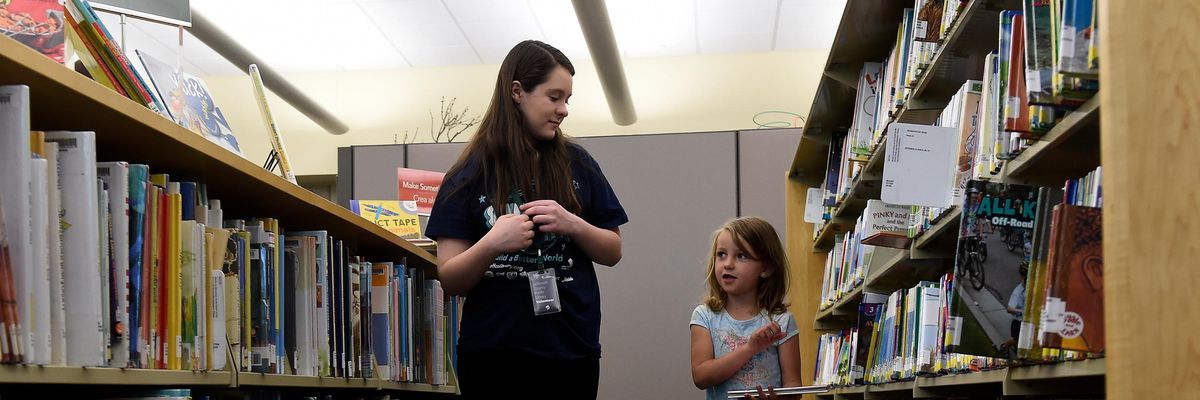
Emilie Matthews helps Maddison Morgan, 5, pick out a book at Belmar Library on June 6, 2017, in Lakewood, Colorado. (Photo: Seth McConnell/The Denver Post via Getty Images)
Right-wing attempts to ban books are showing no sign of slowing down, according to a report released Friday by the American Library Association--and in fact have reached an unprecedented level, with libraries and bookstores increasingly facing legal threats over the materials on their shelves.
The organization, which has been tracking book-banning efforts for more than 20 years, found that so far in 2022, parents and other community members have "challenged" 1,651 different books and have issued 681 complaints across the country.
In 2021, 1,597 individual books were the subject of challenges, which can include written complaints, forms provided by and submitted to a library, or social media posts in which people demand books be removed from a library's collection.
Friday's report showed that right-wing groups like Moms for Liberty have escalated their attacks on library patrons' right to access certain books, with 27 police reports having been filed so far this year over accusations that librarians are providing inappropriate or "pornographic" material to children.
"Efforts to censor entire categories of books reflecting certain voices and views shows that the moral panic isn't about kids: It's about politics."
"We're truly fearful that at some point we will see a librarian arrested for providing constitutionally protected books on disfavored topics," Deborah Caldwell-Stone, director of the Office of Intellectual Freedom at ALA, told The New York Times.
Book challenges this year have mainly focused on titles that center Black or LGBTQ+ characters, according to the Times.
The graphic novel Gender Queer by Maia Kobabe, a memoir about the author's coming of age as a nonbinary person, has been the most frequently targeted book so far this year.
The book was at the center of a vote in Jamestown Township, Michigan last month in which residents rejected essential funding for the town's library, prompting concerns that the library will be forced to close within the next year.
Parents in a town in Washington also filed police reports against the school district for including Gender Queer in a school library's collection, and a Republican lawmaker sued Barnes & Noble to prohibit it from selling the book to minors--a lawsuit that was dismissed last month.
ALA president Lessa Kanani'opua Pelayo-Lozada said the group's report "reflects coordinated, national efforts to silence marginalized or historically underrepresented voices and deprive all of us--young people, in particular--of the chance to explore a world beyond the confines of personal experience."
Banning books that discuss racial inequality or LGBTQ+ issues "denies young people resources that can help them deal with the challenges that confront them," added Pelayo-Lozada. "Efforts to censor entire categories of books reflecting certain voices and views shows that the moral panic isn't about kids: It's about politics."
This country and this world are at a monumental crossroads. US voters have an opportunity to beat back the forces of fascism and confront the billionaires who are rigging the economy, our media system, and our democracy, making it increasingly impossible for ordinary people to get by. We’re not just talking about the election. We’re talking about what must be done once these fascist elements are vanquished from power. We need a bolder set of solutions than what either major party has so far been willing to offer and a working-class movement ready to fight like hell for it. Trump didn't emerge from nowhere. The conditions that fueled MAGA authoritarianism were created by decades of radical neoliberal economic policies and a corrupt political system dominated by corporate interests. They slashed taxes on the super-rich, promising that the benefits would trickle down. They said giveaways to the corporate titans would make life more affordable for the rest of us. It was all bullshit. And when a bitter, betrayed populace searches for someone to blame, right-wing demagogues have little trouble finding scapegoats. People know when they're being lied to, but you won't hear any of this from the corporate media. Only independent journalism—powered and funded by people who believe in building a better world—can deliver truly trustworthy daily news. If you share our vision, please contribute whatever you can to sustain our work. |
Right-wing attempts to ban books are showing no sign of slowing down, according to a report released Friday by the American Library Association--and in fact have reached an unprecedented level, with libraries and bookstores increasingly facing legal threats over the materials on their shelves.
The organization, which has been tracking book-banning efforts for more than 20 years, found that so far in 2022, parents and other community members have "challenged" 1,651 different books and have issued 681 complaints across the country.
In 2021, 1,597 individual books were the subject of challenges, which can include written complaints, forms provided by and submitted to a library, or social media posts in which people demand books be removed from a library's collection.
Friday's report showed that right-wing groups like Moms for Liberty have escalated their attacks on library patrons' right to access certain books, with 27 police reports having been filed so far this year over accusations that librarians are providing inappropriate or "pornographic" material to children.
"Efforts to censor entire categories of books reflecting certain voices and views shows that the moral panic isn't about kids: It's about politics."
"We're truly fearful that at some point we will see a librarian arrested for providing constitutionally protected books on disfavored topics," Deborah Caldwell-Stone, director of the Office of Intellectual Freedom at ALA, told The New York Times.
Book challenges this year have mainly focused on titles that center Black or LGBTQ+ characters, according to the Times.
The graphic novel Gender Queer by Maia Kobabe, a memoir about the author's coming of age as a nonbinary person, has been the most frequently targeted book so far this year.
The book was at the center of a vote in Jamestown Township, Michigan last month in which residents rejected essential funding for the town's library, prompting concerns that the library will be forced to close within the next year.
Parents in a town in Washington also filed police reports against the school district for including Gender Queer in a school library's collection, and a Republican lawmaker sued Barnes & Noble to prohibit it from selling the book to minors--a lawsuit that was dismissed last month.
ALA president Lessa Kanani'opua Pelayo-Lozada said the group's report "reflects coordinated, national efforts to silence marginalized or historically underrepresented voices and deprive all of us--young people, in particular--of the chance to explore a world beyond the confines of personal experience."
Banning books that discuss racial inequality or LGBTQ+ issues "denies young people resources that can help them deal with the challenges that confront them," added Pelayo-Lozada. "Efforts to censor entire categories of books reflecting certain voices and views shows that the moral panic isn't about kids: It's about politics."