SUBSCRIBE TO OUR FREE NEWSLETTER
Daily news & progressive opinion—funded by the people, not the corporations—delivered straight to your inbox.
5
#000000
#FFFFFF
To donate by check, phone, or other method, see our More Ways to Give page.
Daily news & progressive opinion—funded by the people, not the corporations—delivered straight to your inbox.
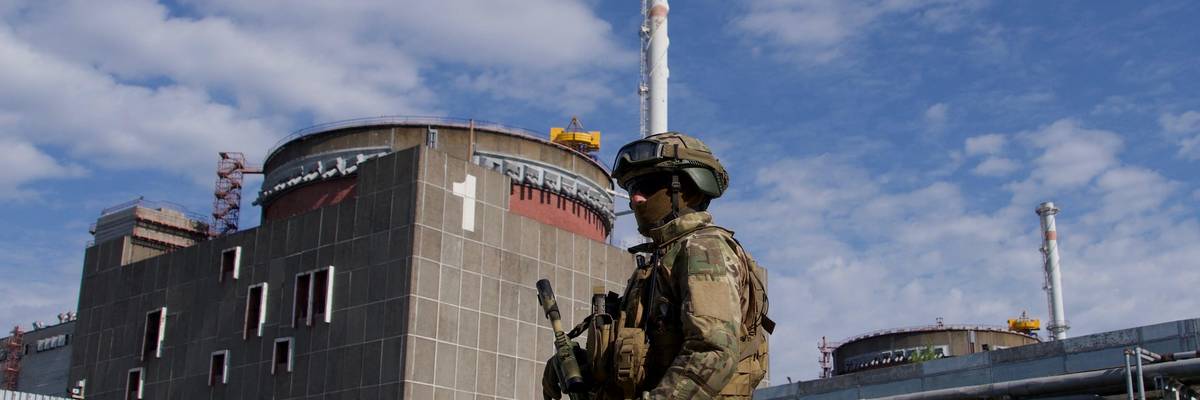
A Russian soldier patrols the territory of the Zaporizhzhia Nuclear Power Station in Energodar, Ukraine on May 1, 2022. (Photo: Andrey Borodulin/AFP via Getty Images)
Global concerns about the possibility of a nuclear disaster at the Zaporizhzhia power station in southeastern Ukraine continued on Monday, with officials from Kyiv calling for the creation of a demilitarized zone around the site and the head of the United Nations condemning the latest shelling there.
"Any attack [on] a nuclear plant is a suicidal thing," U.N. Secretary-General Antonio Guterres said at a press conference in Japan.
The Zaporizhzhia complex, the largest nuclear power plant in Europe and among the 10 largest in the world, was hit by shelling over the weekend, eliciting grave warnings about ongoing threats to public health and the environment "in Ukraine and beyond" from International Atomic Energy Agency chief Rafael Mariano Grossi, who said there is substantial risk for a calamity worse than Chernobyl.
Kyiv and Moscow have traded blame for recent strikes on the site, which is located in a region that Russia took over in March and that Ukraine is trying to recover. According to Ukrainian officials, Russian soldiers damaged three radiation sensors and hurt two workers amid renewed shelling at the plant on Friday and Saturday. Russian authorities, by contrast, alleged that "Ukrainian nationalists" damaged two high-voltage power lines, necessitating a reduction in output to "prevent disruption."
Guterres on Monday stressed that international nuclear inspectors need immediate access to the facility, which is still being operated by Ukrainian technicians.
"We fully support the IAEA in all their efforts in relation to create the conditions of stabilization of the plant," said the U.N. chief.
Yevhenii Tsymbaliuk, Ukraine's ambassador to the IAEA, demanded a U.N.-led international mission to Zaporizhzhia by the end of the month and accused Russia of targeting the site in an attempt to cause blackouts along Ukraine's electricity grid in the south.
"We will use all possible channels of diplomacy to bring the IAEA and U.N. closer to conducting this mission," Tsymbaliuk told reporters in Vienna, home to the world's nuclear watchdog organization. "We really need it urgently, as soon as possible."
Petro Kotin, head of Energoatom, Ukraine's state-owned nuclear power enterprise, made the case for demilitarizing Zaporizhzhia and the surrounding area and called for the deployment of a peacekeeping team to the site.
"The decision that we demand from the world community and all our partners... is to withdraw the invaders from the territory of the station and create a demilitarized zone on the territory of the station," Kotin said on television.
"The presence of peacekeepers in this zone and the transfer of control of it to them, and then also control of the station to the Ukrainian side would resolve this problem," he said.
If missiles were to break two or more containers holding highly radioactive spent nuclear fuel, Kotin emphasized, "it is impossible to assess the scale of this catastrophe."
Guterres' Monday remarks came just two days after he warned that "humanity is playing with a loaded gun" during the Hiroshima peace memorial ceremony, which marked the 77th anniversary of the United States' atomic bombing of Japan--the first and only wartime use of nuclear weapons.
Dear Common Dreams reader, It’s been nearly 30 years since I co-founded Common Dreams with my late wife, Lina Newhouser. We had the radical notion that journalism should serve the public good, not corporate profits. It was clear to us from the outset what it would take to build such a project. No paid advertisements. No corporate sponsors. No millionaire publisher telling us what to think or do. Many people said we wouldn't last a year, but we proved those doubters wrong. Together with a tremendous team of journalists and dedicated staff, we built an independent media outlet free from the constraints of profits and corporate control. Our mission has always been simple: To inform. To inspire. To ignite change for the common good. Building Common Dreams was not easy. Our survival was never guaranteed. When you take on the most powerful forces—Wall Street greed, fossil fuel industry destruction, Big Tech lobbyists, and uber-rich oligarchs who have spent billions upon billions rigging the economy and democracy in their favor—the only bulwark you have is supporters who believe in your work. But here’s the urgent message from me today. It's never been this bad out there. And it's never been this hard to keep us going. At the very moment Common Dreams is most needed, the threats we face are intensifying. We need your support now more than ever. We don't accept corporate advertising and never will. We don't have a paywall because we don't think people should be blocked from critical news based on their ability to pay. Everything we do is funded by the donations of readers like you. When everyone does the little they can afford, we are strong. But if that support retreats or dries up, so do we. Will you donate now to make sure Common Dreams not only survives but thrives? —Craig Brown, Co-founder |
Global concerns about the possibility of a nuclear disaster at the Zaporizhzhia power station in southeastern Ukraine continued on Monday, with officials from Kyiv calling for the creation of a demilitarized zone around the site and the head of the United Nations condemning the latest shelling there.
"Any attack [on] a nuclear plant is a suicidal thing," U.N. Secretary-General Antonio Guterres said at a press conference in Japan.
The Zaporizhzhia complex, the largest nuclear power plant in Europe and among the 10 largest in the world, was hit by shelling over the weekend, eliciting grave warnings about ongoing threats to public health and the environment "in Ukraine and beyond" from International Atomic Energy Agency chief Rafael Mariano Grossi, who said there is substantial risk for a calamity worse than Chernobyl.
Kyiv and Moscow have traded blame for recent strikes on the site, which is located in a region that Russia took over in March and that Ukraine is trying to recover. According to Ukrainian officials, Russian soldiers damaged three radiation sensors and hurt two workers amid renewed shelling at the plant on Friday and Saturday. Russian authorities, by contrast, alleged that "Ukrainian nationalists" damaged two high-voltage power lines, necessitating a reduction in output to "prevent disruption."
Guterres on Monday stressed that international nuclear inspectors need immediate access to the facility, which is still being operated by Ukrainian technicians.
"We fully support the IAEA in all their efforts in relation to create the conditions of stabilization of the plant," said the U.N. chief.
Yevhenii Tsymbaliuk, Ukraine's ambassador to the IAEA, demanded a U.N.-led international mission to Zaporizhzhia by the end of the month and accused Russia of targeting the site in an attempt to cause blackouts along Ukraine's electricity grid in the south.
"We will use all possible channels of diplomacy to bring the IAEA and U.N. closer to conducting this mission," Tsymbaliuk told reporters in Vienna, home to the world's nuclear watchdog organization. "We really need it urgently, as soon as possible."
Petro Kotin, head of Energoatom, Ukraine's state-owned nuclear power enterprise, made the case for demilitarizing Zaporizhzhia and the surrounding area and called for the deployment of a peacekeeping team to the site.
"The decision that we demand from the world community and all our partners... is to withdraw the invaders from the territory of the station and create a demilitarized zone on the territory of the station," Kotin said on television.
"The presence of peacekeepers in this zone and the transfer of control of it to them, and then also control of the station to the Ukrainian side would resolve this problem," he said.
If missiles were to break two or more containers holding highly radioactive spent nuclear fuel, Kotin emphasized, "it is impossible to assess the scale of this catastrophe."
Guterres' Monday remarks came just two days after he warned that "humanity is playing with a loaded gun" during the Hiroshima peace memorial ceremony, which marked the 77th anniversary of the United States' atomic bombing of Japan--the first and only wartime use of nuclear weapons.
Global concerns about the possibility of a nuclear disaster at the Zaporizhzhia power station in southeastern Ukraine continued on Monday, with officials from Kyiv calling for the creation of a demilitarized zone around the site and the head of the United Nations condemning the latest shelling there.
"Any attack [on] a nuclear plant is a suicidal thing," U.N. Secretary-General Antonio Guterres said at a press conference in Japan.
The Zaporizhzhia complex, the largest nuclear power plant in Europe and among the 10 largest in the world, was hit by shelling over the weekend, eliciting grave warnings about ongoing threats to public health and the environment "in Ukraine and beyond" from International Atomic Energy Agency chief Rafael Mariano Grossi, who said there is substantial risk for a calamity worse than Chernobyl.
Kyiv and Moscow have traded blame for recent strikes on the site, which is located in a region that Russia took over in March and that Ukraine is trying to recover. According to Ukrainian officials, Russian soldiers damaged three radiation sensors and hurt two workers amid renewed shelling at the plant on Friday and Saturday. Russian authorities, by contrast, alleged that "Ukrainian nationalists" damaged two high-voltage power lines, necessitating a reduction in output to "prevent disruption."
Guterres on Monday stressed that international nuclear inspectors need immediate access to the facility, which is still being operated by Ukrainian technicians.
"We fully support the IAEA in all their efforts in relation to create the conditions of stabilization of the plant," said the U.N. chief.
Yevhenii Tsymbaliuk, Ukraine's ambassador to the IAEA, demanded a U.N.-led international mission to Zaporizhzhia by the end of the month and accused Russia of targeting the site in an attempt to cause blackouts along Ukraine's electricity grid in the south.
"We will use all possible channels of diplomacy to bring the IAEA and U.N. closer to conducting this mission," Tsymbaliuk told reporters in Vienna, home to the world's nuclear watchdog organization. "We really need it urgently, as soon as possible."
Petro Kotin, head of Energoatom, Ukraine's state-owned nuclear power enterprise, made the case for demilitarizing Zaporizhzhia and the surrounding area and called for the deployment of a peacekeeping team to the site.
"The decision that we demand from the world community and all our partners... is to withdraw the invaders from the territory of the station and create a demilitarized zone on the territory of the station," Kotin said on television.
"The presence of peacekeepers in this zone and the transfer of control of it to them, and then also control of the station to the Ukrainian side would resolve this problem," he said.
If missiles were to break two or more containers holding highly radioactive spent nuclear fuel, Kotin emphasized, "it is impossible to assess the scale of this catastrophe."
Guterres' Monday remarks came just two days after he warned that "humanity is playing with a loaded gun" during the Hiroshima peace memorial ceremony, which marked the 77th anniversary of the United States' atomic bombing of Japan--the first and only wartime use of nuclear weapons.