

Spain has urged the European Union to leave an arcane energy treaty that protects fossil fuel investors at the expense of maintaining a habitable planet.
At issue is the 1994 Energy Charter Treaty (ECT), an obscure agreement whose investor-state dispute settlement (ISDS) mechanism enables fossil fuel corporations to sue governments over anticipated economic losses stemming from plans to move away from coal, oil, and gas.
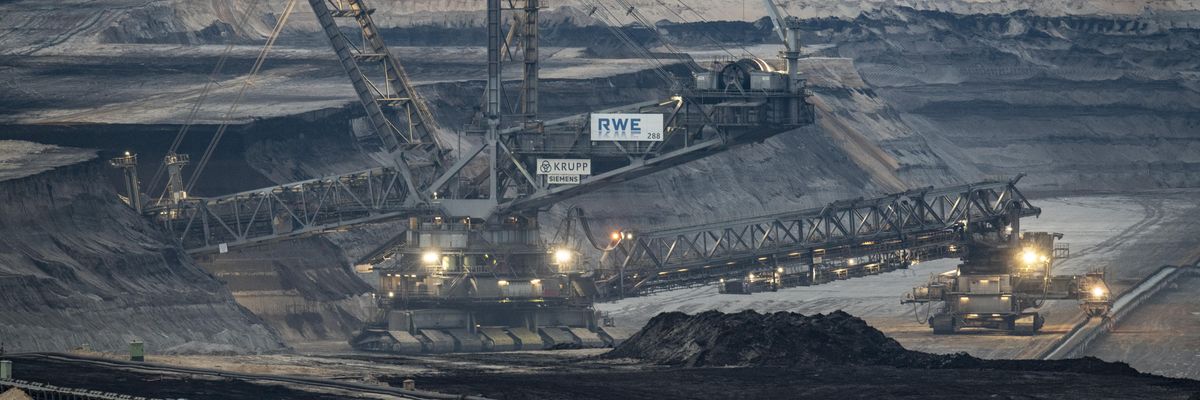
German energy companies RWE and Uniper, for example, are suing the Netherlands for 1.4 billion euros ($1.5 billion) and 1 billion euros ($1.1 billion), respectively, as compensation for the Dutch government's plan to phase out coal by 2030.
Spanish Deputy Prime Minister Teresa Ribera told Politico Tuesday that more than a dozen rounds of talks to reform the treaty, including an E.U. proposal that wouldn't end protections for many existing fossil fuel investments until 2040, have made it clear that the effort "will fail to ensure the alignment of the ECT with the Paris agreement and the objectives of the European Green Deal."
"At a time when accelerating a clean energy transition has become more urgent than ever, it is time that the E.U. and its member states initiate a coordinated withdrawal from the ECT," she said, making Spain the first nation to publicly call for abandoning the accord.
Ribera's comments came as five youth plaintiffs filed a lawsuit challenging the ECT in the European Court of Human Rights.
Related Content

Young Europeans Sue to Stop Treaty That Fossil Fuel Giants Use to Foil Climate Action
In addition to draining billions of dollars in taxpayer money that could otherwise be used to fund climate action, the ECT hinders more robust decarbonization plans, according to critics.
Last year, Yamina Saheb, a former employee of the ECT secretariat who resigned to sound the alarm in 2018, called the pact "a real threat" to the Paris agreement, which seeks to limit global warming to 1.5oC above preindustrial levels by century's end. "It's the biggest threat I am aware of," added the whistleblower.
According to Saheb, foreign investors could, under the ECT, sue governments for 1.3 trillion euros ($1.4 trillion) between now and 2050 as reimbursement for the closure of fossil fuel plants. That sum is equivalent to what the E.U. hopes to spend on a green transition during this pivotal decade.
Given that an estimated 60% of secretive ECT tribunal decisions favor investors, critics say the mere threat of costly litigation has a chilling effect on climate ambition--prompting states to weaken policies in an attempt to discourage energy companies from arguing that certain measures do not meet the ECT's ambiguous standard of "fair and equitable treatment."
The ECT's so-called "future earnings" clause is particularly consequential, as it protects hundreds of billions of dollars worth of fossil fuel infrastructure.
Spain's call to quit the ECT coincided with the publication of a new letter in which 76 climate scientists warned E.U. leaders that continuing to shield coal, oil, and gas investors under the treaty's rules would force countries to "choose between keeping the existing fossil fuel infrastructure running until the end of their lifetimes or facing new ISDS claims."
"Both options will jeopardize the E.U. climate neutrality target and the E.U. Green Deal," said the letter, which implored recipients to withdraw European nations from the ECT.
The ECT's 54 members, stretching from Western Europe through Central Asia to Japan, are meeting this week to negotiate the "modernization" of the nearly 30-year-old agreement.
"Several countries, including Spain and France, have previously called for the European Commission to prepare legal advice on walking out of the pact," Politico reported.
Countries that withdraw from the ECT are still subject to ISDS lawsuits for 20 years after they pull out thanks to a "zombie clause" in the agreement.
British company Rockhopper Exploration exploited this loophole in 2017, suing Italy for 225 million euros ($237 million) in future profits after the government, which had just left the ECT, reintroduced a ban on oil drilling in the Adriatic Sea.
Two unnamed E.U. officials told Politico earlier this week that the bloc's proposal for an extended phase-out of fossil fuel protections was still being discussed despite Japan's opposition.
ECT members are scheduled to meet on Friday to formally conclude reform talks, at which point the European Commission, which negotiates on behalf of the E.U.'s 27 member states, is expected to announce the continent's response to the process.
Spain has urged the European Union to leave an arcane energy treaty that protects fossil fuel investors at the expense of maintaining a habitable planet.
At issue is the 1994 Energy Charter Treaty (ECT), an obscure agreement whose investor-state dispute settlement (ISDS) mechanism enables fossil fuel corporations to sue governments over anticipated economic losses stemming from plans to move away from coal, oil, and gas.
German energy companies RWE and Uniper, for example, are suing the Netherlands for 1.4 billion euros ($1.5 billion) and 1 billion euros ($1.1 billion), respectively, as compensation for the Dutch government's plan to phase out coal by 2030.
Spanish Deputy Prime Minister Teresa Ribera told Politico Tuesday that more than a dozen rounds of talks to reform the treaty, including an E.U. proposal that wouldn't end protections for many existing fossil fuel investments until 2040, have made it clear that the effort "will fail to ensure the alignment of the ECT with the Paris agreement and the objectives of the European Green Deal."
"At a time when accelerating a clean energy transition has become more urgent than ever, it is time that the E.U. and its member states initiate a coordinated withdrawal from the ECT," she said, making Spain the first nation to publicly call for abandoning the accord.
Ribera's comments came as five youth plaintiffs filed a lawsuit challenging the ECT in the European Court of Human Rights.
Related Content
Young Europeans Sue to Stop Treaty That Fossil Fuel Giants Use to Foil Climate Action
In addition to draining billions of dollars in taxpayer money that could otherwise be used to fund climate action, the ECT hinders more robust decarbonization plans, according to critics.
Last year, Yamina Saheb, a former employee of the ECT secretariat who resigned to sound the alarm in 2018, called the pact "a real threat" to the Paris agreement, which seeks to limit global warming to 1.5oC above preindustrial levels by century's end. "It's the biggest threat I am aware of," added the whistleblower.
According to Saheb, foreign investors could, under the ECT, sue governments for 1.3 trillion euros ($1.4 trillion) between now and 2050 as reimbursement for the closure of fossil fuel plants. That sum is equivalent to what the E.U. hopes to spend on a green transition during this pivotal decade.
Given that an estimated 60% of secretive ECT tribunal decisions favor investors, critics say the mere threat of costly litigation has a chilling effect on climate ambition--prompting states to weaken policies in an attempt to discourage energy companies from arguing that certain measures do not meet the ECT's ambiguous standard of "fair and equitable treatment."
The ECT's so-called "future earnings" clause is particularly consequential, as it protects hundreds of billions of dollars worth of fossil fuel infrastructure.
Spain's call to quit the ECT coincided with the publication of a new letter in which 76 climate scientists warned E.U. leaders that continuing to shield coal, oil, and gas investors under the treaty's rules would force countries to "choose between keeping the existing fossil fuel infrastructure running until the end of their lifetimes or facing new ISDS claims."
"Both options will jeopardize the E.U. climate neutrality target and the E.U. Green Deal," said the letter, which implored recipients to withdraw European nations from the ECT.
The ECT's 54 members, stretching from Western Europe through Central Asia to Japan, are meeting this week to negotiate the "modernization" of the nearly 30-year-old agreement.
"Several countries, including Spain and France, have previously called for the European Commission to prepare legal advice on walking out of the pact," Politico reported.
Countries that withdraw from the ECT are still subject to ISDS lawsuits for 20 years after they pull out thanks to a "zombie clause" in the agreement.
British company Rockhopper Exploration exploited this loophole in 2017, suing Italy for 225 million euros ($237 million) in future profits after the government, which had just left the ECT, reintroduced a ban on oil drilling in the Adriatic Sea.
Two unnamed E.U. officials told Politico earlier this week that the bloc's proposal for an extended phase-out of fossil fuel protections was still being discussed despite Japan's opposition.
ECT members are scheduled to meet on Friday to formally conclude reform talks, at which point the European Commission, which negotiates on behalf of the E.U.'s 27 member states, is expected to announce the continent's response to the process.
Spain has urged the European Union to leave an arcane energy treaty that protects fossil fuel investors at the expense of maintaining a habitable planet.
At issue is the 1994 Energy Charter Treaty (ECT), an obscure agreement whose investor-state dispute settlement (ISDS) mechanism enables fossil fuel corporations to sue governments over anticipated economic losses stemming from plans to move away from coal, oil, and gas.
German energy companies RWE and Uniper, for example, are suing the Netherlands for 1.4 billion euros ($1.5 billion) and 1 billion euros ($1.1 billion), respectively, as compensation for the Dutch government's plan to phase out coal by 2030.
Spanish Deputy Prime Minister Teresa Ribera told Politico Tuesday that more than a dozen rounds of talks to reform the treaty, including an E.U. proposal that wouldn't end protections for many existing fossil fuel investments until 2040, have made it clear that the effort "will fail to ensure the alignment of the ECT with the Paris agreement and the objectives of the European Green Deal."
"At a time when accelerating a clean energy transition has become more urgent than ever, it is time that the E.U. and its member states initiate a coordinated withdrawal from the ECT," she said, making Spain the first nation to publicly call for abandoning the accord.
Ribera's comments came as five youth plaintiffs filed a lawsuit challenging the ECT in the European Court of Human Rights.
Related Content
Young Europeans Sue to Stop Treaty That Fossil Fuel Giants Use to Foil Climate Action
In addition to draining billions of dollars in taxpayer money that could otherwise be used to fund climate action, the ECT hinders more robust decarbonization plans, according to critics.
Last year, Yamina Saheb, a former employee of the ECT secretariat who resigned to sound the alarm in 2018, called the pact "a real threat" to the Paris agreement, which seeks to limit global warming to 1.5oC above preindustrial levels by century's end. "It's the biggest threat I am aware of," added the whistleblower.
According to Saheb, foreign investors could, under the ECT, sue governments for 1.3 trillion euros ($1.4 trillion) between now and 2050 as reimbursement for the closure of fossil fuel plants. That sum is equivalent to what the E.U. hopes to spend on a green transition during this pivotal decade.
Given that an estimated 60% of secretive ECT tribunal decisions favor investors, critics say the mere threat of costly litigation has a chilling effect on climate ambition--prompting states to weaken policies in an attempt to discourage energy companies from arguing that certain measures do not meet the ECT's ambiguous standard of "fair and equitable treatment."
The ECT's so-called "future earnings" clause is particularly consequential, as it protects hundreds of billions of dollars worth of fossil fuel infrastructure.
Spain's call to quit the ECT coincided with the publication of a new letter in which 76 climate scientists warned E.U. leaders that continuing to shield coal, oil, and gas investors under the treaty's rules would force countries to "choose between keeping the existing fossil fuel infrastructure running until the end of their lifetimes or facing new ISDS claims."
"Both options will jeopardize the E.U. climate neutrality target and the E.U. Green Deal," said the letter, which implored recipients to withdraw European nations from the ECT.
The ECT's 54 members, stretching from Western Europe through Central Asia to Japan, are meeting this week to negotiate the "modernization" of the nearly 30-year-old agreement.
"Several countries, including Spain and France, have previously called for the European Commission to prepare legal advice on walking out of the pact," Politico reported.
Countries that withdraw from the ECT are still subject to ISDS lawsuits for 20 years after they pull out thanks to a "zombie clause" in the agreement.
British company Rockhopper Exploration exploited this loophole in 2017, suing Italy for 225 million euros ($237 million) in future profits after the government, which had just left the ECT, reintroduced a ban on oil drilling in the Adriatic Sea.
Two unnamed E.U. officials told Politico earlier this week that the bloc's proposal for an extended phase-out of fossil fuel protections was still being discussed despite Japan's opposition.
ECT members are scheduled to meet on Friday to formally conclude reform talks, at which point the European Commission, which negotiates on behalf of the E.U.'s 27 member states, is expected to announce the continent's response to the process.