SUBSCRIBE TO OUR FREE NEWSLETTER
Daily news & progressive opinion—funded by the people, not the corporations—delivered straight to your inbox.
5
#000000
#FFFFFF
To donate by check, phone, or other method, see our More Ways to Give page.
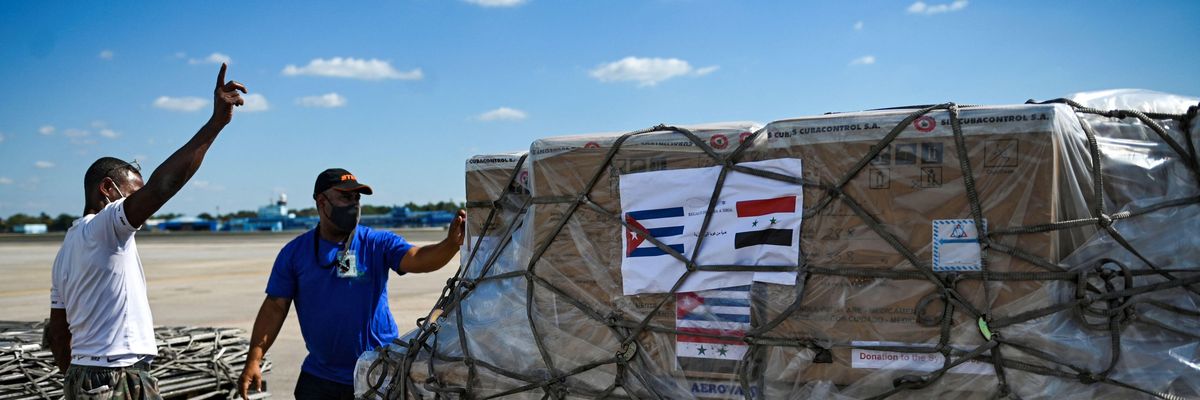
Citing the "enormous potential" of Cuban Covid-19 vaccines to tackle enduring global inequities, a group of 26 House Democrats on Thursday urged President Joe Biden to review U.S. policy toward the long-embargoed nation to ensure that sanctions do not impede its international vaccination campaign.
"We ask that you review U.S. policy towards Cuba in order to facilitate greater global vaccine equity."
"Cuba's goal of vaccinating people in low-income countries offers an important opportunity and bridge for our nations to work together once again on urgent healthcare issues facing the world," states a letter led by Reps. Ayanna Pressley (D-Mass.) and Steve Cohen (D-Tenn.).
Recalling that the U.S. and Cuba "collaborated to confront the Ebola outbreak in West Africa in 2016," the lawmakers write that "as our nation and the world continue to confront the Covid-19 pandemic, we ask you to explore possibilities for engaging with Cuba on issues of global health."
"As an initial step, we ask that you review U.S. policy towards Cuba in order to facilitate greater global vaccine equity," they continue, "with a particular focus on ensuring that U.S. sanctions do not impede current or future efforts by Cuba to share Covid-19 vaccines and related technology and medical support with low-income countries around the world."
The letter notes Biden's stated goal of getting "as many safe and effective vaccines to as many people as fast as possible" by "working with the private sector and all possible partners to expand vaccine manufacturing and distribution."
"U.S. sanctions on Cuba directly impede these goals, not only by harming the country's ability to vaccinate its own population but also by placing obstacles in the way of Cuba's ability to produce and distribute its vaccine to other countries that continue to face shortages," the signers assert.
The letter continues:
In spite of these challenges, Cuba has now managed to achieve the fourth-highest rate of vaccination worldwide. Cuba's tremendous progress in vaccinating its population resulted in large part from its biotechnology sector's successful development of five different Covid vaccines to date.
While Cuba has developed five vaccines, it has primarily used three of them to vaccinate over 90% of the island's population. Clinical trials in both adult and pediatric populations show that the vaccines are very effective, providing nearly 90% protection against symptomatic Covid when administered in three doses.
"Experts believe that these vaccines hold enormous potential for other low-income countries," the lawmakers note. "Unlike with the mRNA vaccines available in the United States, the Cuban vaccines are inexpensive to produce, less challenging to manufacture at scale, and do not require deep freezing."
"Cuba recently announced an ambitious plan to produce and distribute 200 million doses of Covid-19 vaccines at significantly reduced cost to low-income countries, including technology transfers for local vaccine production where possible, as well as medical brigades to build capacity for vaccine distribution where needed," they add.
Related Content

While the letter asks for the Biden administration to remove Cuba from the U.S. state sponsors of terrorism list, it notably does not call for an end to sanctions.
However, most of the individual signers have urged the administration to lift or loosen the embargo, which was imposed 50 years ago as part of a broader U.S. effort to reverse the successful Cuban Revolution through economic, military, and terrorist warfare.
Citing the "enormous potential" of Cuban Covid-19 vaccines to tackle enduring global inequities, a group of 26 House Democrats on Thursday urged President Joe Biden to review U.S. policy toward the long-embargoed nation to ensure that sanctions do not impede its international vaccination campaign.
"We ask that you review U.S. policy towards Cuba in order to facilitate greater global vaccine equity."
"Cuba's goal of vaccinating people in low-income countries offers an important opportunity and bridge for our nations to work together once again on urgent healthcare issues facing the world," states a letter led by Reps. Ayanna Pressley (D-Mass.) and Steve Cohen (D-Tenn.).
Recalling that the U.S. and Cuba "collaborated to confront the Ebola outbreak in West Africa in 2016," the lawmakers write that "as our nation and the world continue to confront the Covid-19 pandemic, we ask you to explore possibilities for engaging with Cuba on issues of global health."
"As an initial step, we ask that you review U.S. policy towards Cuba in order to facilitate greater global vaccine equity," they continue, "with a particular focus on ensuring that U.S. sanctions do not impede current or future efforts by Cuba to share Covid-19 vaccines and related technology and medical support with low-income countries around the world."
The letter notes Biden's stated goal of getting "as many safe and effective vaccines to as many people as fast as possible" by "working with the private sector and all possible partners to expand vaccine manufacturing and distribution."
"U.S. sanctions on Cuba directly impede these goals, not only by harming the country's ability to vaccinate its own population but also by placing obstacles in the way of Cuba's ability to produce and distribute its vaccine to other countries that continue to face shortages," the signers assert.
The letter continues:
In spite of these challenges, Cuba has now managed to achieve the fourth-highest rate of vaccination worldwide. Cuba's tremendous progress in vaccinating its population resulted in large part from its biotechnology sector's successful development of five different Covid vaccines to date.
While Cuba has developed five vaccines, it has primarily used three of them to vaccinate over 90% of the island's population. Clinical trials in both adult and pediatric populations show that the vaccines are very effective, providing nearly 90% protection against symptomatic Covid when administered in three doses.
"Experts believe that these vaccines hold enormous potential for other low-income countries," the lawmakers note. "Unlike with the mRNA vaccines available in the United States, the Cuban vaccines are inexpensive to produce, less challenging to manufacture at scale, and do not require deep freezing."
"Cuba recently announced an ambitious plan to produce and distribute 200 million doses of Covid-19 vaccines at significantly reduced cost to low-income countries, including technology transfers for local vaccine production where possible, as well as medical brigades to build capacity for vaccine distribution where needed," they add.
Related Content
While the letter asks for the Biden administration to remove Cuba from the U.S. state sponsors of terrorism list, it notably does not call for an end to sanctions.
However, most of the individual signers have urged the administration to lift or loosen the embargo, which was imposed 50 years ago as part of a broader U.S. effort to reverse the successful Cuban Revolution through economic, military, and terrorist warfare.
Citing the "enormous potential" of Cuban Covid-19 vaccines to tackle enduring global inequities, a group of 26 House Democrats on Thursday urged President Joe Biden to review U.S. policy toward the long-embargoed nation to ensure that sanctions do not impede its international vaccination campaign.
"We ask that you review U.S. policy towards Cuba in order to facilitate greater global vaccine equity."
"Cuba's goal of vaccinating people in low-income countries offers an important opportunity and bridge for our nations to work together once again on urgent healthcare issues facing the world," states a letter led by Reps. Ayanna Pressley (D-Mass.) and Steve Cohen (D-Tenn.).
Recalling that the U.S. and Cuba "collaborated to confront the Ebola outbreak in West Africa in 2016," the lawmakers write that "as our nation and the world continue to confront the Covid-19 pandemic, we ask you to explore possibilities for engaging with Cuba on issues of global health."
"As an initial step, we ask that you review U.S. policy towards Cuba in order to facilitate greater global vaccine equity," they continue, "with a particular focus on ensuring that U.S. sanctions do not impede current or future efforts by Cuba to share Covid-19 vaccines and related technology and medical support with low-income countries around the world."
The letter notes Biden's stated goal of getting "as many safe and effective vaccines to as many people as fast as possible" by "working with the private sector and all possible partners to expand vaccine manufacturing and distribution."
"U.S. sanctions on Cuba directly impede these goals, not only by harming the country's ability to vaccinate its own population but also by placing obstacles in the way of Cuba's ability to produce and distribute its vaccine to other countries that continue to face shortages," the signers assert.
The letter continues:
In spite of these challenges, Cuba has now managed to achieve the fourth-highest rate of vaccination worldwide. Cuba's tremendous progress in vaccinating its population resulted in large part from its biotechnology sector's successful development of five different Covid vaccines to date.
While Cuba has developed five vaccines, it has primarily used three of them to vaccinate over 90% of the island's population. Clinical trials in both adult and pediatric populations show that the vaccines are very effective, providing nearly 90% protection against symptomatic Covid when administered in three doses.
"Experts believe that these vaccines hold enormous potential for other low-income countries," the lawmakers note. "Unlike with the mRNA vaccines available in the United States, the Cuban vaccines are inexpensive to produce, less challenging to manufacture at scale, and do not require deep freezing."
"Cuba recently announced an ambitious plan to produce and distribute 200 million doses of Covid-19 vaccines at significantly reduced cost to low-income countries, including technology transfers for local vaccine production where possible, as well as medical brigades to build capacity for vaccine distribution where needed," they add.
Related Content
While the letter asks for the Biden administration to remove Cuba from the U.S. state sponsors of terrorism list, it notably does not call for an end to sanctions.
However, most of the individual signers have urged the administration to lift or loosen the embargo, which was imposed 50 years ago as part of a broader U.S. effort to reverse the successful Cuban Revolution through economic, military, and terrorist warfare.