SUBSCRIBE TO OUR FREE NEWSLETTER
Daily news & progressive opinion—funded by the people, not the corporations—delivered straight to your inbox.
5
#000000
#FFFFFF
To donate by check, phone, or other method, see our More Ways to Give page.
Daily news & progressive opinion—funded by the people, not the corporations—delivered straight to your inbox.
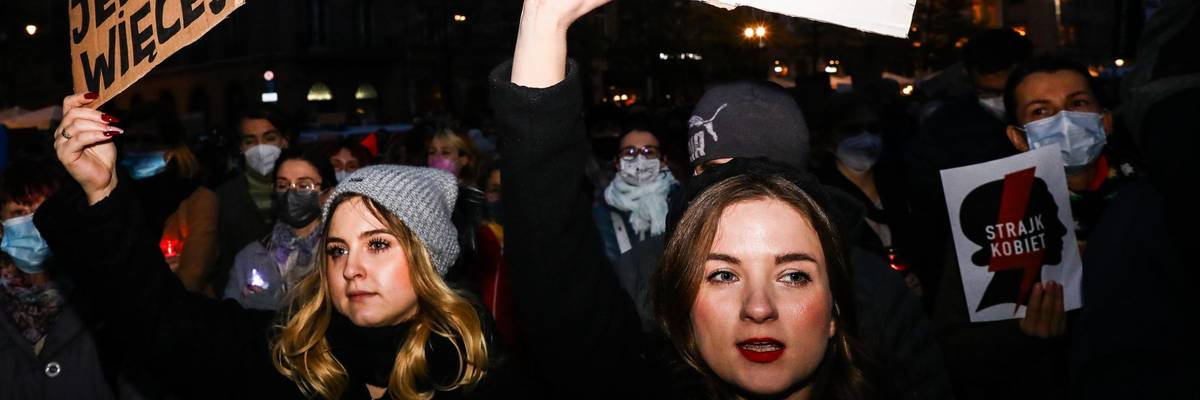
People attend a protest in Krakow, Poland on November 7, 2021 after the death of a 30-year-old woman, Iza, of septic shock in her 22nd week of pregnancy. Iza was denied abortion care despite her condition and that of her unborn baby. (Photo: Beata Zawrzel/NurPhoto via Getty Images)
A new government database tracking people's pregnancies in Poland is sparking fears that medical data will be used to prosecute women who obtain abortion care in other countries or by getting abortion pills through the mail, and potentially to target women who have miscarriages.
"First comes the ban, and then the mechanism for enforcement follows."
Health Minister Adam Niedzielski approved an ordinance last Friday expanding the kind of information that can be stored in a central database on patients, including allergies, blood type, and pregnancy status.
Tracking pregnancies in the country is necessary, Niedzielski claimed, so doctors know if a woman shouldn't receive certain medications or x-rays.
But in a country that banned abortion care in almost all cases in 2020--with exceptions theoretically in the case of health risks to the pregnant woman or of a pregnancy that results from rape or incest--Parliament member Kamila Gasiuk-Pihowicz said Tuesday that the register would be used to "persecute and control Polish women."
"Polish women no longer get pregnant for fear of being forced to give birth in any situation. The reasons for fear have just arrived," said Agnieszka Dziemianowicz-Bak, another left-wing lawmaker. "The pregnancy registry in a country with an almost complete ban on abortion is terrifying."
The register will make it more difficult for Polish women to get around the abortion ban by ordering medication to induce an abortion or to travel to other European countries for care, as many have since the law was passed, said journalist Elizabeth Schumacher.
Abortion Network Amsterdam, a network of volunteers in the Netherlands which provides financial and logistical support to people seeking abortions, said it would still "help each and everyone who is seeking abortion."
The register represents "another violent attack on sexual and reproductive rights in Poland," said international human rights advocate Annika Ojala.
Despite the Polish abortion ban's exception for women whose lives or health are at risk, at least two women have died in recent months because they were denied abortion care.
Poland's rollback of abortion rights comes as the U.S. has also seen restrictions passed in a number of states in recent years and as the U.S. Supreme Court is expected to overturn Roe v. Wade in the coming weeks--a move which would render abortion illegal in more than 20 states.
The Polish pregnancy register, said Pamela Merritt, executive director of Medical Students for Choice in the U.S., illustrates "the logical next step after abortion bans and criminalization."
"First comes the ban, and then the mechanism for enforcement follows," said Merritt.
Dear Common Dreams reader, It’s been nearly 30 years since I co-founded Common Dreams with my late wife, Lina Newhouser. We had the radical notion that journalism should serve the public good, not corporate profits. It was clear to us from the outset what it would take to build such a project. No paid advertisements. No corporate sponsors. No millionaire publisher telling us what to think or do. Many people said we wouldn't last a year, but we proved those doubters wrong. Together with a tremendous team of journalists and dedicated staff, we built an independent media outlet free from the constraints of profits and corporate control. Our mission has always been simple: To inform. To inspire. To ignite change for the common good. Building Common Dreams was not easy. Our survival was never guaranteed. When you take on the most powerful forces—Wall Street greed, fossil fuel industry destruction, Big Tech lobbyists, and uber-rich oligarchs who have spent billions upon billions rigging the economy and democracy in their favor—the only bulwark you have is supporters who believe in your work. But here’s the urgent message from me today. It's never been this bad out there. And it's never been this hard to keep us going. At the very moment Common Dreams is most needed, the threats we face are intensifying. We need your support now more than ever. We don't accept corporate advertising and never will. We don't have a paywall because we don't think people should be blocked from critical news based on their ability to pay. Everything we do is funded by the donations of readers like you. When everyone does the little they can afford, we are strong. But if that support retreats or dries up, so do we. Will you donate now to make sure Common Dreams not only survives but thrives? —Craig Brown, Co-founder |
A new government database tracking people's pregnancies in Poland is sparking fears that medical data will be used to prosecute women who obtain abortion care in other countries or by getting abortion pills through the mail, and potentially to target women who have miscarriages.
"First comes the ban, and then the mechanism for enforcement follows."
Health Minister Adam Niedzielski approved an ordinance last Friday expanding the kind of information that can be stored in a central database on patients, including allergies, blood type, and pregnancy status.
Tracking pregnancies in the country is necessary, Niedzielski claimed, so doctors know if a woman shouldn't receive certain medications or x-rays.
But in a country that banned abortion care in almost all cases in 2020--with exceptions theoretically in the case of health risks to the pregnant woman or of a pregnancy that results from rape or incest--Parliament member Kamila Gasiuk-Pihowicz said Tuesday that the register would be used to "persecute and control Polish women."
"Polish women no longer get pregnant for fear of being forced to give birth in any situation. The reasons for fear have just arrived," said Agnieszka Dziemianowicz-Bak, another left-wing lawmaker. "The pregnancy registry in a country with an almost complete ban on abortion is terrifying."
The register will make it more difficult for Polish women to get around the abortion ban by ordering medication to induce an abortion or to travel to other European countries for care, as many have since the law was passed, said journalist Elizabeth Schumacher.
Abortion Network Amsterdam, a network of volunteers in the Netherlands which provides financial and logistical support to people seeking abortions, said it would still "help each and everyone who is seeking abortion."
The register represents "another violent attack on sexual and reproductive rights in Poland," said international human rights advocate Annika Ojala.
Despite the Polish abortion ban's exception for women whose lives or health are at risk, at least two women have died in recent months because they were denied abortion care.
Poland's rollback of abortion rights comes as the U.S. has also seen restrictions passed in a number of states in recent years and as the U.S. Supreme Court is expected to overturn Roe v. Wade in the coming weeks--a move which would render abortion illegal in more than 20 states.
The Polish pregnancy register, said Pamela Merritt, executive director of Medical Students for Choice in the U.S., illustrates "the logical next step after abortion bans and criminalization."
"First comes the ban, and then the mechanism for enforcement follows," said Merritt.
A new government database tracking people's pregnancies in Poland is sparking fears that medical data will be used to prosecute women who obtain abortion care in other countries or by getting abortion pills through the mail, and potentially to target women who have miscarriages.
"First comes the ban, and then the mechanism for enforcement follows."
Health Minister Adam Niedzielski approved an ordinance last Friday expanding the kind of information that can be stored in a central database on patients, including allergies, blood type, and pregnancy status.
Tracking pregnancies in the country is necessary, Niedzielski claimed, so doctors know if a woman shouldn't receive certain medications or x-rays.
But in a country that banned abortion care in almost all cases in 2020--with exceptions theoretically in the case of health risks to the pregnant woman or of a pregnancy that results from rape or incest--Parliament member Kamila Gasiuk-Pihowicz said Tuesday that the register would be used to "persecute and control Polish women."
"Polish women no longer get pregnant for fear of being forced to give birth in any situation. The reasons for fear have just arrived," said Agnieszka Dziemianowicz-Bak, another left-wing lawmaker. "The pregnancy registry in a country with an almost complete ban on abortion is terrifying."
The register will make it more difficult for Polish women to get around the abortion ban by ordering medication to induce an abortion or to travel to other European countries for care, as many have since the law was passed, said journalist Elizabeth Schumacher.
Abortion Network Amsterdam, a network of volunteers in the Netherlands which provides financial and logistical support to people seeking abortions, said it would still "help each and everyone who is seeking abortion."
The register represents "another violent attack on sexual and reproductive rights in Poland," said international human rights advocate Annika Ojala.
Despite the Polish abortion ban's exception for women whose lives or health are at risk, at least two women have died in recent months because they were denied abortion care.
Poland's rollback of abortion rights comes as the U.S. has also seen restrictions passed in a number of states in recent years and as the U.S. Supreme Court is expected to overturn Roe v. Wade in the coming weeks--a move which would render abortion illegal in more than 20 states.
The Polish pregnancy register, said Pamela Merritt, executive director of Medical Students for Choice in the U.S., illustrates "the logical next step after abortion bans and criminalization."
"First comes the ban, and then the mechanism for enforcement follows," said Merritt.