SUBSCRIBE TO OUR FREE NEWSLETTER
Daily news & progressive opinion—funded by the people, not the corporations—delivered straight to your inbox.
5
#000000
#FFFFFF
To donate by check, phone, or other method, see our More Ways to Give page.
Daily news & progressive opinion—funded by the people, not the corporations—delivered straight to your inbox.
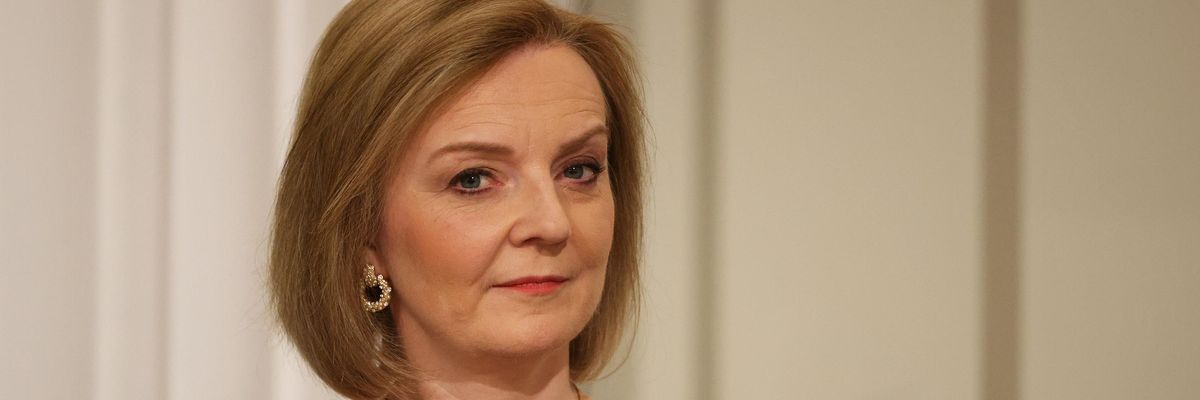
Liz Truss, the British foreign secretary, gives a speech at Mansion House on April 27, 2022 in London, England. Truss said the U.K. and other Western powers should be more aggressive in their response to Russia's invasion of Ukraine, leading peace advocates to warn against "endless war." (Photo: Dan Kitwood/Getty Images)
Anti-war campaigners warned that British Foreign Secretary Liz Truss' aggressive rhetoric at an event in London Wednesday could dangerously provoke Russian President Vladimir Putin, who warned the same day that further intervention by NATO countries in the war in Ukraine will be met with "lightning-fast" retaliation.
Truss suggested to a gathering of government officials that Western allies must go further than just supporting and helping to defend Ukraine two months into Russia's invasion, urging the West to view a Ukrainian victory as a "strategic imperative" for NATO and Europe.
"The war in Ukraine is our war--it is everyone's war... because Ukraine's victory is a strategic imperative for all of us," the foreign secretary said, calling for the allies to consider bolstering defenses in countries including Moldova and Georgia as well as Ukraine. "Heavy weapons, tanks, airplanes--digging deep into our inventories, ramping up production. We need to do all of this."
"A ceasefire and peace talks are the urgent need, not fueling a conflict that will see thousands more Ukrainian people killed and will risk escalation into an all out NATO-Russia war."
Russia must be pushed out of "the whole of Ukraine," Truss said, suggesting that NATO should ensure Putin gives up control of Crimea, which Russia annexed in 2014, and parts of the eastern Donbas region.
In light of Putin's invasion, the NATO target calling for 2% of national spending to be used for defense should be seen as a "floor, not a ceiling," Truss added.
Truss' comments coincided with Putin's warning that countries will face dire consequences if they "intervene in the ongoing events from the outside and create strategic threats for Russia that are unacceptable to us."
The Stop the War Coalition cautioned that Truss' rhetoric was "packed with provocative and dangerous statements that will only serve to escalate an incredibly volatile international situation."
"Liz Truss is playing with fire and it is the Ukrainian people who will get burnt," said Andrew Murray, deputy president of the coalition. "Her rhetoric is a demand for endless war. A ceasefire and peace talks are the urgent need, not fueling a conflict that will see thousands more Ukrainian people killed and will risk escalation into an all out NATO-Russia war."
Truss is not the only Western leader whose recent comments have concerned anti-war groups and international experts. In Kiev this week, U.S. Defense Secretary Lloyd Austin said the Biden administration wants to see "Russia weakened to the degree that it can't do the kinds of things that it has done in invading Ukraine."
In recent days, the U.S. has approved $300 million more in military aid for Ukraine, bringing the total amount it has spent on weapons in the country to $3.7 billion since Russia's invasion in February. NATO's ramp-up of military aid for Ukraine was cited by Russian Foreign Minister Sergey Lavrov this week when he accused Western countries of fighting, "in essence," a proxy war.
At the Quincy Institute for Responsible Statecraft on Wednesday, Anatol Lieven echoed Murray's warning that aggressive rhetoric from the U.K. and its allies could lead to "endless war":
A U.S. strategy of using the war in Ukraine to weaken Russia is also of course completely incompatible with the search for a ceasefire and even a provisional peace settlement. It would require Washington to oppose any such settlement and to keep the war going.
Russia's latest warning to NATO follows its state-owned energy company Gazprom's decision to cut off gas supplies to NATO members Poland and Bulgaria--a move that was denounced as "blackmail" by the European Union--and comes amid reports of explosions in a Russian separatist region in Moldova and in three districts in Russia. Those explosions have prompted fears that the war is spreading outside of Ukraine.
Instead of further provoking Putin and inflaming tensions in the region, said the Stop the War Coalition, the British government must "stop talking up war in Ukraine and throw its weight behind a negotiated peace immediately."
Despite recent rhetoric from the U.K. and U.S., wrote CodePink co-founder Medea Benjamin and journalist Nicolas J.S. Davies at Common Dreams Thursday, "neither side will benefit from a protracted war that lasts for many months or years. The lives of millions of Ukrainians will be lost and ruined, while Russia will be mired in the kind of military quagmire that both the U.S.S.R. and the United States already experienced in Afghanistan, and that most recent U.S. wars have turned into."
Leaders including Truss and Austin must change course and "diplomatically support peace negotiations and make it clear to its ally, Ukraine, that it will support any concessions that Ukrainian negotiators believe are necessary to clinch a peace agreement with Russia," Benjamin and Davies wrote.
"Policy decisions by the United States will have a critical impact on whether there will soon be peace in Ukraine," they added, "or only a much longer and bloodier war."
Dear Common Dreams reader, It’s been nearly 30 years since I co-founded Common Dreams with my late wife, Lina Newhouser. We had the radical notion that journalism should serve the public good, not corporate profits. It was clear to us from the outset what it would take to build such a project. No paid advertisements. No corporate sponsors. No millionaire publisher telling us what to think or do. Many people said we wouldn't last a year, but we proved those doubters wrong. Together with a tremendous team of journalists and dedicated staff, we built an independent media outlet free from the constraints of profits and corporate control. Our mission has always been simple: To inform. To inspire. To ignite change for the common good. Building Common Dreams was not easy. Our survival was never guaranteed. When you take on the most powerful forces—Wall Street greed, fossil fuel industry destruction, Big Tech lobbyists, and uber-rich oligarchs who have spent billions upon billions rigging the economy and democracy in their favor—the only bulwark you have is supporters who believe in your work. But here’s the urgent message from me today. It's never been this bad out there. And it's never been this hard to keep us going. At the very moment Common Dreams is most needed, the threats we face are intensifying. We need your support now more than ever. We don't accept corporate advertising and never will. We don't have a paywall because we don't think people should be blocked from critical news based on their ability to pay. Everything we do is funded by the donations of readers like you. When everyone does the little they can afford, we are strong. But if that support retreats or dries up, so do we. Will you donate now to make sure Common Dreams not only survives but thrives? —Craig Brown, Co-founder |
Anti-war campaigners warned that British Foreign Secretary Liz Truss' aggressive rhetoric at an event in London Wednesday could dangerously provoke Russian President Vladimir Putin, who warned the same day that further intervention by NATO countries in the war in Ukraine will be met with "lightning-fast" retaliation.
Truss suggested to a gathering of government officials that Western allies must go further than just supporting and helping to defend Ukraine two months into Russia's invasion, urging the West to view a Ukrainian victory as a "strategic imperative" for NATO and Europe.
"The war in Ukraine is our war--it is everyone's war... because Ukraine's victory is a strategic imperative for all of us," the foreign secretary said, calling for the allies to consider bolstering defenses in countries including Moldova and Georgia as well as Ukraine. "Heavy weapons, tanks, airplanes--digging deep into our inventories, ramping up production. We need to do all of this."
"A ceasefire and peace talks are the urgent need, not fueling a conflict that will see thousands more Ukrainian people killed and will risk escalation into an all out NATO-Russia war."
Russia must be pushed out of "the whole of Ukraine," Truss said, suggesting that NATO should ensure Putin gives up control of Crimea, which Russia annexed in 2014, and parts of the eastern Donbas region.
In light of Putin's invasion, the NATO target calling for 2% of national spending to be used for defense should be seen as a "floor, not a ceiling," Truss added.
Truss' comments coincided with Putin's warning that countries will face dire consequences if they "intervene in the ongoing events from the outside and create strategic threats for Russia that are unacceptable to us."
The Stop the War Coalition cautioned that Truss' rhetoric was "packed with provocative and dangerous statements that will only serve to escalate an incredibly volatile international situation."
"Liz Truss is playing with fire and it is the Ukrainian people who will get burnt," said Andrew Murray, deputy president of the coalition. "Her rhetoric is a demand for endless war. A ceasefire and peace talks are the urgent need, not fueling a conflict that will see thousands more Ukrainian people killed and will risk escalation into an all out NATO-Russia war."
Truss is not the only Western leader whose recent comments have concerned anti-war groups and international experts. In Kiev this week, U.S. Defense Secretary Lloyd Austin said the Biden administration wants to see "Russia weakened to the degree that it can't do the kinds of things that it has done in invading Ukraine."
In recent days, the U.S. has approved $300 million more in military aid for Ukraine, bringing the total amount it has spent on weapons in the country to $3.7 billion since Russia's invasion in February. NATO's ramp-up of military aid for Ukraine was cited by Russian Foreign Minister Sergey Lavrov this week when he accused Western countries of fighting, "in essence," a proxy war.
At the Quincy Institute for Responsible Statecraft on Wednesday, Anatol Lieven echoed Murray's warning that aggressive rhetoric from the U.K. and its allies could lead to "endless war":
A U.S. strategy of using the war in Ukraine to weaken Russia is also of course completely incompatible with the search for a ceasefire and even a provisional peace settlement. It would require Washington to oppose any such settlement and to keep the war going.
Russia's latest warning to NATO follows its state-owned energy company Gazprom's decision to cut off gas supplies to NATO members Poland and Bulgaria--a move that was denounced as "blackmail" by the European Union--and comes amid reports of explosions in a Russian separatist region in Moldova and in three districts in Russia. Those explosions have prompted fears that the war is spreading outside of Ukraine.
Instead of further provoking Putin and inflaming tensions in the region, said the Stop the War Coalition, the British government must "stop talking up war in Ukraine and throw its weight behind a negotiated peace immediately."
Despite recent rhetoric from the U.K. and U.S., wrote CodePink co-founder Medea Benjamin and journalist Nicolas J.S. Davies at Common Dreams Thursday, "neither side will benefit from a protracted war that lasts for many months or years. The lives of millions of Ukrainians will be lost and ruined, while Russia will be mired in the kind of military quagmire that both the U.S.S.R. and the United States already experienced in Afghanistan, and that most recent U.S. wars have turned into."
Leaders including Truss and Austin must change course and "diplomatically support peace negotiations and make it clear to its ally, Ukraine, that it will support any concessions that Ukrainian negotiators believe are necessary to clinch a peace agreement with Russia," Benjamin and Davies wrote.
"Policy decisions by the United States will have a critical impact on whether there will soon be peace in Ukraine," they added, "or only a much longer and bloodier war."
Anti-war campaigners warned that British Foreign Secretary Liz Truss' aggressive rhetoric at an event in London Wednesday could dangerously provoke Russian President Vladimir Putin, who warned the same day that further intervention by NATO countries in the war in Ukraine will be met with "lightning-fast" retaliation.
Truss suggested to a gathering of government officials that Western allies must go further than just supporting and helping to defend Ukraine two months into Russia's invasion, urging the West to view a Ukrainian victory as a "strategic imperative" for NATO and Europe.
"The war in Ukraine is our war--it is everyone's war... because Ukraine's victory is a strategic imperative for all of us," the foreign secretary said, calling for the allies to consider bolstering defenses in countries including Moldova and Georgia as well as Ukraine. "Heavy weapons, tanks, airplanes--digging deep into our inventories, ramping up production. We need to do all of this."
"A ceasefire and peace talks are the urgent need, not fueling a conflict that will see thousands more Ukrainian people killed and will risk escalation into an all out NATO-Russia war."
Russia must be pushed out of "the whole of Ukraine," Truss said, suggesting that NATO should ensure Putin gives up control of Crimea, which Russia annexed in 2014, and parts of the eastern Donbas region.
In light of Putin's invasion, the NATO target calling for 2% of national spending to be used for defense should be seen as a "floor, not a ceiling," Truss added.
Truss' comments coincided with Putin's warning that countries will face dire consequences if they "intervene in the ongoing events from the outside and create strategic threats for Russia that are unacceptable to us."
The Stop the War Coalition cautioned that Truss' rhetoric was "packed with provocative and dangerous statements that will only serve to escalate an incredibly volatile international situation."
"Liz Truss is playing with fire and it is the Ukrainian people who will get burnt," said Andrew Murray, deputy president of the coalition. "Her rhetoric is a demand for endless war. A ceasefire and peace talks are the urgent need, not fueling a conflict that will see thousands more Ukrainian people killed and will risk escalation into an all out NATO-Russia war."
Truss is not the only Western leader whose recent comments have concerned anti-war groups and international experts. In Kiev this week, U.S. Defense Secretary Lloyd Austin said the Biden administration wants to see "Russia weakened to the degree that it can't do the kinds of things that it has done in invading Ukraine."
In recent days, the U.S. has approved $300 million more in military aid for Ukraine, bringing the total amount it has spent on weapons in the country to $3.7 billion since Russia's invasion in February. NATO's ramp-up of military aid for Ukraine was cited by Russian Foreign Minister Sergey Lavrov this week when he accused Western countries of fighting, "in essence," a proxy war.
At the Quincy Institute for Responsible Statecraft on Wednesday, Anatol Lieven echoed Murray's warning that aggressive rhetoric from the U.K. and its allies could lead to "endless war":
A U.S. strategy of using the war in Ukraine to weaken Russia is also of course completely incompatible with the search for a ceasefire and even a provisional peace settlement. It would require Washington to oppose any such settlement and to keep the war going.
Russia's latest warning to NATO follows its state-owned energy company Gazprom's decision to cut off gas supplies to NATO members Poland and Bulgaria--a move that was denounced as "blackmail" by the European Union--and comes amid reports of explosions in a Russian separatist region in Moldova and in three districts in Russia. Those explosions have prompted fears that the war is spreading outside of Ukraine.
Instead of further provoking Putin and inflaming tensions in the region, said the Stop the War Coalition, the British government must "stop talking up war in Ukraine and throw its weight behind a negotiated peace immediately."
Despite recent rhetoric from the U.K. and U.S., wrote CodePink co-founder Medea Benjamin and journalist Nicolas J.S. Davies at Common Dreams Thursday, "neither side will benefit from a protracted war that lasts for many months or years. The lives of millions of Ukrainians will be lost and ruined, while Russia will be mired in the kind of military quagmire that both the U.S.S.R. and the United States already experienced in Afghanistan, and that most recent U.S. wars have turned into."
Leaders including Truss and Austin must change course and "diplomatically support peace negotiations and make it clear to its ally, Ukraine, that it will support any concessions that Ukrainian negotiators believe are necessary to clinch a peace agreement with Russia," Benjamin and Davies wrote.
"Policy decisions by the United States will have a critical impact on whether there will soon be peace in Ukraine," they added, "or only a much longer and bloodier war."