SUBSCRIBE TO OUR FREE NEWSLETTER
Daily news & progressive opinion—funded by the people, not the corporations—delivered straight to your inbox.
5
#000000
#FFFFFF
To donate by check, phone, or other method, see our More Ways to Give page.
Daily news & progressive opinion—funded by the people, not the corporations—delivered straight to your inbox.
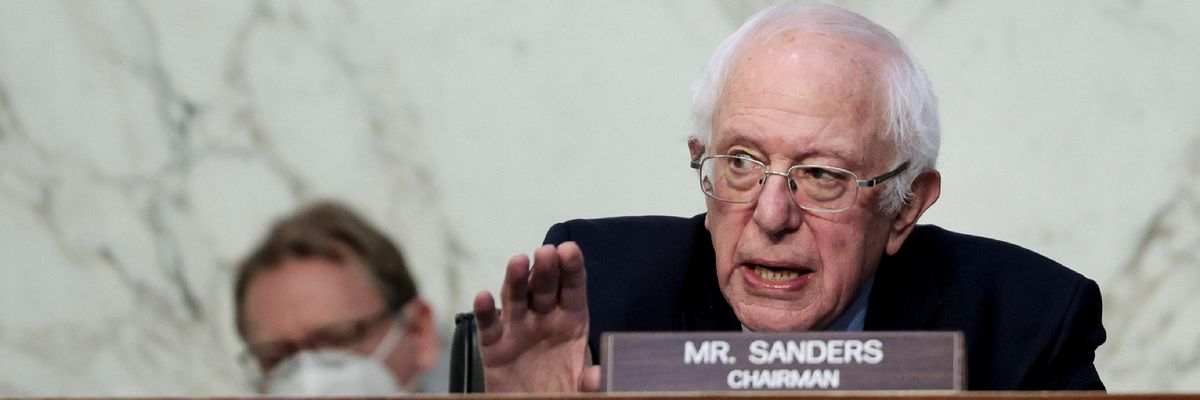
Sen. Bernie Sanders (I-Vt.) listens during a committee hearing on February 17, 2022 in Washington, D.C. (Photo: Anna Moneymaker/Getty Images)
U.S. Sen. Bernie Sanders made clear Tuesday that he would not support the upper chamber's unanimous approval of a global competition bill without changes to provisions he denounced as "corporate welfare."
"The American people want Congress to address corporate greed."
"At a time of massive and growing income and wealth inequality, the American people are outraged at the unprecedented level of corporate greed that is taking place all around them," Sanders (I-Vt.) began a speech on the Senate floor.
Speaking for more than 20 minutes, the Senate Budget Committee chair laid out his opposition to the America Creating Opportunities for Manufacturing, Preeminence in Technology, and Economic Strength (COMPETES) Act.
"Today, while the working class of this country is struggling with higher gas prices, higher food prices, and higher housing prices, the billionaire class and large corporations are doing phenomenally well and, in fact, have never, ever had it so good," Sanders said. "The American people want Congress to address corporate greed and make certain that the wealthiest people and most profitable corporations pay their fair share of taxes."
"And yet, this week, right now, what are we debating here on the floor of the Senate? We are debating legislation to provide some $53 billion in corporate welfare with no strings attached to the highly profitable microchip industry," he noted. "And yes, if you can believe it... this legislation also provides a $10 billion bailout to Jeff Bezos so that his company Blue Origin can launch a rocket ship to the moon."
Bezos, who also founded Amazon, has seen his wealth soar during the ongoing pandemic, Sanders pointed out. As of press time, the Bloomberg Billionaires Index ranked Bezos as the world's second-richest individual, worth $190 billion, behind SpaceX and Tesla CEO Elon Musk at $252 billion.
Sanders announced in his Senate speech that he will not back any unanimous consent request to speed up the passage of the America COMPETES Act--which the House approved in February--unless there is a roll call vote on two "extremely important" amendments he has introduced.
Taking aim at microchip firms, the senator said that "providing $53 billion in corporate welfare to an industry that has outsourced tens of thousands of jobs to low-wage countries and spent hundreds of billions on stock buybacks with no strings attached may make sense to some people, but it does not make sense to me, nor do I think it makes sense to the American people."
"If these companies want taxpayer assistance, we are not going to socialize all of the risks and privatize all of the profits."
Sanders' first amendment "would prevent microchip companies from receiving taxpayer assistance unless they agree to issue warrants or equity stakes to the federal government," he explained. "If private companies are going to benefit from over $53 billion in corporate welfare, the financial gains made by these companies must be shared with the American people, not just wealthy shareholders."
"In other words, all this amendment says is that if these companies want taxpayer assistance, we are not going to socialize all of the risks and privatize all of the profits," he added. "If these investments turn out to be profitable as a direct result of these federal grants, the taxpayers of this country have a right to get a return on that investment."
The senator noted that his amendment directed at the microchip industry "would also require these highly profitable companies not to buy back their own stocks, not to outsource American jobs, not to repeal existing collective bargaining agreements, and to remain neutral in any union organizing effort."
The second amendment "would simply eliminate the $10 billion bailout for Jeff Bezos to fly to the moon," Sanders said, acknowledging the billionaire's personal wealth. "If Mr. Bezos wants to go to the moon, let him use his own money, not the taxpayers'."
While Sanders criticized those two particular elements of the America COMPETES Act, progressives and foreign policy experts have also raised other concerns. As Common Dreams reported last month, an analysis by Ashik Siddique of the National Priorities Project at the Institute for Policy Studies called the bill "part of a dangerous trend of feeding tensions between the U.S. and China."
"The America COMPETES bill would authorize hundreds of billions of dollars in new federal spending on initiatives intended to boost the United States in its competition with the world's other largest economy," Siddique wrote, "even while other critical components of the U.S. economy are chronically underfunded."
Dear Common Dreams reader, It’s been nearly 30 years since I co-founded Common Dreams with my late wife, Lina Newhouser. We had the radical notion that journalism should serve the public good, not corporate profits. It was clear to us from the outset what it would take to build such a project. No paid advertisements. No corporate sponsors. No millionaire publisher telling us what to think or do. Many people said we wouldn't last a year, but we proved those doubters wrong. Together with a tremendous team of journalists and dedicated staff, we built an independent media outlet free from the constraints of profits and corporate control. Our mission has always been simple: To inform. To inspire. To ignite change for the common good. Building Common Dreams was not easy. Our survival was never guaranteed. When you take on the most powerful forces—Wall Street greed, fossil fuel industry destruction, Big Tech lobbyists, and uber-rich oligarchs who have spent billions upon billions rigging the economy and democracy in their favor—the only bulwark you have is supporters who believe in your work. But here’s the urgent message from me today. It's never been this bad out there. And it's never been this hard to keep us going. At the very moment Common Dreams is most needed, the threats we face are intensifying. We need your support now more than ever. We don't accept corporate advertising and never will. We don't have a paywall because we don't think people should be blocked from critical news based on their ability to pay. Everything we do is funded by the donations of readers like you. When everyone does the little they can afford, we are strong. But if that support retreats or dries up, so do we. Will you donate now to make sure Common Dreams not only survives but thrives? —Craig Brown, Co-founder |
U.S. Sen. Bernie Sanders made clear Tuesday that he would not support the upper chamber's unanimous approval of a global competition bill without changes to provisions he denounced as "corporate welfare."
"The American people want Congress to address corporate greed."
"At a time of massive and growing income and wealth inequality, the American people are outraged at the unprecedented level of corporate greed that is taking place all around them," Sanders (I-Vt.) began a speech on the Senate floor.
Speaking for more than 20 minutes, the Senate Budget Committee chair laid out his opposition to the America Creating Opportunities for Manufacturing, Preeminence in Technology, and Economic Strength (COMPETES) Act.
"Today, while the working class of this country is struggling with higher gas prices, higher food prices, and higher housing prices, the billionaire class and large corporations are doing phenomenally well and, in fact, have never, ever had it so good," Sanders said. "The American people want Congress to address corporate greed and make certain that the wealthiest people and most profitable corporations pay their fair share of taxes."
"And yet, this week, right now, what are we debating here on the floor of the Senate? We are debating legislation to provide some $53 billion in corporate welfare with no strings attached to the highly profitable microchip industry," he noted. "And yes, if you can believe it... this legislation also provides a $10 billion bailout to Jeff Bezos so that his company Blue Origin can launch a rocket ship to the moon."
Bezos, who also founded Amazon, has seen his wealth soar during the ongoing pandemic, Sanders pointed out. As of press time, the Bloomberg Billionaires Index ranked Bezos as the world's second-richest individual, worth $190 billion, behind SpaceX and Tesla CEO Elon Musk at $252 billion.
Sanders announced in his Senate speech that he will not back any unanimous consent request to speed up the passage of the America COMPETES Act--which the House approved in February--unless there is a roll call vote on two "extremely important" amendments he has introduced.
Taking aim at microchip firms, the senator said that "providing $53 billion in corporate welfare to an industry that has outsourced tens of thousands of jobs to low-wage countries and spent hundreds of billions on stock buybacks with no strings attached may make sense to some people, but it does not make sense to me, nor do I think it makes sense to the American people."
"If these companies want taxpayer assistance, we are not going to socialize all of the risks and privatize all of the profits."
Sanders' first amendment "would prevent microchip companies from receiving taxpayer assistance unless they agree to issue warrants or equity stakes to the federal government," he explained. "If private companies are going to benefit from over $53 billion in corporate welfare, the financial gains made by these companies must be shared with the American people, not just wealthy shareholders."
"In other words, all this amendment says is that if these companies want taxpayer assistance, we are not going to socialize all of the risks and privatize all of the profits," he added. "If these investments turn out to be profitable as a direct result of these federal grants, the taxpayers of this country have a right to get a return on that investment."
The senator noted that his amendment directed at the microchip industry "would also require these highly profitable companies not to buy back their own stocks, not to outsource American jobs, not to repeal existing collective bargaining agreements, and to remain neutral in any union organizing effort."
The second amendment "would simply eliminate the $10 billion bailout for Jeff Bezos to fly to the moon," Sanders said, acknowledging the billionaire's personal wealth. "If Mr. Bezos wants to go to the moon, let him use his own money, not the taxpayers'."
While Sanders criticized those two particular elements of the America COMPETES Act, progressives and foreign policy experts have also raised other concerns. As Common Dreams reported last month, an analysis by Ashik Siddique of the National Priorities Project at the Institute for Policy Studies called the bill "part of a dangerous trend of feeding tensions between the U.S. and China."
"The America COMPETES bill would authorize hundreds of billions of dollars in new federal spending on initiatives intended to boost the United States in its competition with the world's other largest economy," Siddique wrote, "even while other critical components of the U.S. economy are chronically underfunded."
U.S. Sen. Bernie Sanders made clear Tuesday that he would not support the upper chamber's unanimous approval of a global competition bill without changes to provisions he denounced as "corporate welfare."
"The American people want Congress to address corporate greed."
"At a time of massive and growing income and wealth inequality, the American people are outraged at the unprecedented level of corporate greed that is taking place all around them," Sanders (I-Vt.) began a speech on the Senate floor.
Speaking for more than 20 minutes, the Senate Budget Committee chair laid out his opposition to the America Creating Opportunities for Manufacturing, Preeminence in Technology, and Economic Strength (COMPETES) Act.
"Today, while the working class of this country is struggling with higher gas prices, higher food prices, and higher housing prices, the billionaire class and large corporations are doing phenomenally well and, in fact, have never, ever had it so good," Sanders said. "The American people want Congress to address corporate greed and make certain that the wealthiest people and most profitable corporations pay their fair share of taxes."
"And yet, this week, right now, what are we debating here on the floor of the Senate? We are debating legislation to provide some $53 billion in corporate welfare with no strings attached to the highly profitable microchip industry," he noted. "And yes, if you can believe it... this legislation also provides a $10 billion bailout to Jeff Bezos so that his company Blue Origin can launch a rocket ship to the moon."
Bezos, who also founded Amazon, has seen his wealth soar during the ongoing pandemic, Sanders pointed out. As of press time, the Bloomberg Billionaires Index ranked Bezos as the world's second-richest individual, worth $190 billion, behind SpaceX and Tesla CEO Elon Musk at $252 billion.
Sanders announced in his Senate speech that he will not back any unanimous consent request to speed up the passage of the America COMPETES Act--which the House approved in February--unless there is a roll call vote on two "extremely important" amendments he has introduced.
Taking aim at microchip firms, the senator said that "providing $53 billion in corporate welfare to an industry that has outsourced tens of thousands of jobs to low-wage countries and spent hundreds of billions on stock buybacks with no strings attached may make sense to some people, but it does not make sense to me, nor do I think it makes sense to the American people."
"If these companies want taxpayer assistance, we are not going to socialize all of the risks and privatize all of the profits."
Sanders' first amendment "would prevent microchip companies from receiving taxpayer assistance unless they agree to issue warrants or equity stakes to the federal government," he explained. "If private companies are going to benefit from over $53 billion in corporate welfare, the financial gains made by these companies must be shared with the American people, not just wealthy shareholders."
"In other words, all this amendment says is that if these companies want taxpayer assistance, we are not going to socialize all of the risks and privatize all of the profits," he added. "If these investments turn out to be profitable as a direct result of these federal grants, the taxpayers of this country have a right to get a return on that investment."
The senator noted that his amendment directed at the microchip industry "would also require these highly profitable companies not to buy back their own stocks, not to outsource American jobs, not to repeal existing collective bargaining agreements, and to remain neutral in any union organizing effort."
The second amendment "would simply eliminate the $10 billion bailout for Jeff Bezos to fly to the moon," Sanders said, acknowledging the billionaire's personal wealth. "If Mr. Bezos wants to go to the moon, let him use his own money, not the taxpayers'."
While Sanders criticized those two particular elements of the America COMPETES Act, progressives and foreign policy experts have also raised other concerns. As Common Dreams reported last month, an analysis by Ashik Siddique of the National Priorities Project at the Institute for Policy Studies called the bill "part of a dangerous trend of feeding tensions between the U.S. and China."
"The America COMPETES bill would authorize hundreds of billions of dollars in new federal spending on initiatives intended to boost the United States in its competition with the world's other largest economy," Siddique wrote, "even while other critical components of the U.S. economy are chronically underfunded."