SUBSCRIBE TO OUR FREE NEWSLETTER
Daily news & progressive opinion—funded by the people, not the corporations—delivered straight to your inbox.
5
#000000
#FFFFFF
To donate by check, phone, or other method, see our More Ways to Give page.
Daily news & progressive opinion—funded by the people, not the corporations—delivered straight to your inbox.
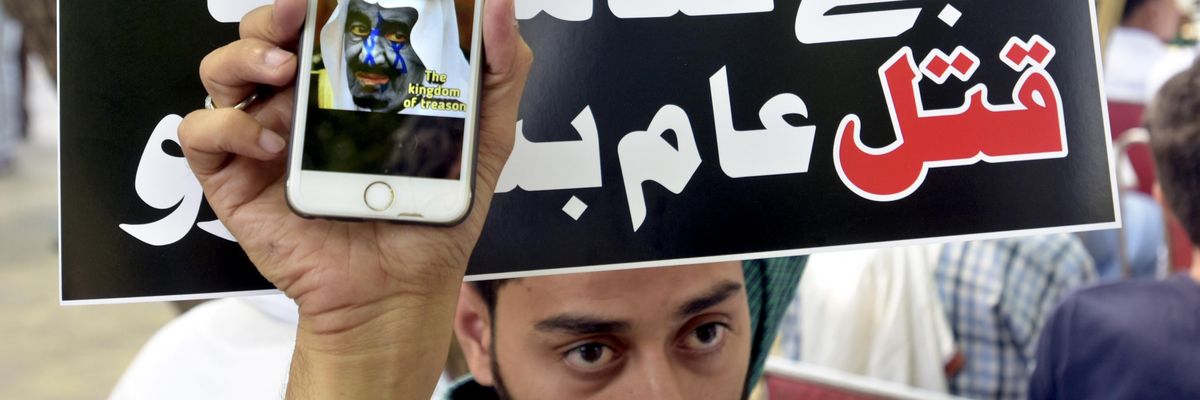
Demonstrators in New Delhi, India protest Saudi Arabia's mass execution of dozens of Shi'ite Muslims on May 13, 2019. (Photo: Sushil Kumar/Hindustan Times via Getty Images)
Prominent international human rights groups and defenders on Tuesday condemned Saudi Arabia's recent execution of 81 people in a single day and called on the fundamentalist monarchy to enact a moratorium on capital punishment and commute the death sentences of all condemned prisoners.
"The death penalty is incompatible with fundamental tenets of human rights and dignity, the right to life, and the prohibition of torture."
As Common Dreams reported, Saturday's executions are believed to have been the largest mass killing in the modern Saudi kingdom's 90-year history. More than half of those put to death were members of the minority Shi'ite Muslim community.
The Saudi Interior Ministry said the men--among them seven Yemenis and a Syrian--were executed for alleged crimes ranging from murder to the nebulous charge of "monitoring and targeting officials and expatriates."
Michael Page, deputy Middle East director at Human Rights Watch (HRW), said in a statement on Tuesday that "Saudi Arabia's mass execution of 81 men this weekend was a brutal show of its autocratic rule, and a justice system that puts the fairness of their trials and sentencing into serious doubt."
"The shocking callousness of their treatment is compounded by the fact that many families found out about their loved ones' deaths just like the rest of us, after the fact and through the media," he added.
United Nations High Commissioner for Human Rights Michelle Bachelet on Monday said that "some of those executed were sentenced to death following trials that did not meet fair trial and due process guarantees, and for crimes that did not appear to meet the most serious crimes threshold, as required under international law."
The former Chilean president asserted that "implementation of death sentences following trials that do not offer the required fair trial guarantees is prohibited by international human rights and humanitarian law and may amount to a war crime," while reiterating that "the death penalty is incompatible with fundamental tenets of human rights and dignity, the right to life, and the prohibition of torture."
"I am concerned that Saudi legislation contains an extremely broad definition of terrorism, including non-violent acts that supposedly 'endanger national unity' or 'undermine the state's reputation,'" Bachelet added. "This risks criminalizing people exercising their rights to freedom of expression and peaceful assembly."
According to Amnesty International, the 81 executions carried out by Saudi Arabia exceeded the country's 2020 total of 27 by 300% in one fell swoop. The human rights group says that the fundamentalist monarchy ranked fifth in global executions in 2020 after China, Iran, Egypt, and Iraq.
"This execution spree is all the more chilling in light of Saudi Arabia's deeply flawed justice system, which metes out death sentences following trials that are grossly and blatantly unfair, including basing verdicts on 'confessions' extracted under torture or other ill-treatment," Lynn Maalouf, Amnesty's deputy regional director for the Middle East and North Africa, said in a statement Tuesday.
"Such a shocking number of deaths also reveals Saudi Arabia's lack of transparency in death penalty cases since we know that the number of trials resulting in prisoners being placed on death row is always significantly higher than what is publicly reported," she added. "Many individuals today in Saudi Arabia are at imminent risk of execution."
Despite having one of the world's worst overall human rights records, the United States and other democracies remain staunch supporters of the Saudi regime. United Kingdom Prime Minister Boris Johnson is scheduled to visit the kingdom this week, where he will reportedly push for an increase in oil production amid supply disruptions caused by Russia's invasion of Ukraine.
In an implicit rebuke of the celebrity-laden, multibillion-dollar global Saudi public relations effort that HRW calls "image laundering," Medea Benjamin, co-founder of the peace group CodePink and author of Kingdom of the Unjust: Behind the U.S.-Saudi Connection, said in a statement Monday that last weekend's mass executions "should dispel any views that Saudi's de facto ruler Crown Prince Mohammed bin Salman is any type of 'reformer.'"
"As the U.S. is imposing massive sanctions on Russia for the invasion of Ukraine," Benjamin added, "it is pandering to Saudi Arabia despite its brutal seven-year war on Yemen and this outrageous execution of 81 people in a single day."
Dear Common Dreams reader, It’s been nearly 30 years since I co-founded Common Dreams with my late wife, Lina Newhouser. We had the radical notion that journalism should serve the public good, not corporate profits. It was clear to us from the outset what it would take to build such a project. No paid advertisements. No corporate sponsors. No millionaire publisher telling us what to think or do. Many people said we wouldn't last a year, but we proved those doubters wrong. Together with a tremendous team of journalists and dedicated staff, we built an independent media outlet free from the constraints of profits and corporate control. Our mission has always been simple: To inform. To inspire. To ignite change for the common good. Building Common Dreams was not easy. Our survival was never guaranteed. When you take on the most powerful forces—Wall Street greed, fossil fuel industry destruction, Big Tech lobbyists, and uber-rich oligarchs who have spent billions upon billions rigging the economy and democracy in their favor—the only bulwark you have is supporters who believe in your work. But here’s the urgent message from me today. It's never been this bad out there. And it's never been this hard to keep us going. At the very moment Common Dreams is most needed, the threats we face are intensifying. We need your support now more than ever. We don't accept corporate advertising and never will. We don't have a paywall because we don't think people should be blocked from critical news based on their ability to pay. Everything we do is funded by the donations of readers like you. When everyone does the little they can afford, we are strong. But if that support retreats or dries up, so do we. Will you donate now to make sure Common Dreams not only survives but thrives? —Craig Brown, Co-founder |
Prominent international human rights groups and defenders on Tuesday condemned Saudi Arabia's recent execution of 81 people in a single day and called on the fundamentalist monarchy to enact a moratorium on capital punishment and commute the death sentences of all condemned prisoners.
"The death penalty is incompatible with fundamental tenets of human rights and dignity, the right to life, and the prohibition of torture."
As Common Dreams reported, Saturday's executions are believed to have been the largest mass killing in the modern Saudi kingdom's 90-year history. More than half of those put to death were members of the minority Shi'ite Muslim community.
The Saudi Interior Ministry said the men--among them seven Yemenis and a Syrian--were executed for alleged crimes ranging from murder to the nebulous charge of "monitoring and targeting officials and expatriates."
Michael Page, deputy Middle East director at Human Rights Watch (HRW), said in a statement on Tuesday that "Saudi Arabia's mass execution of 81 men this weekend was a brutal show of its autocratic rule, and a justice system that puts the fairness of their trials and sentencing into serious doubt."
"The shocking callousness of their treatment is compounded by the fact that many families found out about their loved ones' deaths just like the rest of us, after the fact and through the media," he added.
United Nations High Commissioner for Human Rights Michelle Bachelet on Monday said that "some of those executed were sentenced to death following trials that did not meet fair trial and due process guarantees, and for crimes that did not appear to meet the most serious crimes threshold, as required under international law."
The former Chilean president asserted that "implementation of death sentences following trials that do not offer the required fair trial guarantees is prohibited by international human rights and humanitarian law and may amount to a war crime," while reiterating that "the death penalty is incompatible with fundamental tenets of human rights and dignity, the right to life, and the prohibition of torture."
"I am concerned that Saudi legislation contains an extremely broad definition of terrorism, including non-violent acts that supposedly 'endanger national unity' or 'undermine the state's reputation,'" Bachelet added. "This risks criminalizing people exercising their rights to freedom of expression and peaceful assembly."
According to Amnesty International, the 81 executions carried out by Saudi Arabia exceeded the country's 2020 total of 27 by 300% in one fell swoop. The human rights group says that the fundamentalist monarchy ranked fifth in global executions in 2020 after China, Iran, Egypt, and Iraq.
"This execution spree is all the more chilling in light of Saudi Arabia's deeply flawed justice system, which metes out death sentences following trials that are grossly and blatantly unfair, including basing verdicts on 'confessions' extracted under torture or other ill-treatment," Lynn Maalouf, Amnesty's deputy regional director for the Middle East and North Africa, said in a statement Tuesday.
"Such a shocking number of deaths also reveals Saudi Arabia's lack of transparency in death penalty cases since we know that the number of trials resulting in prisoners being placed on death row is always significantly higher than what is publicly reported," she added. "Many individuals today in Saudi Arabia are at imminent risk of execution."
Despite having one of the world's worst overall human rights records, the United States and other democracies remain staunch supporters of the Saudi regime. United Kingdom Prime Minister Boris Johnson is scheduled to visit the kingdom this week, where he will reportedly push for an increase in oil production amid supply disruptions caused by Russia's invasion of Ukraine.
In an implicit rebuke of the celebrity-laden, multibillion-dollar global Saudi public relations effort that HRW calls "image laundering," Medea Benjamin, co-founder of the peace group CodePink and author of Kingdom of the Unjust: Behind the U.S.-Saudi Connection, said in a statement Monday that last weekend's mass executions "should dispel any views that Saudi's de facto ruler Crown Prince Mohammed bin Salman is any type of 'reformer.'"
"As the U.S. is imposing massive sanctions on Russia for the invasion of Ukraine," Benjamin added, "it is pandering to Saudi Arabia despite its brutal seven-year war on Yemen and this outrageous execution of 81 people in a single day."
Prominent international human rights groups and defenders on Tuesday condemned Saudi Arabia's recent execution of 81 people in a single day and called on the fundamentalist monarchy to enact a moratorium on capital punishment and commute the death sentences of all condemned prisoners.
"The death penalty is incompatible with fundamental tenets of human rights and dignity, the right to life, and the prohibition of torture."
As Common Dreams reported, Saturday's executions are believed to have been the largest mass killing in the modern Saudi kingdom's 90-year history. More than half of those put to death were members of the minority Shi'ite Muslim community.
The Saudi Interior Ministry said the men--among them seven Yemenis and a Syrian--were executed for alleged crimes ranging from murder to the nebulous charge of "monitoring and targeting officials and expatriates."
Michael Page, deputy Middle East director at Human Rights Watch (HRW), said in a statement on Tuesday that "Saudi Arabia's mass execution of 81 men this weekend was a brutal show of its autocratic rule, and a justice system that puts the fairness of their trials and sentencing into serious doubt."
"The shocking callousness of their treatment is compounded by the fact that many families found out about their loved ones' deaths just like the rest of us, after the fact and through the media," he added.
United Nations High Commissioner for Human Rights Michelle Bachelet on Monday said that "some of those executed were sentenced to death following trials that did not meet fair trial and due process guarantees, and for crimes that did not appear to meet the most serious crimes threshold, as required under international law."
The former Chilean president asserted that "implementation of death sentences following trials that do not offer the required fair trial guarantees is prohibited by international human rights and humanitarian law and may amount to a war crime," while reiterating that "the death penalty is incompatible with fundamental tenets of human rights and dignity, the right to life, and the prohibition of torture."
"I am concerned that Saudi legislation contains an extremely broad definition of terrorism, including non-violent acts that supposedly 'endanger national unity' or 'undermine the state's reputation,'" Bachelet added. "This risks criminalizing people exercising their rights to freedom of expression and peaceful assembly."
According to Amnesty International, the 81 executions carried out by Saudi Arabia exceeded the country's 2020 total of 27 by 300% in one fell swoop. The human rights group says that the fundamentalist monarchy ranked fifth in global executions in 2020 after China, Iran, Egypt, and Iraq.
"This execution spree is all the more chilling in light of Saudi Arabia's deeply flawed justice system, which metes out death sentences following trials that are grossly and blatantly unfair, including basing verdicts on 'confessions' extracted under torture or other ill-treatment," Lynn Maalouf, Amnesty's deputy regional director for the Middle East and North Africa, said in a statement Tuesday.
"Such a shocking number of deaths also reveals Saudi Arabia's lack of transparency in death penalty cases since we know that the number of trials resulting in prisoners being placed on death row is always significantly higher than what is publicly reported," she added. "Many individuals today in Saudi Arabia are at imminent risk of execution."
Despite having one of the world's worst overall human rights records, the United States and other democracies remain staunch supporters of the Saudi regime. United Kingdom Prime Minister Boris Johnson is scheduled to visit the kingdom this week, where he will reportedly push for an increase in oil production amid supply disruptions caused by Russia's invasion of Ukraine.
In an implicit rebuke of the celebrity-laden, multibillion-dollar global Saudi public relations effort that HRW calls "image laundering," Medea Benjamin, co-founder of the peace group CodePink and author of Kingdom of the Unjust: Behind the U.S.-Saudi Connection, said in a statement Monday that last weekend's mass executions "should dispel any views that Saudi's de facto ruler Crown Prince Mohammed bin Salman is any type of 'reformer.'"
"As the U.S. is imposing massive sanctions on Russia for the invasion of Ukraine," Benjamin added, "it is pandering to Saudi Arabia despite its brutal seven-year war on Yemen and this outrageous execution of 81 people in a single day."