SUBSCRIBE TO OUR FREE NEWSLETTER
Daily news & progressive opinion—funded by the people, not the corporations—delivered straight to your inbox.
5
#000000
#FFFFFF
To donate by check, phone, or other method, see our More Ways to Give page.
Daily news & progressive opinion—funded by the people, not the corporations—delivered straight to your inbox.
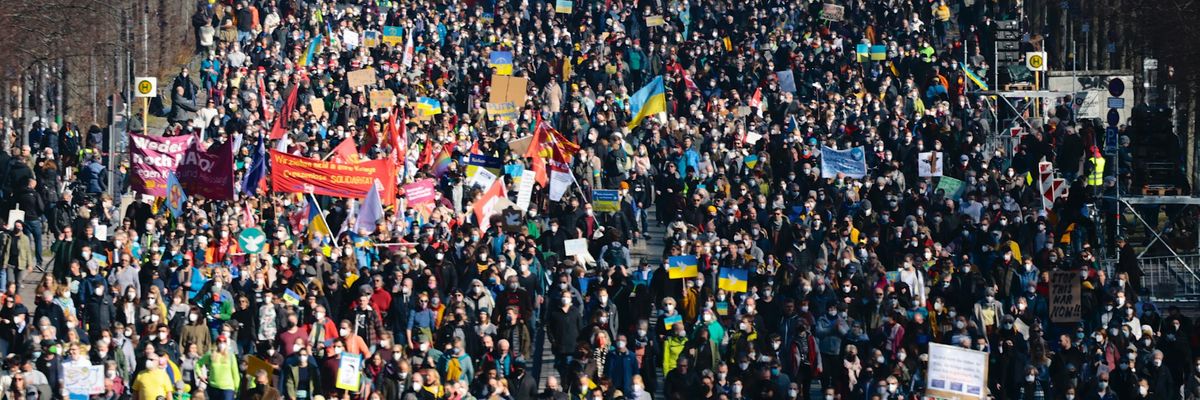
People protesting against Russia's war on Ukraine gather on March 13, 2022 in Berlin, Germany. (Photo: Hannibal Hanschke/Getty Images)
Tens of thousands of people took to the streets to join anti-war demonstrations across Europe on Sunday as Russia continued its deadly assault on Ukraine, bombarding major cities and intensifying a humanitarian crisis that is having reverberating effects worldwide.
In addition to protests in Berlin, London, Warsaw, and Madrid--where participants carried signs and banners that read "Stop the War" and "Peace and Solidarity for the People in Ukraine"--demonstrations sprang up on a smaller scale in occupied Ukrainian cities and in Moscow, despite the threat of arrest and police brutality.
Thousands of Russian anti-war protesters have been detained and abused by law enforcement since the invasion of Ukraine began on February 24, according to human rights organizations.
The demonstrations Sunday came amid some signs of diplomatic progress in talks between Russia and Ukraine, which have been negotiating on the border of Belarus since the early days of the invasion.
Mykhailo Podolyak, an adviser to Ukrainian President Volodymyr Zelenskyy, said Sunday that Russia is "beginning to talk constructively" and predicted that "we will achieve some results literally in a matter of days."
Leonid Slutsky, a Russian delegate to the negotiations with Ukraine, echoed his counterpart's assessment.
"According to my personal expectations, this progress may grow in the coming days into a joint position of both delegations, into documents for signing," Slutsky told reporters Sunday, without offering specifics on what an agreement would entail.
Seemingly positive developments in diplomatic talks came as Russia showed no sign of easing its attack, which has forced more than 2.5 million people to flee Ukraine and internally displaced millions more.
Zelenskyy said Saturday that around 125,000 people have been able to escape through humanitarian corridors established in besieged cities, but hundreds of thousands remain trapped in Mariupol and other areas facing heavy shelling from Russian forces.
Early Sunday morning, Russia bombed a Ukrainian military facility located just 22 miles from the border of Poland, a NATO member. The airstrike, believed to be Russia's westernmost attack on Ukraine thus far, killed dozens of people and wounded more than 130 others.
The Associated Press reported that "continued fighting on multiple fronts heaped further misery on the country Sunday and provoked renewed international outrage."
Brent Renaud, an American journalist who had previously contributed to the New York Times, was killed by Russian forces in the town of Irpin, Ukrainian authorities said Sunday. A second journalist who was traveling with Renaud was reportedly injured.
"We are shocked and saddened to learn of the death of U.S. journalist Brent Renaud in Ukraine," Carlos Martinez de la Serna of the Committee to Protect Journalists said in a statement. "This kind of attack is totally unacceptable, and is a violation of international law. Russian forces in Ukraine must stop all violence against journalists and other civilians at once, and whoever killed Renaud should be held to account."
According to the United Nations, at least 549 civilians have been killed and nearly 1,000 have been wounded since Russia invaded Ukraine--estimates that are believed to be significant undercounts.
Local Ukrainian officials said Sunday that 2,187 civilians have been killed in Mariupol alone since the start of Russia's attack.
Dear Common Dreams reader, It’s been nearly 30 years since I co-founded Common Dreams with my late wife, Lina Newhouser. We had the radical notion that journalism should serve the public good, not corporate profits. It was clear to us from the outset what it would take to build such a project. No paid advertisements. No corporate sponsors. No millionaire publisher telling us what to think or do. Many people said we wouldn't last a year, but we proved those doubters wrong. Together with a tremendous team of journalists and dedicated staff, we built an independent media outlet free from the constraints of profits and corporate control. Our mission has always been simple: To inform. To inspire. To ignite change for the common good. Building Common Dreams was not easy. Our survival was never guaranteed. When you take on the most powerful forces—Wall Street greed, fossil fuel industry destruction, Big Tech lobbyists, and uber-rich oligarchs who have spent billions upon billions rigging the economy and democracy in their favor—the only bulwark you have is supporters who believe in your work. But here’s the urgent message from me today. It's never been this bad out there. And it's never been this hard to keep us going. At the very moment Common Dreams is most needed, the threats we face are intensifying. We need your support now more than ever. We don't accept corporate advertising and never will. We don't have a paywall because we don't think people should be blocked from critical news based on their ability to pay. Everything we do is funded by the donations of readers like you. When everyone does the little they can afford, we are strong. But if that support retreats or dries up, so do we. Will you donate now to make sure Common Dreams not only survives but thrives? —Craig Brown, Co-founder |
Tens of thousands of people took to the streets to join anti-war demonstrations across Europe on Sunday as Russia continued its deadly assault on Ukraine, bombarding major cities and intensifying a humanitarian crisis that is having reverberating effects worldwide.
In addition to protests in Berlin, London, Warsaw, and Madrid--where participants carried signs and banners that read "Stop the War" and "Peace and Solidarity for the People in Ukraine"--demonstrations sprang up on a smaller scale in occupied Ukrainian cities and in Moscow, despite the threat of arrest and police brutality.
Thousands of Russian anti-war protesters have been detained and abused by law enforcement since the invasion of Ukraine began on February 24, according to human rights organizations.
The demonstrations Sunday came amid some signs of diplomatic progress in talks between Russia and Ukraine, which have been negotiating on the border of Belarus since the early days of the invasion.
Mykhailo Podolyak, an adviser to Ukrainian President Volodymyr Zelenskyy, said Sunday that Russia is "beginning to talk constructively" and predicted that "we will achieve some results literally in a matter of days."
Leonid Slutsky, a Russian delegate to the negotiations with Ukraine, echoed his counterpart's assessment.
"According to my personal expectations, this progress may grow in the coming days into a joint position of both delegations, into documents for signing," Slutsky told reporters Sunday, without offering specifics on what an agreement would entail.
Seemingly positive developments in diplomatic talks came as Russia showed no sign of easing its attack, which has forced more than 2.5 million people to flee Ukraine and internally displaced millions more.
Zelenskyy said Saturday that around 125,000 people have been able to escape through humanitarian corridors established in besieged cities, but hundreds of thousands remain trapped in Mariupol and other areas facing heavy shelling from Russian forces.
Early Sunday morning, Russia bombed a Ukrainian military facility located just 22 miles from the border of Poland, a NATO member. The airstrike, believed to be Russia's westernmost attack on Ukraine thus far, killed dozens of people and wounded more than 130 others.
The Associated Press reported that "continued fighting on multiple fronts heaped further misery on the country Sunday and provoked renewed international outrage."
Brent Renaud, an American journalist who had previously contributed to the New York Times, was killed by Russian forces in the town of Irpin, Ukrainian authorities said Sunday. A second journalist who was traveling with Renaud was reportedly injured.
"We are shocked and saddened to learn of the death of U.S. journalist Brent Renaud in Ukraine," Carlos Martinez de la Serna of the Committee to Protect Journalists said in a statement. "This kind of attack is totally unacceptable, and is a violation of international law. Russian forces in Ukraine must stop all violence against journalists and other civilians at once, and whoever killed Renaud should be held to account."
According to the United Nations, at least 549 civilians have been killed and nearly 1,000 have been wounded since Russia invaded Ukraine--estimates that are believed to be significant undercounts.
Local Ukrainian officials said Sunday that 2,187 civilians have been killed in Mariupol alone since the start of Russia's attack.
Tens of thousands of people took to the streets to join anti-war demonstrations across Europe on Sunday as Russia continued its deadly assault on Ukraine, bombarding major cities and intensifying a humanitarian crisis that is having reverberating effects worldwide.
In addition to protests in Berlin, London, Warsaw, and Madrid--where participants carried signs and banners that read "Stop the War" and "Peace and Solidarity for the People in Ukraine"--demonstrations sprang up on a smaller scale in occupied Ukrainian cities and in Moscow, despite the threat of arrest and police brutality.
Thousands of Russian anti-war protesters have been detained and abused by law enforcement since the invasion of Ukraine began on February 24, according to human rights organizations.
The demonstrations Sunday came amid some signs of diplomatic progress in talks between Russia and Ukraine, which have been negotiating on the border of Belarus since the early days of the invasion.
Mykhailo Podolyak, an adviser to Ukrainian President Volodymyr Zelenskyy, said Sunday that Russia is "beginning to talk constructively" and predicted that "we will achieve some results literally in a matter of days."
Leonid Slutsky, a Russian delegate to the negotiations with Ukraine, echoed his counterpart's assessment.
"According to my personal expectations, this progress may grow in the coming days into a joint position of both delegations, into documents for signing," Slutsky told reporters Sunday, without offering specifics on what an agreement would entail.
Seemingly positive developments in diplomatic talks came as Russia showed no sign of easing its attack, which has forced more than 2.5 million people to flee Ukraine and internally displaced millions more.
Zelenskyy said Saturday that around 125,000 people have been able to escape through humanitarian corridors established in besieged cities, but hundreds of thousands remain trapped in Mariupol and other areas facing heavy shelling from Russian forces.
Early Sunday morning, Russia bombed a Ukrainian military facility located just 22 miles from the border of Poland, a NATO member. The airstrike, believed to be Russia's westernmost attack on Ukraine thus far, killed dozens of people and wounded more than 130 others.
The Associated Press reported that "continued fighting on multiple fronts heaped further misery on the country Sunday and provoked renewed international outrage."
Brent Renaud, an American journalist who had previously contributed to the New York Times, was killed by Russian forces in the town of Irpin, Ukrainian authorities said Sunday. A second journalist who was traveling with Renaud was reportedly injured.
"We are shocked and saddened to learn of the death of U.S. journalist Brent Renaud in Ukraine," Carlos Martinez de la Serna of the Committee to Protect Journalists said in a statement. "This kind of attack is totally unacceptable, and is a violation of international law. Russian forces in Ukraine must stop all violence against journalists and other civilians at once, and whoever killed Renaud should be held to account."
According to the United Nations, at least 549 civilians have been killed and nearly 1,000 have been wounded since Russia invaded Ukraine--estimates that are believed to be significant undercounts.
Local Ukrainian officials said Sunday that 2,187 civilians have been killed in Mariupol alone since the start of Russia's attack.