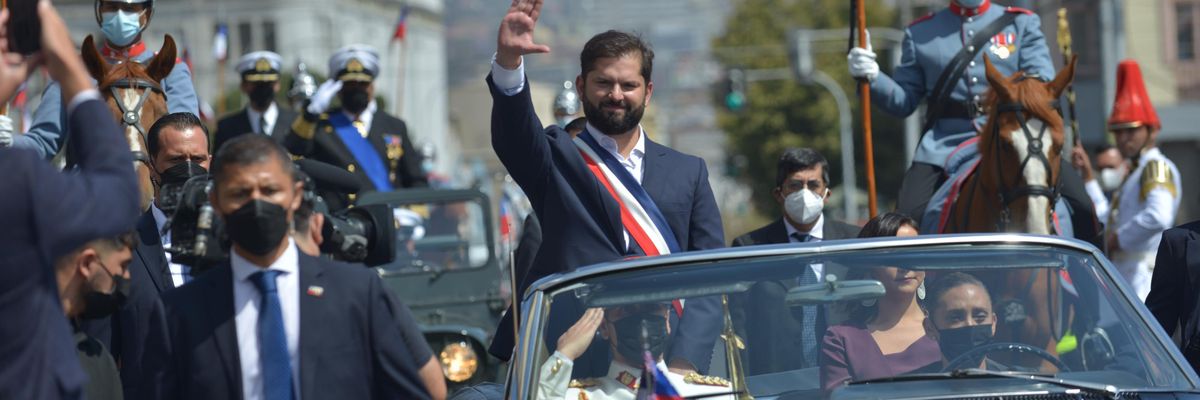
Chilean President Gabriel Boric leaves Congress after his inauguration ceremony in Valparaiso, Chile on March 11, 2022. (Photo: Vanessa Rubilar Quintana/Anadolu Agency via Getty Images)
Progressives Worldwide Applaud New Hope for Chile as President Gabriel Boric Sworn In
"Without a shadow of a doubt, Boric is leading us into a new chapter of Chilean history."
Progressives around the world cheered Friday as former student activist Gabriel Boric was sworn in as Chile's new president, marking the most profound shift in the Andean nation's political direction since the restoration of democracy and the end of a U.S.-backed military dictatorship three decades ago.
"This is the best generation of young politicians Chile has had in 50 years."
"Before the people and peoples of Chile I promise," Boric said during his swearing-in ceremony at Congress in Valparaiso, "know that we are going to do our best to rise to the challenges we face as a country."
Guests at the Boric's inauguration included a representative from each of Chile's Indigenous peoples, Chilean activists including Gustavo Gatica--who was left blind after being shot in the face during a 2019 Estallido social protest against inequality--as well as foreign dignitaries such as former Brazilian President Dilma Rousseff and former British Labour Party leader Jeremy Corbyn.
Speaking on behalf of the Peace and Justice Project he founded, Corbyn wished Boric "all the best and all our support and solidarity," adding that the new president "has a huge task to heal the wounds of the past, close the gap between the richest and the poorest, and give hope to the next generation."
At age 36, Boric--a democratic socialist who ran on a platform of sweeping progressive reforms--is the youngest-ever Chilean president. He was one of the leading figures in the 2011-13 student protests against educational and societal inequities. Boric was subsequently elected twice to the national Chamber of Deputies representing Magallanes, the Chilean Antarctic region, and emerged as a leading advocate for constitutional reform during the Estallido social uprising, which began in 2019 over a subway fare hike in Santiago and was violently repressed under former right-wing President Sebastian Pinera, a billionaire businessman.
Boric decisively defeated Jose Antonio Kast--head of the far-right Republican Party and a former supporter of longtime U.S.-backed military dictator Gen. Augusto Pinochet--in the runoff round of last year's presidential election. Kast, the son of a German Nazi military officer, ran on a neoliberal economic, law-and-order, and anti-immigrant platform, and also opposes abortion and same-sex marriage.
With 14 women among its 24 ministers, Boric's will be the first majority-woman cabinet in the history of the Western Hemisphere. Its members will include Defense Minister Maya Fernandez Allende--the granddaughter of Salvador Allende, the democratically elected Marxist president who killed himself after he was deposed in the U.S.-backed 1973 coup that brought Pinochet to power--and Sports Minister Alexandra Benado and Education Minister Marco Antonio Avila, the first openly LGBTQ+ cabinet officials in Chilean history.
Marigen Vargas, a 62-year-old who traveled all night to attend Friday's inauguration, told Reuters that Boric "reminds me of Allende, but I hope it has a happier ending. We want a more united, happier Chile."
Boric has vowed to be a president "of all Chileans" while working to expand and improve the welfare state and combat inequality in a nation where the richest 1% of the people hold more than a quarter of all wealth. Constitutional reform--in a 2020 plebiscite, 78% of Chilean voters approved a constitutional re-write--will loom large in his administration.
"It's impossible to separate Boric's victory from the constitutional process," writes U.S. democratic socialist activist David Duhalde. "Many voted for him in order to preserve the process started by the Estallido social. Had Kast won, he would have been unable to stop the drafting, but could have used the bully pulpit of the presidency to push for a 'no' vote in the national referendum to accept or reject the replacement."
The direction of the new government was evident in its first official act: the dismissal of 139 lawsuits that the Pinera administration had filed against protesters charged with violating the dictatorship-era State Security Law during the Estallido social.
In a statement, Justice Minister Marcela Rios and Interior and Public Security Minister Izkia Siches explained the new administration is seeking to ensure that the security law "is not used for unjust and disproportionate persecution."
The ministers also promised to begin the process of determining reparations "for the victims of human rights violations."
Luis Maira, an 81-year-old former leftist federal deputy forced into exile during the Pinochet regime and a mentor to Boric, told The Guardian that "this is the best generation of young politicians Chile has had in 50 years."
"Without a shadow of a doubt," he added, "Boric is leading us into a new chapter of Chilean history."
We are at a crossroads
This country and this world are at a monumental crossroads. US voters have an opportunity to beat back the forces of fascism and confront the billionaires who are rigging the economy, our media system, and our democracy, making it increasingly impossible for ordinary people to get by. We’re not just talking about the election. We’re talking about what must be done once these fascist elements are vanquished from power. We need a bolder set of solutions than what either major party has so far been willing to offer and a working-class movement ready to fight like hell for it. Trump didn't emerge from nowhere. The conditions that fueled MAGA authoritarianism were created by decades of radical neoliberal economic policies and a corrupt political system dominated by corporate interests. They slashed taxes on the super-rich, promising that the benefits would trickle down. They said giveaways to the corporate titans would make life more affordable for the rest of us. It was all bullshit. And when a bitter, betrayed populace searches for someone to blame, right-wing demagogues have little trouble finding scapegoats. People know when they're being lied to, but you won't hear any of this from the corporate media. Only independent journalism—powered and funded by people who believe in building a better world—can deliver truly trustworthy daily news. Our Fall Campaign is underway, and we need your help. To power our newsroom through the rest of the year, we need to raise $125,000 by midnight on October 31. So if you share our vision, please contribute whatever you can to sustain our work. |
Progressives around the world cheered Friday as former student activist Gabriel Boric was sworn in as Chile's new president, marking the most profound shift in the Andean nation's political direction since the restoration of democracy and the end of a U.S.-backed military dictatorship three decades ago.
"This is the best generation of young politicians Chile has had in 50 years."
"Before the people and peoples of Chile I promise," Boric said during his swearing-in ceremony at Congress in Valparaiso, "know that we are going to do our best to rise to the challenges we face as a country."
Guests at the Boric's inauguration included a representative from each of Chile's Indigenous peoples, Chilean activists including Gustavo Gatica--who was left blind after being shot in the face during a 2019 Estallido social protest against inequality--as well as foreign dignitaries such as former Brazilian President Dilma Rousseff and former British Labour Party leader Jeremy Corbyn.
Speaking on behalf of the Peace and Justice Project he founded, Corbyn wished Boric "all the best and all our support and solidarity," adding that the new president "has a huge task to heal the wounds of the past, close the gap between the richest and the poorest, and give hope to the next generation."
At age 36, Boric--a democratic socialist who ran on a platform of sweeping progressive reforms--is the youngest-ever Chilean president. He was one of the leading figures in the 2011-13 student protests against educational and societal inequities. Boric was subsequently elected twice to the national Chamber of Deputies representing Magallanes, the Chilean Antarctic region, and emerged as a leading advocate for constitutional reform during the Estallido social uprising, which began in 2019 over a subway fare hike in Santiago and was violently repressed under former right-wing President Sebastian Pinera, a billionaire businessman.
Boric decisively defeated Jose Antonio Kast--head of the far-right Republican Party and a former supporter of longtime U.S.-backed military dictator Gen. Augusto Pinochet--in the runoff round of last year's presidential election. Kast, the son of a German Nazi military officer, ran on a neoliberal economic, law-and-order, and anti-immigrant platform, and also opposes abortion and same-sex marriage.
With 14 women among its 24 ministers, Boric's will be the first majority-woman cabinet in the history of the Western Hemisphere. Its members will include Defense Minister Maya Fernandez Allende--the granddaughter of Salvador Allende, the democratically elected Marxist president who killed himself after he was deposed in the U.S.-backed 1973 coup that brought Pinochet to power--and Sports Minister Alexandra Benado and Education Minister Marco Antonio Avila, the first openly LGBTQ+ cabinet officials in Chilean history.
Marigen Vargas, a 62-year-old who traveled all night to attend Friday's inauguration, told Reuters that Boric "reminds me of Allende, but I hope it has a happier ending. We want a more united, happier Chile."
Boric has vowed to be a president "of all Chileans" while working to expand and improve the welfare state and combat inequality in a nation where the richest 1% of the people hold more than a quarter of all wealth. Constitutional reform--in a 2020 plebiscite, 78% of Chilean voters approved a constitutional re-write--will loom large in his administration.
"It's impossible to separate Boric's victory from the constitutional process," writes U.S. democratic socialist activist David Duhalde. "Many voted for him in order to preserve the process started by the Estallido social. Had Kast won, he would have been unable to stop the drafting, but could have used the bully pulpit of the presidency to push for a 'no' vote in the national referendum to accept or reject the replacement."
The direction of the new government was evident in its first official act: the dismissal of 139 lawsuits that the Pinera administration had filed against protesters charged with violating the dictatorship-era State Security Law during the Estallido social.
In a statement, Justice Minister Marcela Rios and Interior and Public Security Minister Izkia Siches explained the new administration is seeking to ensure that the security law "is not used for unjust and disproportionate persecution."
The ministers also promised to begin the process of determining reparations "for the victims of human rights violations."
Luis Maira, an 81-year-old former leftist federal deputy forced into exile during the Pinochet regime and a mentor to Boric, told The Guardian that "this is the best generation of young politicians Chile has had in 50 years."
"Without a shadow of a doubt," he added, "Boric is leading us into a new chapter of Chilean history."